Frashokereti: The Making Wonderful
~500 CE (Sassanid Zoroastrian theological synthesis) · Persia (Sassanid Empire, modern Iran)
Contents
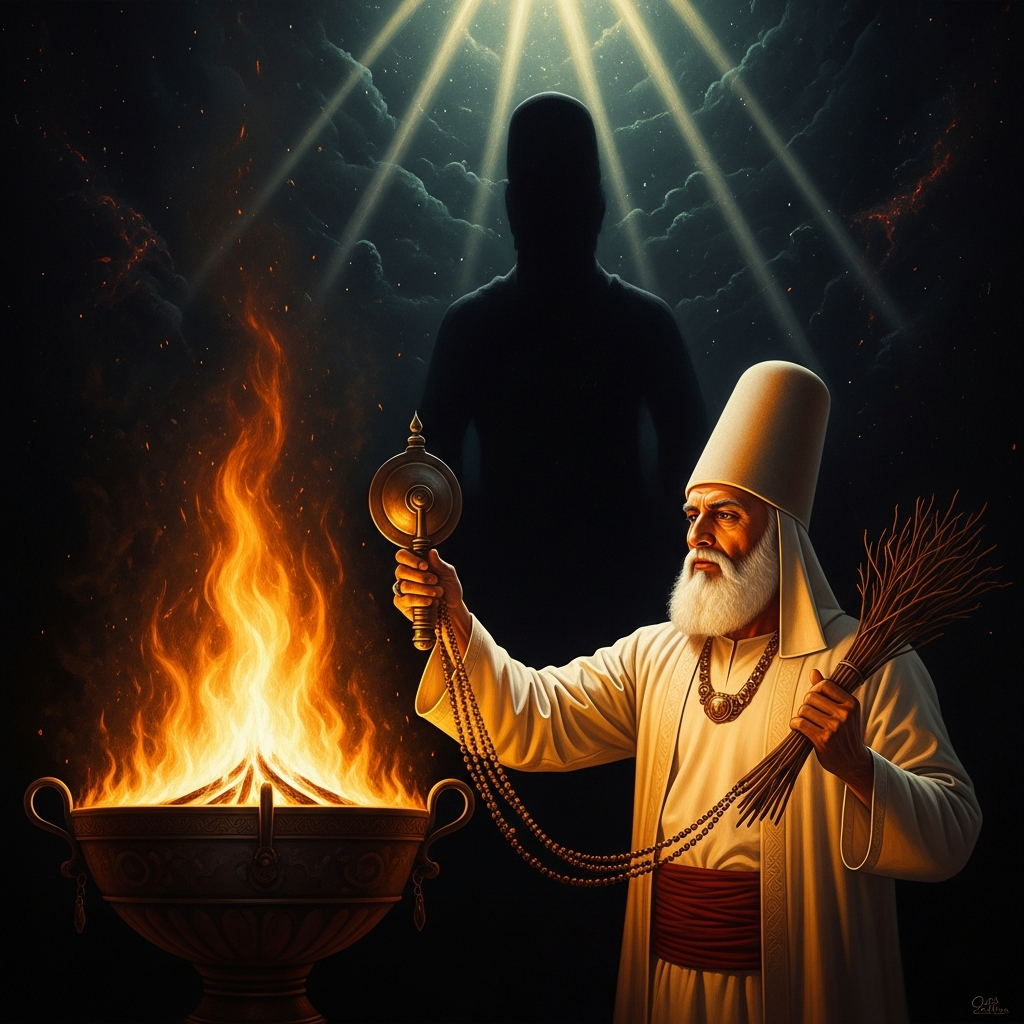
At the end of time the world will not be destroyed. It will be perfected. A Zoroastrian priest in Sassanid Persia performs the Yasna ceremony — the daily ritual that, according to the theology, actively holds back the darkness and keeps the world from ending before it is ready.
- When
- ~500 CE (Sassanid Zoroastrian theological synthesis)
- Where
- Persia (Sassanid Empire, modern Iran)
He rises before the sun.
This is not a preference. It is a cosmological requirement. The dawn is when the forces of light make their daily claim against the forces of darkness, and the claim needs to be made by a human voice as well as by the sun itself. The priest’s name does not survive in the texts that describe him — he is one of a thousand Sassanid magi, the professional inheritors of Zarathustra’s revelation, who perform the Yasna ceremony every day in fire temples from the Euphrates to the Oxus. But the ceremony survives. The theology that makes the ceremony urgent survives.
He ties the kusti — the sacred cord, woven of seventy-two strands for the seventy-two chapters of the Yasna — three times around his waist. He covers his mouth with the padan, the cloth mask, so that his breath does not pollute the sacred fire. He enters the inner sanctuary.
The fire is always lit. This is the point. The fire is always lit.
The theology works like this.
Ahura Mazda created the world good. Angra Mainyu — the Destructive Spirit, the Lie, the principle of evil in the cosmos — attacked it. The world we live in now is the world of the attack: the mixing, the gumezishn, in which good and evil are mingled together in every stone and every breath. Time itself was created by this attack — Ahura Mazda stretched time like a net to trap Angra Mainyu in, knowing that in time, evil can be defeated. Outside of time, evil and good were simply opposed and could not resolve. Inside time, they fight, and the fight has an outcome.
The outcome is called frashokereti. From the Avestan: frašō.kərəti. “The making wonderful.” “The making fresh and excellent.” Not apocalypse in the Greek sense — not unveiling — but renovation. Renewal. The world at the end of time is not destroyed and replaced. It is perfected.
The priest understands this as an engineer understands a construction project. The world is being built. Every day of the ceremony, every prayer correctly spoken, every fire correctly maintained, every choice in favor of truth over the lie — these are materials in the construction. The theology is explicit: human beings are not spectators of the renovation. They are workers.
In the middle portion of the Yasna ceremony, the priest crushes the haoma plant. This is the ritual drink, the sacred plant that generates haurvatat — integrity, wholeness — one of the six Amesha Spentas, the divine attributes that Ahura Mazda embodies and that the ceremony aims to invoke and sustain. The crushing is noisy. The prayers are audible. In a Sassanid fire temple in the fifth or sixth century of the common era, this ceremony is performed by men who believe — correctly, as the historical record will eventually show — that they are living in one of the most dangerous periods of the long war.
The Zoroastrian community has survived Alexander, who burned Persepolis and destroyed the original Avestan manuscripts. It has survived the Parthians, who were sympathetic but disorganized. Under the Sassanids it has flourished — the state religion of the greatest Iranian empire since the Achaemenids — but the walls are pressing in. Rome and Byzantium press from the west. The Arab peninsula is beginning to stir. The priest performing the Yasna this morning does not know that within a century the Arab conquest will end the Sassanid empire and send the Zoroastrian community into a centuries-long survival story that will eventually deposit it in Gujarat and Karachi and Mumbai, where it persists today as the Parsi community.
He knows that the fire must be kept lit. He knows the daily ceremony holds something together that will collapse if the ceremony stops.
He is right. He cannot know how right.
The eschatology of frashokereti has a structure as precise as a liturgy.
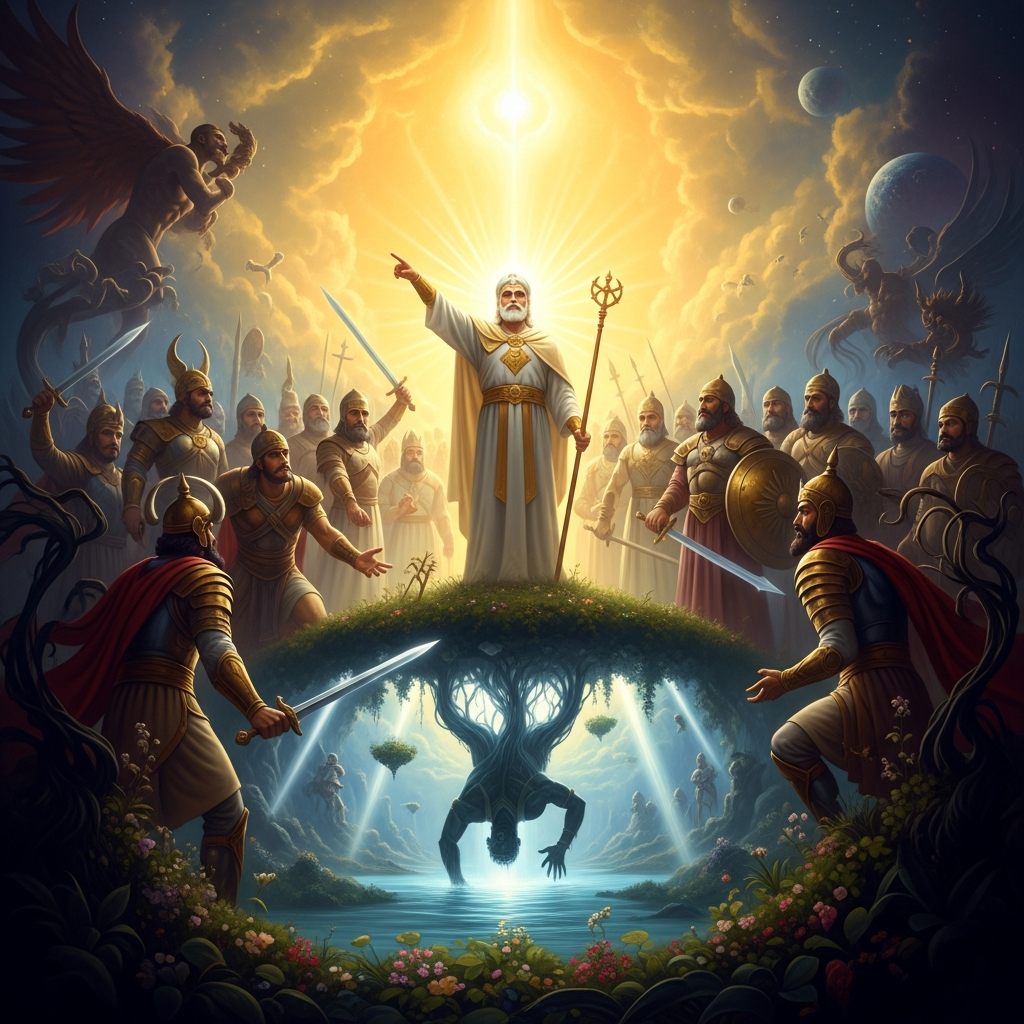
At the end of time — which the Zoroastrian tradition calculates as twelve thousand years after the creation, divided into four ages of three thousand years each — the great battle will occur. Angra Mainyu will marshal his demons: Aeshma of the Wounding Spear, Az the demon of greed and lust, Druj the Lie itself in demonic form. The yazatas, the divine beings who serve Ahura Mazda, will meet them in a final combat.
The combat will not be long. The outcome is predetermined by the structure of reality — good is real, evil is parasitic on reality, and parasites cannot ultimately outlast their host. Angra Mainyu will be driven back. The demons will be scattered. The great demon Gahi — who, according to the Bundahishn, gave Ahriman a kiss on the face that woke him from his stupor at the beginning of time — will be finally dissolved.
Then the metal will melt.
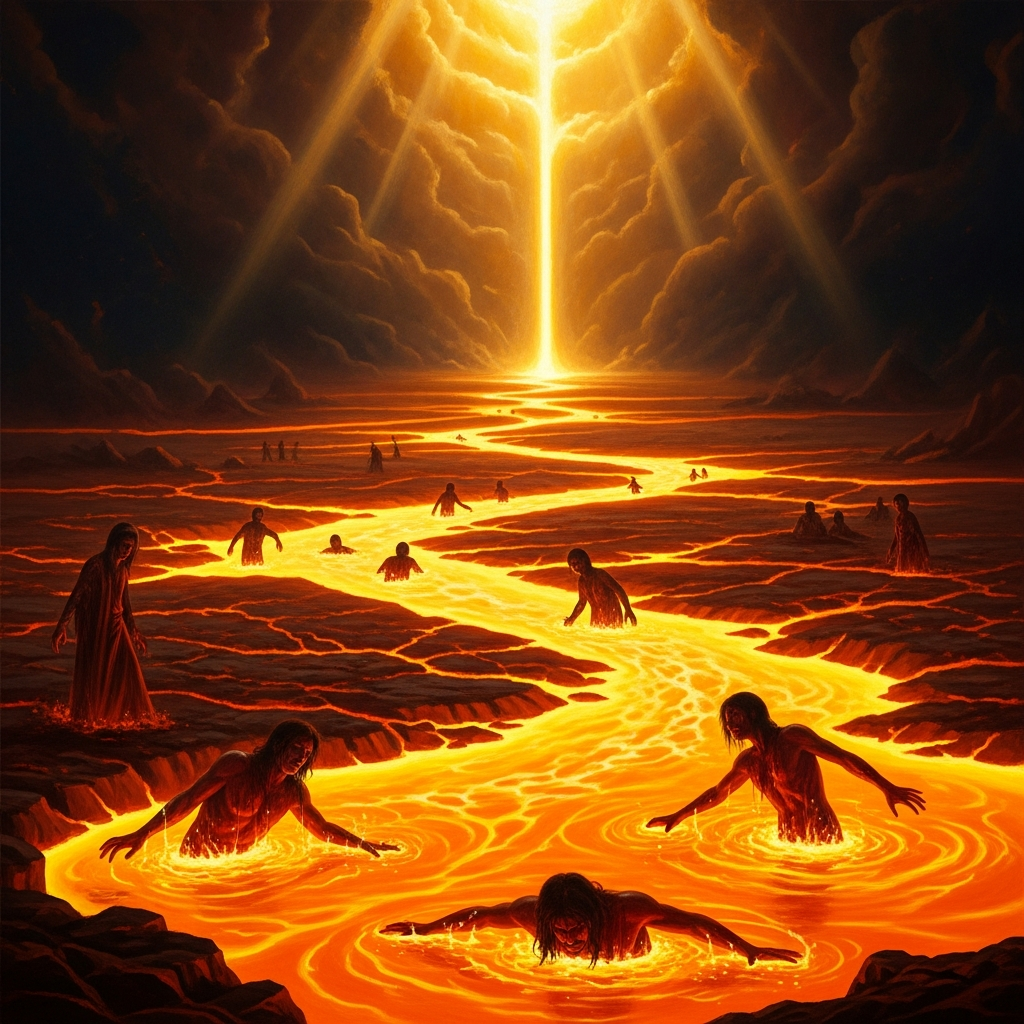
This is the image that cannot be rationalized away: the ordeal of molten metal. In the Zoroastrian vision of frashokereti, Airyaman — the divine patron of friendship and healing — calls for the final purification. All the metal in the mountains of the world melts and flows together in a great river across the earth. Every living person and every dead person — the dead have been raised now, this is the resurrection, ristakhiz — passes through the river.
The righteous pass through it as through warm milk. This is the text’s exact formulation. The evil pass through it as through burning metal — but they pass through it. They are not destroyed. They are purified. Even the wicked are ultimately saved in the Zoroastrian eschatology, because Ahura Mazda’s creation is good, and nothing that was created good can be permanently destroyed by the parasite that attacked it.
After the ordeal, the earth is flat. The bumps and valleys — many of which were created by the demonic attacks — are smoothed away. The river of metal settles and the earth is radiant. The sun never sets. There is no more night. There is no more hunger, no more thirst, no more old age, no separation between the living and the dead. The Bundahishn says: the world will be as it was — as it was before Angra Mainyu attacked, before the mixing began.
Except that it will have been through the fight. It will be the first world plus the victory.
The priest finishes the Yasna before noon. This too is required — the sun must be above the horizon, the forces of light in their daily ascendancy, when the ceremony concludes. He extinguishes nothing. The fire continues.
He steps out of the inner sanctuary and into the courtyard of the fire temple. The air of Sassanid Persia is warm with early summer. In the street outside the temple walls, merchants are arguing over the price of silk. A camel is complaining. A child is running. The whole mixed world, the gumezishn, grinding forward through its twelve-thousand-year project of working out the consequences of the primordial attack.
He washes his hands in the ritual manner. He unties and reties the kusti. He speaks the prayer that dedicates the work of the morning to Ahura Mazda.
He has held back the end for one more day. This is not a metaphor. According to the theology, it is literally what he has done.
The Zoroastrian vision of the end of time is the most optimistic eschatology in human religious history. Not because it promises paradise for the righteous and hell for the wicked — everyone promises that. Because it promises that even the wicked will be purified. Because it promises that the world will not be destroyed but perfected. Because it places the burden of that perfection on the shoulders of people who wake before dawn and speak the correct words and keep the fire lit.
The fire is always lit. This is the point.
This is always the point.
Scenes
A Zoroastrian priest performs the Yasna at the sacred fire in Sassanid Persia — the daily ritual that holds back Angra Mainyu and keeps the renovation of the world on schedule
 Generating art…
 In the Zoroastrian vision of the end, molten metal flows like a river across the earth: the righteous pass through it as through warm milk; the wicked are purified and then pass through
 Generating art…
 Ahura Mazda and the yazatas defeat Angra Mainyu at the last battle — not the destruction of the world, but its perfection: frashokereti, the making wonderful
 Generating art…
 Echoes Across Traditions
Entities
- Ahura Mazda
- Angra Mainyu (Ahriman)
- Saoshyant
- The Yazatas
- Zarathustra


Sources
- *Avesta* — the Zoroastrian canon, particularly the *Yasna*, *Yasht*, and *Vendidad* (compiled under Sassanid dynasty, ~4th c. CE)
- Mary Boyce, *Zoroastrians: Their Religious Beliefs and Practices* (Routledge, 1979)
- Philip G. Kreyenbroek, *Zoroastrianism under Persistent Conditions* (2011)
- Anders Hultgård, 'Persian Apocalypticism,' in *The Encyclopedia of Apocalypticism* (Continuum, 1998)
- Shaul Shaked, *Dualism in Transformation: Varieties of Religion in Sasanian Iran* (School of Oriental and African Studies, 1994)