Bodhidharma Meets the Emperor
c. 520 CE · Jiankang (modern Nanjing), Liang Dynasty China — and Shaolin Monastery, Mount Song
Contents
An Indian monk crosses the sea, walks into the throne room of the most pious emperor in China, and answers every question with a door slammed shut.
- When
- c. 520 CE
- Where
- Jiankang (modern Nanjing), Liang Dynasty China — and Shaolin Monastery, Mount Song
The emperor has built temples.
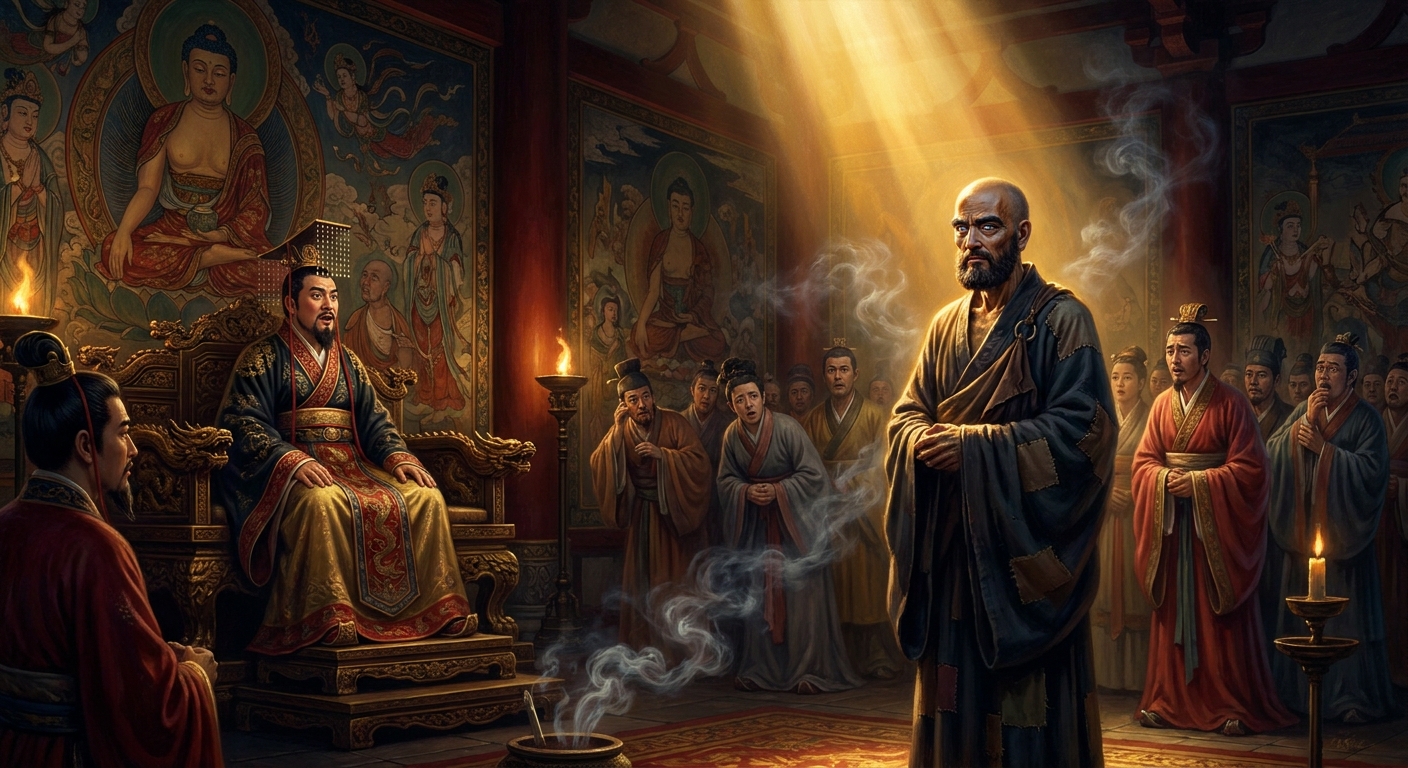
He has copied sutras with his own hand. He has freed slaves, fed monks, ransomed himself from his own treasury and back again to make a point about generosity. The court calls him the Bodhisattva-Emperor. When the Indian monk is announced — sea-burned, blue-eyed, wrapped in a red robe the color of wound — Wu of Liang sits forward on the dragon throne expecting praise.
“Since I came to the throne,” the emperor says, “I have built temples, copied sutras, ordained monks beyond counting. What merit have I earned?”
Bodhidharma looks at him.
“No merit.”
The translator hesitates. The court hesitates. The incense does not.
The emperor recovers. He is a scholar; he has another question.
“Then what is the highest meaning of the holy truth?”
“Vast emptiness,” Bodhidharma says. “Nothing holy.”
The throne room cools by a degree. The phrase is not Buddhist politeness. It is a hammer through stained glass. The emperor has spent twenty years building a religion of merit, hierarchy, robes, gold-leaf, holy things — and a man with a beggar’s bowl has just told him there is nothing holy in any of it. Not the temples. Not the sutras. Not the throne. Not the monk who is saying so.
Wu’s hands tighten on the armrests. His final question comes out colder than he intended.
“Who, then, stands before me?”
Bodhidharma’s answer is the third door, and the smallest, and the one that has never closed since.
“I don’t know.”
He walks out of Jiankang.
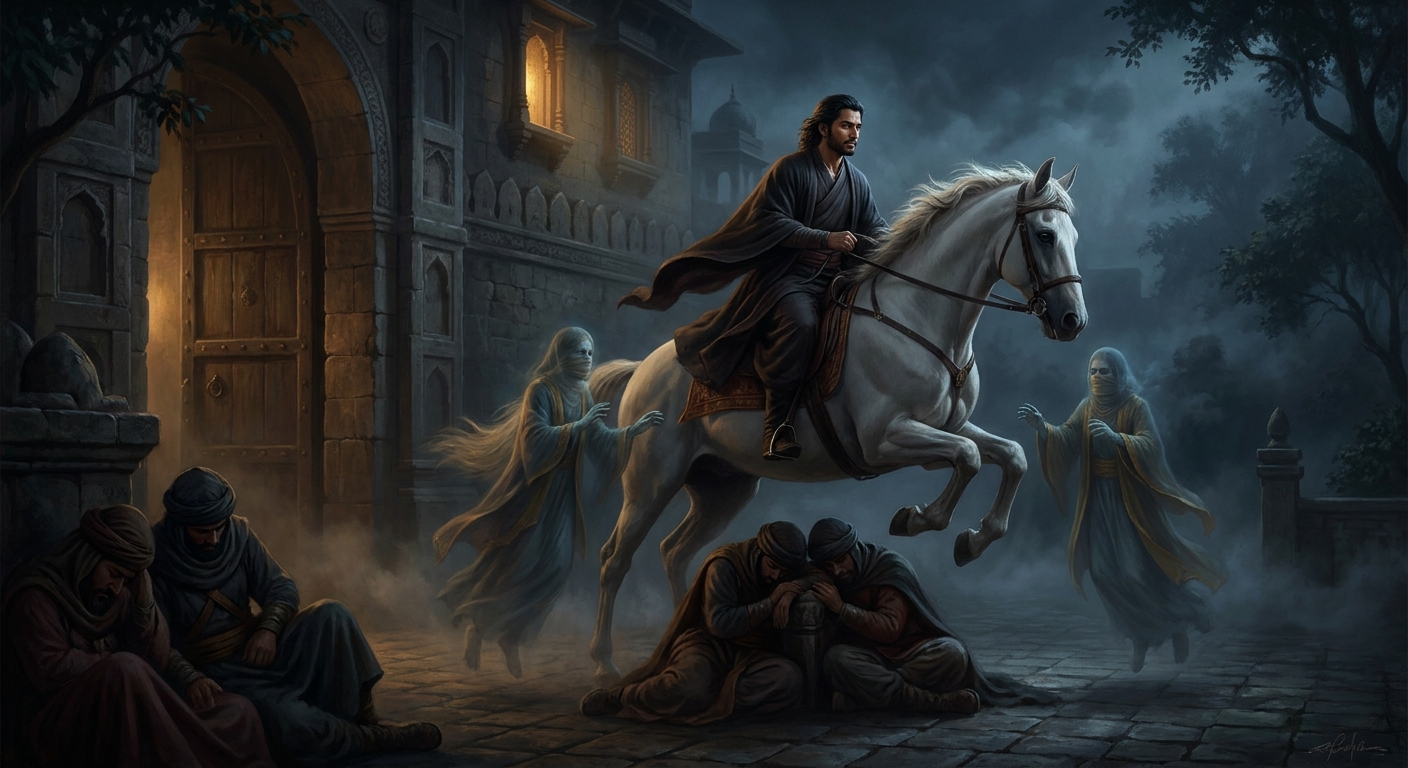
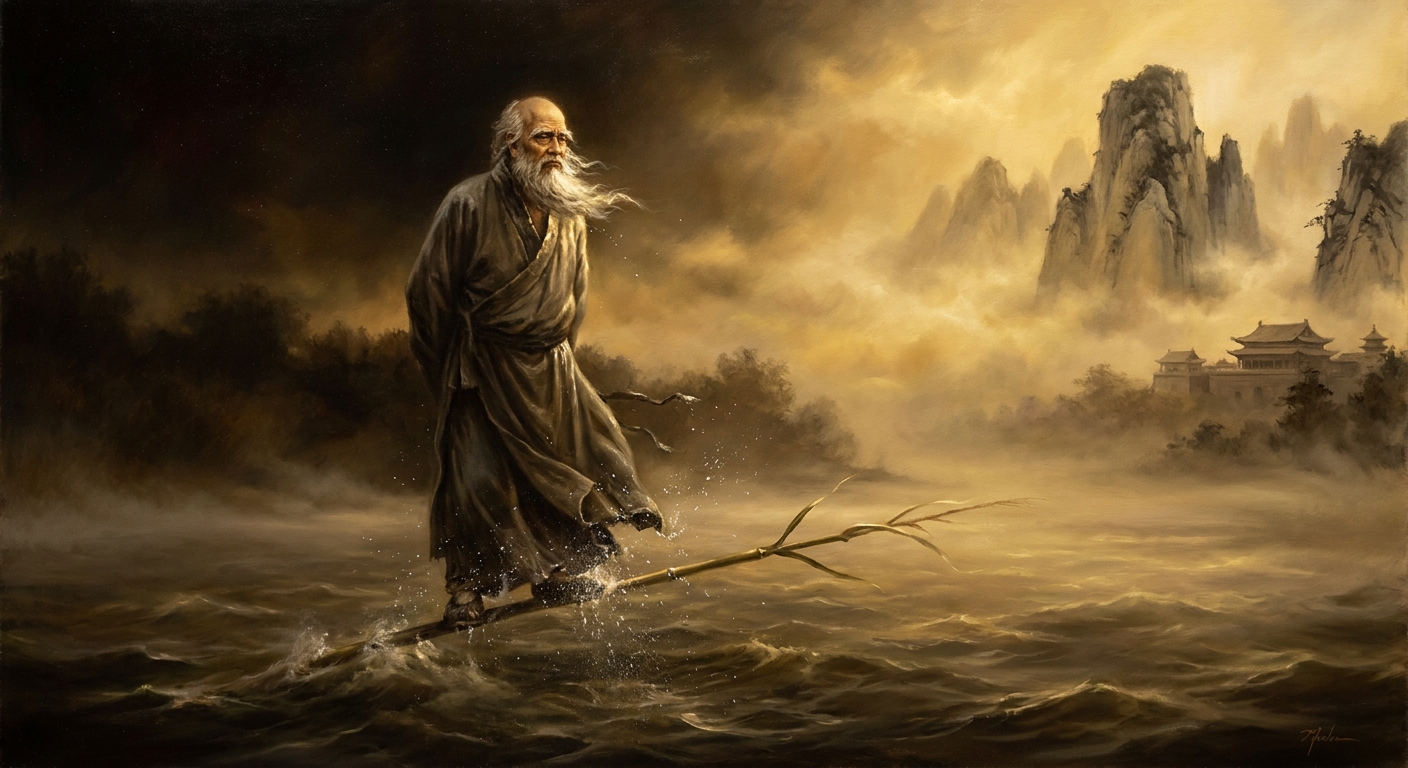
The emperor does not stop him. There is nothing to negotiate with a man who refuses to be a someone. Bodhidharma travels north. At the Yangtze the ferry will not wait, so the legend says he plucks a single reed from the bank, steps onto it, and crosses the river on it the way another tradition’s prophets walk on water. The reed becomes an icon. Every Chan painter for a thousand years will paint him on it, beard streaming, eyes furious, going north to a wall.
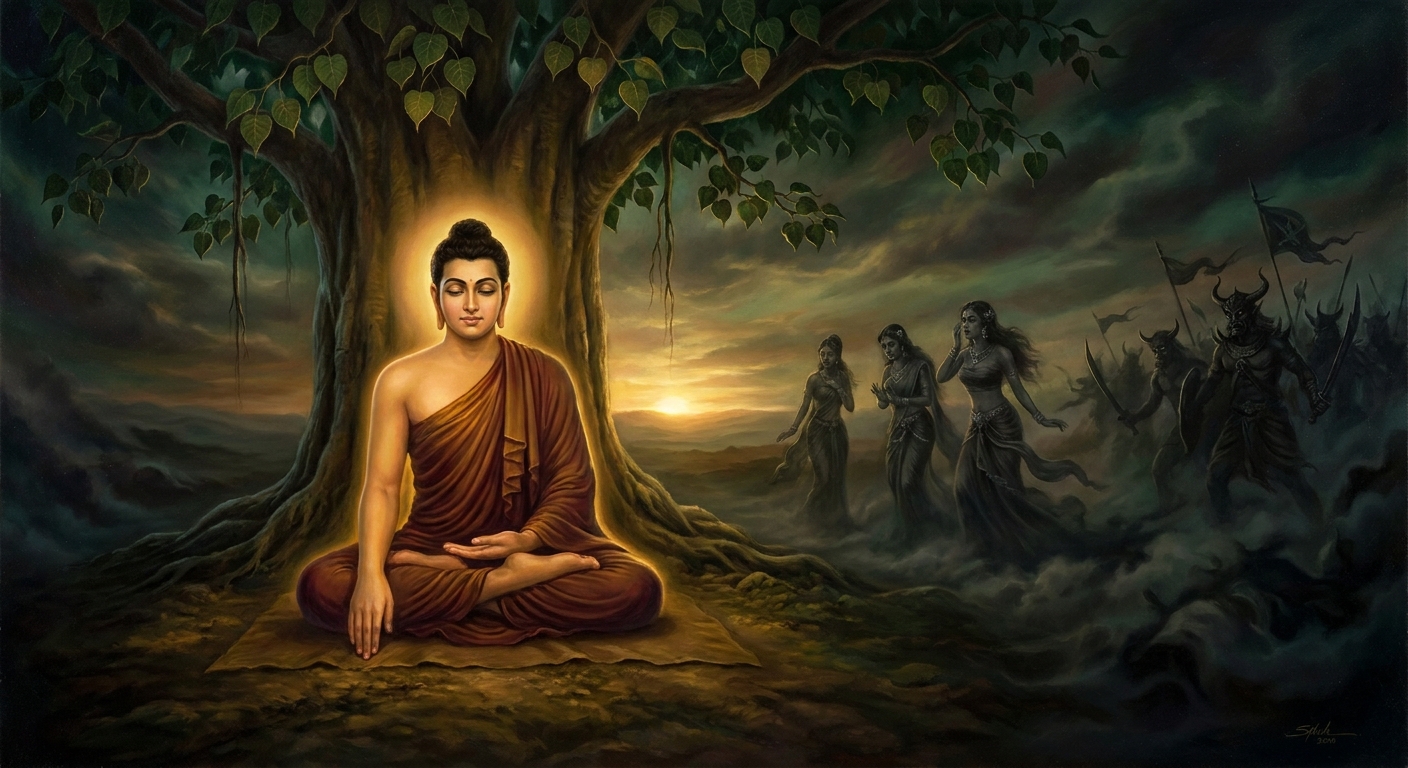
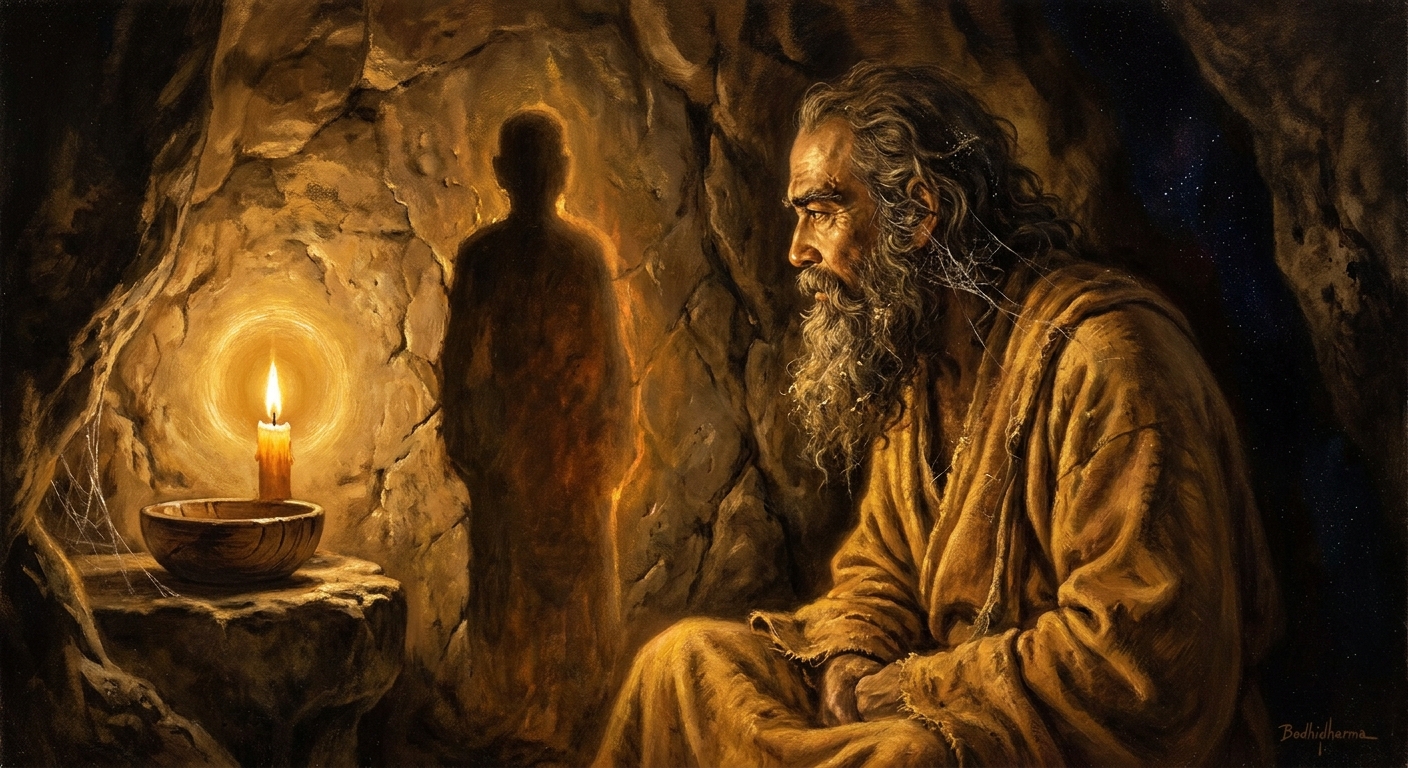
He reaches Shaolin Monastery on Mount Song. The monks offer him a cell. He refuses. He walks up to the cliff behind the temple, finds a cave, sits down facing the rock, and does not move.
For nine years.
The villagers bring rumors down the mountain. The barbarian’s legs have rotted off. His shadow has burned into the cave wall. Birds nest in his beard. He has not blinked since the year he arrived.
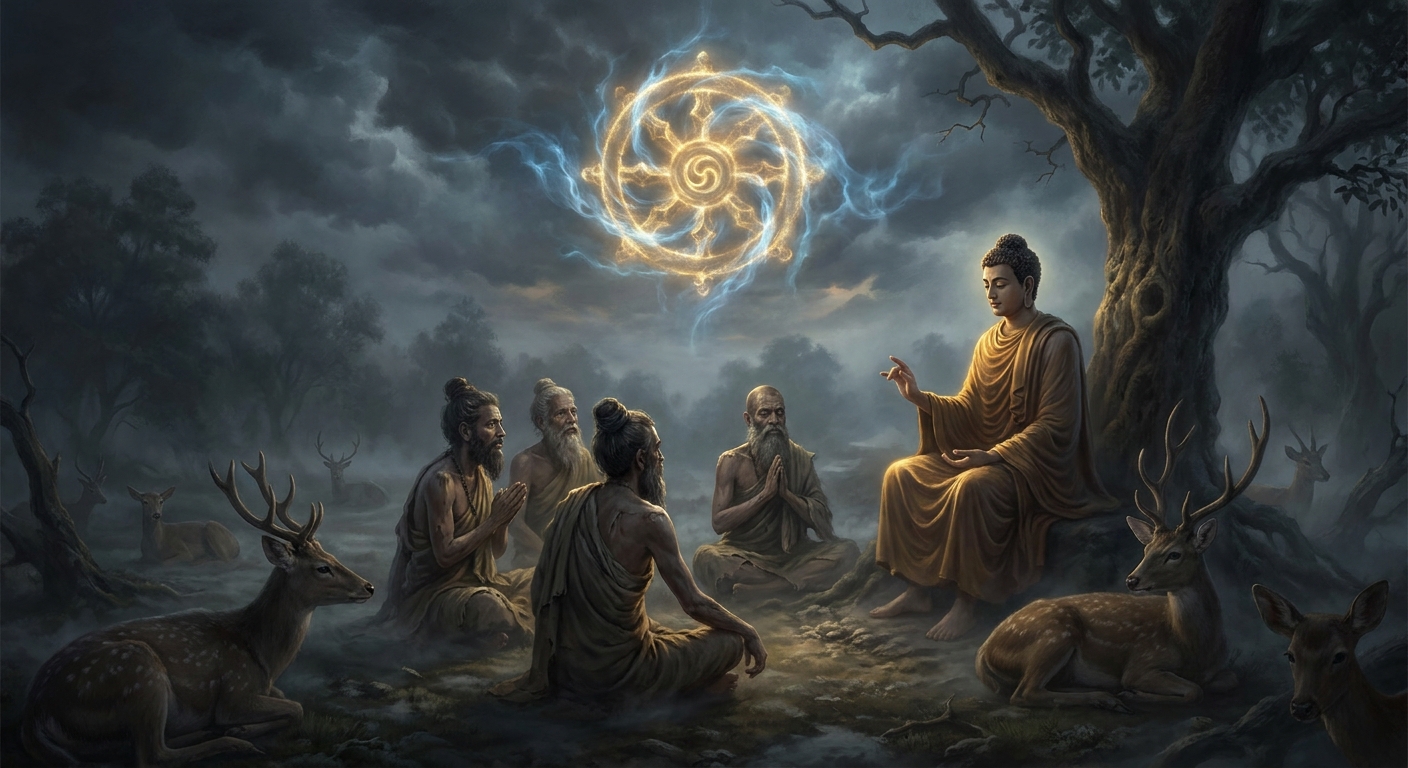
A monk named Huike climbs the mountain in winter to ask for teaching. Bodhidharma will not turn around. Huike stands in the snow for a night. Then a day. Then another night. The snow rises to his knees, then his thighs. To prove the seriousness of his question, Huike draws a sword and cuts off his own left arm and lays it, steaming, in the snow at the cave’s mouth.
Bodhidharma turns, finally.
“What do you seek?”
“My mind has no peace,” Huike says. “Master, pacify it for me.”
“Bring me your mind,” Bodhidharma says, “and I will pacify it.”
Huike searches. He searches the way a man searches a burning house for a child. He cannot find it.
“I have searched for the mind,” Huike says at last, “and I cannot take hold of it.”
“There,” Bodhidharma says. “I have pacified it.”
The transmission has been made.
Not in a sutra. Not in a temple. Not in front of an emperor. In a cave, in winter, between a one-armed Chinese pilgrim and an Indian who would not turn around. The robe and bowl that will mark the Chan patriarchate for the next two centuries pass from Bodhidharma to Huike on a rock with no witness but the snow.
The lineage that begins on this mountain becomes Chan. Chan becomes Zen when it crosses to Japan. Zen becomes the way the modern West first learns the word koan. All of it traces back to three answers given to a disappointed emperor and one question answered in a cave.
No merit. Nothing holy. I don’t know.
Wu’s question was the religious question — what have I earned, what is the truth, who are you. Bodhidharma’s answers were the same answer in three keys: there is no transaction here. The temple is not the temple. The throne is not the throne. The monk is not the monk.
Chan, and through it Zen, defines itself in the negative space of that throne room. Not by what it adds to Buddhism but by what it refuses to add. No merit. No hierarchy. No holy. A wall, a cave, nine years, and a question you cannot answer except by losing the one who is asking.
The emperor died believing he had been insulted. The lineage that walked out of his court is still walking.
Scenes
The blue-eyed barbarian stands before the Liang throne
Generating art… He crosses the Yangtze on a single reed, robe heavy with river-spray, the south already behind him
 Generating art…
 Nine years facing the cave wall at Shaolin
 Generating art…
 Echoes Across Traditions
Entities
- Bodhidharma
- Emperor Wu of Liang
- Huike
Sources
- *Blue Cliff Record* (*Biyan Lu*), case 1 — Yuanwu Keqin (1125 CE)
- Daoxuan, *Xu Gaoseng Zhuan* (*Continued Biographies of Eminent Monks*, 645 CE)
- Daoyuan, *Jingde Chuandeng Lu* (*Transmission of the Lamp*, 1004 CE)
- D.T. Suzuki, *Essays in Zen Buddhism, First Series* (1927)
- John R. McRae, *Seeing Through Zen* (2003)