Angulimala: Nine Hundred and Ninety-Nine Fingers
c. 5th century BCE · Kosala, northern India — the forest road outside Savatthi
Contents
A serial killer has vowed to make a garland of a thousand human fingers. Nine hundred and ninety-nine are already strung. The Buddha walks toward him on the forest road. Angulimala runs as fast as he can and cannot close the gap. What happens in the space between a sprint and a walk is the whole teaching.
- When
- c. 5th century BCE
- Where
- Kosala, northern India — the forest road outside Savatthi
The man’s name, before, was Ahimsaka — Harmless One. His mother named him for what she wanted him to become.
He was a scholar’s son, brilliant enough to be sent to Taxila, which is where the best teachers were, and gifted enough to become the most talented student of a famous brahmin whose name the texts do not bother to preserve. The other students were jealous of his standing. They went to the brahmin and told him that Ahimsaka had seduced his wife. The brahmin, who believed them, did what jealous teachers sometimes do: he invented a task that was meant to kill the student. He said: to complete your education, you must bring me a thousand human right-hand little fingers, strung as a garland. A task impossible enough that Ahimsaka would die in the attempting.
Ahimsaka did not die. He went into the forest and he began.
By the time the story reaches us, he has nine hundred and ninety-nine fingers on the garland. He wears them around his neck. The flesh has long since gone; what remains is bone, strung on a cord, clicking when he walks. The forest in the vicinity of Savatthi has been emptied of travelers and villagers; people know the range of the man they call Angulimala — the finger-garland — and they do not enter the trees alone. The king is preparing an army.
His mother does not know this. Or she knows it and does not believe it, the way mothers sometimes cannot close the gap between the child they held and the reports coming out of the forest. She takes food to the edge of the trees and calls his name — the old name, Ahimsaka — and waits. On this particular morning she decides to go further in. She walks into the forest to find her son.
Angulimala sees her from a distance. He has one finger left to collect. His mother has always been the one exception, the limit he has not crossed, and this morning, on the last day, the limit gives way. He begins to walk toward her.
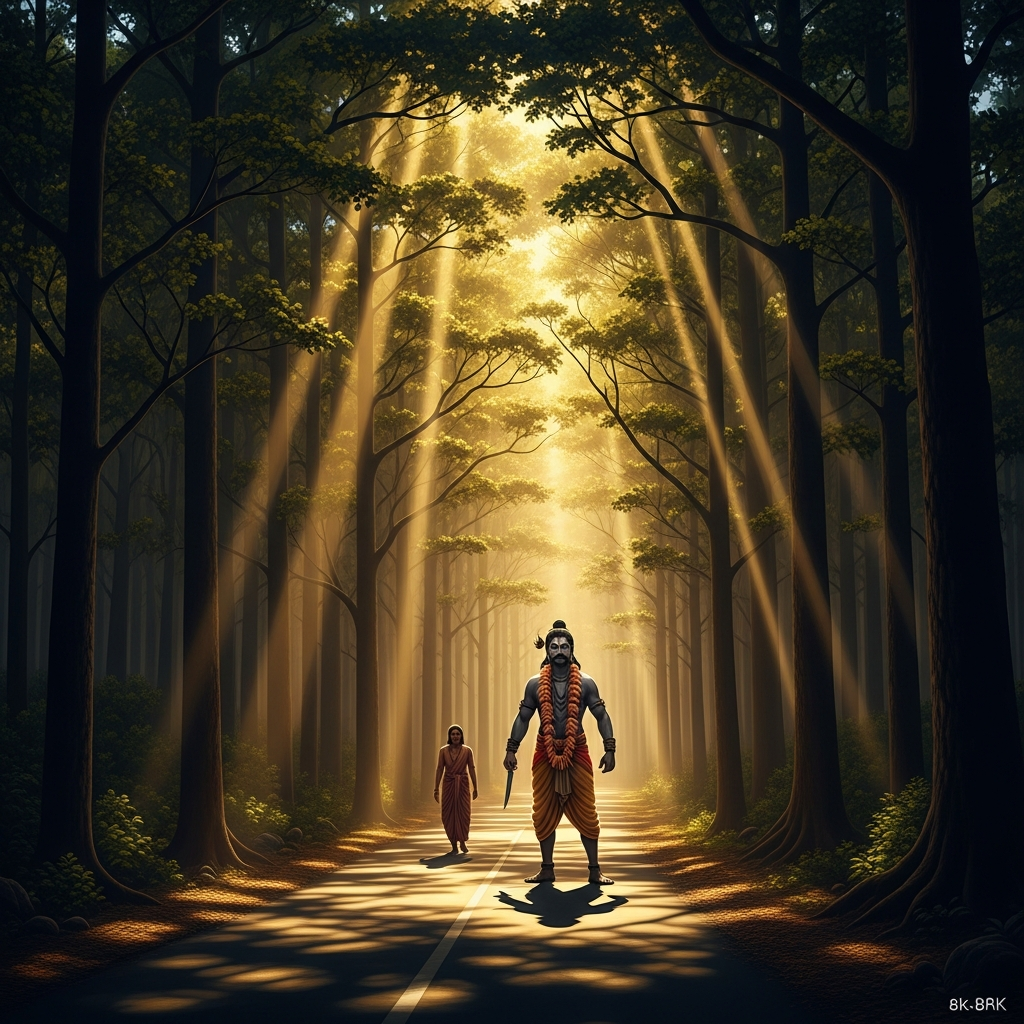
On the road approaching the forest, a man is walking.
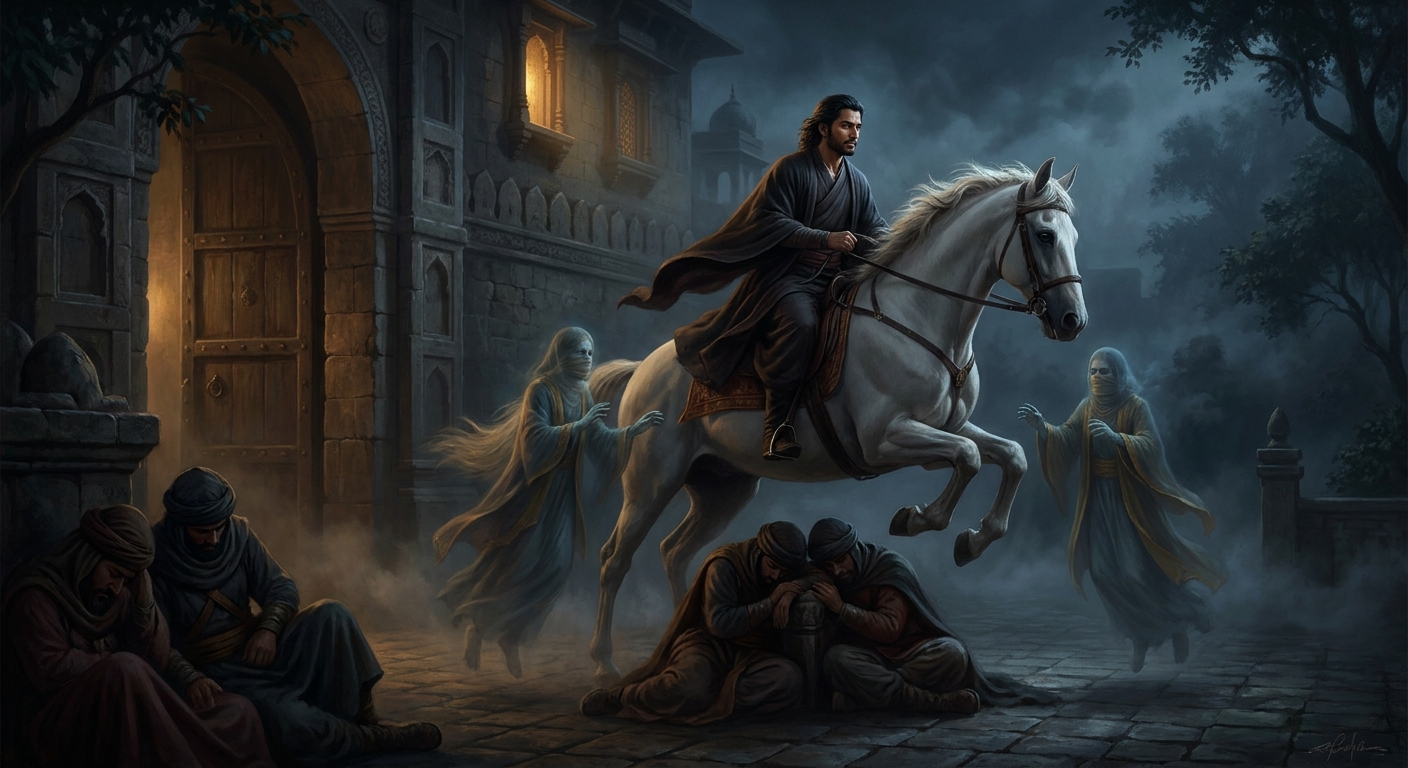
This is unusual. Everyone knows the road is closed. The king’s soldiers do not use it. The villagers have stopped. The farmers detour for an extra hour to avoid it. A single man is walking the road, in robes, without a weapon, at the steady pace of someone who is going somewhere and knows the way.
Angulimala sees the man and makes a decision. He does not have to go to his mother. He turns and runs toward the solitary figure on the road.
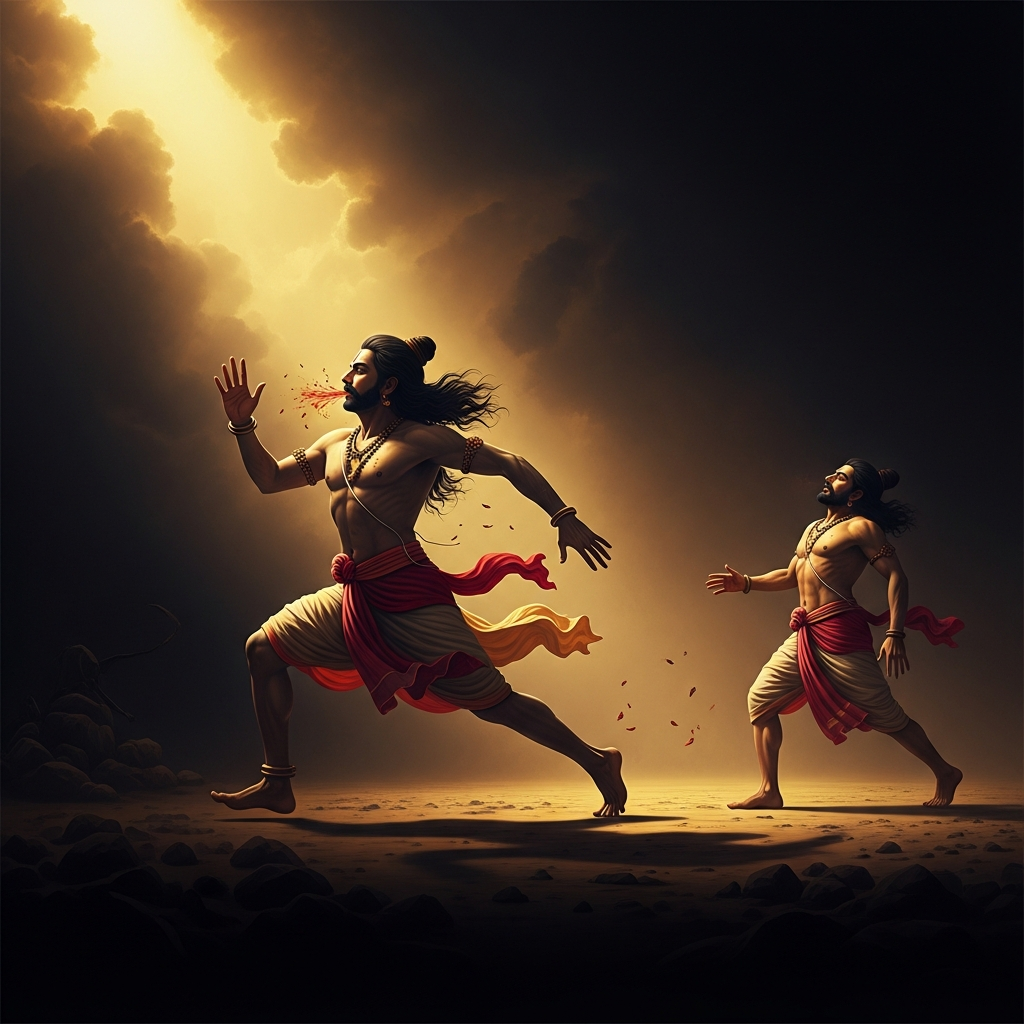
He is fast. He has been living in a forest and hunting human beings for years; he is in better physical condition than almost anyone in Kosala. He runs at full speed, closing the distance to the man on the road.
The distance does not close.
The man is walking. Angulimala is running. The gap between them stays exactly the same. He runs harder. The gap stays. He runs until his lungs are burning and his legs have gone past pain into something else, and the man in front of him is walking at a pilgrim’s pace and the gap has not closed by a single hand’s width.
Angulimala stops running.
He shouts: Stop, ascetic. Stop.
The man continues walking. He says, without turning around: I have stopped, Angulimala. You stop.
This is not a physical claim. The man is not saying he has stopped moving. He is saying that he stopped a long time ago — stopped harming, stopped the motion of violence that perpetuates itself through human lives like a fire that finds new fuel, stopped the chain in which cruelty begets jealousy begets injury begets revenge begets the long degradation of the person doing the revenging.
Angulimala is a scholar’s son. He was trained in interpretation. He understands, in the space between one breath and the next, that he is being told something about the nature of what he has been doing.
He says: You walk and call it stopping. I am standing still and you call it moving. Explain.
The Buddha turns around. He says that beings with wisdom restrain themselves from harm. This is what stopping means. Angulimala has been running — in the deepest sense, running at full speed — for years. He has not stopped once. He has moved faster and faster, and the garland of fingers has grown, and the running has not gotten him closer to the thing he was supposedly pursuing.
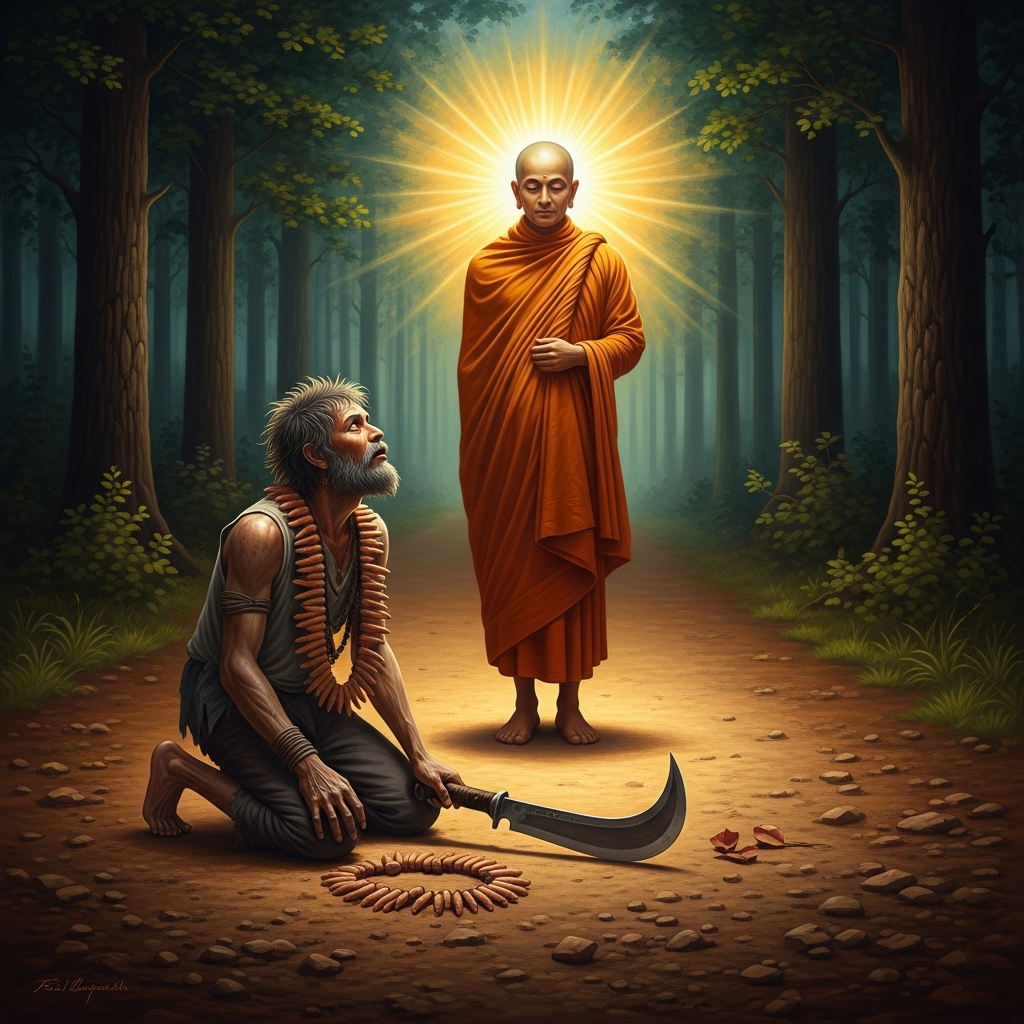
Angulimala drops the knife. He drops the garland. He asks to become a monk.
The story does not end there, because the tradition is honest about what transformation costs.
He is ordained. He is given robes. He is given the practice. He walks into Savatthi with his bowl for alms, and the people who recognize him throw rocks. He is struck on the head. He bleeds through the robes into the dust of the road. He goes back to the Buddha bleeding, and the Buddha tells him to bear it. This is what bearing means: to stand in the middle of the consequences of what you have done and not run from them and not add to them. To stop, in the full sense, and be stopped.
He bears it. He practices. He reaches liberation and teaches the precepts and lives out the rest of his life in the robes. He becomes a touchstone — the answer to the question asked whenever the tradition claims that liberation is available to anyone. When someone says surely not to someone who has done what I have done, the answer is: Angulimala.
The king does take his army to the forest. He finds no one there.
The thing that moves through violence is not the person. The person is the forest the thing moves through, and when the thing finally stops — when something outside the violence meets it and does not run from it and does not join it — the forest can be still. Ahimsaka, whose name meant Harmless One, became Angulimala, and then became something the texts call by a different name: one who is freed. His mother named him first. The Buddha named him last. The distance between the two names is the whole road.
Scenes
The forest road at midday — sunlight through sal trees making columns of gold and shadow
 Generating art…
 Angulimala at full sprint, his legs blurred with effort, his breath torn out of his chest
 Generating art…
 Angulimala on his knees in the road-dust, the garland fallen from his neck, his knife in the dirt beside him
 Generating art…
 Echoes Across Traditions
Entities
- Angulimala
- The Buddha
- Ahimsaka
Sources
- Bhikkhu Bodhi (trans.), *The Middle Length Discourses of the Buddha: A Translation of the Majjhima Nikaya* (Wisdom Publications, 1995) — MN 86, 'Angulimala Sutta'
- Bhikkhu Nanamoli and Bhikkhu Bodhi (trans.), *The Connected Discourses of the Buddha* (Wisdom Publications, 2000)
- Walpola Rahula, *What the Buddha Taught* (Grove Press, 1959)
- Bhikkhu Analayo, *Compassion and Emptiness in Early Buddhist Meditation* (Windhorse Publications, 2015)
- Rupert Gethin, *The Foundations of Buddhism* (Oxford University Press, 1998)