The Night Under the Bodhi Tree
~528 BCE · Siddhartha's awakening · Bodh Gaya, beneath the Bodhi tree
Contents
Siddhartha Gautama sits beneath a pipal tree and faces the demon Mara's three temptations—desire, fear, and doubt—refusing to move until enlightenment breaks at dawn.
- When
- ~528 BCE · Siddhartha's awakening
- Where
- Bodh Gaya, beneath the Bodhi tree
He comes to the tree in autumn.
The Bodhi tree stands at Bodh Gaya like a root driven upward through the earth, its branches spreading over a spot where the earth itself seems thinner — permeable. Siddhartha has nowhere else to go. Six years of teachers have left him only more confused. Six years of fasting have left him hollow as a drum, his ribs like a xylophone, his breath so thin it barely clouds a mirror. A village girl named Sujata — who saw him collapsing — gave him milk-rice, and he accepted. That act of surrender to the middle way, to neither starvation nor indulgence, has brought him here. Not to victory. Not to triumph. To this tree, this night, this vow:
I will not rise until I understand.
There is no god to grant him enlightenment. There is no Brahman descending with fire. There is only this man, this body, this mind that has chased itself in circles for six years and found nothing. The tree does not move for him. The earth does not speak. He sits, and the sun falls, and the dark comes up like water.
The first hours are peace. The body settles. The breath quiets. He has trained in meditation, learned to see the spaces between thoughts, to let the mind rest on itself like still water. The night is cold, but not unbearable. The tree is shelter. He is safe.
Then the scratching begins.
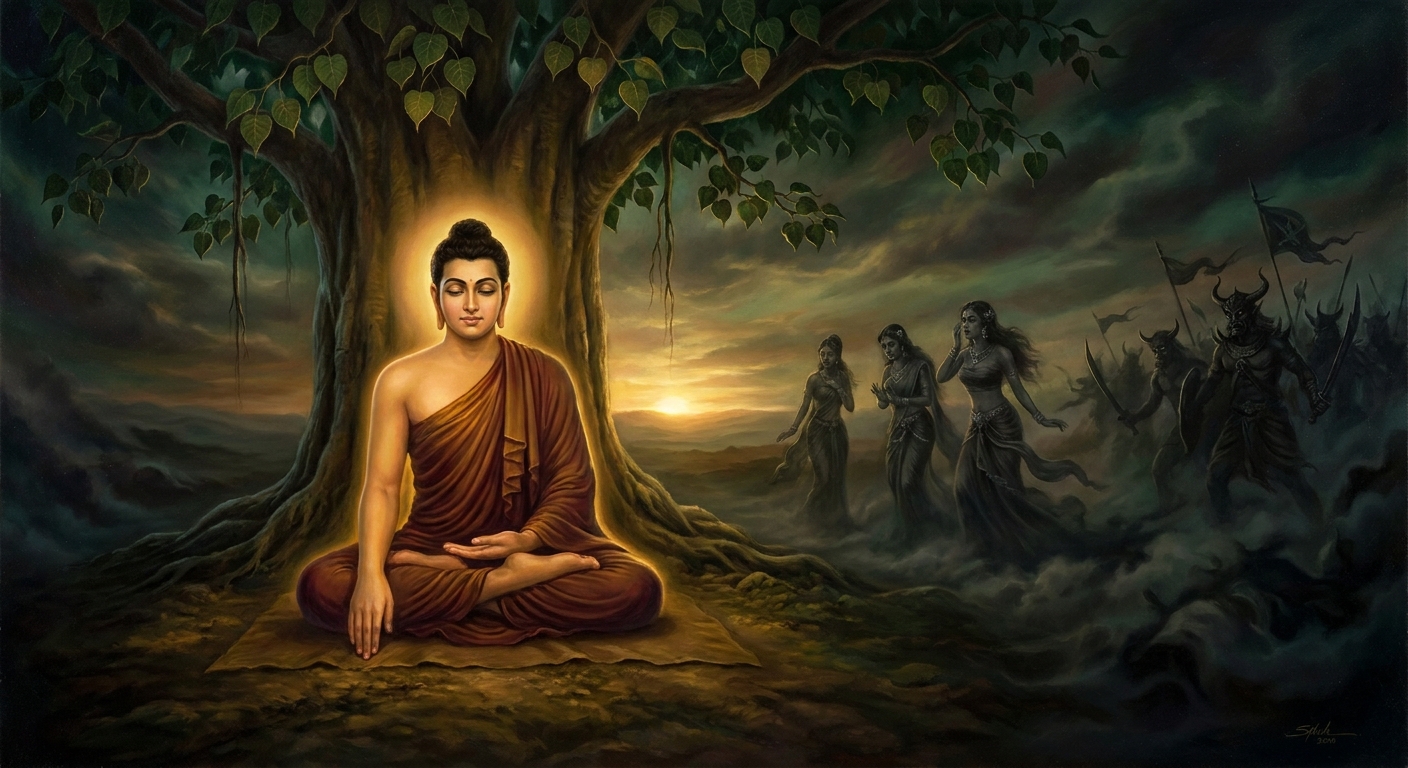
At first it sounds like branches — the sound of the wind that is not wind, the whisper of things moving through the dark. Shapes gather at the edge of perception. They do not resolve. Mara has come. Not as a single demon, not as a king on a throne, but as the embodiment of everything that keeps beings trapped in samsara — the personification of craving itself, of the fear that accompanies the loss of everything you think you own, of the doubt that whispers that you do not deserve to be free.
The first assault is desire.
Mara sends his three daughters — Tanha (Craving), Arati (Aversion), and Raga (Passion) — and they approach through the dark like a slow wave. They are beautiful in every way: young and old, innocent and experienced, delicate and fierce. They dance. They transform. They offer every pleasure a human body can imagine, every comfort a human heart can crave. They whisper that Siddhartha has suffered enough, that he has earned rest, that enlightenment can wait, that there is no shame in accepting joy.
The women surround him. They touch him. They sing. They are not crude temptations — they are sophisticated, seductive, almost reasonable. They offer him the life he abandoned: not as a prince in a palace, but as a sage surrounded by devoted followers, honored, comfortable, at peace.
Siddhartha does not move.
Not from strength. Not from anger or disgust or moral superiority. From the simple recognition that all of it — the pleasure and the promise — is impermanent. The daughters’ beauty, like all beauty, is a shape the universe makes and unmakes. To grasp at it is to grasp at mist. He sees this clearly, and in seeing it, the women do not fade so much as become transparent. They are still there, still dancing, still singing, but they have lost their power to deceive. He watches them the way you watch clouds pass across the moon — without judgment, without attachment.
The women withdraw. Not defeated. Merely ineffective.
The second assault is fear.
The scratching becomes a sound. The dark becomes a presence. Mara unleashes his armies — not soldiers but forces, not creatures but embodied terror. Flaming rocks the size of mountains hurtle toward Siddhartha. Boiling mud geysers up from the earth. The sky splits into lightning. Demons with fangs and claws and eyes like burning coals surround the tree. They roar. They wave weapons. They promise annihilation.
A warrior faced with this — any normal human — would run. The body’s ancient programs would activate: flight. The cave of the body would slam its doors. The heart would hammer. The mind would scatter.
But Siddhartha recognizes what the Odin of the Norse will recognize centuries later: that fear and courage are not opposites. Fear is a thought like any other thought. Courage is not the absence of fear. Courage is seeing the fear clearly and choosing not to be moved by it.
The flaming rocks fall toward him. Before they reach him, they become flower petals. The mud turns to sandalwood paste. The demons’ roars become the sound of wind in bamboo. Not through any magic Siddhartha has worked, but through the simple fact that his mind is no longer grasping at safety, no longer fighting for survival. When you stop fighting the illusion, the illusion loses its grip.
The armies cannot touch him.
The third assault is the most subtle. The most dangerous. The one that has broken more seekers than violence or pleasure ever will.
Doubt.
Mara approaches now directly. Not as an external force but as a whisper in the mind — a voice that sounds almost like reason, like truth, like reality itself. And he asks the question that destroys kingdoms:
Who are you?
Who witnesses your right to sit here? Who authorized you? Who are your credentials? What makes you different from any madman sitting under a tree convinced he is having visions? Your father was a king — he will not acknowledge you. Your wife will not vouch for you. Your son will not call you father. The five ascetics who walked with you for six years abandoned you when you ate food. Where is your lineage? Where is your approval? Where is your proof?
You are nobody. Nobody’s son. Nobody’s student. Nobody’s heir. You have no right to claim this seat. You have no right to enlightenment. You are sitting here alone in the dark, about to die, and nobody will ever know. The world will forget you before your body has cooled.
This is the attack on identity itself. Not on the body, which is simple matter. Not on the senses, which can be trained. But on the deepest sense of worth, the fundamental I am, the voice that says I belong, I matter, I have a place in the universe.
For the first time in the night, Siddhartha moves.
But not to defend himself. Not to argue or to prove his worth or to refute Mara’s claim. He simply reaches down and touches the earth with his right hand. A gesture so simple that it would be easy to miss its meaning. His palm presses against the soil beneath the Bodhi tree.
“The earth is my witness,” he says.
Not loudly. Not with anger. Simply. The way a man might touch a tree to confirm that a tree is real, that gravity is real, that the ground is solid beneath his feet.
And the earth trembles.
Not an earthquake. A tremor that runs through the realm. The ground shakes. Mara is thrown backward. The armies dissolve. The seductive daughters flee. The darkness cracks open. And in that crack comes the first light of dawn.
What Siddhartha has done is the most radical act in all of religion: he has refused to be moved.
Not by pleasure. Not by pain. Not by the promise of reward or the threat of punishment. Not by the whisper that he is not good enough, not worthy enough, not chosen enough. He has simply sat, and when the earth itself was questioned as a witness, he touched it.
It was enough.
The night dissolves. The sun rises. Colors return to the world — the green of the leaves, the blue of the sky, the gold of the dawn light filtering through the branches of the Bodhi tree. And Siddhartha, who sat as a prince, who walked as a renunciate, who fell as a starving ascetic, rises as the Buddha — the Awakened One.
He has seen his past lives, stretching back through countless rebirths. He has seen the karma of all beings, the chain of cause and effect that binds each consciousness to its own suffering. He has seen the Four Noble Truths: that suffering exists, that suffering has a cause (craving), that suffering can cease, and that the path to the cessation of suffering is the Eightfold Path of right view, intention, speech, action, livelihood, effort, mindfulness, and concentration.
He has not gone anywhere. He has simply stopped running.
The Buddha will spend the next forty-five years teaching this discovery to anyone who will listen. He will establish the Sangha — a community of monks and nuns who practice the same way. He will declare that anyone — regardless of caste, gender, or birth — can achieve what he achieved. He will refuse to make himself the object of worship, insisting instead that his teachings, not his person, are what matter. “Be lamps unto yourselves,” he will tell his monks at the moment of his death. “Take refuge in the Dharma.”
But the foundation is this night: the night a man sat alone under a tree and refused to be moved by the voice that said he was nobody. That refusal, and the earth’s answer, changed everything.
Enlightenment is not something the gods grant to the worthy. It is something any consciousness can see for itself, once it stops running from the truth. That is the Buddhist claim. That is the Bodhi tree. That is the night Mara learned that there is one weapon he cannot wield against a mind that has truly stopped craving: and that weapon is the truth itself.
“I see you, Mara,” the Buddha will say, many times, in the years to come, when doubt or fatigue whispers the old temptations. And in the seeing, Mara disappears. Darkness cannot survive the light of clear seeing. It is not a fight. It is a simple fact of nature — like fire burning darkness, like the sun rising, like a man touching the earth and finding it real.
Echoes Across Traditions
Entities
- Siddhartha
- Mara
- Sujata

Sources
- Buddhacarita (The Life of Buddha) by Aśvaghoṣa, 2nd century CE — detailed account of Mara's assault
- Mahavastu (Great Story) — early Buddhist narrative text
- Lalitavistara Sutra — Sanskrit narrative of the Buddha's life
- Sutta Nipata and Samyutta Nikaya (Mara-samyutta) — Pali Canon accounts of Mara's temptations
- Jātaka tales — stories of the Buddha's past lives