The Great Departure
~534 BCE · Kapilavastu, the Shakya kingdom · The palace at Kapilavastu, then the wilderness
Contents
At 29, Prince Siddhartha Gautama rides beyond his father's palace walls, sees old age, sickness, death, and a wandering ascetic, and that same night cuts his hair, lays down his robes, and walks into the forest — the renunciation that sets everything in motion.
- When
- ~534 BCE · Kapilavastu, the Shakya kingdom
- Where
- The palace at Kapilavastu, then the wilderness
The palace has no cracks in it.
That is the point. King Suddhodana built it that way — three compounds, one for each season, walls thick enough to hold the weather out and the world out with it. Siddhartha is twenty-nine years old and has never seen an old man. He has never been permitted to see one. His father received the prophecy at his birth from the seer Asita: this child will become either a great king or a great renunciant. Suddhodana chose for him. He chose walls.
So Siddhartha has silk. He has Yashodhara, who is beautiful and kind. He has their infant son Rahula — the name means fetter, though no one says that aloud. He has three palaces and a thousand diversions and every sight his father could arrange to keep him content inside the arrangement. What he does not have is the sight of a single human body failing.
He is twenty-nine years old and he does not know that bodies fail.
The charioteer is Channa. The horse is Kanthaka — white, loyal, bred for a prince. Siddhartha has argued his father’s chamberlain into allowing an excursion beyond the east gate. A prince should know his kingdom. A prince should see the city. His father has ordered the roads cleared of the unpleasant in advance, the way a man sweeps a path before a guest whose sensibilities are fragile.
But you cannot clear a road of everything. The gods, the tradition says, arrange what Suddhodana could not prevent.
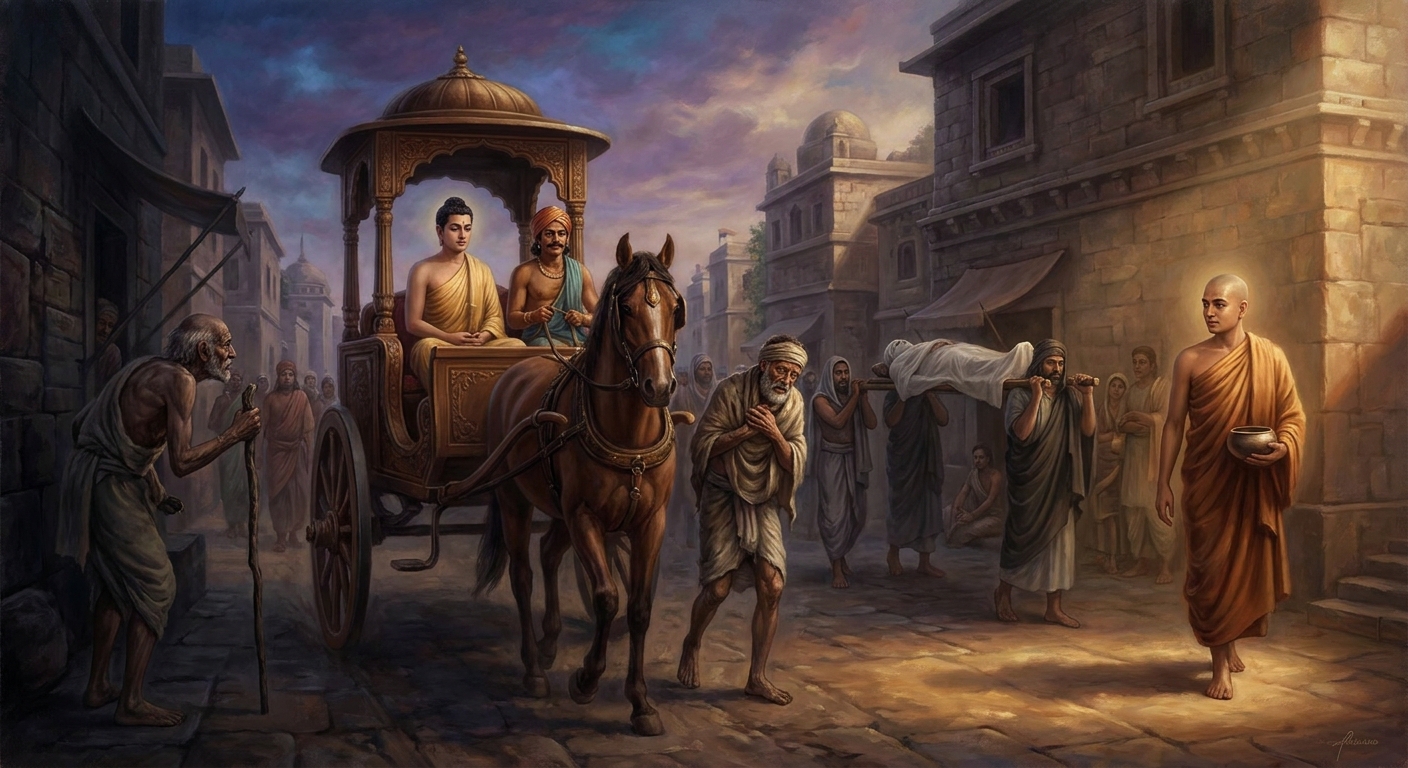
The first sight is an old man.
He is bent so far forward his spine has made a question mark of him. His hair is white and sparse. His skin has the texture of bark left in rain. He leans on a stick that is barely enough to hold him. He is moving, but only barely — each step a negotiation between his will and his body about whether they will continue to cooperate. Siddhartha stares. He does not know what he is looking at. He has to ask Channa: what is this?
Channa tells him. This is old age. This comes for everyone. This will come for the prince. This will come for Yashodhara. This will come for the infant Rahula, if Rahula lives long enough to receive it.
Siddhartha sits in the chariot and does not speak for a long time.
The second sight is a sick man.
He is burning with fever at the roadside, limbs slack and trembling, eyes glassed over and aimed at nothing. His breath comes in the wrong rhythm. Someone has brought him water; he cannot reach it. Siddhartha asks the same question. Channa gives the same shape of answer: sickness. It comes without invitation. It does not consult rank or beauty or wealth. It simply arrives. Siddhartha looks at his own hands — steady, young, untroubled — and understands for the first time that they are on loan.
The third sight is a corpse.
Four men carry it on a litter toward the cremation grounds. The body has the particular stillness that is different from sleep: the stillness of a thing that has permanently vacated. The family follows behind it making sounds Siddhartha has no framework for. He has been kept from grief the way other men are kept from fire. He asks Channa what has happened. Channa tells him. This man has died. Everything that was him — his hunger, his memory, his preference for one kind of food over another — is already gone, and the fire will take what is left. This happens to everyone. This will happen to the prince.
Siddhartha does not say anything at all on the ride home.
The fourth sight is different from the other three.
He is a wandering ascetic — a shramana, a striver — walking along the road with a begging bowl and an ochre robe and nothing else. He has no sandals. He has no destination that requires arriving by any particular time. But his face is what stops the chariot.
He is serene.
Not the serene of a man who has been protected from suffering. The serene of a man who has looked directly at suffering — has sat with it, has asked it every question, has stopped running — and found something on the other side of it that cannot be taken. He walks in the world that has just destroyed Siddhartha three times in an afternoon, and he walks through it the way water walks through stone: present, patient, unbroken.
Siddhartha watches until the man rounds the bend. Then he asks Channa to take him home.
That night he goes to Yashodhara’s room.
She is asleep, Rahula at her breast, both of them peaceful in the lamplight in the way that sleeping people are always peaceful — the world’s difficulties suspended, the body returned to its original simplicity. He stands in the doorway and looks at them for a long time. He does not wake them. Later, the tradition will argue about this: was it cowardice, or was it a kindness he could not explain? He knows that if he wakes her, she will understand. She will not stop him. She will grieve, and the grief will be real, and he will stay anyway out of the grief, and that will be the end of it.
He kisses her sleeping forehead. He touches Rahula’s hand, which closes on his finger in the automatic grip of infants. He stays another moment. Then he goes.
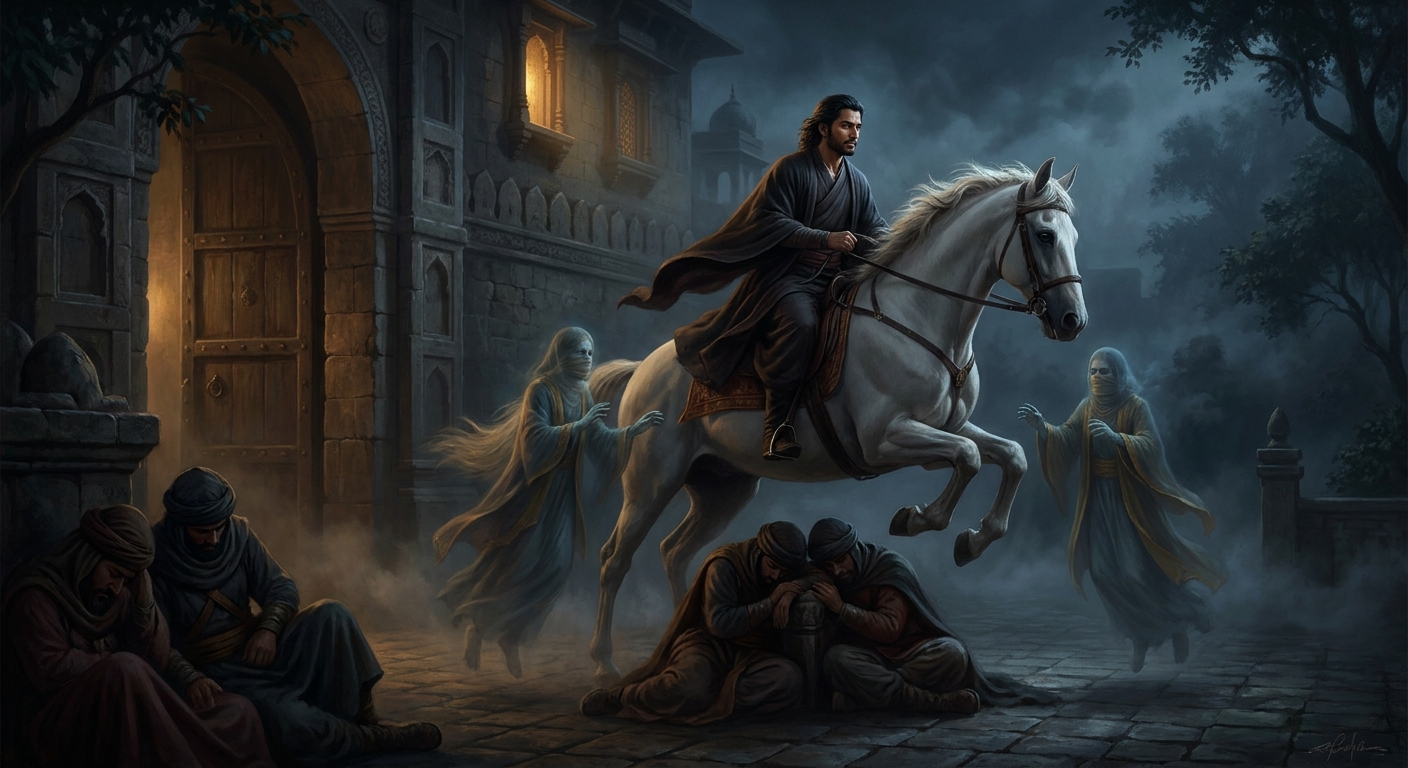
In the courtyard, Kanthaka is already saddled. Channa is there. Neither of them speaks. The horse’s hooves are muffled by the gods, the tradition says — the palace does not wake, the guards do not stir, the city breathes on undisturbed — as Siddhartha rides through the gate and into the dark outside the walls.
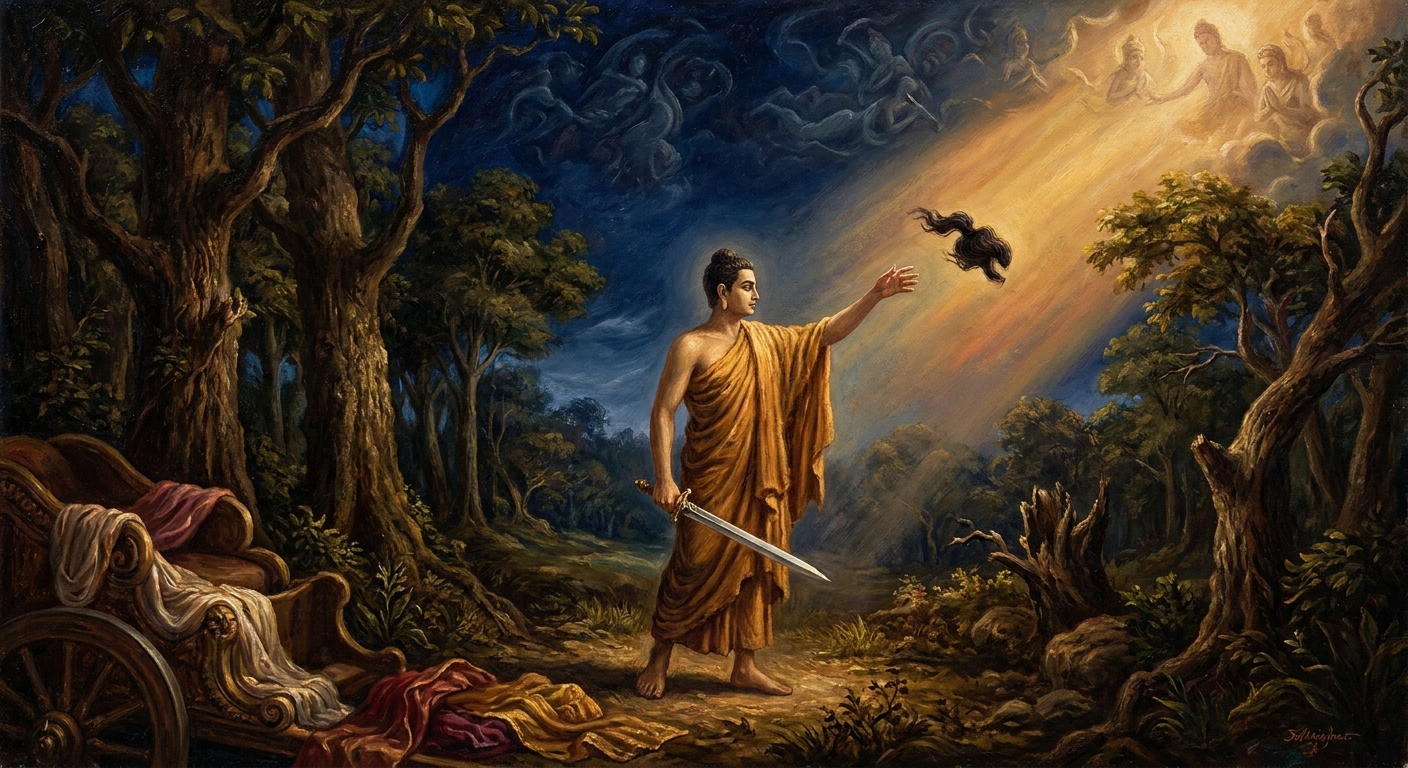
They ride through the night. By the time the sky begins to lighten they are at the edge of the forest. Siddhartha dismounts. He takes off his jewels and gives them to Channa. He takes off his robes. He draws his sword — a prince’s sword, ornamental, never used in actual war — and gathers his topknot in his fist. He cuts. The hair falls. He is not a prince anymore; the sword has made that exact.
He hands Channa the sword. He asks him to take Kanthaka home.
Channa weeps. The horse weeps — the Buddhacarita says this plainly, without apology, because horses know when the thing they have carried is gone. Siddhartha watches them turn back toward Kapilavastu until the trees take them, and then he turns and walks into the forest with a begging bowl and the robe of an ascetic and nothing else.
He is twenty-nine years old. He does not know what he is walking toward. He knows with absolute precision what he is walking away from.
He will spend six years in that forest. He will nearly die of it. He will find teachers and exhaust them and find that exhaustion is not the same as wisdom. He will starve until his spine is visible through his stomach. He will hold his breath until his ears ring. He will do everything the tradition of striving asks of him and discover that striving is not the answer either.
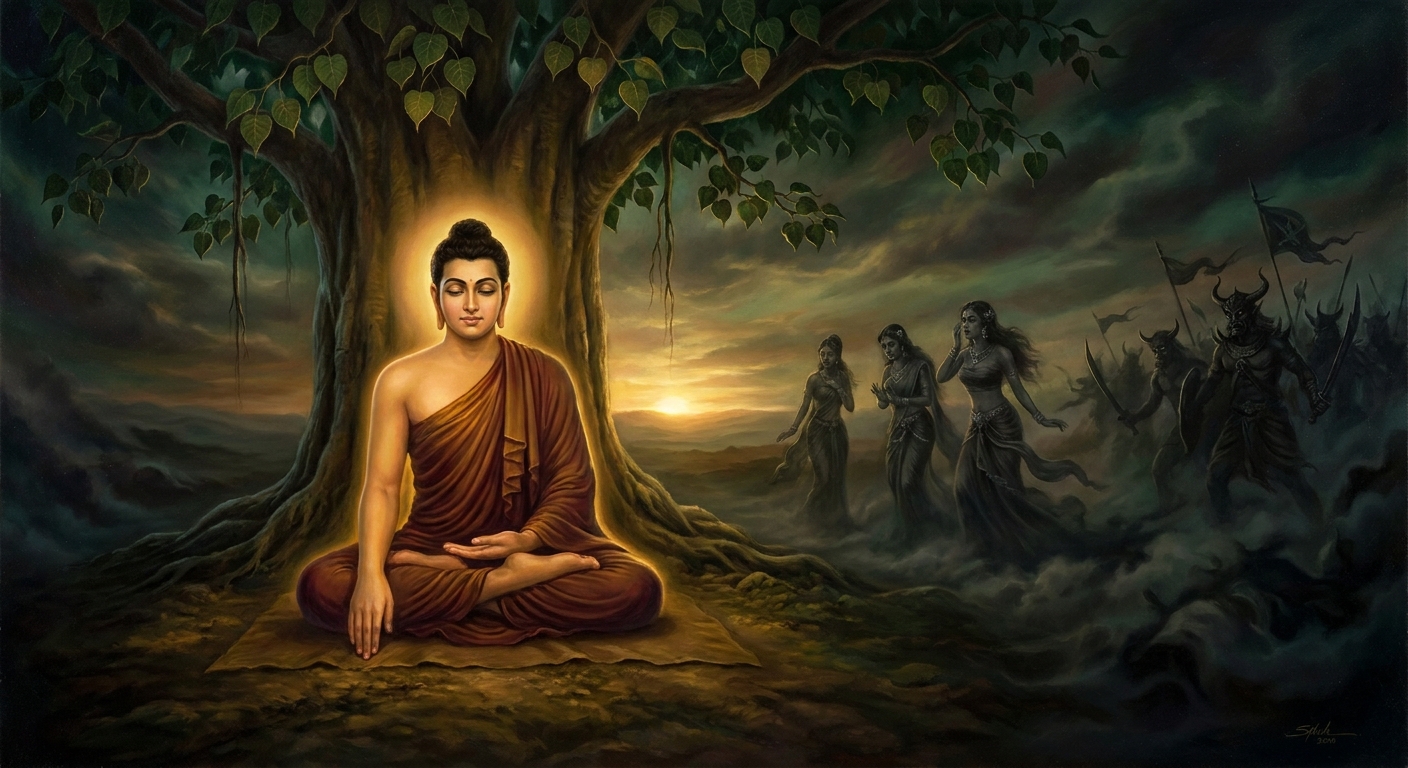
And then, six years from this night, he will sit under a tree in Bodh Gaya and refuse to move until the question is answered. By dawn it will be.
But that is a different story. This story ends here, in the grey before sunrise at the edge of a forest, with a prince who is no longer a prince walking into the dark under the trees. The hair is already on the ground. The horse is already gone. The gate is already behind him. There is nothing left to lay down.
This is the moment every monk since has been trying to repeat: not the enlightenment, which is rare, but the departure, which is a choice — the turning away from the arranged life toward the uncontrolled one. Francis in the square. Muhammad in the cave. The charioteer weeping on the road back to the palace he left.
You cannot unknow what Siddhartha saw outside those walls. That is why his father built them.
The date ~534 BCE follows the traditional chronology placing Siddhartha’s birth at 563 BCE. Some scholars date the birth to c. 480 BCE, which would shift the departure accordingly — the event is not in dispute, only its position in calendar time.
Kanthaka, the tradition says, died of grief on the road back to Kapilavastu. Channa eventually became a monk. Yashodhara eventually became a nun. Rahula was ordained at age seven — the youngest monk in the Sangha. The family Siddhartha left that night did not stay behind. They followed.
Scenes
The Four Sights: an old man, a sick man, a corpse, a wandering ascetic — four encounters outside the palace walls that collapse the world Siddhartha had been given to live in
 Generating art…
 The Great Departure: Siddhartha rides Kanthaka through the palace gate in the small hours, Channa at his side, the sleeping city unaware that its prince is leaving for good
Generating art… The sword draws clean through the topknot — the last act of the prince, the first act of the renunciant
 Generating art…
 Echoes Across Traditions
Entities
- Siddhartha
- Yashodhara
- Rahula
- Channa
- Kanthaka
Sources
- Aśvaghoṣa, *Buddhacarita* (Life of the Buddha), c. 1st–2nd century CE
- *Lalitavistara Sutra*, c. 3rd century CE
- *Mahavastu*, c. 2nd century CE
- Bhikkhu Sujato, *History of Mindfulness* (2012)
- Karen Armstrong, *Buddha* (Penguin, 2001)