Daniel in the Lions' Pit
~539 BCE · the early Persian period · Babylon, under Persian rule
Contents
King Darius is tricked into signing a decree against prayer. Daniel prays anyway. The lions' den seals overnight. At dawn, he walks out unharmed. The accusers do not.
- When
- ~539 BCE · the early Persian period
- Where
- Babylon, under Persian rule
The decree takes one day to write and thirty days to kill.
Darius the Mede has just inherited Babylon — all its rivers, all its gods, all its complicated machinery of court politics — and the satraps and ministers who served Nebuchadnezzar before him see the new king clearly: powerful, generous, and easy to flatter. They study Daniel the way predators study a fence. He is Darius’s favorite. He is a Jew. He prays three times a day toward Jerusalem, and he will not stop for anything. The trap almost writes itself.
They approach the king the way courtiers have always approached kings: in a mass, deferential, unanimous. All the ministers have agreed, they say. All the satraps have consulted. No one dissents. (Daniel was not consulted. He is not mentioned.) The proposal is a formality, really, a mark of the king’s glory: for thirty days, let no petition go to any god or man except King Darius himself. Violators into the lions.
Darius signs it.
The Medes and Persians have a rule: the king’s decree, once signed, cannot be revoked. Not by the king. Not by anyone. This is the mechanism the satraps are banking on. It is not really a law about prayer. It is a law about the king’s inability to save his favorite minister once they have Daniel in their teeth.
Daniel goes home.
The windows of his upper chamber face Jerusalem. He has prayed this way since before the exile, since before Babylon, since he was young enough that the direction still meant a physical place he might return to rather than a compass point that meant toward the thing I will not give up. He opens the windows. He kneels. He gives thanks. He asks for what he needs. He does this three times a day, the way you do a thing that is not optional.
The satraps are watching from the street.
There is no drama in the arrest. He does not run. He does not argue. He does not offer a legal interpretation of the decree or question its validity. He simply finishes praying and lets them take him.
They bring him before Darius, who understands immediately that he has been used. The text says he labors until sundown trying to find a legal exit. There is none. The law of the Medes and Persians does not bend. He has signed it. His own hand. His own seal.
He says to Daniel, before the pit: Your God, whom you serve faithfully — may he save you.
It is not a prayer exactly. It is something more desperate than a prayer. It is a king admitting that there is a power in the room that does not answer to him.
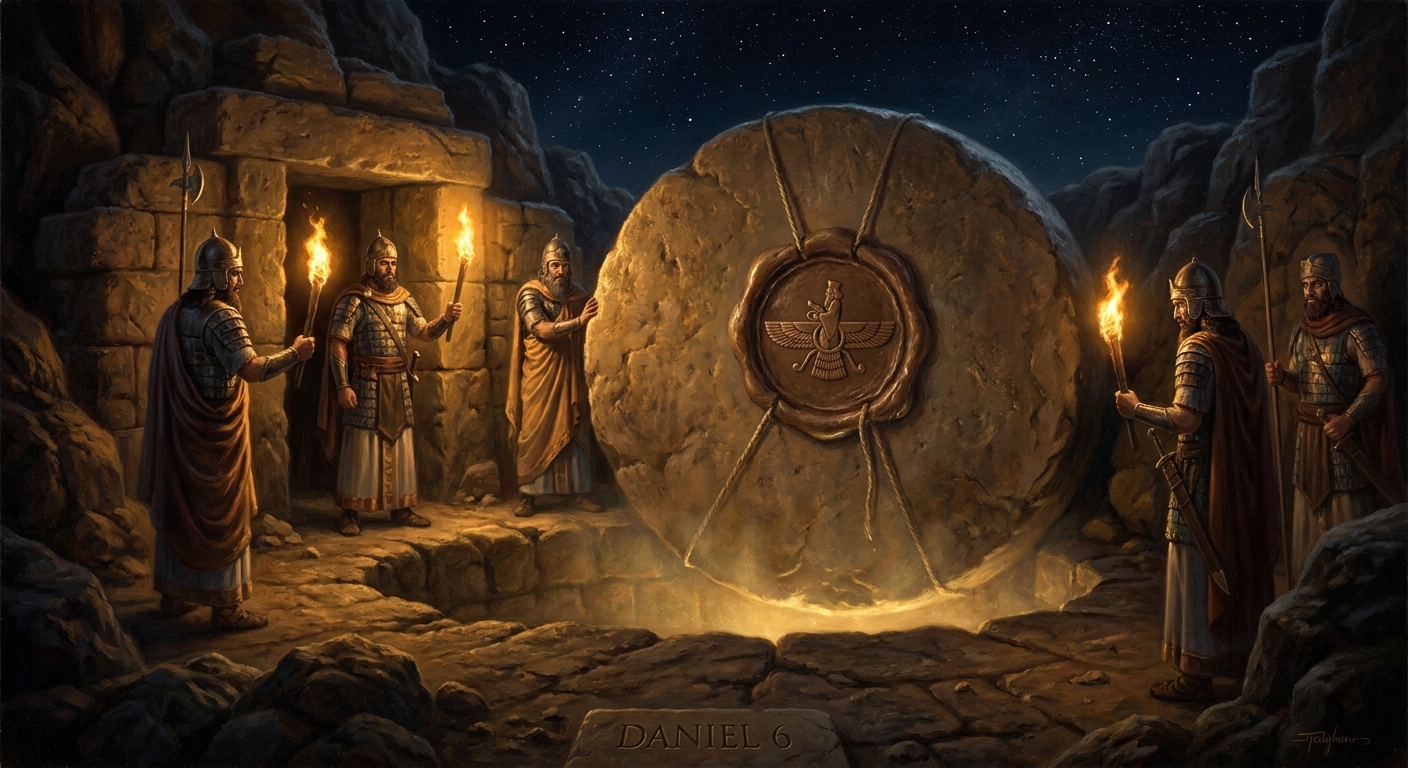
They lower Daniel into the pit. They roll the stone across the mouth. Darius seals it with his own signet ring and with the rings of his ministers, so that nothing can be changed — not by the king’s mercy, not by anyone’s. The sealing is the law making itself impossible to circumvent. It is also the law trapping everyone who sealed it inside its own logic.
The lions are not described. They do not need to be. A lions’ pit in the Persian court is not metaphor. It is a working execution chamber. The Persians have maintained it for generations.
The king goes back to his palace. He does not eat. He sends away the musicians. He does not sleep.
The night in the palace and the night in the pit run parallel but tell nothing of each other. The text is silent about what Daniel does inside. It is silent about the lions. It records only the king, pacing, unable to eat, unable to sleep, waiting for a dawn that will either end his grief or confirm it.
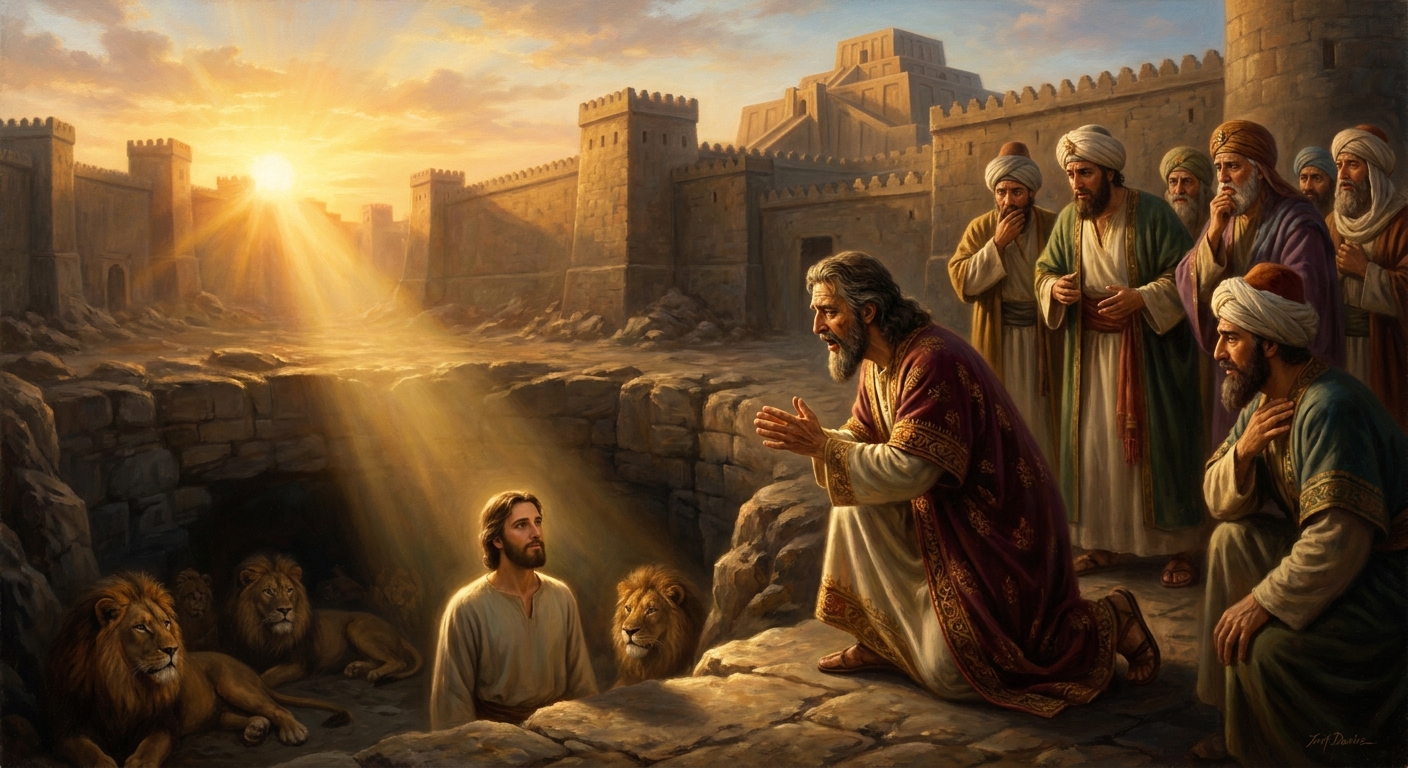
At first light, Darius runs.
This is not a detail most paintings choose. The king of Persia, master of the largest empire then existing on earth, runs to the pit of lions at dawn and shouts down into it with a voice the text calls anguished: Daniel, servant of the living God — has your God, whom you serve faithfully, been able to save you from the lions?
The grammar of the question is everything. Has he been able. Not has he chosen to or did he bother to. The king is asking whether the God of a conquered people has the capacity. He is asking it into a sealed pit. He is not optimistic.
From below: O king, live forever. My God sent his angel and shut the mouths of the lions. They have not harmed me, for I was found innocent before him, and before you, O king, I have done no wrong.
Daniel comes up from the pit unharmed. The text specifies: no injury was found on him, for he had trusted in his God.
Then the text does something the illuminated manuscripts tend to leave out.
Darius orders the men who accused Daniel brought forward. Their wives. Their children. All of them. Into the pit.
They have not yet reached the floor before the lions are on them. The text is precise about this. It is not describing lions who were starved or specially provoked. It is describing a demonstration. The same lions who did not touch Daniel consume the accusers before they reach the bottom. This is the text making sure the reader understands that what happened to Daniel was not the behavior of drowsy or well-fed lions. It was something else. The lions were there. The lions were working. They simply did not work on Daniel.
The families are not accused of anything. The Persian custom of collective punishment is neither defended nor criticized. The text simply records it, the way it records everything: directly, without commentary, trusting the reader to feel the weight.
Darius issues a new decree. He cannot unsign the old one, but he can write another. He writes to every people in every language in every corner of his empire: In all my royal dominion, let all tremble and fear before the God of Daniel. For he is the living God, enduring forever. His kingdom shall never be destroyed. He delivers and rescues. He works signs and wonders in heaven and on earth.
He has become, in the span of one sleepless night and one morning, a man who believes in the God of the exiles. The lions’ pit has converted the king of Persia in a way that thirty years of Daniel’s service in the court could only prepare for.
The story is set in 539 BCE, in Babylon, at the hinge of empires. It was almost certainly written — or given its final form — four hundred years later, during the Maccabean crisis, when Antiochus IV Epiphanes was doing to the Jews of Palestine exactly what Darius’s decree threatened to do to Daniel: mandating apostasy under penalty of death. The men and women reading Daniel 6 in 167 BCE were not reading history. They were reading instructions.
Pray with the windows open.
Let them see you.
Trust that the lion’s mouth can be shut by the same power that made it.
The pit recurs. Joseph is thrown into a pit by his brothers before he rises to save Egypt. Christ descends into the earth for three days before the resurrection. The stone at the pit’s mouth and the stone at the tomb’s mouth are, in the church’s oldest reading, the same theological object: the seal that the empire believes is final, which turns out not to be.
Daniel does not explain how the lions were silenced. He reports what happened and who did it. That is the entire argument: not a theology of miracles, but a testimony that the one who trusts in the living God is not abandoned — not even at the bottom of the pit, not even in the dark, not even with the stone rolled over the mouth and sealed with every ring the empire owns.
Scenes
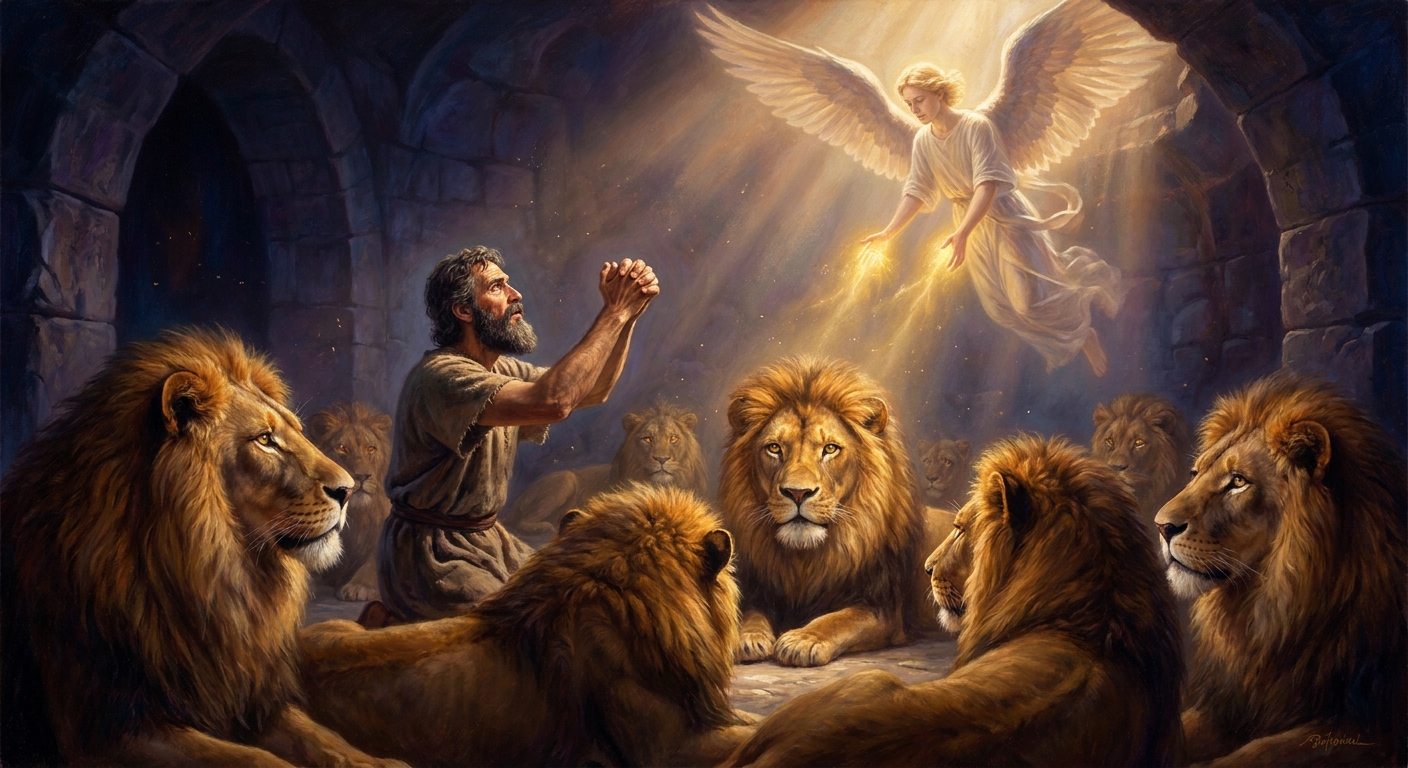
Daniel kneels in prayer as the lions stand calm around him
Generating art… The stone rolled across the entrance, sealed with the king's signet
 Generating art…
 Dawn at the pit
 Generating art…
 Echoes Across Traditions
Entities
- Daniel
- Darius the Mede
- the Lions
Sources
- Daniel 6 (Robert Alter trans., *The Hebrew Bible: The Writings*, 2019)
- Josephus, *Antiquities of the Jews* 10.10
- John J. Collins, *Daniel: A Commentary on the Book of Daniel* (Hermeneia, 1993)