The Man Who Had Everything and Gave It Up in an Afternoon
c. 6th century BCE — contemporary with Mahavira's teaching ministry (c. 557–527 BCE) · Rajagriha (modern Rajgir, Bihar)
Contents
Shalibhadra is so wealthy he has thirty-two wives and never leaves his palace because his mother brings him a different portion of the world to enjoy each day and he has not yet run out of portions. One afternoon his mother goes to hear Mahavira teach. She comes back changed. She tells Shalibhadra what she heard. He asks to see Mahavira himself. The meeting is brief. That afternoon he becomes a monk.
- When
- c. 6th century BCE — contemporary with Mahavira's teaching ministry (c. 557–527 BCE)
- Where
- Rajagriha (modern Rajgir, Bihar)
The morning portion of the world is musicians.
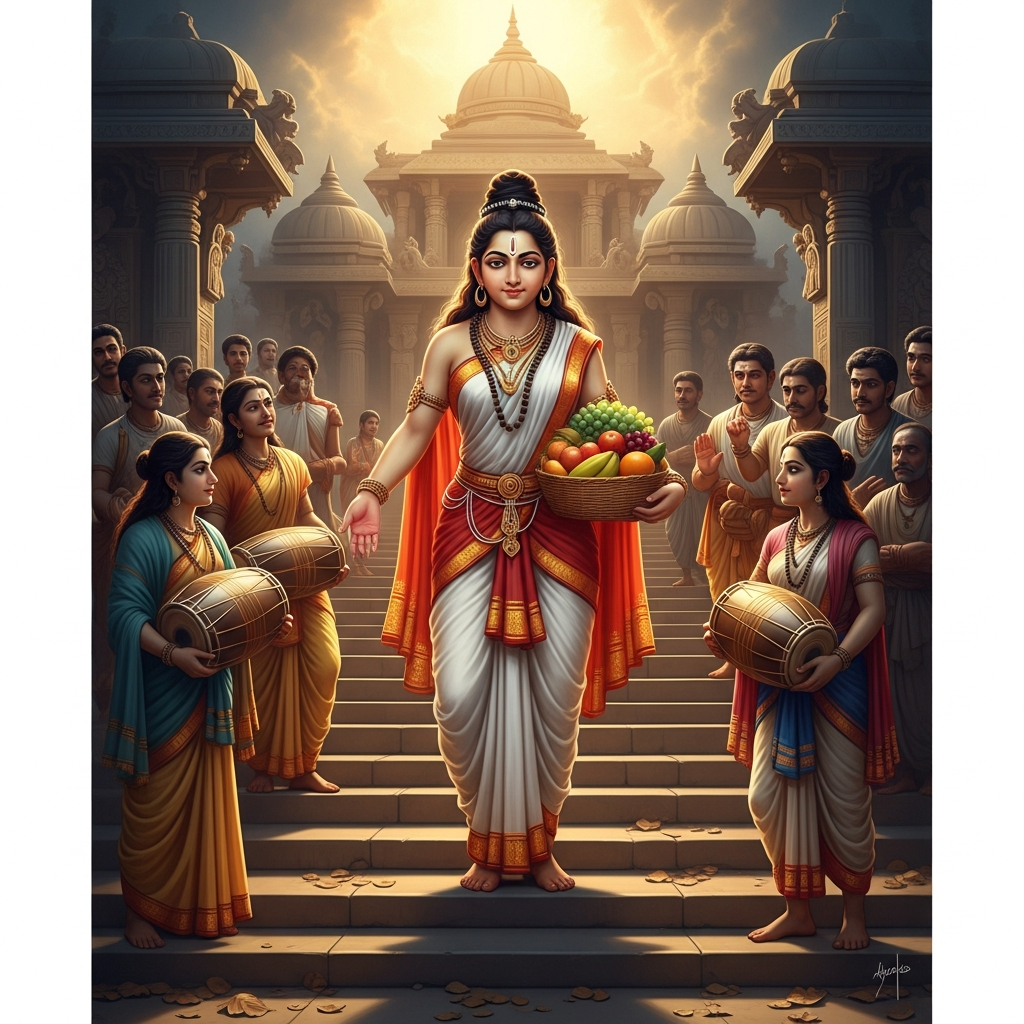
Bhadra has found them in the market district of Rajagriha, where they arrived yesterday from the southern coast — seven players, three instruments none of them plays in exactly the same tuning, and a vocalist who begins her phrase before the word arrives and ends after the word has left. She has negotiated their day rate. She is carrying the basket of their fee. She climbs the steps of the palace the way she climbs them every morning, with something specific selected from the catalog of available experience, to be presented to her son who has not left the palace in longer than she wants to calculate.
Shalibhadra is still in bed. This is normal. The thirty-two apartments of the palace are arranged so that he circulates among his thirty-two wives on a rotation that Bhadra manages with the precision of a chamberlain — today is one apartment, tomorrow another — and this morning the apartment is the one with the eastern window and the particular quality of morning light that he has always found useful for listening to music. He is awake when she arrives. He is not restless. He is never restless.
The musicians play for three hours. He eats the fruits she has brought from the mountain valleys — there is a particular valley, a week’s journey north, that produces a yellow fruit that does not exist anywhere else, and she has a contact in the market who sources it — while the vocalist resolves her phrase before the word and after it. He is content. He is genuinely content. This is the point the tradition is making and it must be taken seriously: he is not a glutton in denial, not a man performing happiness over boredom. He has thirty-two wives and the love of each is real and the fruit from the valley is genuinely extraordinary and the music is good and he has never run out of portions.
He simply has never run out of portions.
In the afternoon, Bhadra goes out.
Mahavira is teaching in the forest at the edge of the city. The public discourses of a Tirthankara draw everyone — merchants, farmers, nobles, monks from other traditions who have come to argue or to listen, women who sit in their own section of the assembly. Bhadra goes the way she has gone to public discourses before: as a woman of means, accustomed to the good seats, with the reasonable expectation that she will hear something interesting and return with an improved supply of something for the morning basket.
She sits in the assembly and Mahavira teaches.
She is there for the duration of the discourse, which runs from afternoon to early evening. What he says is not secret — the five great vows, the nature of the soul, the mechanics of karma, the path of liberation, the same teaching he has been giving for years in every city on the Gangetic plain. What happens to her while he says it is harder to describe. The texts report it obliquely: she is changed. She climbs back down from the teaching with her hands empty — she has brought nothing from the morning basket today, because the portion of the world she has returned with is not a thing she can carry.
She climbs the steps.
Shalibhadra sees her face.
He has never seen her face like this.
Not sad. Not ecstatic. Something more structural — the expression of a person who has had a dimension added, or more precisely, a dimension revealed that was already there. She does not weep. She sits down across from him and tells him what Mahavira taught.
She tells him carefully. She tells him about the soul and the karma-particles and the five great vows and the path of liberation and the thirty-three thousand ganadharas and disciples who have already taken the vows and the logic of aparigraha — non-possession, the vow that says you hold nothing, own nothing, claim nothing, because everything you claim clings to your soul as karma and adds to the weight you are carrying between births.
He listens.
He is a man who has spent his adult life surrounded by the maximum possible quantity of things to possess, and he has found that the maximum possible quantity of things to possess produces, after a sufficiently long period of time, a strange and clean kind of transparency. He has had the musicians and the fruit and the thirty-two apartments and the yellow fruit from the northern valley and all of it was real and good and he does not regret it and it has left a remainder. Not an absence — he would not call it lack. A remainder. A something that is not addressed by adding more portions.
He hears his mother describe what Mahavira said and he recognizes the remainder.
He asks to see Mahavira.
The meeting is brief.
The tradition does not record what was said. This is characteristic: the most significant encounters in the Jain hagiographies are often brief or wordless, because the transmission being described is not propositional. Mahavira has taught the doctrine. The doctrine has been delivered, at one remove, by Bhadra. Shalibhadra arrives not to receive information but to confirm an understanding that has already formed.
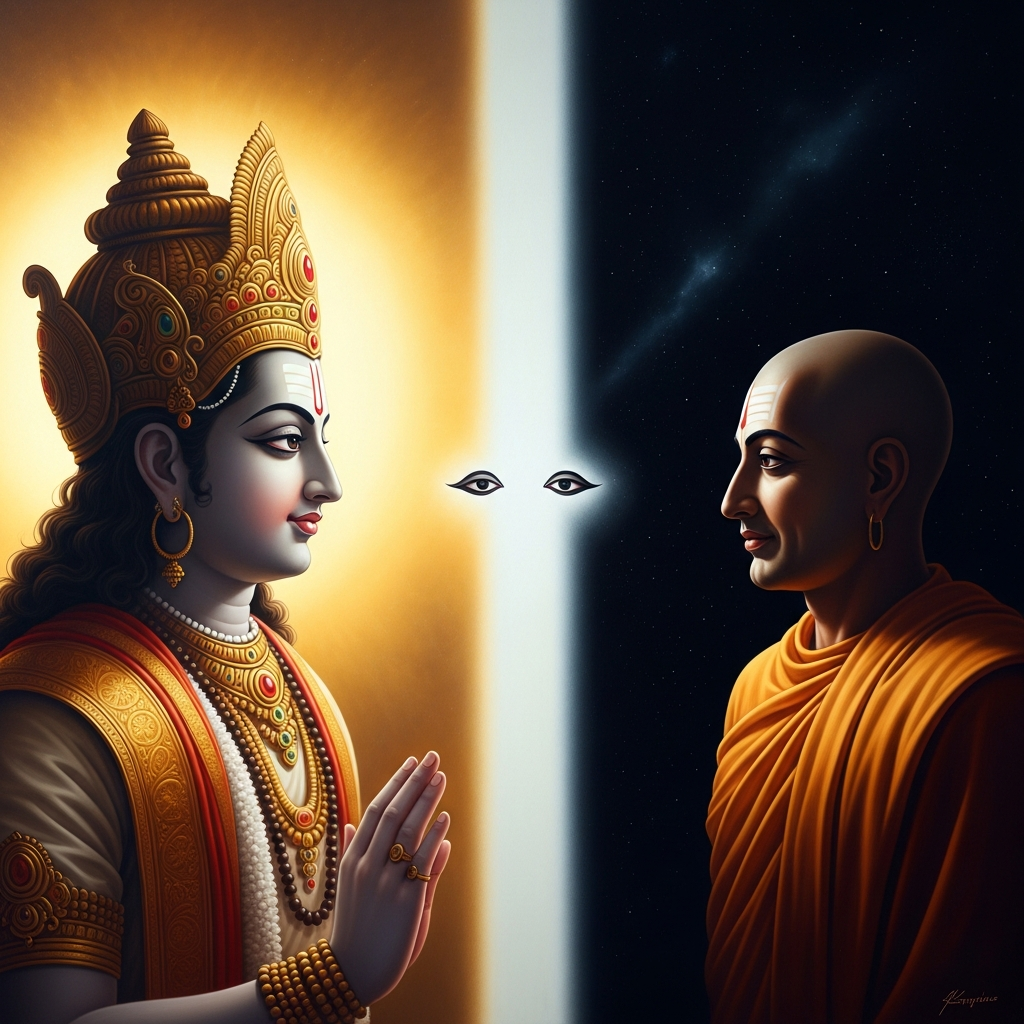
He stands in front of the man who has chosen the absolute minimum of sensory life. He himself represents the absolute maximum. He looks at Mahavira.
Mahavira looks at him.
What Shalibhadra sees, the texts suggest, is not deprivation. The monk who sleeps without shelter and eats once a day and owns nothing and has burned thirty years of karma away through austerity is not, in his face or his posture or his presence, a man who is lacking. He is instead a man who is entirely present — present in the way that only the person who has released every claim on everything can be present, because nothing is pulling him backward into what he has and nothing is pulling him forward into what he wants and so he is, simply and completely, here.
Shalibhadra returns to the palace.
He walks through the thirty-two apartments. He does not stop in each one — this is not a farewell tour. He is not sentimental, which is one of the surprising things about him: there is no reported weeping, no long final conversation, no elaborate distribution of the wealth to specified recipients. He releases it the way he received the teaching: completely, and without drama.
His thirty-two wives. He visits them in the time remaining before evening and he tells them what has happened. The accounts differ on what they say. Some traditions say they understand. Some say they are devastated. One tradition says some of them eventually become nuns themselves, which would make Shalibhadra’s household one of the more remarkable sites of collective renunciation in the Jain canon.
He takes the vows that afternoon. Five great vows, delivered in the presence of Mahavira, received into a monk’s life with the simplicity of a man who has had everything and is now prepared to have nothing because he has understood, through the having of everything, what nothing addresses.
His friend Dhanya renounces with him. In the tradition, the two become a pair — the wealthy merchant and his companion who walk together into the practice. Dhanya has less to give up. The tradition notes this without comment but the contrast is its own teaching: Dhanya’s renunciation is perhaps the more conventional kind, the giving up of a comfortable life. Shalibhadra’s is something stranger.
They practice together. They achieve liberation together, according to some accounts, or separately, according to others, and the disagreement between accounts is itself interesting: the tradition cannot decide whether the man who had everything and gave it up in an afternoon is a story about an individual or about a pair, and perhaps the answer is that it is about both, and that the tradition’s uncertainty is the tradition being honest.
Bhadra continues living. She continues climbing stairs. She does not take the vows of a nun immediately — her story has more time in it, more chapters, and the texts give her a long life and eventually a liberated death. She is the pivot on which the story turns: the woman who went out to hear a teaching and came back changed and told her son what she had heard.
She did not know, climbing those stairs that evening, that she was ending the rotation of the thirty-two apartments. She was carrying the remainder. She handed it to him. He knew what it was.
The palace in Rajagriha is gone — the city itself is archaeological now, mounds and excavation trenches in the state of Bihar where the Gangetic plain has swallowed three millennia of buildings. The yellow fruit from the northern valley does not have a verified location. The musicians from the southern coast may have gone home or may have found another patron. What remains is the story: the man who had everything could renounce it instantly, and those who have less can barely give up anything, and the tradition that records this paradox does not explain it, which is itself a kind of precision — the same precision as saying that all claims are made from a standpoint, and this one is made from the standpoint of the released.
Scenes
The palace of Shalibhadra in Rajagriha
 Generating art…
 Bhadra returns from the public discourse with Mahavira
 Generating art…
 The meeting between Shalibhadra and Mahavira
 Generating art…
 Echoes Across Traditions
Entities
- Shalibhadra
- Mahavira
- Bhadra
- Dhanya

Sources
- *Trishashti Shalaka Purusha Caritra* (Hemacandra, 12th century CE) — the Shalibhadra narrative
- *Uvasagadasao* (Uvashagadasha) — early Agamic text on lay disciples of Mahavira
- Paul Dundas, *The Jains* (Routledge, 2nd ed. 2002)
- John E. Cort, *Jains in the World* (Oxford University Press, 2001)
- Padmanabh S. Jaini, *The Jaina Path of Purification* (University of California Press, 1979)