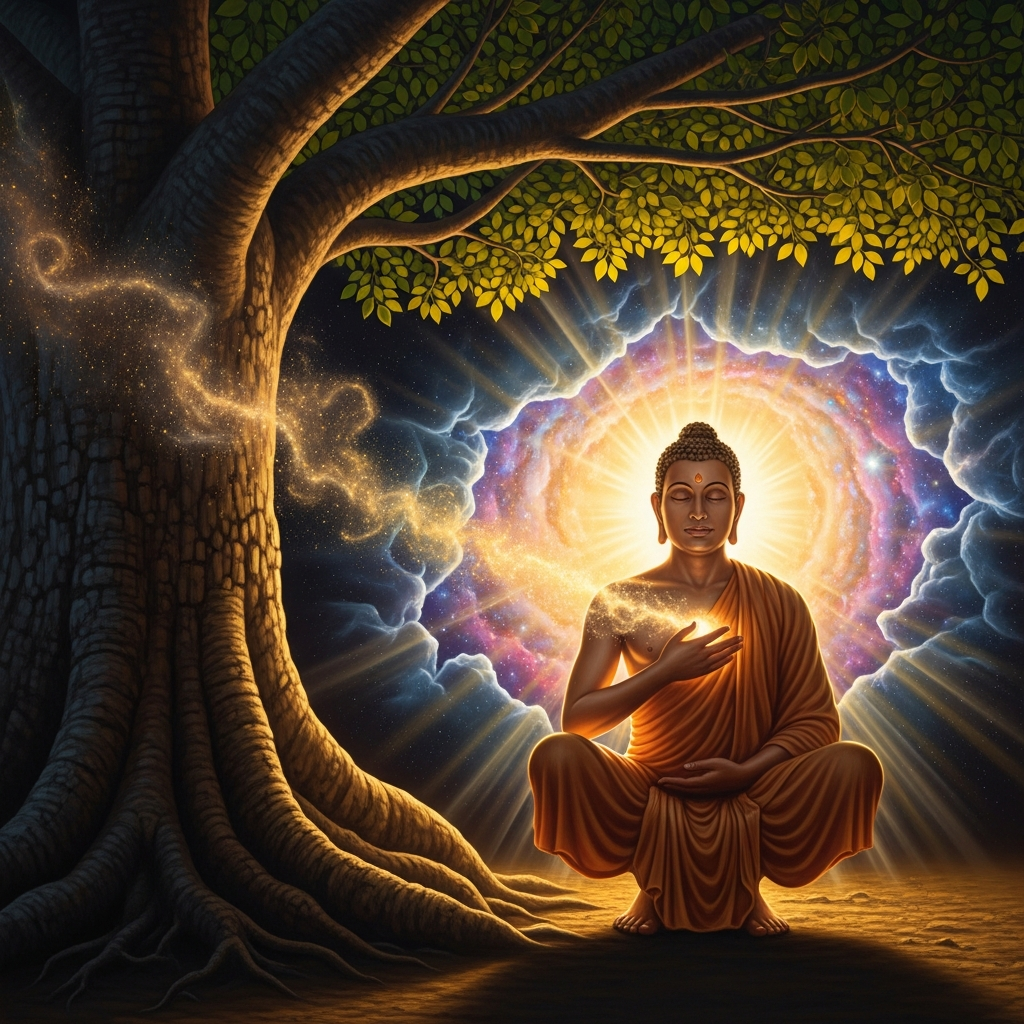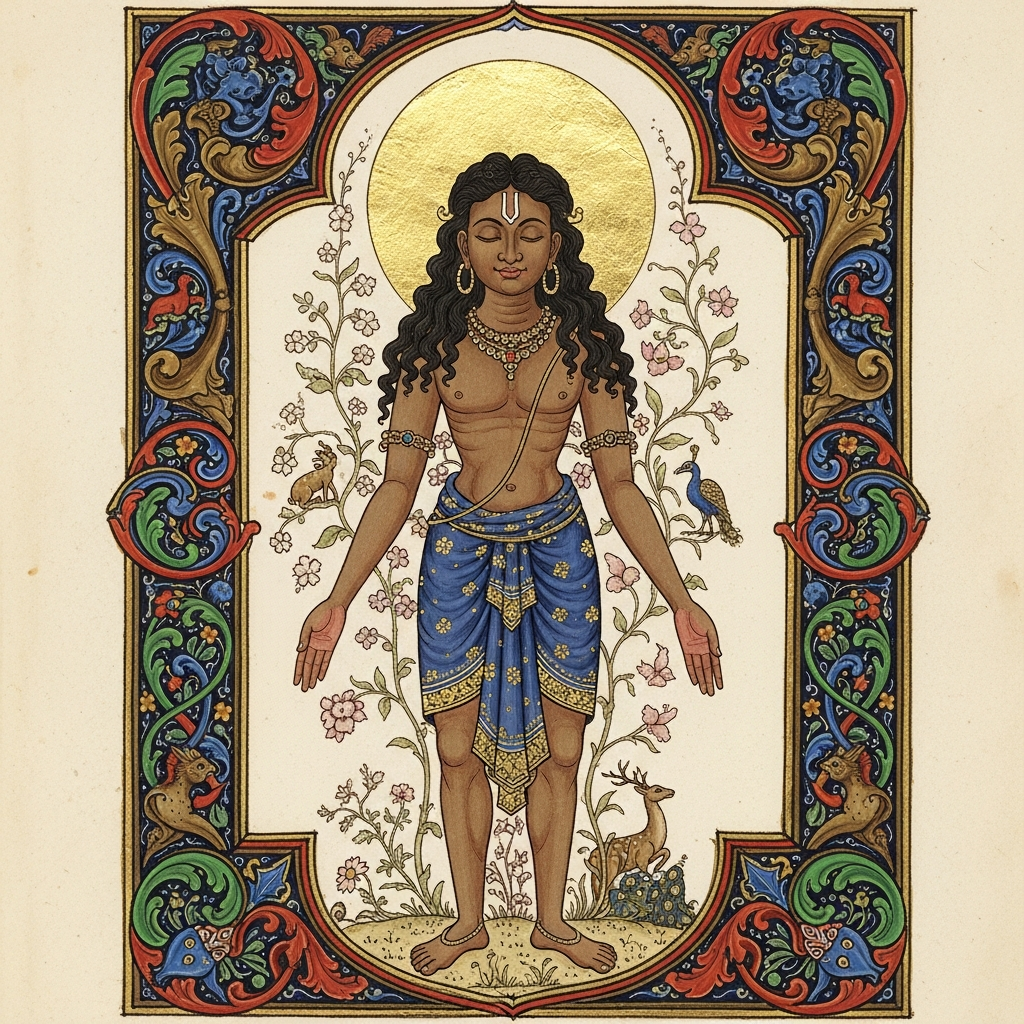
The Meditator Stopped by His Own Victory
The generation after Rsabhanatha, the first Tirthankara — traditional epoch · A forest at the boundary of Bharata's kingdom; later the liberation site at Kailasha
Contents
Bahubali defeats his brother Bharata in single combat for the kingship of the world, then renounces the victory before he can pick it up. He stands in the forest for a year in total motionless meditation while vines climb his legs and birds nest in his hair. After a year, his sisters arrive and tell him the one thing that breaks the impasse: *You are standing on your pride.*
- When
- The generation after Rsabhanatha, the first Tirthankara — traditional epoch
- Where
- A forest at the boundary of Bharata's kingdom; later the liberation site at Kailasha
The combat is agreed upon by both sides as the civilized alternative to war.
Bharata, the eldest son of Rsabhanatha, the first Tirthankara, has inherited the earth — the whole of it, or rather the vast empire of the early cosmic age — and his younger brother Bahubali holds a single kingdom at its edge. Bharata sends his chakra — the divine spinning disc that is the symbol of universal dominion — to Bahubali’s city as a demand for submission. The disc returns to Bharata’s hand. Bahubali refuses.
Rather than send armies, they agree: they will compete in three contests. An eye-fight, staring until one looks away. A water-fight, throwing water at each other with cupped hands. A wrestling match. In all three contests, Bahubali wins.
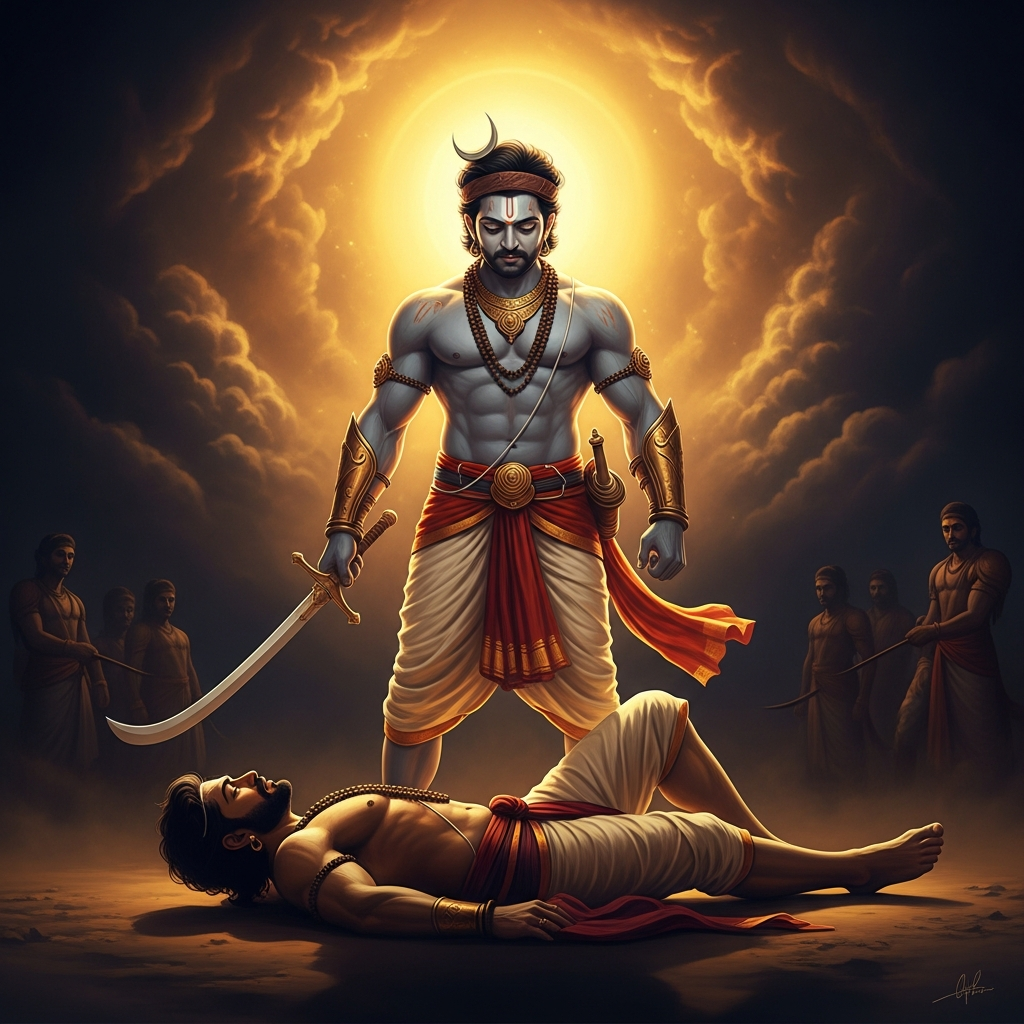
He stands above his brother, who has conceded, and the kingdoms of the world are a step away from his extended hand.
He looks at them.
He looks at Bharata.
He looks at the crowd assembled to witness the resolution of a dynastic dispute that could have killed thousands and instead has been settled with a staring contest and a wrestling match, and he becomes aware, in a manner he cannot immediately name, that he is about to pick up something he does not want.
He renounces. On the spot. He reaches up and tears out his own hair — the five-fisted plucking that his father taught by example — and walks away from Bharata and the kingdoms and the assembled crowd and into the forest at the edge of the contested territory.
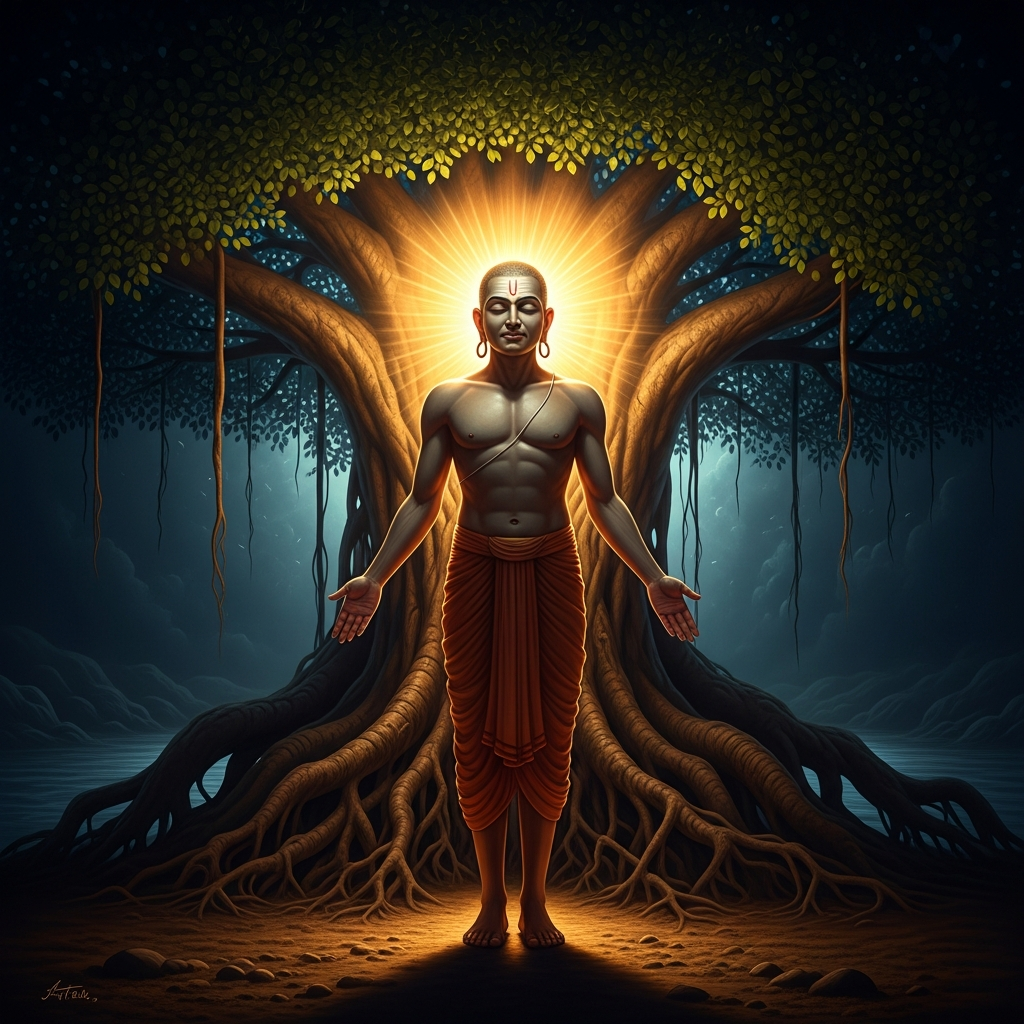
He walks until he finds a tree. He stands in kayotsarga — body-abandonment, arms hanging free — and he does not move again.
The first weeks are straightforward in the way that beginning is always straightforward: he has chosen this, his will is fully engaged, the physical discomfort is registering but not yet dominant. The Jain practice of kayotsarga is precise in its requirements — no intentional movement, the body offered to gravity, awareness maintained without the ordinary fidgeting that keeps a person comfortable in their skin. It is harder than it sounds and he knew it would be harder than it sounds and he does it anyway because he has just watched his father do it for twelve years and emerge omniscient, and because the alternative — picking up the kingdoms — is not acceptable.
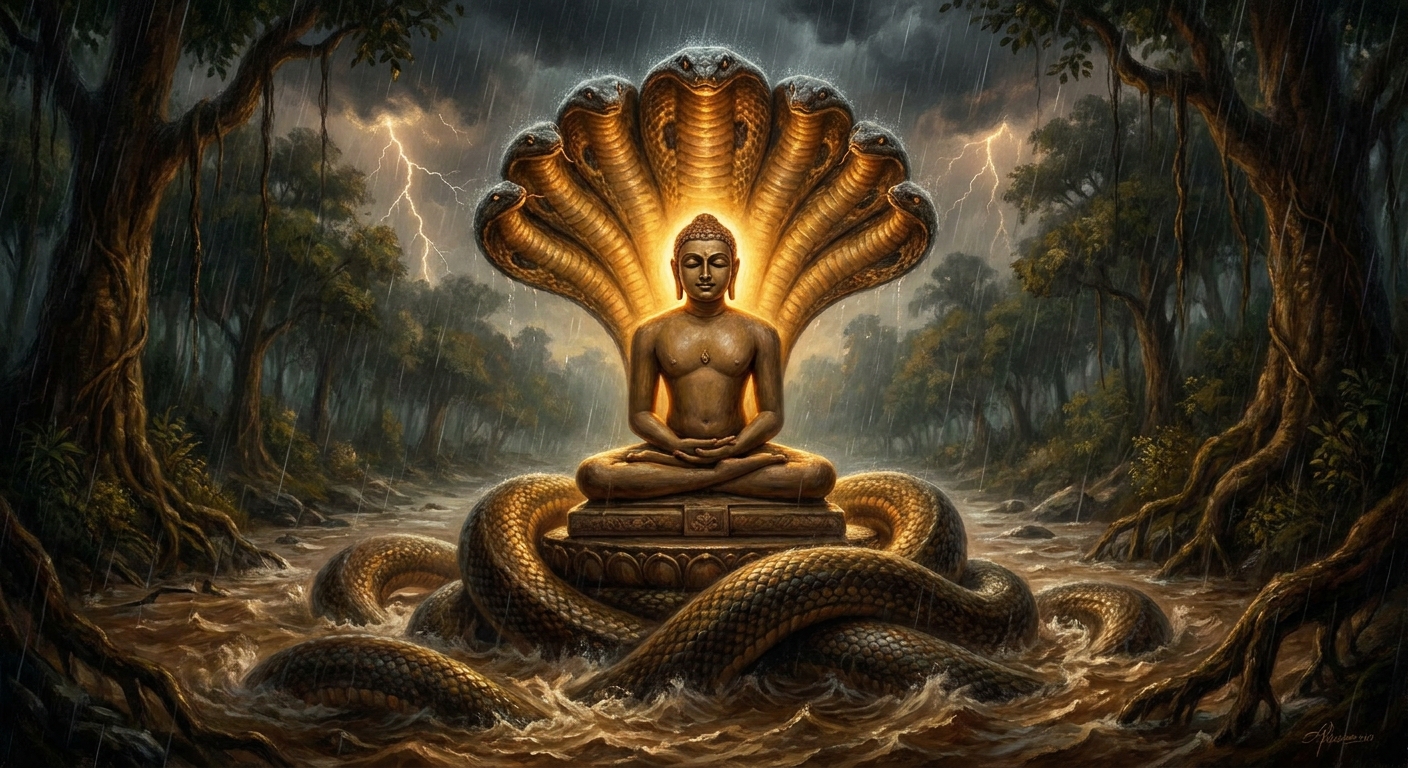
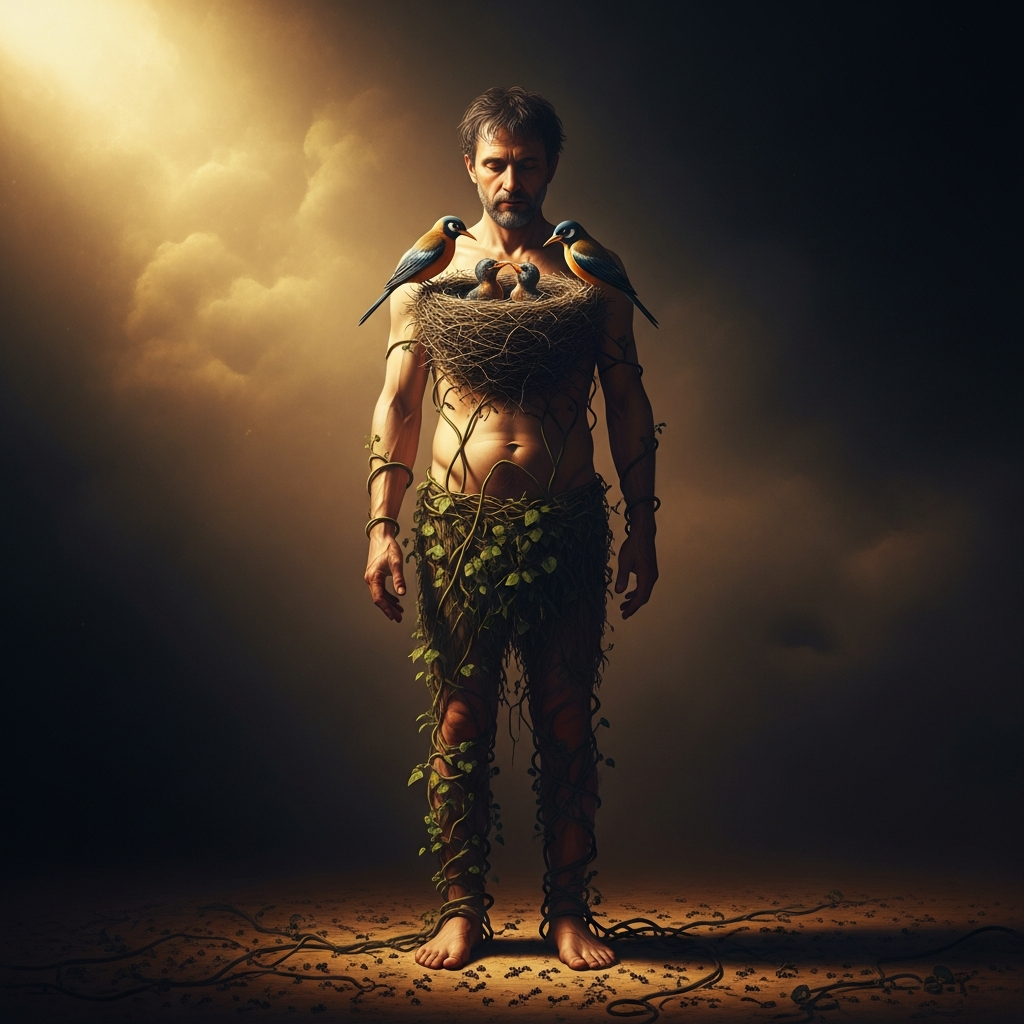
The rain comes. He stands in it. The sun comes. He stands in it. The cold comes. He stands in it. Ants find his feet and build their paths across them, incorporating his toes into their routes with the practical indifference of creatures who do not distinguish between a root and a meditator. Vines find his legs and climb them, because a motionless thing in a forest is a surface and the vines have no theology. Birds find his matted hair — it has been months now, the hair uncut since his father’s example taught him to pluck it but not maintain it — and build a nest in the density above his ear.
He is aware of all of this the way a mountain is aware of weather: registering, not bothered, not engaged, not resisting.
But he is not achieving kevala-jnana. This is the problem.
The omniscience does not come.
It should come. He has done everything correctly. He has renounced the kingdoms, he has renounced the competition, he has renounced the victory that was his by right of combat, he has stood in the forest for a year while the forest grew through him and on him and around him, and the omniscience has not come.
In the Jain understanding of karma, this means something specific. The soul achieves liberation when the last karma-particle burns away. A year of this practice should have burned considerably. And yet.
And yet he is still standing. The omniscience is not there. Something is still clinging.
He cannot see it from inside his own practice, which is the nature of the last attachment: the things you can see, you can address. The thing you cannot see is the one that holds.
He stands for a full year. The vines have reached his waist.
His sisters arrive.
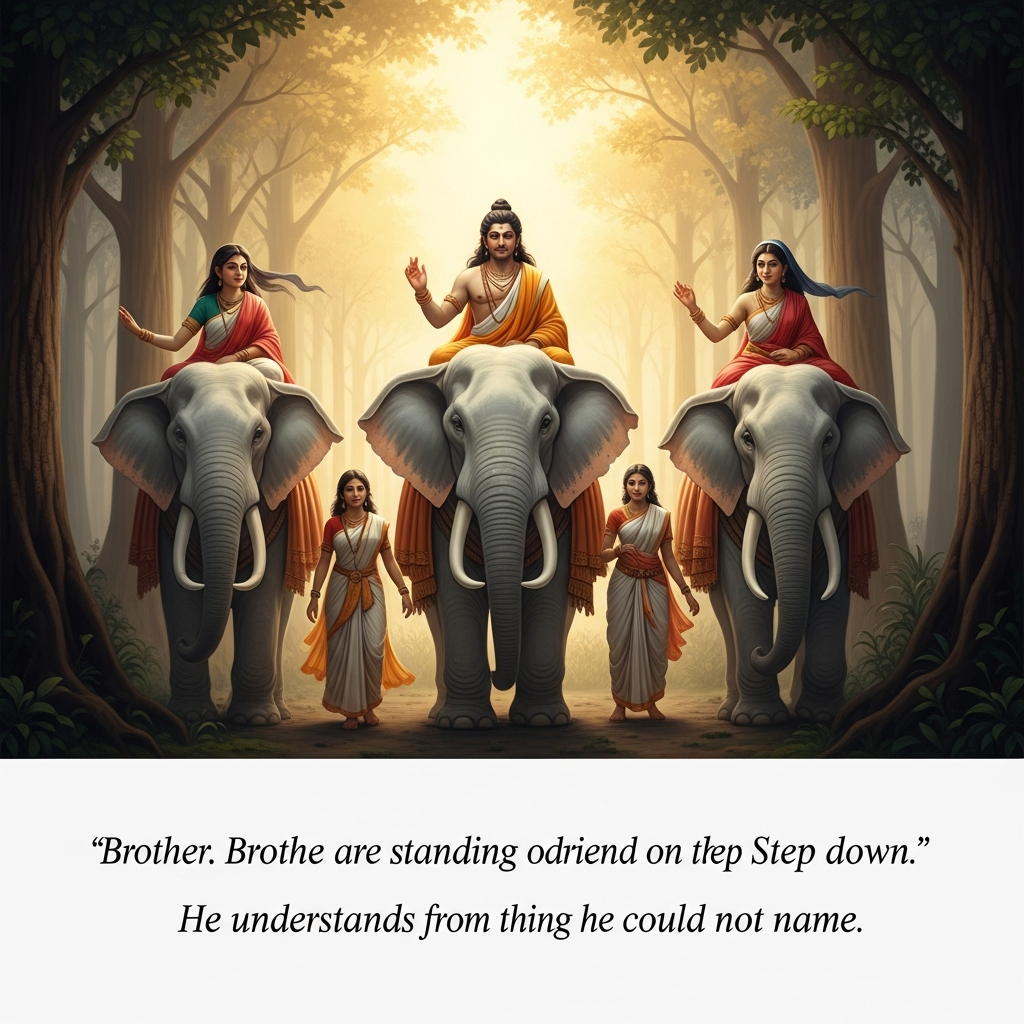
Brahmi and Sundari — both of them ordained as Jain nuns, both of them traveling on white elephants because they are the daughters of the first Tirthankara and ceremony accompanies them even in the forest. They stop at the edge of the grove and look at their brother, who is standing with vines to his waist and birds in his hair and the whole of the forest’s year’s growth using his stillness as a scaffold.
They understand immediately what he cannot see.
Brahmi calls to him. Brother. You are standing on an elephant.
It is an instruction. The idiom, in Jain discourse, means: you are elevated on something — specifically, on the pride of having won, of having demonstrated that you could take everything and chose not to. You renounced the kingdoms. You did not renounce the fact of the renunciation. You are standing, even now, on the back of your own magnificent gesture.
Step down from the elephant.
He hears this. The hearing takes a moment because it is being heard from inside a year of meditation and the year of meditation has created a stillness that processes information more slowly than ordinary time. It enters him. It moves through his understanding like water through limestone, finding the passage that was already there.
He has been standing on his pride. The pride is in the standing: the posture that says, I could have taken the kingdoms and I chose this instead. The karma-particle is not a dramatic thing. It is the size of a thought. It is the thought: look what I gave up.
He releases it. He steps off the elephant.
Kevala-jnana opens in him like a window. The omniscience is instantaneous, complete, total — every soul in the cosmos, every karma-particle on every soul, every past life and every future moment, simultaneously present, without mediation. He holds it the way light holds a room.
He teaches for a time and achieves liberation on the summit of Kailasha, in the same posture — arms hanging loose, body returned to gravity, the forest around him doing what forests do.
The texts give Bahubali’s body exact dimensions: five hundred and twenty-five dhanusha in height, which by some calculations is over half a mile, which is the tradition asserting that the scale of his renunciation was not ordinary-human-sized. The iconographic tradition takes this literally.
At Shravanabelagola in Karnataka, there is a monolithic statue carved from a single granite outcrop on the summit of Vindyagiri Hill. It is fifty-seven feet tall, which is the largest monolithic statue in the world. Bahubali stands in kayotsarga — arms at his sides, feet together, eyes fixed on a middle distance that is not any point in the visible world. Vines are carved climbing his legs. Snakes wind around his feet. Anthills rise at his ankles. He wears nothing but the meditation.
Every twelve years — the cycle is called Mahamastakabhisheka, the great head-anointing — the statue is covered from head to foot. Saffron. Sandalwood paste. Milk. Sugarcane juice. Gold coins. Flowers. The priests climb scaffolding erected around the granite body and pour the substances from above while hundreds of thousands of pilgrims crowd the hillside below.
The sugarcane juice is Shreyansa Kumar’s gesture, repeated: the first alms, given to the first wandering monk by a king who remembered something from a previous life. The statue receives it again, every twelve years, poured over the head of the man who had to be told by his sisters that he was standing on an elephant.
The nest in his hair has been empty for a long time. The birds left when the omniscience opened and the stillness became a different kind of stillness — the stillness that is not motionlessness but completion. The vines kept growing after he left. They are still growing. In the temple at Shravanabelagola they are carved in granite, permanent and patient, waiting for the next anointing the way they waited, in the first year, for the meditator to finish being stopped by his own victory.
Scenes
The moment after the victory
 Generating art…
 Months into the standing meditation
 Generating art…
 His sisters Brahmi and Sundari approach through the forest on white elephants, already ordained as nuns
 Generating art…
 Echoes Across Traditions
Entities
- Bahubali
- Bharata
- Rsabhanatha
- Brahmi
- Sundari

Sources
- *Adipurana* (Jinasena, c. 9th century CE), cantos 36-47 — the primary Bahubali narrative
- *Trishashti Shalaka Purusha Caritra* (Hemacandra, 12th century CE), vol. 1
- Paul Dundas, *The Jains* (Routledge, 2nd ed. 2002)
- Padmanabh S. Jaini, *The Jaina Path of Purification* (University of California Press, 1979)
- Settar Shadakshari, *Inviting Death: Historical Experiments on Sepulchral Hill* (Institute of Indian Art History, 1990) — on the Shravanabelagola monolith and the Mahamastakabhisheka