Parshvanatha and the Serpent King
c. 800 BCE (traditional dates 877-777 BCE) · a forest grove on the banks of the Ganges, somewhere in the kingdom of Varanasi
Contents
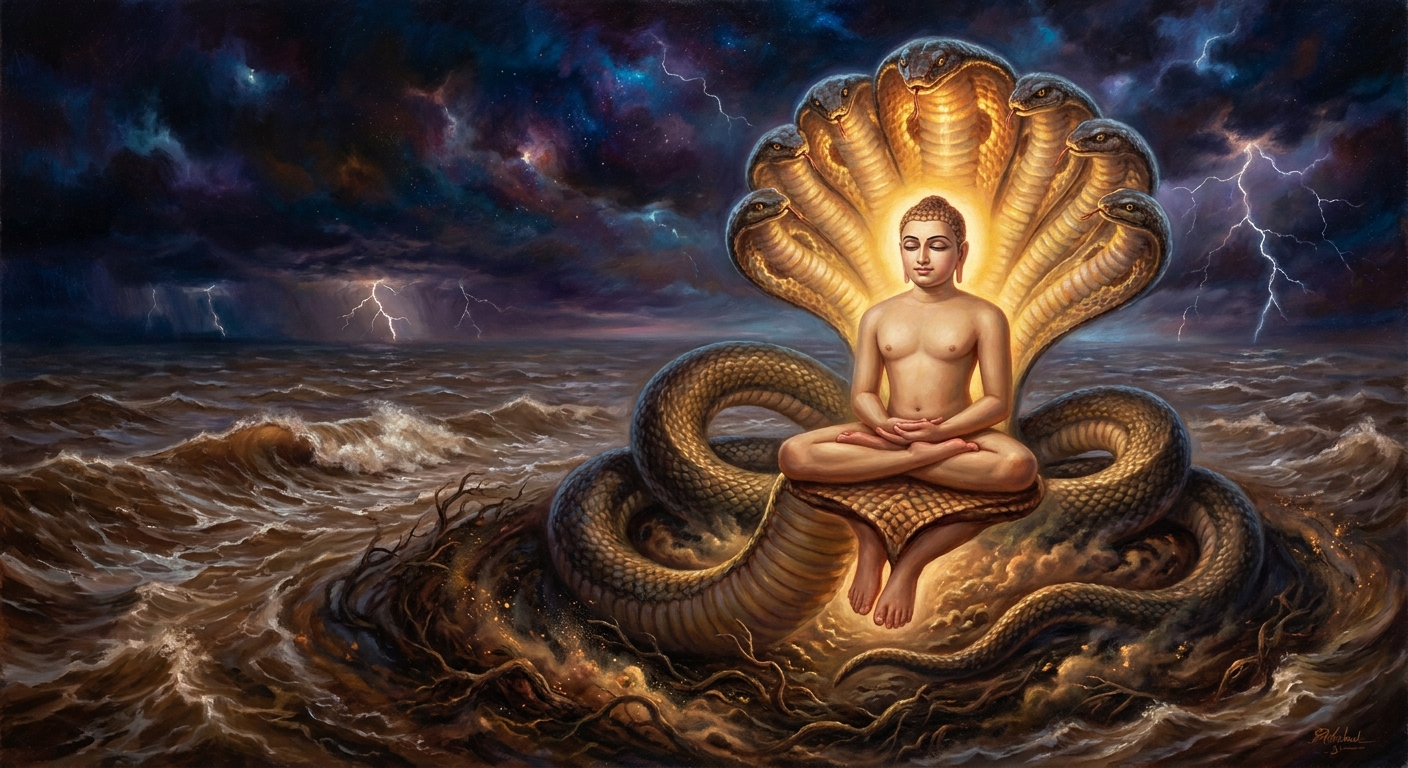
An ascetic stands motionless beneath a forest tree as a monsoon breaks; the serpent-king and his queen rise from the earth and shield him with their hooded canopies.
- When
- c. 800 BCE (traditional dates 877-777 BCE)
- Where
- a forest grove on the banks of the Ganges, somewhere in the kingdom of Varanasi
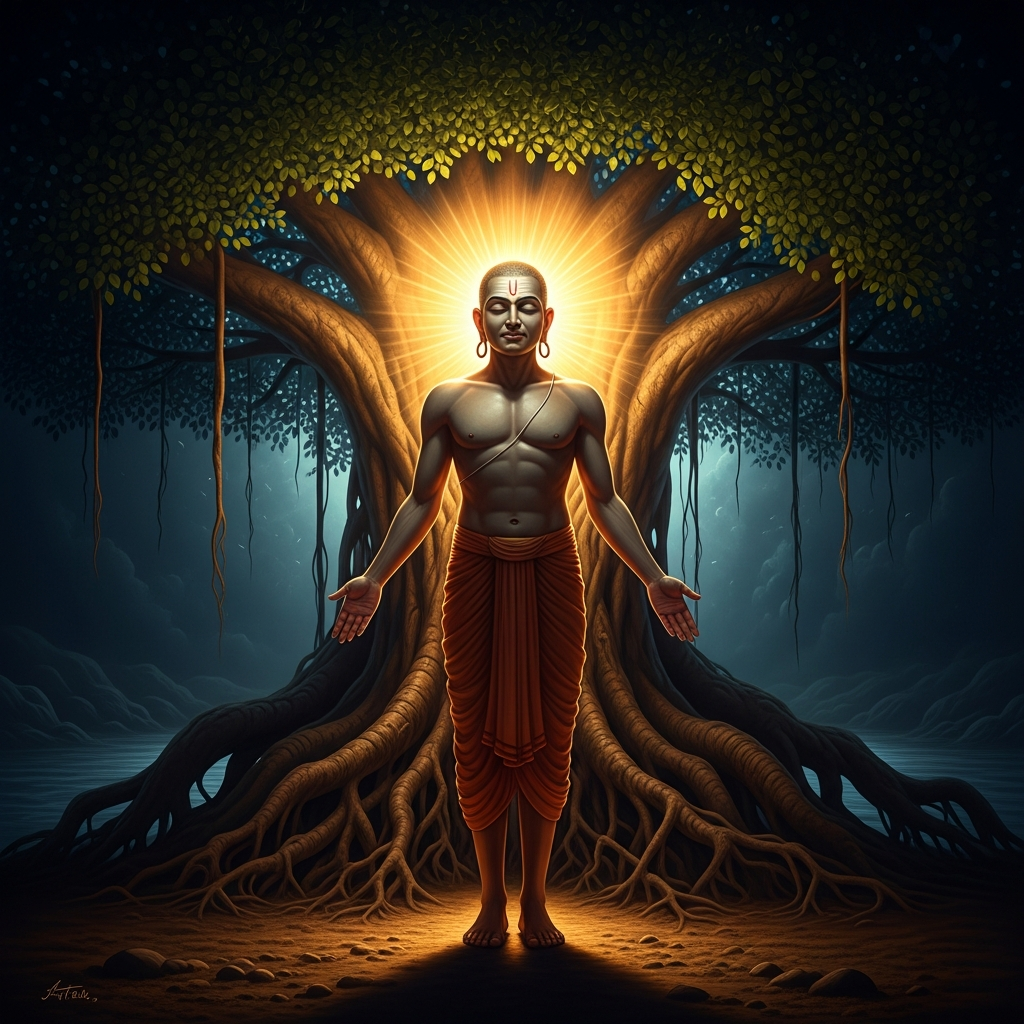
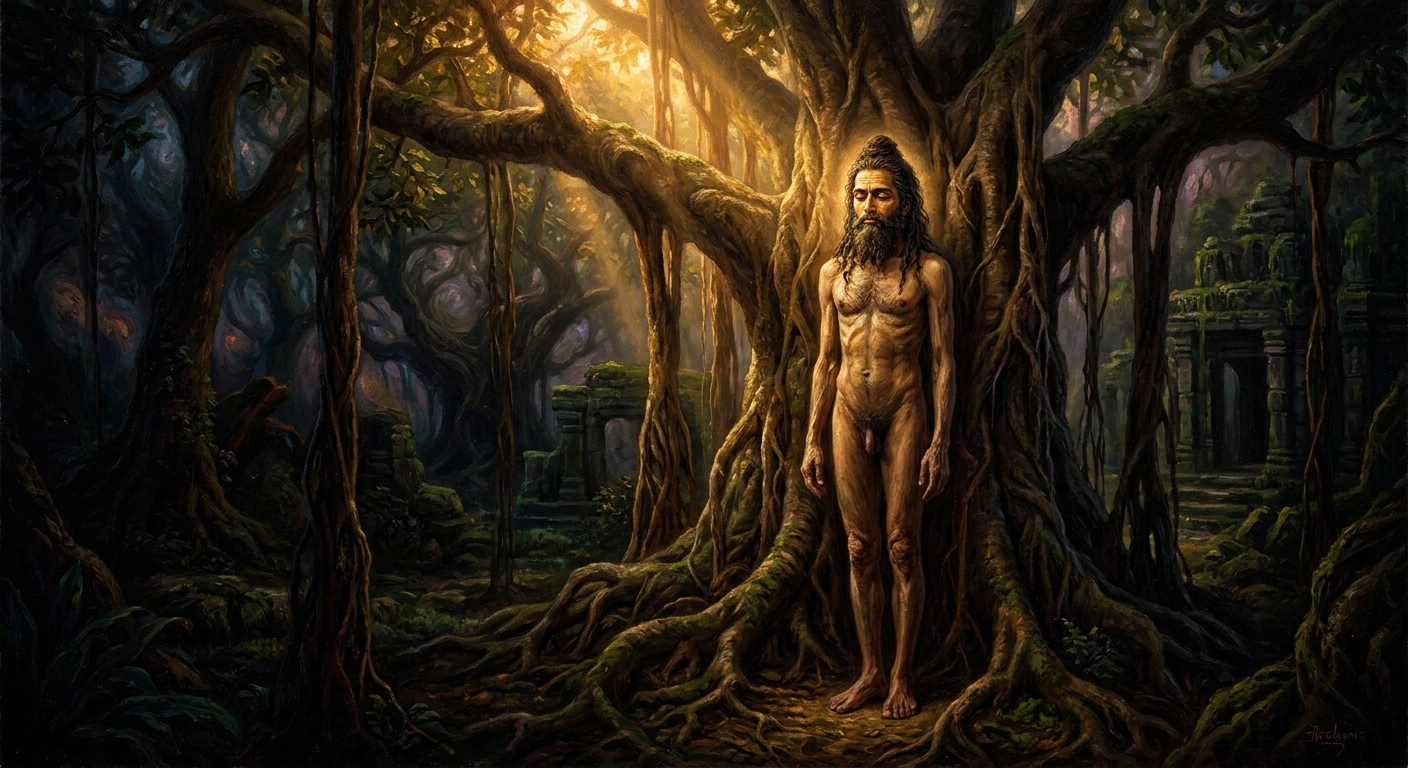
He stands beneath the tree at twilight.
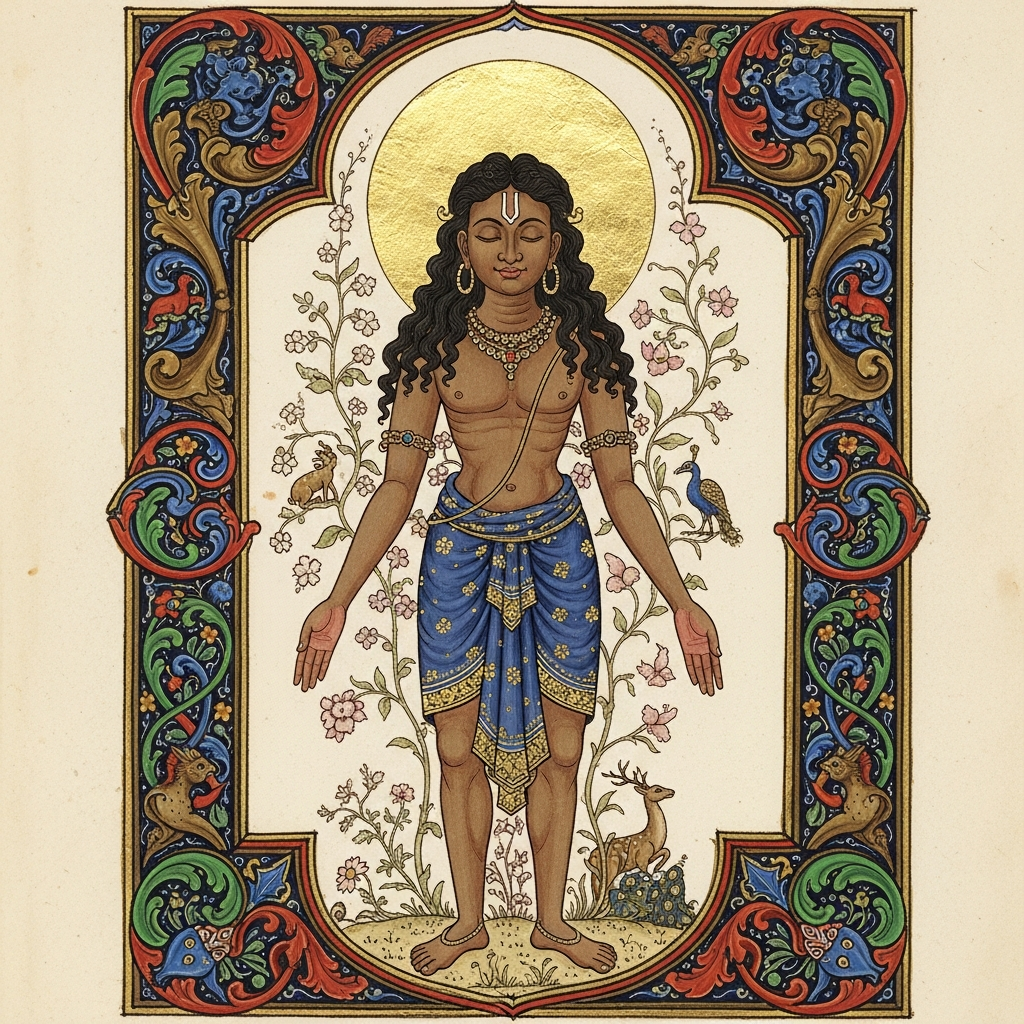
He is no longer a prince. He has been Parshva for thirty years and an ascetic for eighty-three days, since he walked out of his father’s palace at Varanasi and gave away the last of his ornaments at the city gate. He stands now in kayotsarga — the posture of body-abandonment — feet slightly apart, arms hanging loose, eyes fixed on a point a hand’s breadth in front of his nose. He has not moved since dawn. He will not move until liberation comes for him, or it does not.
The forest is going dark. The first heavy drops touch the leaves above him. Somewhere, far off, a peacock screams.
The storm is coming. He registers it the way a stone registers weather. He does not move.
The hatred has a history.
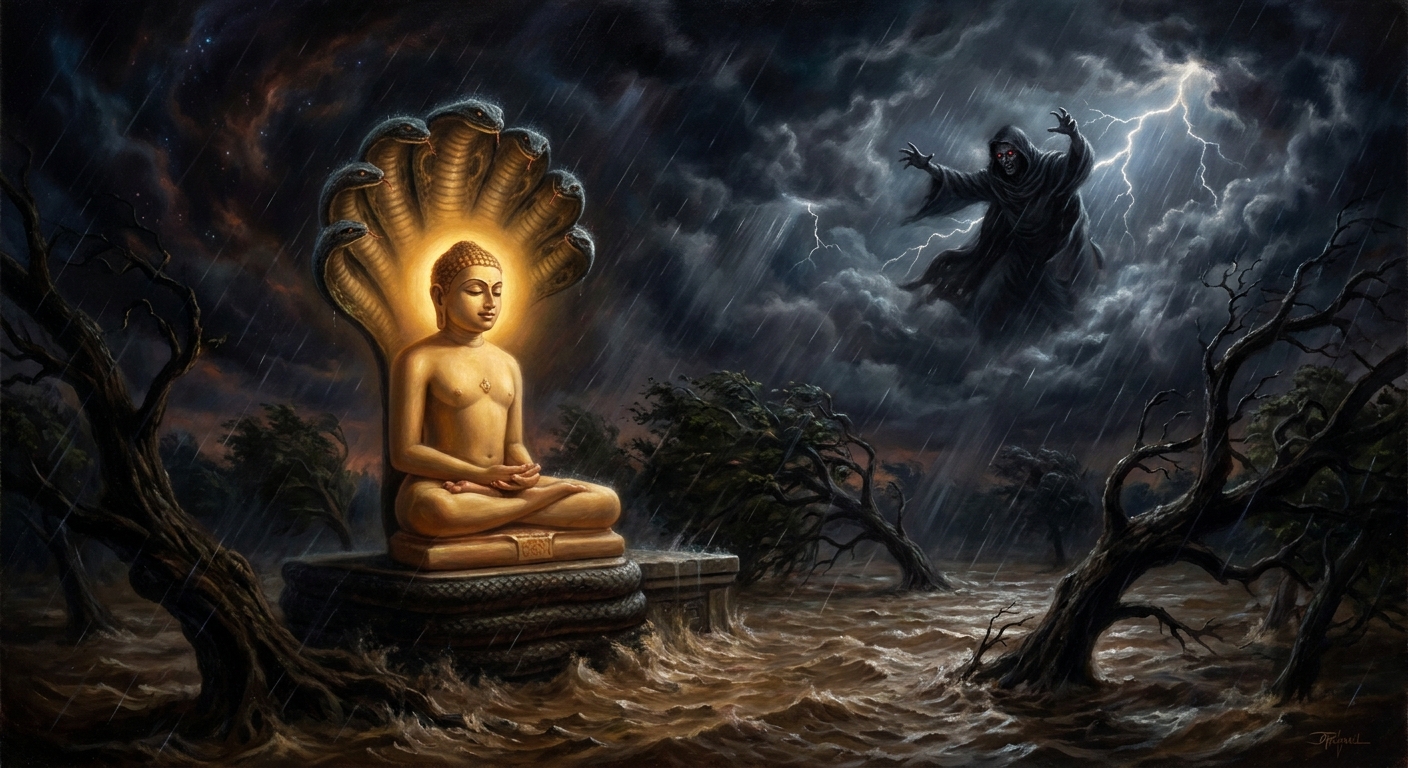
Nine lifetimes ago, the texts say, a hermit named Kamatha was burning a great log on his sacrificial fire when Parshva — then a prince passing on the road — heard the cries inside the wood and ordered the log split. A serpent crawled out half-burned and died at his feet. The serpent’s soul, in time, was reborn as Dharanendra, king of the naga. Kamatha, humiliated by the prince who had exposed his ignorance, was reborn through nine bodies carrying the grudge. He is now a daitya, a storm-demon. He has been waiting for this night.
The drops become a downpour. The downpour becomes a wall.
Wind tears branches off the banyan above him. Hail rakes the clearing. The river rises — the texts say it rises in minutes, not hours, with the speed of unnatural intent — and laps at his ankles, then his knees, then his thighs. The wind pulls leaves and small animals past his head. A panicked deer lunges through the grove. The water is at his waist now, climbing.
He does not move.
He has stopped distinguishing.
The cold of the water and the heat of his own breath, the pull of the current and the still center of his spine, the screaming wind and the silence of his own attention — they have stopped being two things. Equanimity, the Jains call it. Samata. The moment when the soul stops flinching from the body’s report. He is not enduring the storm. The storm is happening, and he is happening, and they are happening to each other without one being more real than the other.
Kamatha pours hail. Kamatha pours fire. Kamatha pours stones from the sky. Each one strikes and is felt and is filed and is released. Parshva’s eyes do not close. Parshva’s mouth does not move. Parshva is not, in any sense Kamatha can recognize, resisting — and that, more than anything, is what the storm-demon cannot bear.
The earth at Parshva’s feet trembles.
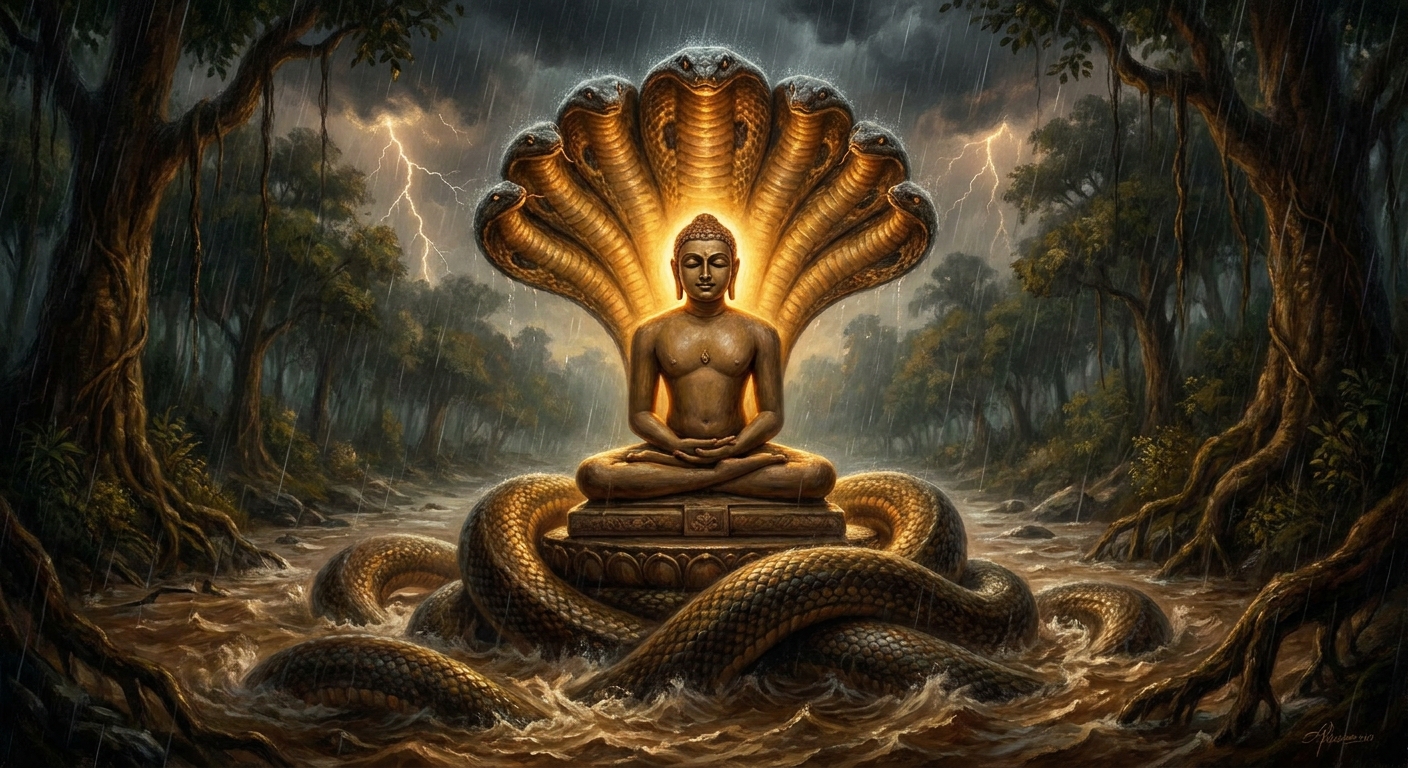
Two coils break the surface of the rising water. They are thicker than a man’s body, banded gold and emerald, scales catching what little light remains. Dharanendra. King of the serpents. The soul of the half-burned snake, returned across nine births to a debt he has not forgotten.
Beside him, slighter, jeweled at the brow: Padmavati. His queen.
They rise around the saint without touching him. Padmavati’s coils bear his feet up clear of the water — gently, gently, the way a mother lifts a sleeping child. Dharanendra rears behind him to a height of seven hoods, each hood broad as a chariot wheel, and spreads them above Parshva’s head in a living canopy.
The hail strikes the hoods and runs off. The wind breaks against the scales. The rain falls everywhere in the forest and does not fall on the saint.
Parshva does not look up.
He does not thank them. He does not need to. The vow he took on the night he walked out of Varanasi was simple — I will harm nothing, I will lie about nothing, I will take nothing, I will possess nothing — and the vow has, by its own logic, drawn its protectors. The cosmos has noticed. The cosmos has sided.
Kamatha, hovering above the storm, sees the canopy and understands. His grudge has been answered by a creature that should have died nine lifetimes ago and did not, because the soul that was the prince that day has continued, also, to exist. The same soul. The same gesture of mercy. There is no winning against a being who has stopped requiring victory. He withdraws. The storm thins. The river goes back down.
The texts say Kamatha eventually repents and is forgiven, because in Jainism even the storm-demon has a soul, and every soul, in the end, has to choose Asha or Druj — though they would not use those words.
Parshvanatha stands in the kayotsarga posture for eighty-three days more.
At the end of that time, on the eighty-fourth day of his ascesis, kevala-jnana opens in him the way it will later open in Mahavira at the Rijupalika. The serpents, their work done, sink back into the earth. He walks out of the forest and begins to teach. He gathers thousands of disciples. He establishes the four great restraints — non-violence, truthfulness, non-stealing, non-possession — that Mahavira will, two and a half centuries later, find still being practiced by the Parshvapatya monks his own parents belonged to.
He is, in every meaningful sense, the founder Mahavira inherits.
The image of the saint under the snake-canopy, repeated in temple sculpture across India for three thousand years, is the doctrine made stone: non-violence is not weakness; it is the strongest thing in the cosmos, and the cosmos knows it.
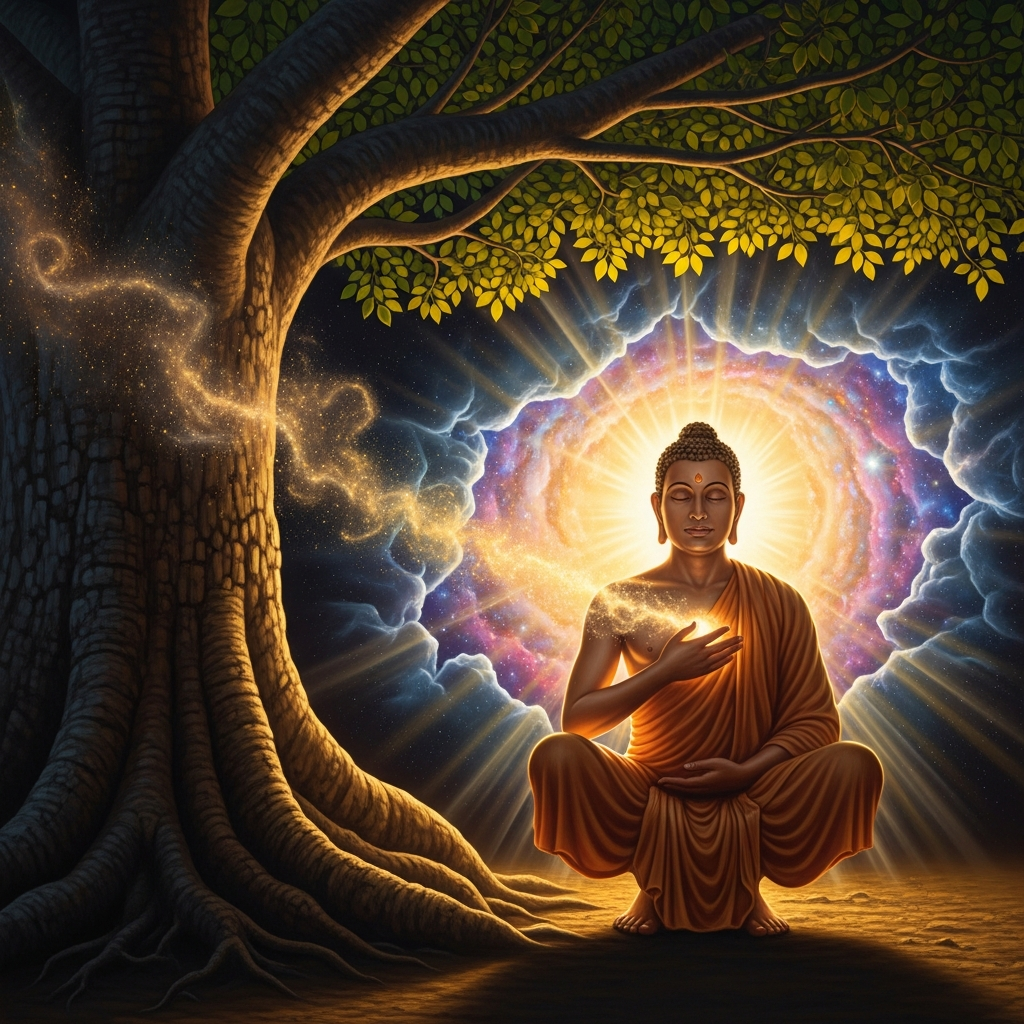
Six centuries later, in a different forest, a different ascetic will sit beneath a different tree, and a different serpent-king named Mucalinda will rise from the earth to shelter him from a different storm. The Buddhists will tell the story as theirs. They are not wrong. The story is older than either tradition; both tribes inherited it from the same Indic intuition that the wild thing knows the holy thing when it sees it.
Dharanendra and Padmavati are still worshipped today, especially in the Digambara temples of Karnataka and the Shvetambara temples of Rajasthan, as the yaksha and yakshini attached to Parshvanatha’s image. The childless pray to Padmavati. The frightened pray to Dharanendra. The serpent-canopy spreads, in granite, in bronze, in painted cloth, over millions of meditating saints across India who have never moved, in a storm that has not yet ended.
Scenes
Parshvanatha enters the *kayotsarga* posture beneath a banyan, motionless, eyes fixed on the tip of his nose
 Generating art…
 Kamatha, jealous from a hatred carried across nine lifetimes, sends the monsoon down on him in unnatural fury
 Generating art…
 Dharanendra and Padmavati rise from beneath the soil, the king's seven hoods spreading above the saint's head, the queen's coils lifting his feet clear of the rising water
 Generating art…
 Echoes Across Traditions
Entities
- Parshvanatha
- Dharanendra
- Padmavati
- Kamatha
- the Tirthankaras
Sources
- *Kalpa Sutra* (Bhadrabahu, c. 4th century BCE; sections on the lives of the Tirthankaras)
- *Uttaradhyayana Sutra* 23 (Parshva and Mahavira's disciples in dialogue — the oldest reference to Parshva as a historical figure)
- Paul Dundas, *The Jains* (Routledge, 2nd ed. 2002), ch. 2
- Padmanabh S. Jaini, *The Jaina Path of Purification* (1979)
- Maurice Bloomfield, *The Life and Stories of the Jaina Savior Pārśvanātha* (Johns Hopkins, 1919)