The Man Who Had to Invent Renunciation
The first Tirthankara of the present cosmic cycle — traditional epoch: tens of millions of years ago · The city of Ayodhya; thereafter the entire subcontinent, barefoot
Contents
Rsabhanatha — Adinatha, the First Lord — teaches humanity farming and cities and the sixty-four arts, rules as king, and then does something no one in the history of the world has ever done before: he renounces. No tradition of almsgiving exists to receive him. He wanders for a year, collapsing from hunger, because the world does not yet know how to give.
- When
- The first Tirthankara of the present cosmic cycle — traditional epoch: tens of millions of years ago
- Where
- The city of Ayodhya; thereafter the entire subcontinent, barefoot
He is not the first man. He is the first man of this cosmic age, which is a different thing.
The Jain cosmos turns in vast cycles, each cycle vast as geology, and each cycle has its series of twenty-four Tirthankaras — ford-makers, builders of the crossing from samsara to liberation. Rsabhanatha is the first of this cycle’s twenty-four. He is born in Ayodhya to a mother who dreams fourteen auspicious dreams the night before his birth — something about an elephant, a bull, a lion. He is born with the vajra-rishabha-naracha physique: a body so perfect it is itself a kind of argument. He grows up a king’s son. He becomes a king.
Here is what the texts say the early humans of his cosmic era do not know: they do not know how to plow. They do not know how to build houses from materials other than the trees they live in. They do not know how to cook. They eat kalpa fruit from wish-fulfilling trees that are already beginning, in this declining cosmic age, to produce less fruit than they once did. The trees are almost bare. The fruit is almost gone. And the humans stand in front of the bare trees with the particular helplessness of a species that has never needed to think.
Rsabhanatha is a king who understands that his first task is to teach his people how to live. He does.
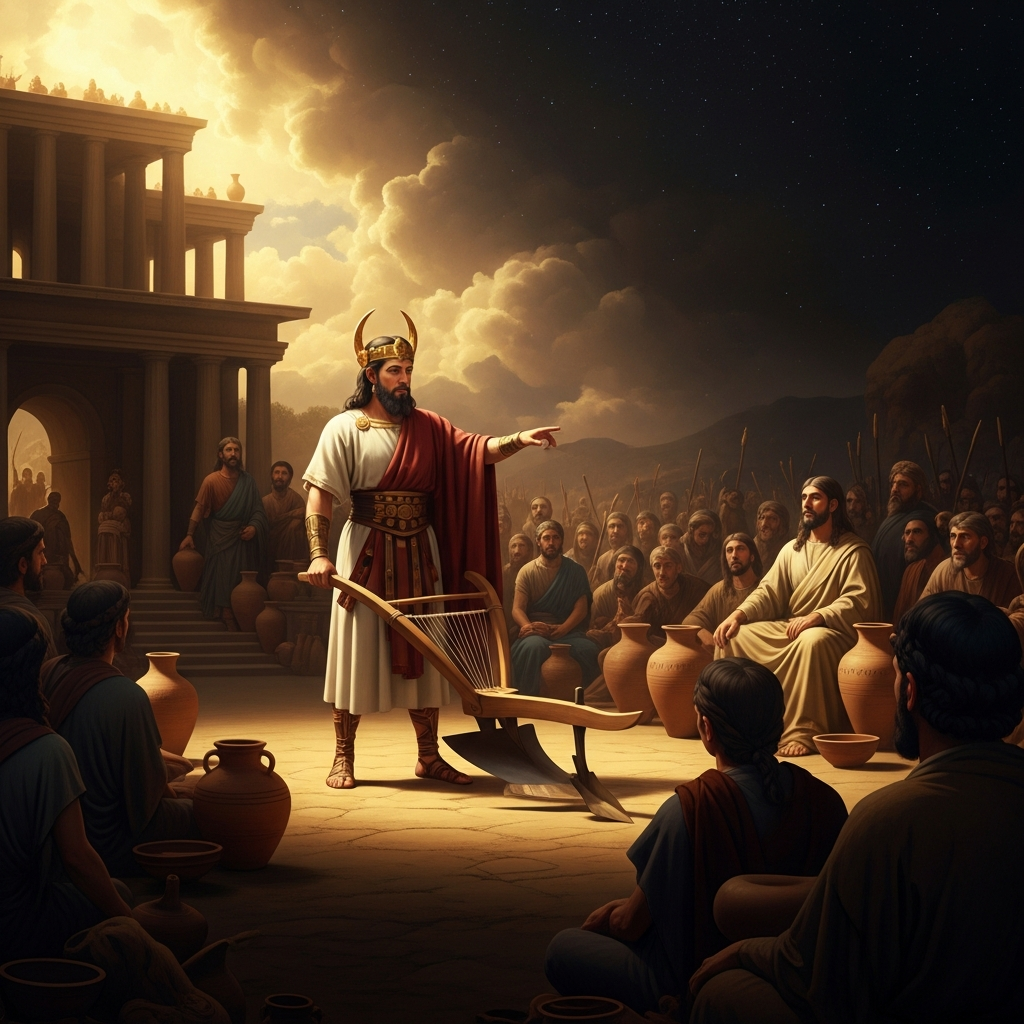
He teaches them to plow. He teaches them to plant seeds and wait for rain and harvest on schedule. He teaches them to build with brick and stone, to fire pottery, to weave cloth from cotton he has shown them how to grow. He teaches them the sixty-four arts — calligraphy, music, dance, medicine, arithmetic, astronomy, architecture — and the hundred crafts: the working of iron and bronze and gold, the making of boats and carts and weapons. He is not a poet of civilization. He is its engineer. He shows them how to do each thing, one thing at a time, until the doing is muscle memory.
He also gives them law. He divides humanity into four groups — kshatriya (warriors), vipra (learned), vaishya (traders), shudra (servants) — and gives each group its duties. He names his sons and distributes kingdoms. Bharata, his eldest son and heir, will give his name to the land that will be called India. His younger son Bahubali will one day defeat Bharata in combat and then renounce the victory before he can pick it up.
The texts say Rsabhanatha has a hundred sons and two daughters. One of the daughters teaches the sixty-four arts to the women of the realm. He rules for an enormous span of time in a cosmic calendar that thinks in millions of years. He does everything a king is supposed to do.
Then he watches his daughter Nilanjana dance.
She is performing at court. She is performing perfectly. And then, mid-gesture, in the middle of a precise and lovely movement, she dies — collapses, goes still, is carried out. The performance continues without her because the other dancers do not miss a beat. They are trained to continue.
He watches the dance continue and understands something about impermanence that he has known for his entire reign in theory but not yet in the body. The body is the last to understand. The body has now understood.
He calls his sons and distributes what remains to distribute. He removes his ornaments. He removes his robes. He does this in public, at court, in front of everyone who has spent their lives watching him rule, and nobody knows what he is doing because what he is doing has never been done before. There is no word yet for renunciation. There is no tradition of the wandering monk, no social category that will make sense of a king walking away from everything naked. He is, in the most literal possible sense, inventing the act as he performs it.
He pulls out his own hair by the roots. He walks out of Ayodhya.
The year that follows is the hardest part of his story, which is saying something.
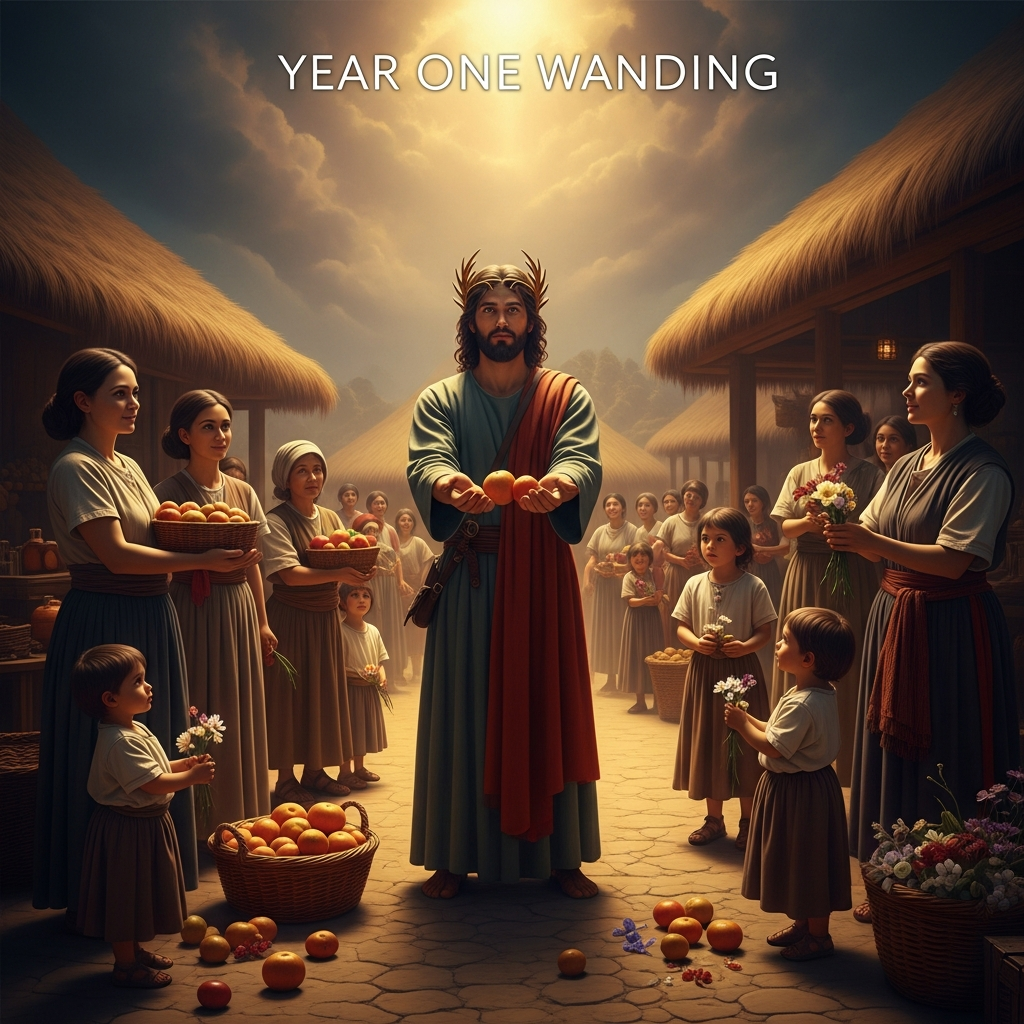
He wanders. He stands in villages with his hands cupped in the gesture of the monk requesting alms — a gesture that he, in this moment, is inventing. The villagers come out to see him. They bring gifts. They bring flowers, they bring fruit, they bring cloth, they bring gold. They bring everything a visitor of importance might want. They pile it beside his feet.
He stands with his cupped hands extended and they cannot understand what he wants.
The cupped hands — hands that hold nothing, ask only for something small enough to eat, take nothing ornamental, take nothing permanent — are not a gesture anyone has yet seen. Nobody understands the grammar of the monk’s hands. They cannot translate the body’s language. They see a former king, magnificently serene, surrounded by their gifts, and they think they have not yet given him enough.
He is starving. He does not eat their gifts because they are not offered in the form his practice requires: food given freely, not prepared specifically for him, not acquired by killing, offered without resentment, placed directly in the cupped palms. The fruits piled at his feet are not this. He does not take them. He walks to the next village. This goes on for a year.
He collapses in a sugarcane field.
He is standing in his usual posture — kayotsarga, body-abandonment, arms hanging free, the body offered to gravity but not claimed by it — and his body has reached the limit of the fast and gone beyond it, and he is still standing because he has not yet decided to sit down, when a king named Shreyansa Kumar passes through the grove.
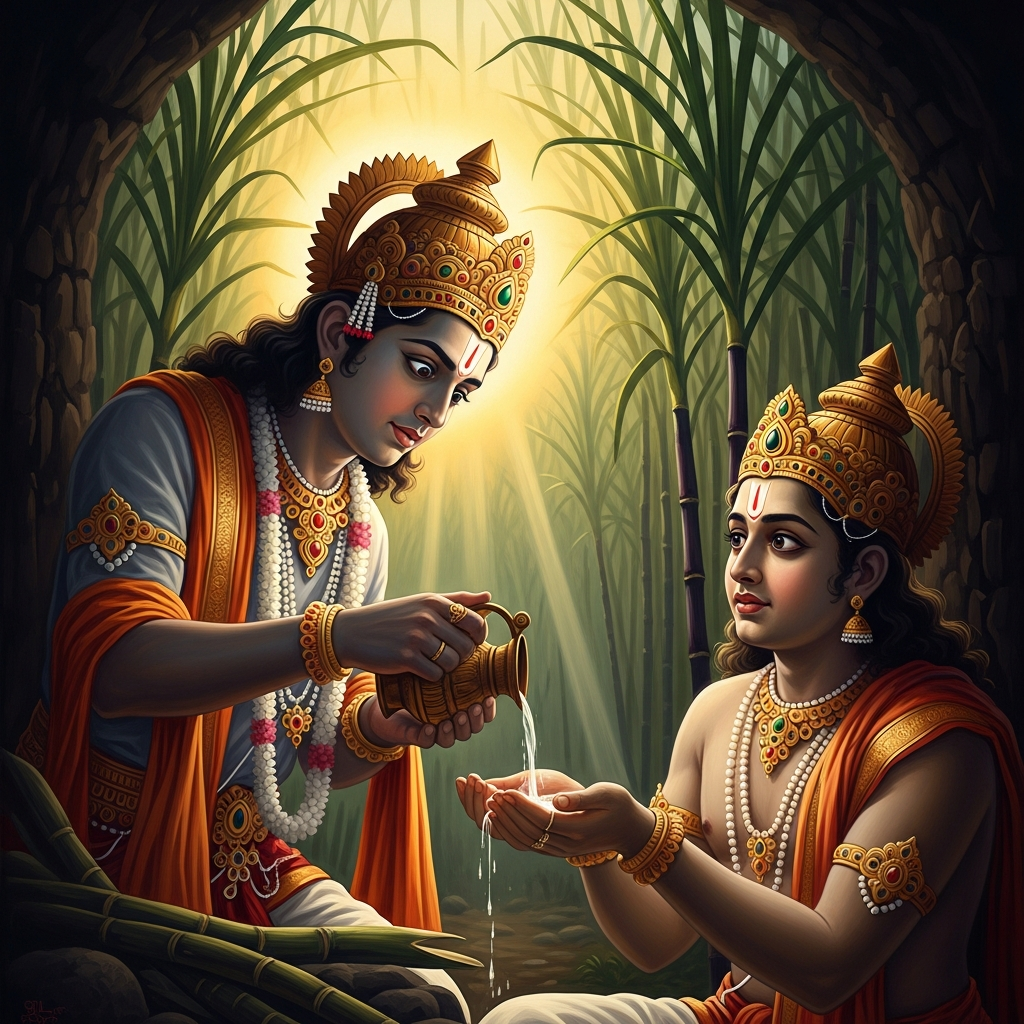
The king sees the ascetic. Something in the king — the texts say it is jati-smara, the memory of a previous life in which he himself practiced the path of the monk, and he has carried the knowledge across the birth and forgotten it consciously while it remained in the body — understands instantly what is needed. He has sugarcane juice in a vessel on his cart. He pours it into the cupped palms.
The first alms. The first dana. The founding gesture of the relationship that will sustain Jainism through every century of its existence: the layperson who cannot renounce providing for the monk who has. Shreyansa Kumar is carried in the Jain tradition as the Tirthankaras carry their trees — each of the twenty-four Tirthankaras is associated with the tree beneath which their omniscience opens; Shreyansa Kumar is associated with the moment that makes the monastic life possible for everyone who follows.
He pours the juice into the waiting hands. Rsabhanatha drinks.
The omniscience, kevala-jnana, comes later — under an ashoka tree, after the proper period of preparation, the last particle of karma finally burned away. He gathers his monks and disciples, the eleven ganadharas who will carry his teaching. He speaks the doctrine that will hold for this entire cosmic age: the five great vows, the six necessary duties, the doctrine of the soul’s intrinsic liberation waiting beneath the karma-crust of every life. He preaches for a time so long the texts describe it in astronomical units.
He dies — attains moksha, liberation, the final departure — on Mount Kailasha, the summit that every Jain tradition has agreed on as his liberation site. He exits the cycle for the last time, the soul no longer circling, no longer accreting karma, gone into the Siddha-loka — the realm of the liberated, which is not a place but an absence of place, a pure existence above the top of the cosmos, where the souls that have finished hover in permanent omniscience.
The world he taught how to live continues. The tradition he founded by inventing renunciation from scratch, in a year when no one understood his cupped hands, continues in the same gesture repeated by every Jain monk who asks for food today.
He had to be first. The first always has to invent the tradition from inside a world that does not have language for it yet. The cupped hands in the sugarcane grove were the first grammar, offered before anyone knew what sentence they were completing. Shreyansa Kumar completed it. Jainism has been completing it ever since.
Scenes
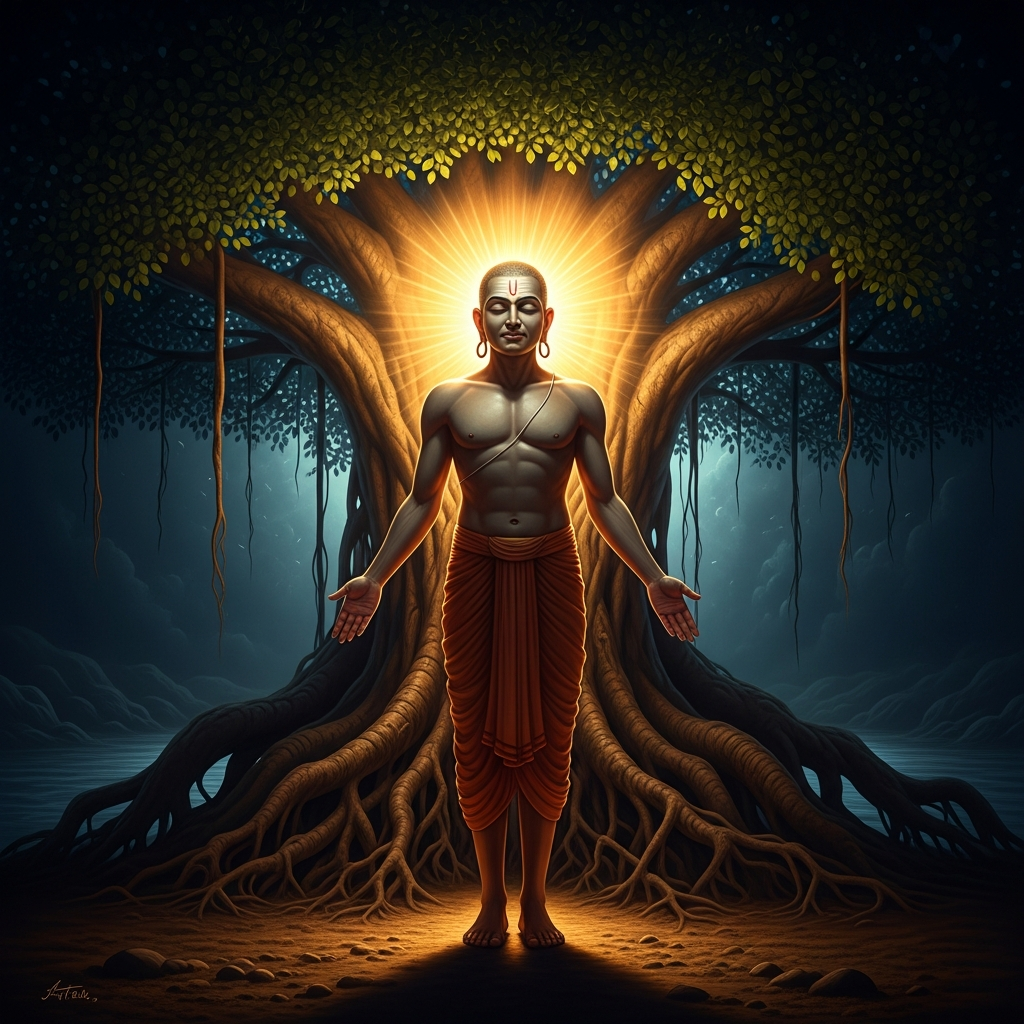
The first king stands before a crowd that does not yet know what a plow is
 Generating art…
 Year one of the wandering
 Generating art…
 A king named Shreyansa Kumar pours sugarcane juice into Rsabhanatha's cupped palms in a sugarcane grove
 Generating art…
 Echoes Across Traditions
Entities
- Rsabhanatha
- Adinatha
- Bharata
- Bahubali
- Shreyansa Kumar

Sources
- *Adipurana* (Jinasena, c. 9th century CE) — the primary Digambara account of Rsabhanatha's life
- *Trishashti Shalaka Purusha Caritra* (Hemacandra, c. 12th century CE) — Shvetambara account
- Paul Dundas, *The Jains* (Routledge, 2nd ed. 2002)
- Padmanabh S. Jaini, *The Jaina Path of Purification* (University of California Press, 1979)
- John E. Cort, *Jains in the World* (Oxford University Press, 2001)