The Comet and the Gate
26 March 1997 · Rancho Santa Fe, California · A nine-thousand-square-foot rented mansion at 18241 Colina Norte, San Diego County
Contents
Thirty-nine members of an American UFO religion lay themselves down in a Rancho Santa Fe mansion in matching black uniforms and Nike sneakers, believing the tail of comet Hale-Bopp conceals a craft come to lift their souls to the next evolutionary level.
- When
- 26 March 1997 · Rancho Santa Fe, California
- Where
- A nine-thousand-square-foot rented mansion at 18241 Colina Norte, San Diego County
The comet appears in the spring sky like a punctuation mark.
Hale-Bopp has been visible to the naked eye since the previous summer — a brightness with a long pale tail dragging across the constellations. Astronomers note it is one of the brightest comets of the century. Tabloid radio hosts speculate, in the way American radio hosts always speculate about comets, that something is hidden behind it. An amateur astronomer reports a companion object. The report is wrong. By the time it is debunked, it has already entered a small, careful religious community in southern California as confirmation of what they have been waiting forty years to confirm.
Marshall Applewhite watches the comet from the patio. He is sixty-five. His partner Ti — Bonnie Lu Nettles — has been dead twelve years. He has not stopped speaking to her.
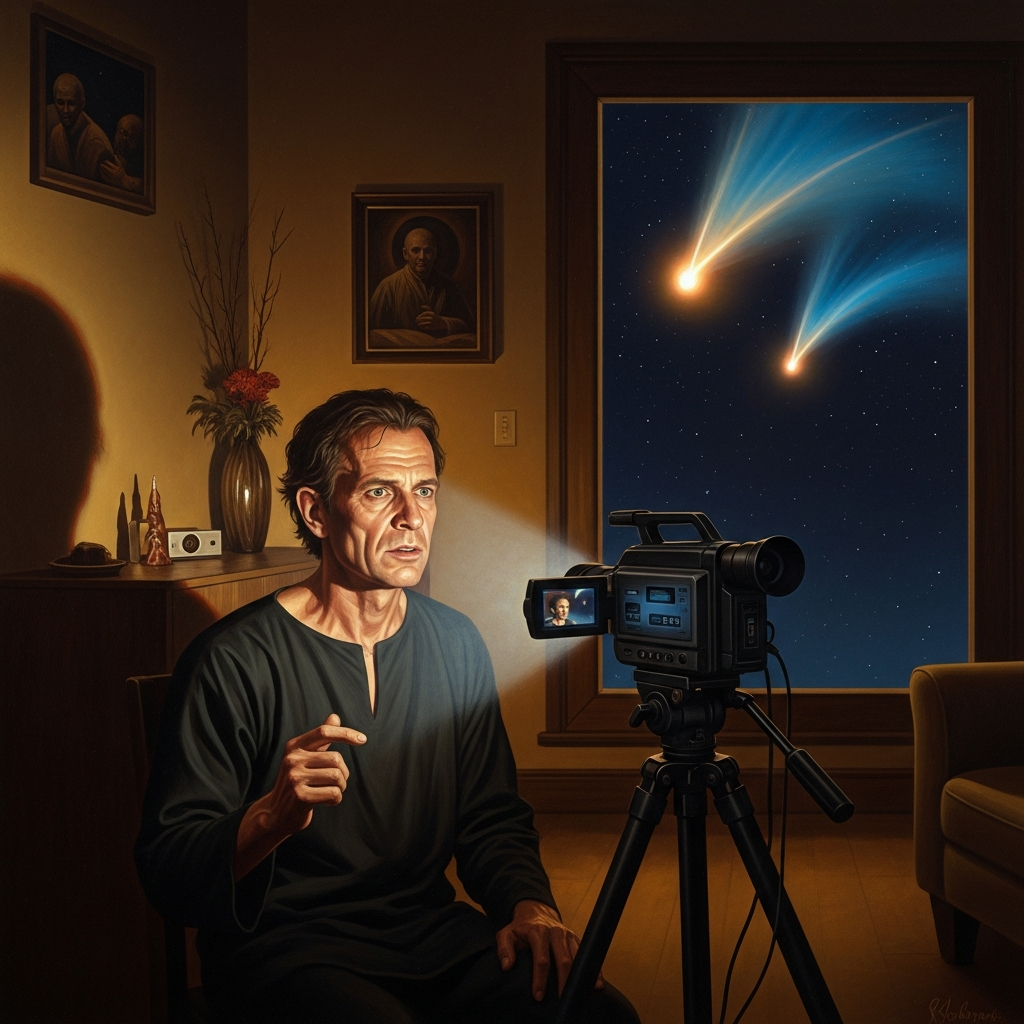
He sits down in front of the camera in a black turtleneck.
“By the time you view this tape,” he says, “we will have exited our vehicles.” His face is gentle. His eyes are the eyes of a defrocked music professor who has spent two decades convinced he is the second incarnation of the captain who walked the earth as Jesus of Nazareth. He believes this without bitterness. He explains it the way another man might explain a job change. The Next Level, he says, is calling them home. The vehicles — bodies, in the group’s vocabulary — are to be set aside.
The members appear in pairs, one after another, each in matching black, each cheerful. “I’m so happy,” one says. “I’ve been waiting for this for a long time.” Another laughs at the camera. They are not coerced. They are not drugged. They have, by the careful measure of every sociologist who studied them, freely and lucidly chosen this.
Robert Balch, the sociologist who lived among them in 1975, will say later that Heaven’s Gate is the most theologically consistent group he ever encountered. They simply followed the premises to the end.
The premises are second-century.
Strip the science fiction and the cosmology is Apocryphon of John. The earth is a soul-prison. Its rulers — the Luciferians, in Applewhite’s vocabulary; the Archons, in the Sethian — work to keep souls trapped in matter. The Next Level is the Pleroma, the fullness, the realm of pure spirit beyond the planetary spheres. The body is a vehicle one enters and one exits. Salvation is not forgiveness. Salvation is escape.
What Applewhite added — and only this — was the spacecraft. The mechanism of escape, in classical Gnosticism, was knowledge: the soul ascended through the spheres reciting the right passwords to each gatekeeper. In the Heaven’s Gate version, the soul ascended in a literal ship. The cosmology was identical. The conveyance was updated for the late twentieth century, the way every religion updates its conveyances. Elijah had a chariot of fire. The Class would have a craft.
Hale-Bopp was the bus stop.
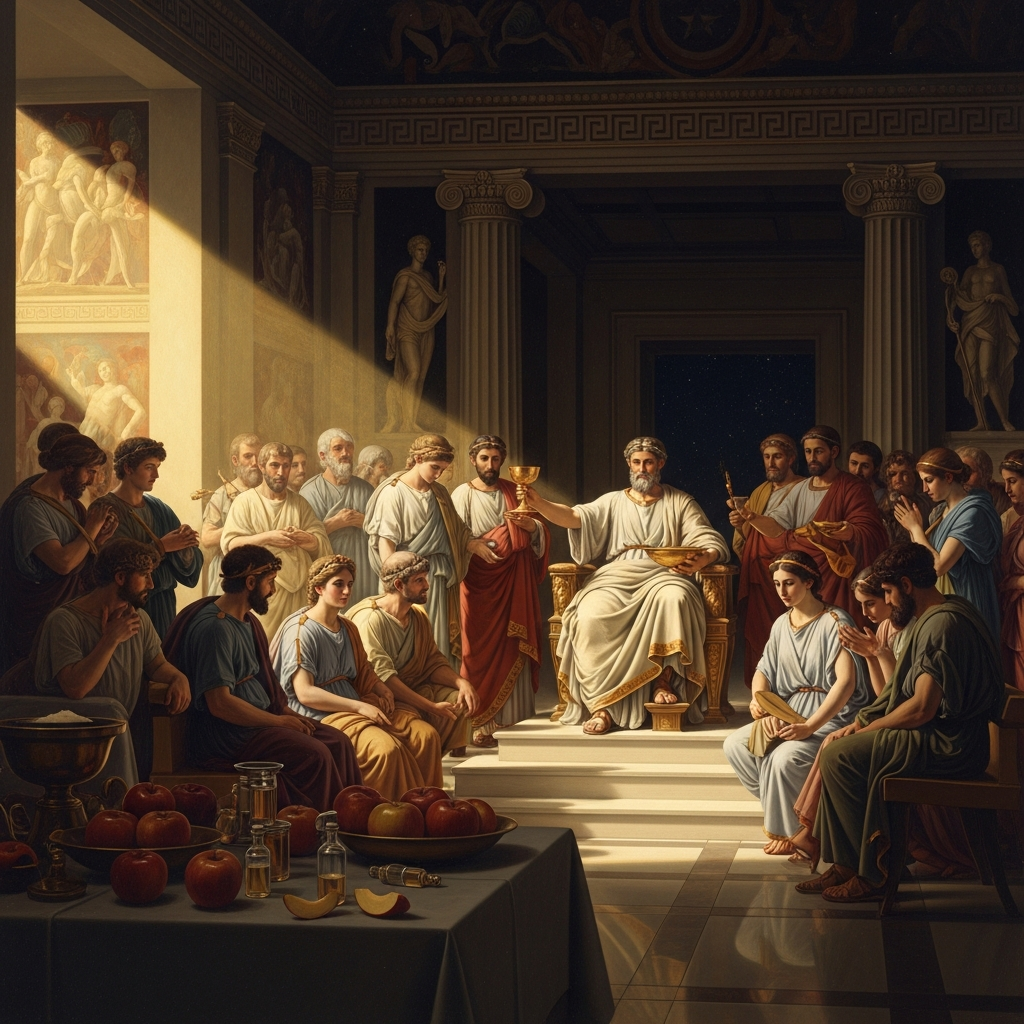
They eat the applesauce in three shifts.
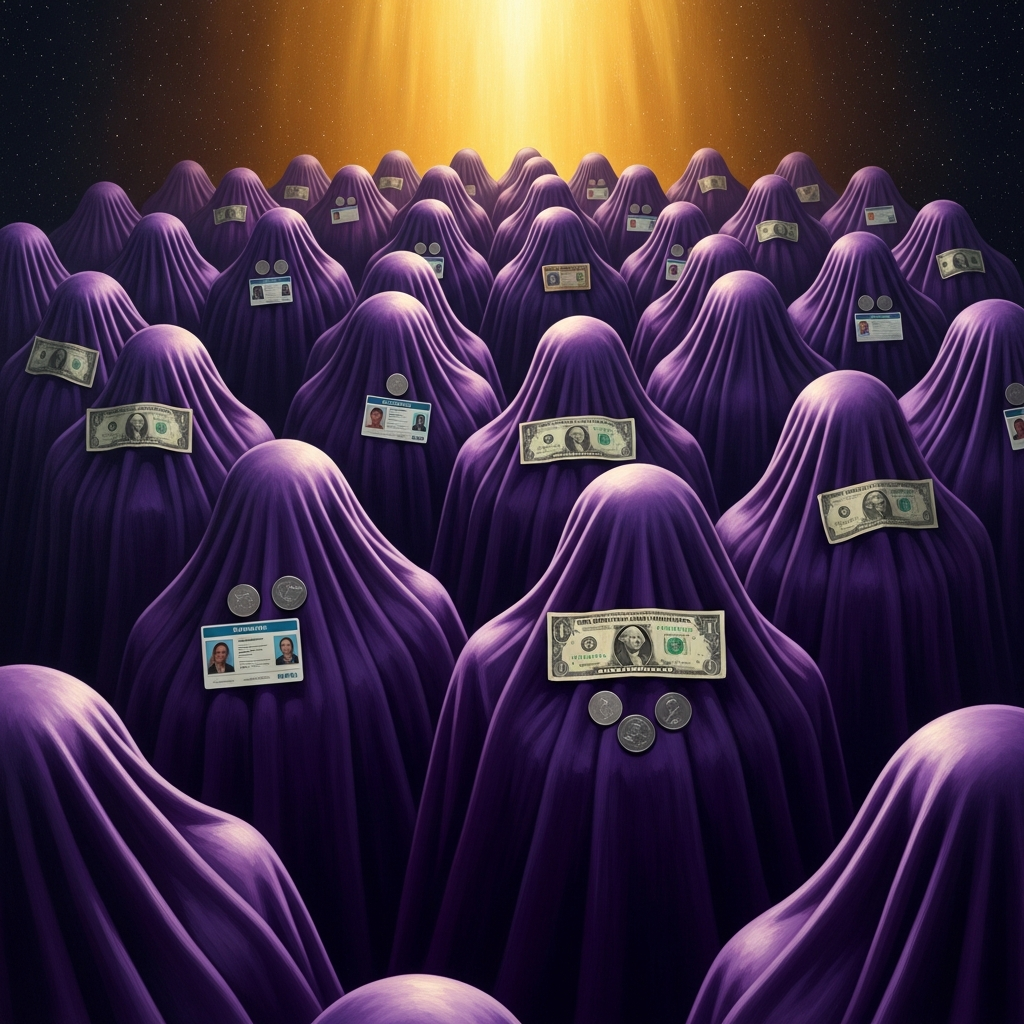
Fifteen on the first night, fifteen on the second, nine on the third — the seniormost members in the final group, attending the deaths of the others before their own. The dose is phenobarbital mixed with applesauce or pudding, washed down with vodka, finished with a plastic bag over the head. Each member has been issued a small purple cloth shroud. Each member has $5.75 in their pocket — a five-dollar bill and three quarters, exact change, the precise meaning of which has never been definitively established and which the group itself, characteristically, never explained.
They die on bunk beds. They die in pairs, then in solitaries, the survivors arranging the dead with the same gentle care the dead would have arranged them. The last nine clean the house. The last two make the call to a former member in Beverly Hills with the location and the videotape. Then they lie down beside the others.
By the time the police arrive, the bodies have begun to decompose in the desert spring heat, and the news helicopters above the property cannot yet tell what is on the floor of the house.
Thirty-nine.
Twenty-one women, eighteen men. The youngest twenty-six, the oldest seventy-two. A Houston software engineer. A retired postal worker. The brother of a Star Trek actress, who would speak for years afterward of the mildness with which her brother had become a stranger. They had been together, most of them, for two decades. They had renounced sexuality, renounced family, renounced names. Several of the men, including Applewhite, had voluntarily castrated themselves years earlier in pursuit of what they understood to be the genderless physiology of the Next Level. They had supported themselves building websites — Higher Source, the company was called — for clients who never suspected the developers were preparing to leave the planet.
They left careful notes. They left their identification beside their bodies. They left a website, which the surviving members maintain to this day, and which will outlive most of the institutions you will read about today.
The cautionary lesson of Heaven’s Gate is not that the members were stupid. They were not. Several were trained engineers. The lesson is theological.
Gnosticism is the recurrent heresy of the Christian West. It comes back every century, sometimes loud, sometimes quiet — the conviction that the body is a prison, the world a mistake, the saving god an alien from outside the cosmos, and the right response is escape. Augustine fought it. Irenaeus fought it. The Cathars revived it and were burned for it. The Romantic poets played at it. The Theosophists rebranded it. And in 1997 it walked into a rented mansion in Rancho Santa Fe wearing matching Nikes.
The thirty-nine believed they were boarding a ship. They were boarding, in fact, a tradition almost two thousand years old, dressed in late-twentieth-century clothing. The comet was a coincidence. The theology was not.
A faith that teaches you the world is the enemy and the body is a vehicle to be exited has, eventually, only one place to go. The Class went there gently, by their own hand, with the dignity their teacher had spent decades preparing them for. That dignity is the most disturbing thing about the photographs. It is also the warning.
Scenes
Marshall Applewhite records the final exit videos in the spring of 1997 as Hale-Bopp brightens overhead
 Generating art…
 The class assembles in the Rancho Santa Fe house and takes the phenobarbital-and-applesauce in three shifts
 Generating art…
 Thirty-nine bodies are found three days later, each draped in purple shrouds, each with $5
 Generating art…
 Echoes Across Traditions
Entities
- Marshall Applewhite (Do)
- Bonnie Lu Nettles (Ti)
- the thirty-nine of the Class
- comet Hale-Bopp
Sources
- Robert Balch and David Taylor, longitudinal field studies 1975-1997 (Balch infiltrated the group as a participant-observer in the early years)
- Benjamin E. Zeller, *Heaven's Gate: America's UFO Religion* (NYU Press, 2014)
- Hugh B. Urban, *The Church of Scientology* and *New Age, Neopagan, and New Religious Movements* (California, 2015) — comparative chapters
- The Heaven's Gate website (heavensgate.com), preserved by surviving members in perpetuity
- The exit videos of Marshall Applewhite, March 1997 (publicly released)