No Future Without Forgiveness
1995 – 1998 · the South African Truth and Reconciliation Commission · Cape Town and venues across South Africa — public hearings of perpetrators and victims of apartheid violence
Contents
For three years a small Anglican archbishop in a purple cassock sits at the front of a hearing room in Cape Town, listens to torturers describe what they did to mothers and sons, and offers the country a theology built on a Xhosa word: *Ubuntu* — I am because we are.
- When
- 1995 – 1998 · the South African Truth and Reconciliation Commission
- Where
- Cape Town and venues across South Africa — public hearings of perpetrators and victims of apartheid violence
The room is small.
A community hall, a church basement, a school auditorium — wherever the Commission sits this week, the format is the same. A long table at the front. Microphones. Headphones for translation between English and Afrikaans and Xhosa and Zulu and Sotho. A chairman in a purple cassock under whose hands the country’s wound is being laid open.
A widow rises. She has been waiting twelve years to know what happened to her husband. The man who killed him is in the witness box across from her, applying for amnesty. The procedure is precise. He must tell the full truth. He must establish that the act was politically motivated. If he does — even if he tortured a man to death — he walks free.
She is being asked to listen to him list what he did, in front of cameras, in her own language. She is being asked to consider a country in which both of them have to live tomorrow.
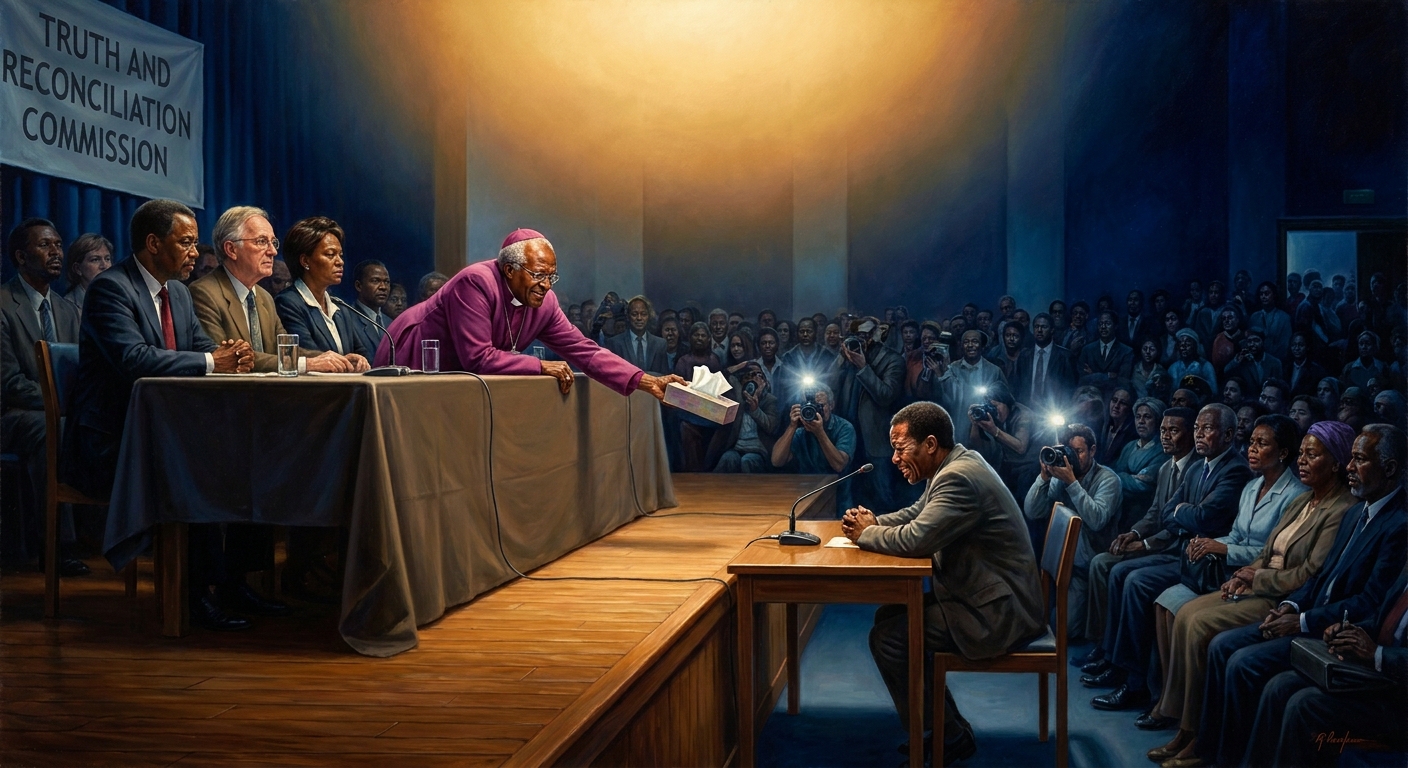
Tutu cries openly at the bench.
Reporters note it on the second day of hearings. He puts his head in his hands when a woman describes what she found of her son. He weeps when an elderly man, who has been searching for his disappeared brother for fifteen years, finally hears the location of the grave. The cameras capture it. South African newspapers debate whether the Chairman is too emotional to chair.
He is exactly as emotional as the Chairman of such a Commission should be. He has said, repeatedly, that the country is not a courtroom and the bench is not a tribunal. The country is a wound. The Commission is a poultice. He is not going to pretend the pus does not hurt.
The deal is unprecedented.
Mandela’s transitional government, in 1995, faces a choice with no good options. Nuremberg-style prosecutions of apartheid security forces would crash the negotiated transition. Generals who handed over power on the understanding of immunity will go to war if the immunity is rescinded. A blanket amnesty — the path Argentina and Chile took — leaves the victims with nothing.
The Promotion of National Unity and Reconciliation Act, 1995, charts the third path. Amnesty is not automatic and not collective. It is granted only on full disclosure of specific acts, only when those acts were politically motivated, only after a public hearing in which the victims may speak. Truth in exchange for liberty.
Tutu accepts the chair on the condition that the hearings will be public, that they will be religious in tone (he opens each session with a prayer, and the secularists protest), and that the victims, not the perpetrators, will define the proceedings.
The testimony breaks the country.
A man named Eric Taylor describes how the Cradock Four were murdered in 1985. A man named Jeffrey Benzien, a Cape Town security officer, demonstrates the wet-bag torture technique on a kneeling volunteer in front of his own former victim. A man named Dirk Coetzee, head of the Vlakplaas death squad, describes how Griffiths Mxenge was killed and the body burned over an open fire while the killers grilled meat next to it.
Antjie Krog, the Afrikaans poet covering the hearings for the SABC, writes a book called Country of My Skull. She cannot sleep. The translators cannot sleep. The country sleeps with the radio on.
Tutu insists, in every press conference, that this is not closure but disclosure.
Forgiveness, he says, is not pretending things are other than they are. Forgiveness is the recognition of a ghastliness that has happened. Forgiveness does not mean condoning what has been done. It means taking what happened seriously and not minimizing it; drawing out the sting in the memory that threatens our entire existence.
The theology comes from his Anglican formation and his lifelong Xhosa formation in equal measure. Ubuntu, he says, again and again. Umuntu ngumuntu ngabantu — a person is a person through other persons. The torturer is dehumanized by his act. The victim is dehumanized by the act. The community is dehumanized by silence. The hearing — the truth told aloud, with the body of the perpetrator and the body of the survivor in the same room — is the beginning of re-humanization for both.
It is not therapy. It is not justice. It is something the world does not have a category for.
Some refuse.
Winnie Madikizela-Mandela refuses, at first, to acknowledge any role in the murder of Stompie Moeketsi. P. W. Botha, the former state president, refuses to appear at all and is convicted of contempt. F. W. de Klerk apologizes only for the abstract category, apartheid, and refuses to apologize for any specific authorization. The amnesty applications of Eugene de Kock and the security police produce files that no European government in the same period would have allowed daylight.
The TRC is imperfect. It does not deliver full reparations to most victims. It does not prosecute most who refused to apply. It is criticized from the left for letting murderers walk and from the right for staging a national show trial of Afrikaners.
It also stops the war that almost every analyst predicted. South Africa does not become Yugoslavia. It does not become Rwanda. It does not become Northern Ireland. It becomes, instead, a flawed democracy whose flaws are negotiated rather than detonated.
Tutu’s Final Report runs to seven volumes. He hands it to Mandela on October 29, 1998. He weeps at the handover. Mandela weeps. The country moves on, imperfectly, into the next decade.
In 1999 Tutu publishes No Future Without Forgiveness, the book that names the experiment for the world. He dies on December 26, 2021, in Cape Town, at ninety. The state funeral is in St. George’s Cathedral, where he had once preached during apartheid with riot police lining the aisle, daring them with a smile from the pulpit: we have already won. We are inviting you to join the winning side.
Ubuntu is not a slogan. It is an ontological claim. It says that the self is not the prior unit and the community is not its assembly. The community is the prior unit and the self is its expression. To injure another is to injure oneself by definition. To restore another is to restore oneself by definition.
Western liberal jurisprudence does not have a category for this. The TRC was not a court. It was an attempt to render an African ontology procedural — to design a process that took the relational nature of the human being as its operative assumption rather than as a sentimental afterthought.
Whether the experiment fully worked is debated thirty years on. Whether anything else would have worked at all is harder to argue.
Scenes
Archbishop Tutu at the TRC bench, Cape Town, 1996 — purple cassock, pectoral cross, the witness box facing him
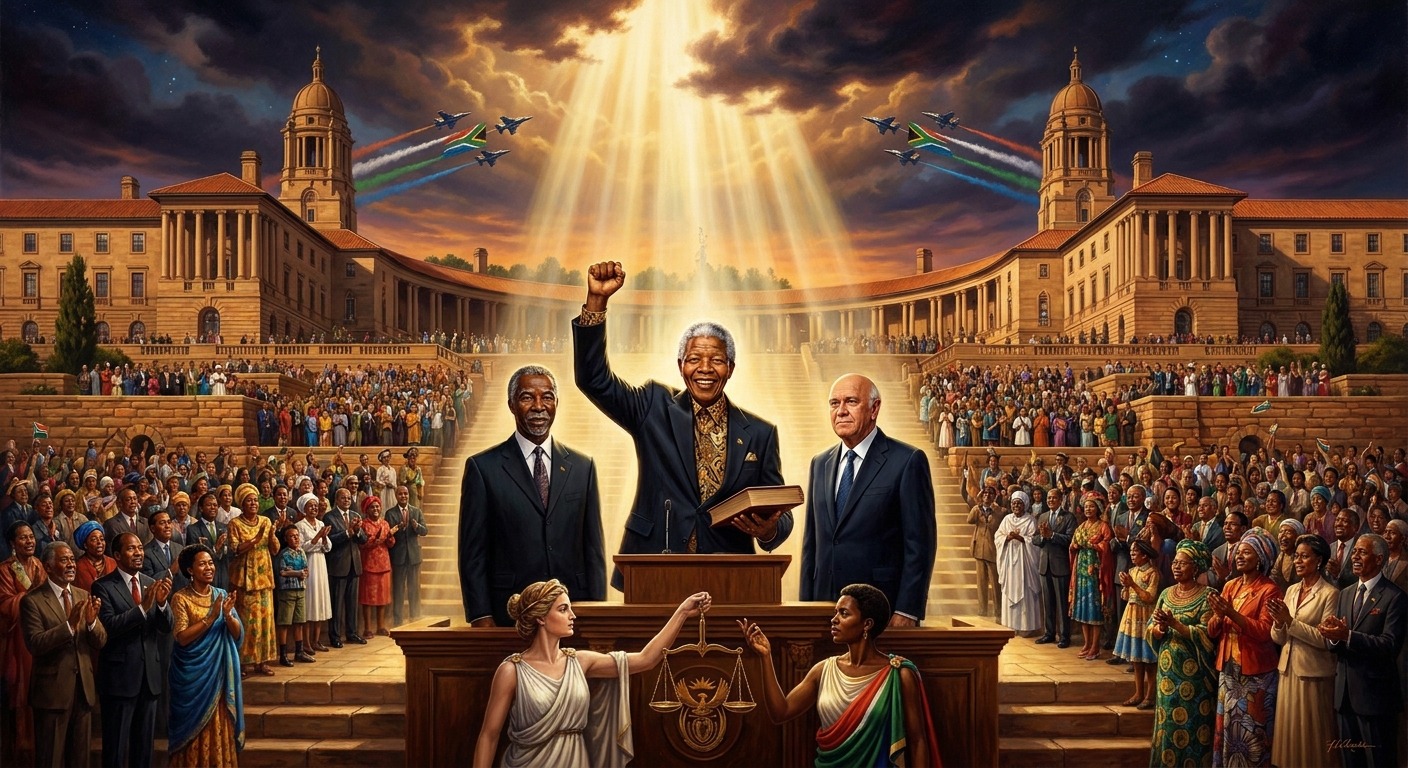
Generating art… Pretoria, May 10, 1994 — Nelson Mandela inaugurated; the country has eighteen months to invent the TRC before the wounds infect
 Generating art…
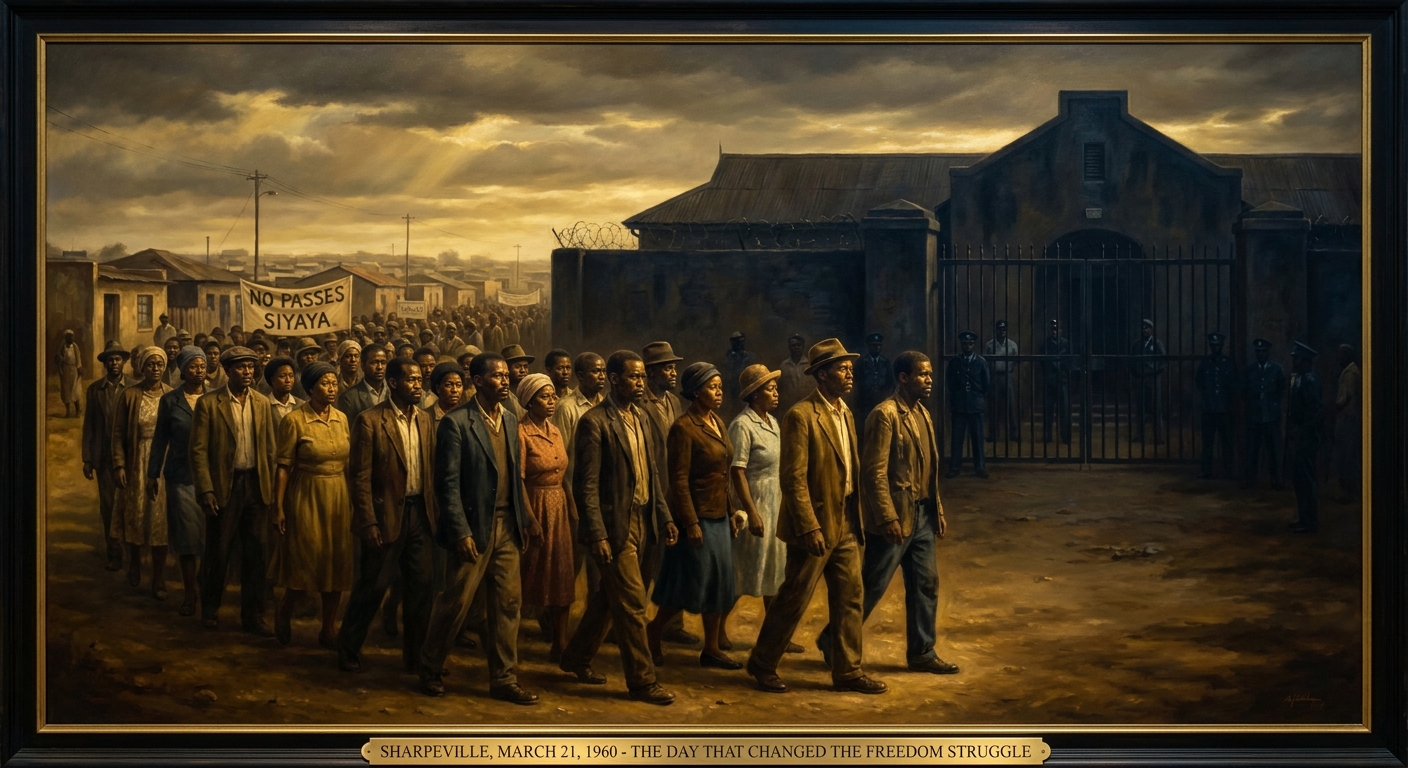
 Sharpeville — the 1960 massacre site that haunted every TRC hearing thirty-five years later
 Generating art…
 Echoes Across Traditions
Entities
- Desmond Mpilo Tutu
- Nelson Mandela
- F. W. de Klerk
- the Truth and Reconciliation Commission
- Steve Biko
Sources
- Desmond Tutu, *No Future Without Forgiveness* (1999)
- Antjie Krog, *Country of My Skull: Guilt, Sorrow, and the Limits of Forgiveness in the New South Africa* (1998)
- Truth and Reconciliation Commission of South Africa, *Final Report* (Vols. I-VII, 1998-2003)
- John Allen, *Rabble-Rouser for Peace: The Authorized Biography of Desmond Tutu* (2006)
- Pumla Gobodo-Madikizela, *A Human Being Died That Night: A South African Woman Confronts the Legacy of Apartheid* (2003)