The Lamb at Mount Carmel
28 February – 19 April 1993 · Mount Carmel Center, near Waco, Texas · The Mount Carmel compound, ten miles east of Waco, McLennan County, Texas
Contents
Fifty-one days outside Waco, Texas: a young preacher who believed he was the messianic Lamb of Revelation 5 facing down the federal government, four ATF agents and six Davidians dead at the opening raid, seventy-six dead in the fire that ended it.
- When
- 28 February – 19 April 1993 · Mount Carmel Center, near Waco, Texas
- Where
- The Mount Carmel compound, ten miles east of Waco, McLennan County, Texas
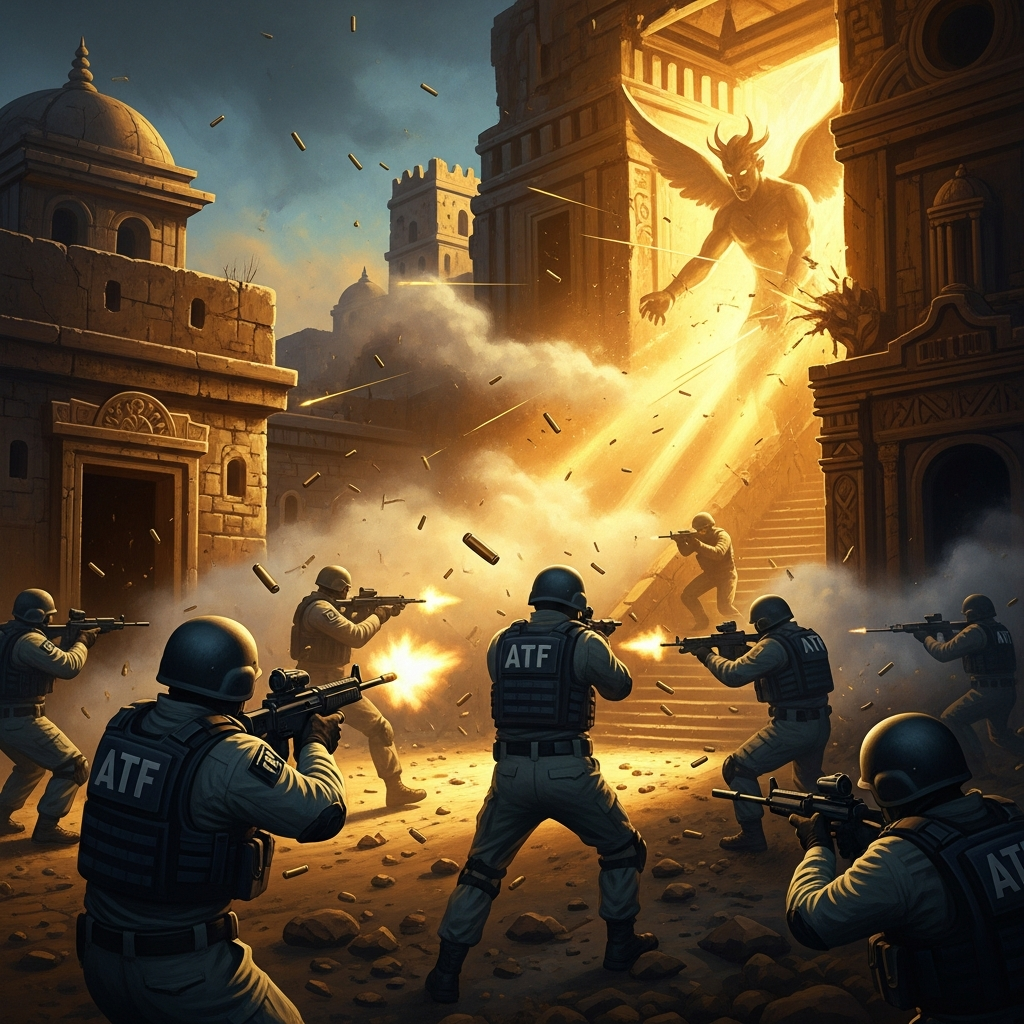
The cattle trailers come up the dirt road at nine-fifty-five on a Sunday morning.
Seventy-six ATF agents are crouched inside them, dressed for entry. The agency has briefed the raid as a dynamic entry — a short, overwhelming arrival that will end before the residents can organize a response. The intelligence is wrong. The residents have known the agents were coming for at least twenty minutes. A local news cameraman, lost on the way to the staging area, has stopped a Davidian named David Jones to ask for directions, and Jones has driven straight back to the compound to tell Koresh.
Koresh meets the agents at the front door unarmed. He has been preaching about this morning for nine years. He recognizes it the way an actor recognizes the cue for his entrance.
The shooting starts within seconds. No investigator has ever determined which side fired first. By eleven-thirty, four ATF agents are dead and six Davidians are dead, and the FBI is on its way from Washington.
The siege begins that afternoon.
Mount Carmel is not a fortress. It is a sprawling, badly built two-story complex on the Texas prairie, made of donated lumber and corrugated metal. It houses about a hundred and thirty people: thirty-five children, a dozen Britons, several Australians, a sociology graduate student, an attorney, a pop musician — Koresh himself, who had recorded a rock album under the name Cyrus a few years earlier — and a community that has organized its days around Bible study and the patient, line-by-line reading of the prophetic books.
The FBI rings the property with Bradley fighting vehicles. They cut the power. They aim stadium lights at the windows. They blast Tibetan chants and the screams of dying rabbits at the building through loudspeakers, all night, for weeks.
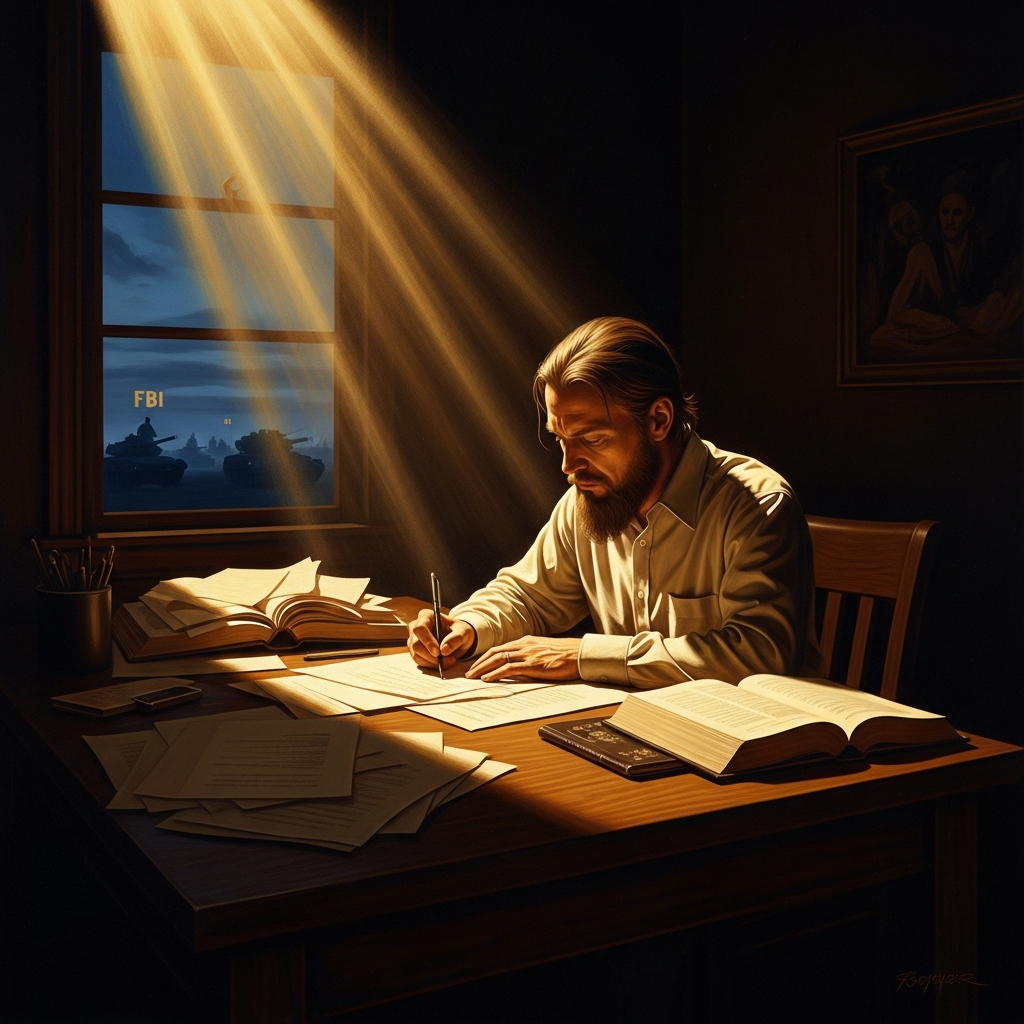
Inside, Koresh writes.
He is writing a manuscript on the seven seals.
The book of Revelation, chapter five: the slain Lamb takes the scroll from the right hand of the One on the throne, and only he is worthy to break the seals. Koresh has been teaching for nearly a decade that he himself is that Lamb — not Christ returned, but a second anointed messianic figure prophesied for the end-time, a Cyrus (the Hebrew Koresh) raised up to open what the first Christ left sealed.
It is a strange theology to outsiders. It is not strange at all to anyone who has read nineteenth-century Adventism. Koresh stands at the end of a long line — William Miller, Ellen White, Victor Houteff, Ben Roden, Lois Roden — each of whom believed the unfolding of Revelation had a next chapter and that they had been chosen to read it. Koresh’s innovation was the claim that the unfolding was now.
He promises the FBI negotiators, on day forty-five, that he will surrender once he has finished writing his commentary on the seals. The negotiators do not believe him. James Tabor, a New Testament scholar reached by phone in Charlotte, tells them: if you understand his theology, you will understand that he means it. Tabor’s advice is not taken. Within Koresh’s own framework, the manuscript is the thing he was born to write. Within the FBI’s framework, it is a stalling tactic.
He completes the first seal on the morning of 18 April.
The tanks come at six-oh-two on the morning of the nineteenth.
They are CEV — Combat Engineering Vehicles — modified M60s with steel booms welded to their fronts. The booms punch through the walls of the compound like a fist through drywall. Behind the booms, ferret rounds of CS gas. The plan, the FBI insists, is not assault. The plan is to make the building uninhabitable until the residents come out. The residents do not come out.
The wind on the prairie is gusting at thirty miles an hour. The walls of Mount Carmel are wood and tar paper. The interior is dark and crowded with frightened children. The cause of the fire — an open flame from a hurricane lamp, the gas, an internal decision to martyrdom — has been argued for thirty years, and the inquiries have not converged.
What is not in dispute: at twelve-oh-seven the first smoke shows from the second-floor window. At twelve-twelve the entire structure is burning. The flames are visible from the helicopters circling overhead, from the press encampment two miles away, from the suburbs of Waco. The FBI’s fire trucks are forty minutes back at the staging area. By the time they reach the compound, the building is a black skeleton on the prairie.
Seventy-six people are dead inside. Twenty-five are children.
Nine survivors walk out.
David Thibodeau is one of them. He will spend the rest of his life describing what it was like inside, and what nobody outside the compound has ever quite been able to grasp: that for the people who lived there, the apocalypse on the news that afternoon was not a tragedy. It was a vindication. They had been told by their teacher that Babylon would come for them, and Babylon had come. The seals were opening. The fact that they had not survived was, in the framework, beside the point. The framework had survived.
Koresh is found in a hallway with a single gunshot wound to the forehead. The medical examiner cannot determine whether the shot was self-inflicted or administered by his lieutenant Steve Schneider, who lies dead beside him with his own gunshot wound. Both are possible. Both are theologically coherent. The Lamb, in Revelation 5, is slain.
The Branch Davidians believed they were living inside the book of Revelation. The federal government believed it was conducting a tax-and-firearms enforcement action. The two frameworks could not see each other across the prairie, and the gap between them filled with smoke.
The lesson of Waco is not that apocalyptic communities are dangerous. They are, sometimes, but the more uncomfortable lesson is that the modern state is bad at recognizing them. The FBI’s behavioral analysts, trained on hostage negotiations with bank robbers, treated Koresh’s biblical citations as evasions. The biblical scholars who tried to brief them — Tabor, Phillip Arnold — were marginalized as soft on the suspect. A community whose entire interpretive grammar was the King James Bible was approached as if it were a criminal enterprise that happened to use religious vocabulary.
Two years to the day after the fire, Timothy McVeigh parked a rented truck in front of the Murrah Federal Building in Oklahoma City and detonated it, killing one hundred and sixty-eight people. He had visited Waco during the siege. He cited the date deliberately. The fire at Mount Carmel did not stay at Mount Carmel. Apocalyptic theology, when met with overwhelming force rather than careful reading, generates the next apocalypse. That is the warning the seventy-six were not, themselves, in a position to deliver.
Scenes
The ATF raid breaches the compound on a cold Sunday morning; gunfire begins almost immediately
 Generating art…
 The fifty-one-day siege; Koresh writes his exegesis of the seven seals as FBI tanks circle the property
 Generating art…
 On 19 April the tanks insert tear gas; by noon the compound is on fire and seventy-six people are dead, twenty-five of them children
 Generating art…
 Echoes Across Traditions
Entities
- David Koresh
- the Branch Davidian community
- the ATF / FBI
- the Lamb of Revelation
Sources
- James D. Tabor and Eugene V. Gallagher, *Why Waco? Cults and the Battle for Religious Freedom in America* (California, 1995)
- Stuart A. Wright (ed.), *Armageddon in Waco: Critical Perspectives on the Branch Davidian Conflict* (Chicago, 1995)
- Kenneth G. C. Newport, *The Branch Davidians of Waco: The History and Beliefs of an Apocalyptic Sect* (Oxford, 2006)
- The Department of Justice and Treasury Department reports on the raid and siege (1993)
- David Thibodeau, *A Place Called Waco* (PublicAffairs, 1999) — survivor account