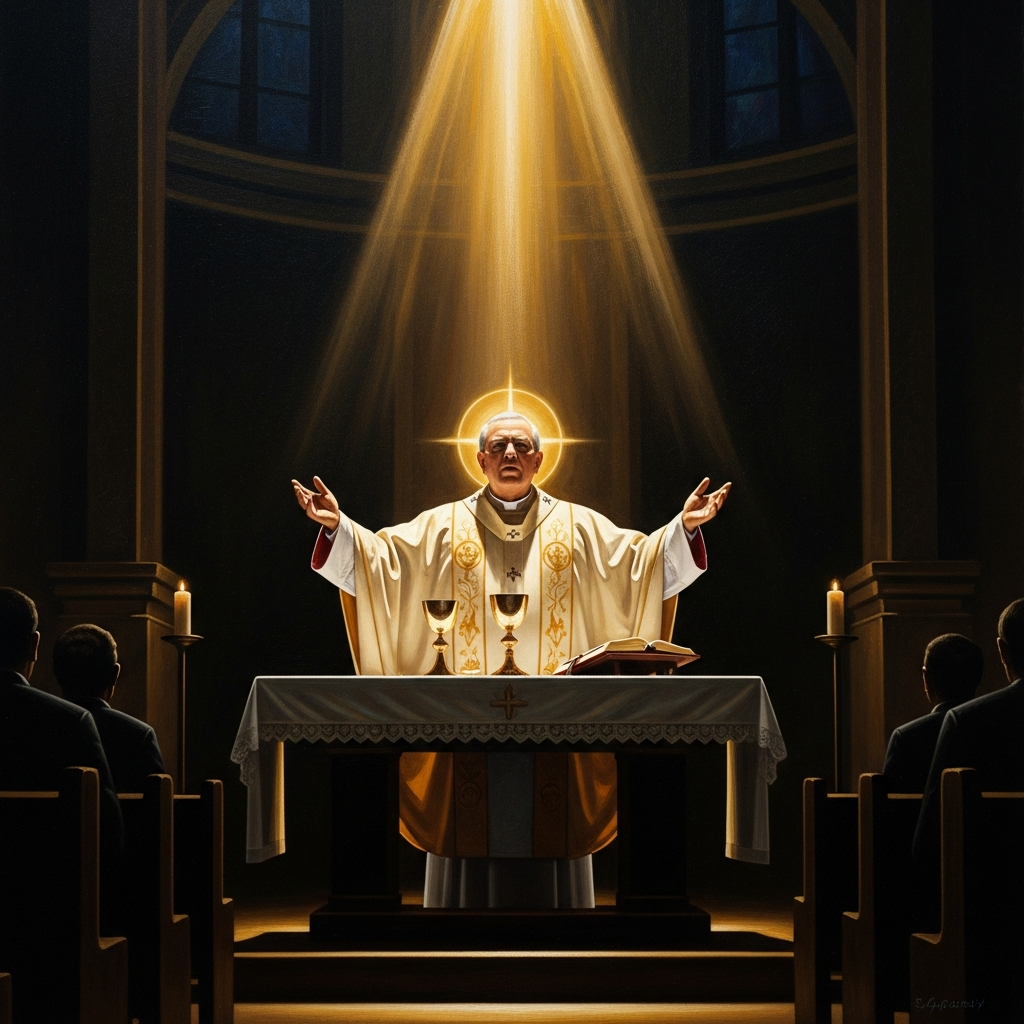
Romero at the Altar
March 24, 1980 CE · The chapel of the Hospital of Divine Providence, San Salvador, El Salvador
Contents
On the morning of March 24, 1980, in a small chapel attached to a cancer hospital in San Salvador, the archbishop of a country at war with itself raises a chalice over a wafer and is killed by a single rifle shot fired through the open chapel door — and becomes, in that instant, the only archbishop in Catholic history murdered at the altar during Mass and the practical icon of the theology he had spent three years preaching: that to stand with the poor against the state is itself a religious act, and that to die for that standing is to die for the faith.
- When
- March 24, 1980 CE
- Where
- The chapel of the Hospital of Divine Providence, San Salvador, El Salvador
The chapel is small.
This is the first thing to register. The Hospital of Divine Providence is a Carmelite-run cancer hospice on the western side of San Salvador, and the chapel attached to it has perhaps a hundred seats, a low altar, a small wooden door that opens directly to the parking area, and a window through which the light at six in the evening comes in slanted and yellow. The archbishop has lived in a small house on this property since he refused the official residence — the residence the previous archbishop had occupied, the one that came with a swimming pool and a gardener and a certain proximity to the families who run the country. He chose instead to live among dying women.
He has come down to celebrate a memorial Mass for the mother of a friend.
He is wearing the violet vestments of Lent. He has not slept much. The radio sermon yesterday — the one he preached from the cathedral, the one that has been broadcast across the country, the one that ended with the order — has been the longest of his life. He has been told, repeatedly, by his closest friends, that he should not be standing here in this chapel tonight in vestments under a hanging light bulb in front of an open door.
He stands here anyway.
He was not, three years ago, the man he is tonight.
This is the fact that has to be insisted on, because the legend collapses too easily into the icon and the icon is not the whole truth. When Oscar Arnulfo Romero was named archbishop of San Salvador in February 1977, the wealthy families of El Salvador were relieved. He was sixty years old, scholarly, conservative in liturgy, suspicious of liberation theology, considered safe. The progressive priests of the archdiocese were dismayed for the same reason. The papers in San Salvador were openly pleased: a churchman who would not make trouble.
Three weeks later, on March 12, 1977, Father Rutilio Grande — Jesuit, Romero’s friend, a priest who had been organizing campesinos in the village of Aguilares to read the Bible together and to ask why the land was concentrated in the hands of fourteen families — is ambushed on a country road and shot dead, along with an old man and a fifteen-year-old boy who happen to be in the jeep with him.
Romero drives to Aguilares that night. He sees the bodies. He sees Grande’s face on the floor of a small parish house, lit by candles, his glasses still on. He sees the campesinos sitting on the ground around the body, weeping, and the children watching him watch.
Something happens to him in that room. Theologians who have written about Romero have been careful, mostly, not to oversimplify. They will say that the seeds were already there, that his rural upbringing and his pastoral instincts had prepared him, that he was a slower convert than the iconography suggests. All of that is true. But it is also true that on the night of March 12, 1977, in a small parish house in Aguilares, Oscar Romero became someone different than he had been the morning before.
He does not stop being a churchman. He becomes the kind of churchman who reads the names of the dead on the radio every Sunday.
For three years he does this.
Every Sunday he preaches from the cathedral and the homily is broadcast nationwide on YSAX, the diocesan radio station. He uses the homily to read the names of the disappeared and the killed from the previous week. He names the death squads. He names the patterns. He says, again and again, in slightly different language each time, the single sentence that the families who run the country cannot tolerate: the persecution of the church is the persecution of the poor, because the church has chosen the side of the poor, because Christ has chosen the side of the poor, and any church that does not stand on that side is not the church of Christ.
He writes a letter to Jimmy Carter in February 1980, asking the president of the United States to stop sending military aid to the Salvadoran junta. The letter is polite. It is also unanswerable: he tells Carter that American weapons are killing his people. Carter does not stop the aid.
The death squads bomb YSAX twice. Romero rebuilds it both times. He receives, weekly, threats specific enough to be plausible. He tells a Mexican journalist a few weeks before his death: If they kill me, I will rise again in the Salvadoran people. He says this without theatricality. It is a statement of his theology. It is also, as it will turn out, accurate.
On Sunday, March 23, 1980, he preaches the homily that gets him killed.
The cathedral is full. The radio is broadcasting. He has just read, again, the long list of names. He builds, slowly, toward the end of the sermon. He addresses the soldiers of the army directly. Brothers, he says, you are part of our own people. You are killing your own peasant brothers and sisters. Before an order to kill given by a man, the law of God must prevail: Thou shalt not kill. No soldier is obliged to obey an order against the law of God. An immoral law, no one is obliged to fulfill.
He raises his voice for one sentence — the only time he raises it in the entire homily. In the name of God, then, and in the name of this suffering people whose laments rise up to heaven each day more tumultuous, I beseech you, I beg you, I order you in the name of God: stop the repression!
The cathedral erupts in applause that lasts more than a minute. Romero stands at the pulpit and does not respond. He knows what he has just done.
The next morning the order goes out from a house in San Salvador associated with Major Roberto D’Aubuisson, founder of the death squads, future founder of the ARENA party, future presidential candidate: the archbishop is to be eliminated. A small team is assembled. A driver, a marksman with a .22-caliber rifle, a vehicle.
They wait for him to celebrate Mass.
It is six in the evening on March 24.
Romero stands at the small altar in the chapel of the Hospital of Divine Providence. He has just finished the homily. The reading was from John 12: Unless a grain of wheat falls into the earth and dies, it remains alone; but if it dies, it bears much fruit. The homily was about that grain. It was about the offering of one’s life for others. It was, in retrospect, almost intolerably literal.
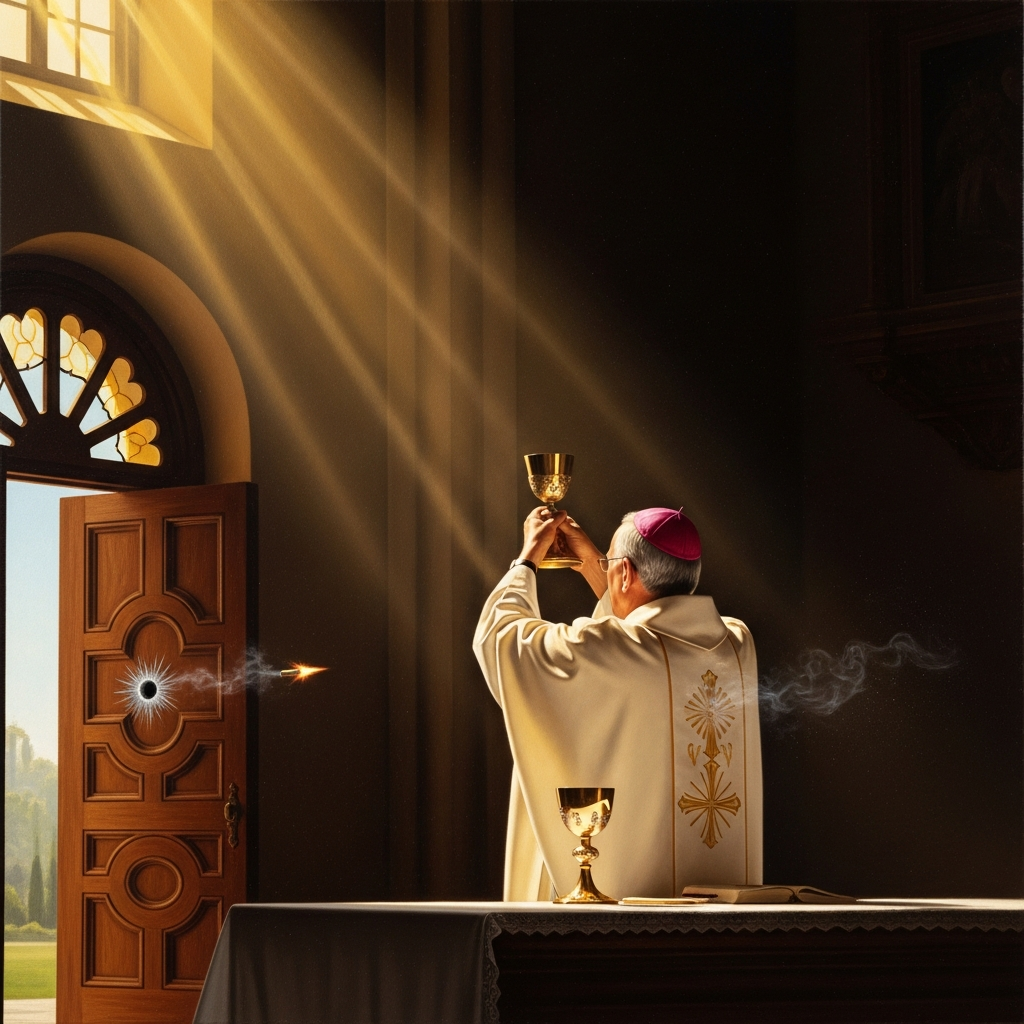
He moves to the offertory. He raises the chalice. The wine is in his hands, lifted toward the altar’s small wooden cross. The light bulb above him catches the silver.
A red Volkswagen Passat has stopped on the road outside. The chapel door is open to the parking area for ventilation. The marksman — single bullet, hollow-point, .22 — fires once through the open door.
The bullet enters Romero’s chest. He falls behind the altar. The chalice tips and the wine spills across the white cloth. The hosts scatter on the floor. The nuns in the front row scream. A doctor from the hospital runs from the back. By the time he reaches the altar, the archbishop is already dead.
He has been the archbishop of San Salvador for three years and one month. He has been a martyr for ninety seconds.
The funeral, six days later in the Cathedral of San Salvador, is one of the largest religious gatherings in the history of Central America. Tens of thousands fill the plaza outside. Cardinals from Mexico and Spain and the United States concelebrate at the altar. The casket is positioned where Romero used to preach.
Halfway through the Mass, bombs detonate in the plaza. The army opens fire on the crowd from the buildings around the cathedral. Forty people die in the panic. The mourners flood into the cathedral itself, carrying the wounded over the heads of the priests, and the funeral becomes — as Romero’s life had become — a confrontation between the Mass and the gun.
Inside, behind the altar, the casket is hidden in a side chapel for safety. It will not be visible to the public again that day. The cardinals concelebrate the Eucharist over the bodies of the wounded laid out in the side aisles. Outside, the army keeps firing.
When the crowd finally disperses, hours later, the cathedral floor is wet with blood and consecrated wine. The two are not, by this point in the afternoon, easily distinguishable.
It will take thirty-eight years for Rome to canonize him.
Pope John Paul II, who had been suspicious of liberation theology, prayed at his tomb in 1983 — a private gesture, before the official process. Pope Benedict XVI, who as Cardinal Ratzinger had issued the 1984 Instruction critical of liberation theology, lifted the block on Romero’s beatification process in 2012. Pope Francis — Argentine, Jesuit, formed in the Latin American church that Romero had served — beatified him in 2015 and canonized him in 2018.
The canonization document specifies the cause of death: in odium fidei. In hatred of the faith.
This phrase matters more than the canonization itself. The official position of the Catholic Church is now that Oscar Romero was killed because of his Christian faith. Not because of his politics. Because of his faith. Which means that the politics he was killed for — the option for the poor, the denunciation of state violence, the refusal to bless the army’s killing — is, by official Catholic teaching, what Christian faith requires.
This is, theologically, what liberation theology had always claimed. The institution had spent decades arguing the opposite. The institution has now changed its mind. The change came too late for Romero, but not for the doctrine.
He had said it himself, the week before he was killed, to an interviewer who asked him whether he was afraid. A bishop will die, he said, but the church of God, which is the people, will never perish.
The grain has fallen into the earth. The fruit is still being counted.
Scenes
Archbishop Oscar Romero celebrates his last Mass at the chapel of the Hospital of Divine Providence, March 24 1980 — moments before the shot
Generating art… The single rifle shot fired through the open chapel door as Romero elevates the chalice — killed at the altar in the act of consecration
 Generating art…
 Romero's funeral in the Cathedral of San Salvador, March 30 1980: tens of thousands gather, bombs detonate in the plaza, the army opens fire on the crowd
 Generating art…
 Echoes Across Traditions
Entities
- Oscar Arnulfo Romero
- Roberto D'Aubuisson
- Jimmy Carter
- Gustavo Gutiérrez
- Pope Francis
Sources
- Jon Sobrino, *Archbishop Romero: Memories and Reflections* (1990)
- James R. Brockman, *Romero: A Life* (1989)
- Oscar Romero, *The Violence of Love* (compiled sermons, trans. James R. Brockman, 1988)
- Marie Dennis, Renny Golden, and Scott Wright, *Oscar Romero: Reflections on His Life and Writings* (2000)
- Matt Eisenbrandt, *Assassination of a Saint: The Plot to Murder Óscar Romero and the Quest to Bring His Killers to Justice* (2017)