The Last Tape at Jonestown
Saturday, 18 November 1978 · Jonestown, Guyana · The agricultural pavilion at the Peoples Temple settlement, Northwest District, Guyana
Contents
On a Saturday afternoon in the Guyanese jungle, Jim Jones gathers nine hundred of his followers around a vat of cyanide-laced Flavor-Aid and calls it revolutionary suicide. The forty-minute reel that survives him is the most harrowing recording in American religious history.
- When
- Saturday, 18 November 1978 · Jonestown, Guyana
- Where
- The agricultural pavilion at the Peoples Temple settlement, Northwest District, Guyana
The shooting at the airstrip is over by five-thirty.
Congressman Leo Ryan lies in the dust beside the Twin Otter. Three reporters and a defector named Patricia Parks lie near him. A truck has pulled up, men have stepped out, and the gunfire has lasted under a minute. Word travels the six miles back to the pavilion before the bodies are cool.
Jones is waiting for it.
He has been awake for days. The amphetamines have hollowed his face. His wife Marceline has begged him to eat. The defectors who left with Ryan that morning — the Parks family, the Bogues, sixteen people — were the rupture he had warned the community against for years, the proof, in his ruined logic, that the conspiracy against them was real and final. He picks up the microphone. He calls the community to the pavilion.
“The time has come for us to meet in another place,” he says.
The tape begins mid-sentence. Children sit on the wooden benches. Mothers hold infants. The vat of Flavor-Aid stands at the front of the pavilion in a metal tub, the cyanide already stirred in by the medical team. Larry Schacht, the camp doctor, has been preparing for this for weeks. The syringes, for the babies, are laid out on a folding table.
Jones speaks the way a tired pastor speaks at the end of a long service. “We’ve been so betrayed. We’ve been so terribly betrayed.” His voice is gentle. He is not screaming. The horror of the tape is its calm — the pastoral cadence wrapped around the impossible request, the practiced rhetoric of a man who has rehearsed this moment in sermons for a decade and is finally, exhaustedly, delivering it.
A woman stands.
Christine Miller, sixty years old, a Temple member since the California days. She steps to the microphone. “I think there were too few who left for the planes to take off.” She is arguing — quietly, respectfully, in the call-and-response idiom of the Temple itself — that the children should not have to die. That there is still a way out. That Russia, the long-promised refuge, might still take them.
The crowd murmurs against her. “You’re afraid to die,” someone says. Jones answers her gently and then less gently. “I’m tired of it all,” he tells her. “It’s never been a problem with me, Christine. The problem is that they don’t leave us alone.” Her voice grows smaller against the mass of the assembly. She sits down. She is the only voice on the tape that says no.
She will be among the dead by sunset.
The children go first.
The medical team carries the infants forward. The cyanide is administered with syringes — squirted into the back of the throat. The older children drink from paper cups. Mothers hold them. Some mothers are screaming. Some are not. Jones speaks over the screaming.
“Stop these hysterics,” he says. “This is not the way for people who are socialists or communists to die. We must die with some dignity.”
It takes about five minutes for a child to die from oral cyanide. The pavilion fills with the sound of it. The tape captures the sound. The transcript, when scholars later prepared it, marks these passages only as (crying, screaming). There is no ethical way to render them on a page. There is no ethical way to listen to them. There is also no ethical way to pretend they did not happen.
“We didn’t commit suicide,” Jones says, near the end of the reel. “We committed an act of revolutionary suicide protesting the conditions of an inhuman world.”
He is quoting Huey Newton. He has been quoting Huey Newton for years. The phrase revolutionary suicide was, in Newton’s original usage, a political stance — the refusal to die quietly under oppression. Jones has bent it ninety degrees. He has turned a phrase about resistance into a phrase about a vat. The bend is the whole theology.
The microphone picks up the adults drinking. It picks up Marceline, his wife — once a registered nurse, once a Methodist who joined her young husband’s integrated Indianapolis ministry in 1949 — saying nothing audible. It picks up the singing. The Temple loved to sing. They sang as they died.
The tape ends because the recorder ends.
There are still living people in the pavilion when it stops — perhaps a hundred, perhaps more — but the reel runs out, and there is no one alive thinking to flip it. The Guyanese army arrives the next morning. They walk into the clearing and find nine hundred and nine bodies arranged in concentric rings around the vat. Jones lies near the chair, shot once in the head, by his own hand or another’s; the autopsy could not say.
Two hundred and seventy-six of the dead are children.
Jonestown is, that morning, the largest single loss of American civilian life since the Civil War. It will hold that record for twenty-three years, until the towers fall.
The tape is the document because the tape will not let you look away. Reading about Jonestown lets you keep your distance. Listening to Jonestown — the singing, the children, Christine Miller’s lone voice arguing for life against a community that has decided on death — does not.
The followers were not stupid. They were not weak. They were schoolteachers and nurses and former Black Panthers and Methodist deacons and elderly women who had walked picket lines in the segregated South. They had given their pensions to the Temple because the Temple had fed the hungry, integrated the schools, marched with Cesar Chavez. They had earned the right to be believed when they said the Temple was the most just community they had ever known.
And then a damaged man at the center of it built an altar of paranoia, and they could not, in the end, see the altar for the man. Every theological tradition has a name for this. The Hebrew Bible calls it idolatry. The Christian gospels call it the wolf in shepherd’s clothing. The Buddhists call it the corruption of the sangha by the unenlightened teacher. The cautionary lesson of Jonestown is not that religion is dangerous. It is that the most beautiful religious impulse — community, sacrifice, the willingness to die for one another — is the exact impulse a damaged shepherd will harvest.
The tape exists so we cannot forget that.
Scenes
Congressman Leo Ryan and the defectors are shot at the Port Kaituma airstrip; word reaches the pavilion
 Generating art…
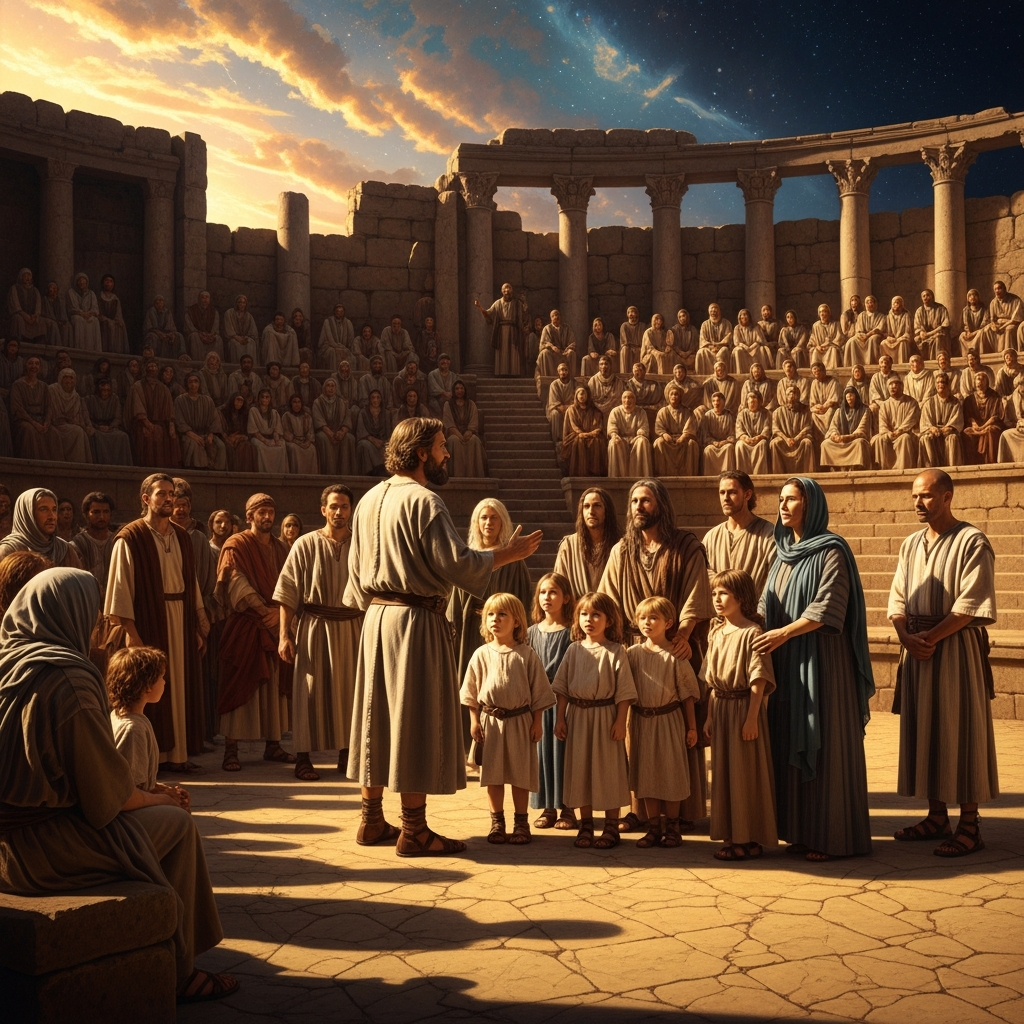
 Jones gathers the community and announces the moment has come; the children are brought forward first
 Generating art…
 The tape runs for forty minutes; nine hundred and nine people lie in the clearing when it ends
 Generating art…
 Echoes Across Traditions
Entities
- Jim Jones
- the Peoples Temple congregation
- Christine Miller
- Congressman Leo Ryan
- Marceline Jones
Sources
- FBI tape Q042 (the 'death tape'), Jonestown, 18 November 1978
- Tim Reiterman, *Raven: The Untold Story of the Rev. Jim Jones and His People* (Dutton, 1982)
- Jeff Guinn, *The Road to Jonestown* (Simon & Schuster, 2017)
- The Jonestown Institute archive, San Diego State University (Rebecca Moore, ed.)
- David Chidester, *Salvation and Suicide: An Interpretation of Jim Jones, the Peoples Temple, and Jonestown* (Indiana, 1988)