Gutiérrez and the Poor Who Read the Bible
1960s-1971 CE — the development of liberation theology; *A Theology of Liberation* published 1971 · Rimac barrio, Lima, Peru — and the base communities across Latin America
Contents
In a hillside slum on the edge of Lima — one of the millions of squatter settlements that ring every South American city as the rural poor flood into them looking for work — a young Peruvian priest watches small groups of campesinos read the Hebrew Exodus together by lamplight and notice, slowly, that the same God who freed slaves from Pharaoh has something to say about their landlords and their wages, and in noticing this they are doing something the seminaries of Europe have not done in five hundred years: they are reading the Bible from underneath, and they are getting it right.
- When
- 1960s-1971 CE — the development of liberation theology; *A Theology of Liberation* published 1971
- Where
- Rimac barrio, Lima, Peru — and the base communities across Latin America
The hill is called Rimac.
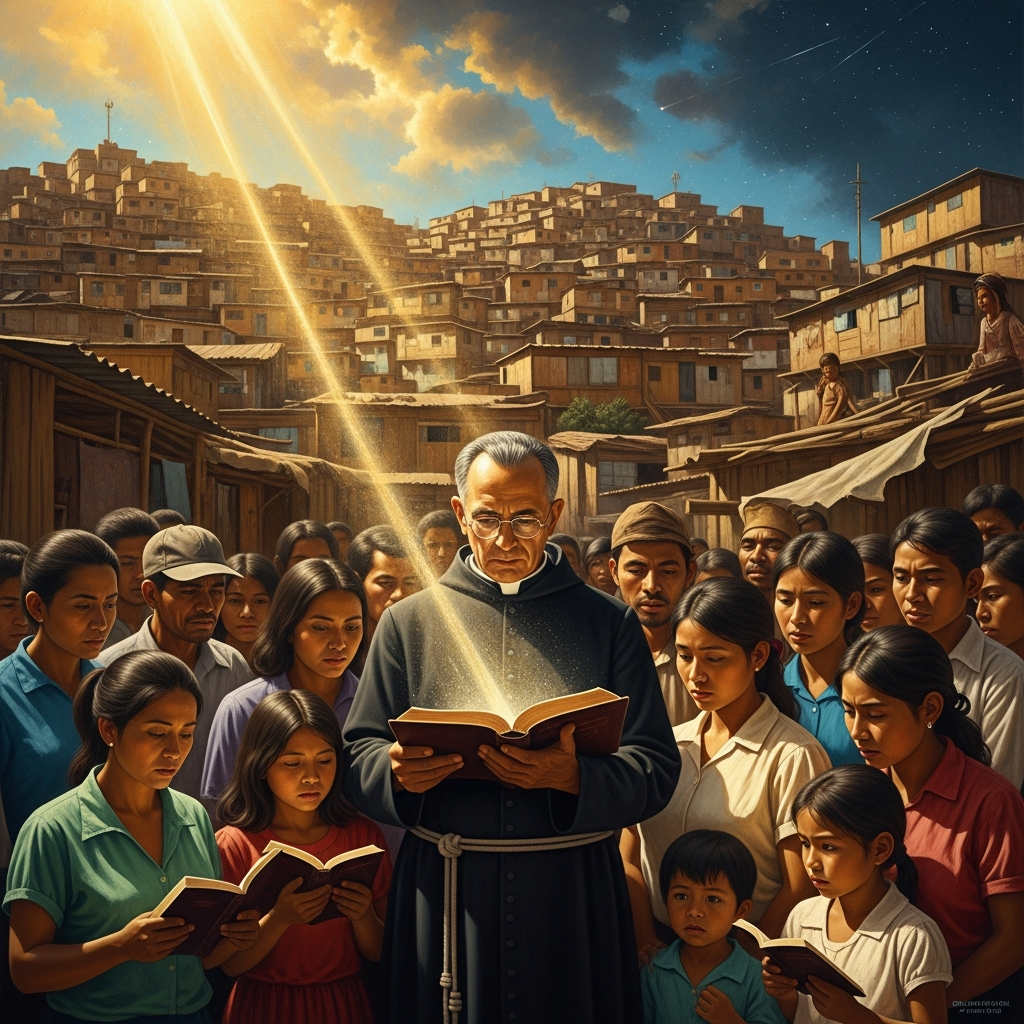
It rises north of the Rio Rimac on the edge of Lima, and in the early 1960s it is one of the hundreds of squatter settlements that ring the city. The settlements are called barriadas or pueblos jóvenes — young towns — and they grow as the rural poor pour in from the Andes, looking for work, looking for a hospital, looking for a school for their children, looking for the future the haciendas no longer offer them. They build their houses out of woven reeds and cardboard and corrugated tin, and when they have a little money they replace the reeds with brick. The water is carried up the hill in cans. The electricity, when there is electricity, is borrowed from a single illegal connection that runs from the bottom of the slope to a single bulb in a single shack.
The young priest who walks up this hill has a Belgian medical degree he never used and a doctorate from the Catholic University of Lyon and a conviction that the European theology he has been taught — a theology of personal sin, individual salvation, abstract grace — is unable to say anything useful to the people who live in the houses on this hill.
His name is Gustavo Gutiérrez. He is mestizo, the son of an Andean mother and a Spanish father, raised partly in Lima, partly in the highlands. He has had a chronic limp since he had osteomyelitis as a child. When he walks up the Rimac hill the climb takes a long time. He has time, on the climb, to think.
What he is thinking, in the early 1960s, is that something is happening in the barriadas that the seminary in Lyon could not have predicted.
The thing happening is that the people are reading the Bible.
This sounds, said quickly, unremarkable. It is not unremarkable. For four hundred years, since the Council of Trent and the Counter-Reformation, the Catholic Church in Latin America had not been a Bible-reading church. The Bible was read at Mass, in Latin, by the priest. The laity heard it. They did not study it. They were told what it meant. The priesthood mediated between the text and the people, and the priesthood, in colonial Latin America, had also mediated between the people and the encomiendas, between the people and the haciendas, between the people and the colonial governors. The mediation, in both directions, had been good for the priests and good for the patrones and bad for the people.
Then, between 1962 and 1965, the Second Vatican Council reopened the Catholic Church to vernacular Scripture. The constitution Dei Verbum declared that the Bible should be made widely available to the faithful. Lumen Gentium called the church the People of God. Mass began to be said in Spanish and Portuguese and Quechua. Bible study groups began to form in the parishes.
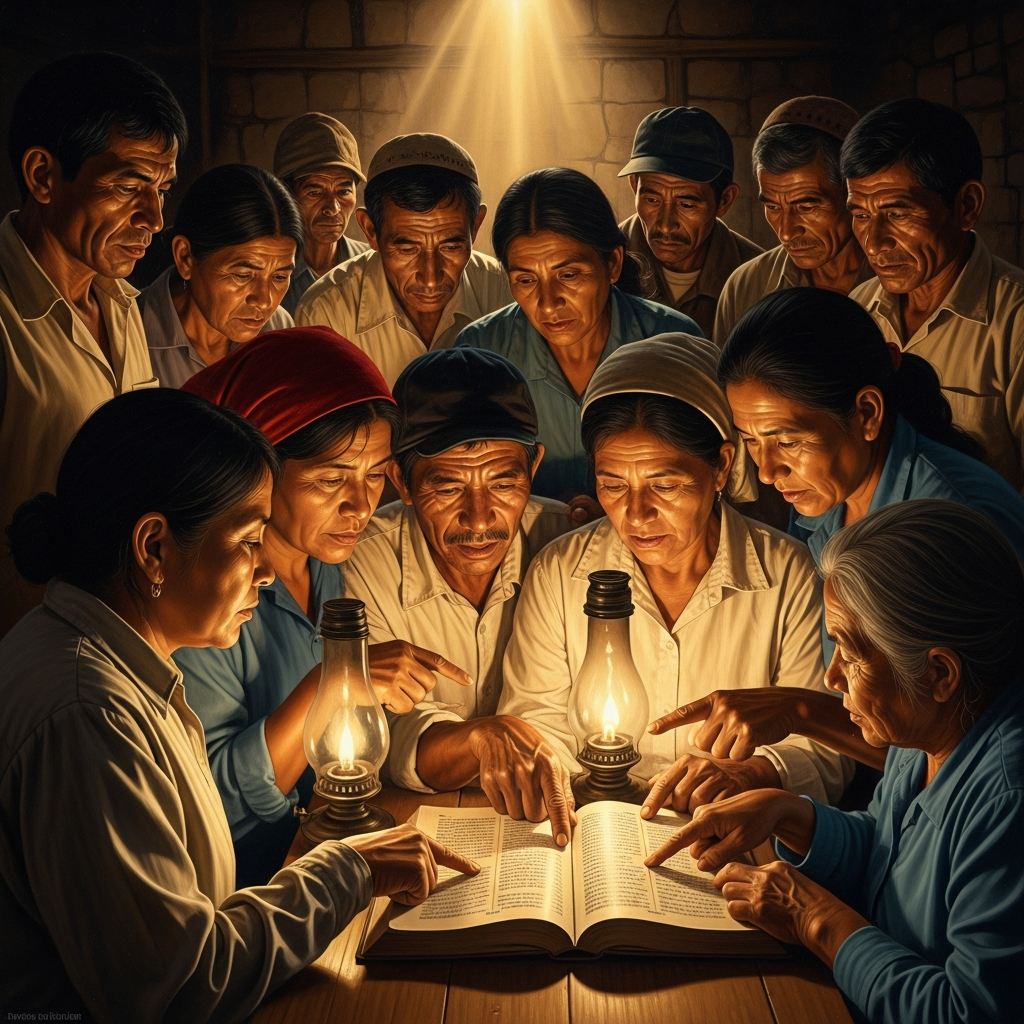
And in the barriadas, where there were not enough priests for the population — where one priest might serve fifteen thousand people scattered across a slope of brick and tin — the Bible study groups began to function without priests. They formed around lay catechists. They formed around women who could read. They formed around miners’ union organizers and former Communists who had become, against their own theory, Catholic again because their wives had refused to baptize the babies any other way.
The groups were called comunidades eclesiales de base — base ecclesial communities. The base, in the term, was not a metaphor. It meant the bottom. It meant the people whose feet were on the ground.
Gutiérrez watches them. He listens. He notices what they are doing.
They are reading Exodus. They are reading Genesis. They are reading Amos and Isaiah and Jeremiah. They are reading the Magnificat. They are reading the Sermon on the Mount. And they are noticing things that the European seminaries had not noticed in five hundred years.
They are noticing that Pharaoh is in the Bible. That the Pharaoh in Exodus is a real political figure with real economic interests, who works the Hebrews because their labor is profitable to him, and that the God of Moses takes the side of the workers against him. They are noticing that the Hebrew prophets are not preaching about an afterlife but about land tenure and royal corruption and the systematic theft of the poor by the rich. They are noticing that Mary’s Magnificat — He hath put down the mighty from their seats, and exalted them of low degree; He hath filled the hungry with good things; and the rich He hath sent empty away — is a song about a redistribution.
They are noticing, in other words, that the Bible is about them. Not metaphorically. Literally. The book describes a God whose attention is bent toward the poor, who acts in history on behalf of the enslaved, who has stern words for landlords and judges and kings. The campesinos in the barriadas recognize their landlords in the Bible’s landlords. They recognize their judges in the Bible’s judges. They recognize their kings in the Bible’s kings.
They also recognize themselves.
Gutiérrez sees this happening and he understands, with a clarity that arrives all at once, that he is watching something theological occur. The poor are doing what the seminaries had been failing to do. They are reading the Bible from underneath. And from underneath, the Bible reads differently than it does from the parlors of Lyon.
He decides to write the theology that the comunidades de base are already practicing.
The book takes years. He works on it in fragments — homilies, lecture notes, essays for Peruvian theological reviews. He travels through Latin America, attending the meetings of the Latin American Bishops’ Conference. He is at Medellín in 1968, when the Latin American bishops, meeting in Colombia, formally adopt a preferential option for the poor as a category of Catholic teaching. He helps draft the language. The phrase will reshape Catholic social thought.
In 1971 the book is published in Lima as Teología de la Liberación: Perspectivas. The English translation, two years later, will travel further and faster than anyone had predicted. A Theology of Liberation is read in seminaries from Berkeley to Birmingham to Manila. It is translated into Korean and Tagalog and Swahili. The argument it makes is short and dense and unflinching.
The argument is this. Salvation, in the Bible, is not only or primarily salvation from sin in the abstract. It is salvation from the conditions that crush human life. It is liberation. The God of the Bible is a liberating God — first of slaves from Egypt, then of exiles from Babylon, then of the poor from the chains the prophets name. The Incarnation, the cross, the resurrection are events in this history of liberation. They are not interruptions of it.
Therefore: the church, if it is faithful to the God of the Bible, must take the side of the poor — not because the poor are morally superior, not because charity is a virtue, but because God has taken that side and the church is required to follow.
This is the preferential option for the poor. It is not optional. It is what the option of being a Christian commits one to.
The book is also clear that this means specific things. It means using the analytic tools of social science — including, where useful, the structural analysis of class and exploitation that comes from Marx — to understand why the poor are poor. It does not mean accepting Marx’s atheism, which Gutiérrez explicitly rejects. It means refusing the comfort of an abstract universalism that floats above the question of who has the boot and whose neck is under it. It means doing theology with one’s feet in the barriadas.
The Vatican’s reaction is mixed and slow and famous.
In 1984 Cardinal Joseph Ratzinger, then prefect of the Congregation for the Doctrine of the Faith and later Pope Benedict XVI, issues an Instruction on Certain Aspects of the Theology of Liberation. The Instruction does not condemn liberation theology in total. It distinguishes between what it calls a legitimate option for the poor and what it considers an illegitimate use of Marxist categories. It expresses concern about the political instrumentalization of the Gospel.
The Instruction names no liberation theologians directly. But its criticisms are read, accurately, as directed primarily at Leonardo Boff in Brazil and Jon Sobrino in El Salvador. Boff is silenced for a year. Sobrino’s books are subjected to scrutiny. Gutiérrez himself, who had been more careful about the Marxist categories than Boff or some others, is not silenced. He is, however, watched.
He is also, throughout this period, working in Lima. He is teaching at the Catholic University. He is writing. He is — and this is the fact the polemics often miss — saying Mass and giving communion and walking up the Rimac hill to the comunidades. The theology has not become a theory disconnected from the practice. He is in his sixties now, and his limp has gotten worse, but he is still walking up the hill.
In 2013, the Argentine Jesuit Jorge Mario Bergoglio is elected pope.
Bergoglio takes the name Francis — the first pope to do so, in honor of the saint of Assisi who had embraced poverty and had spoken to the wolves and had, as Pope Francis would later say, built a church for the poor. Francis has been, in his Argentine years, a complicated figure on liberation theology — closer to the teología del pueblo, the theology of the people, than to the more Marxian variants, but rooted in the same Latin American soil and shaped by the same forty years of base communities.
In September 2013, L’Osservatore Romano, the Vatican’s newspaper, publishes a long, favorable interview with Gustavo Gutiérrez. In 2015, the same Cardinal Gerhard Müller who is now prefect of the Congregation for the Doctrine of the Faith — Ratzinger’s old job — co-authors a book with Gutiérrez. Müller calls Gutiérrez a friend and a teacher.
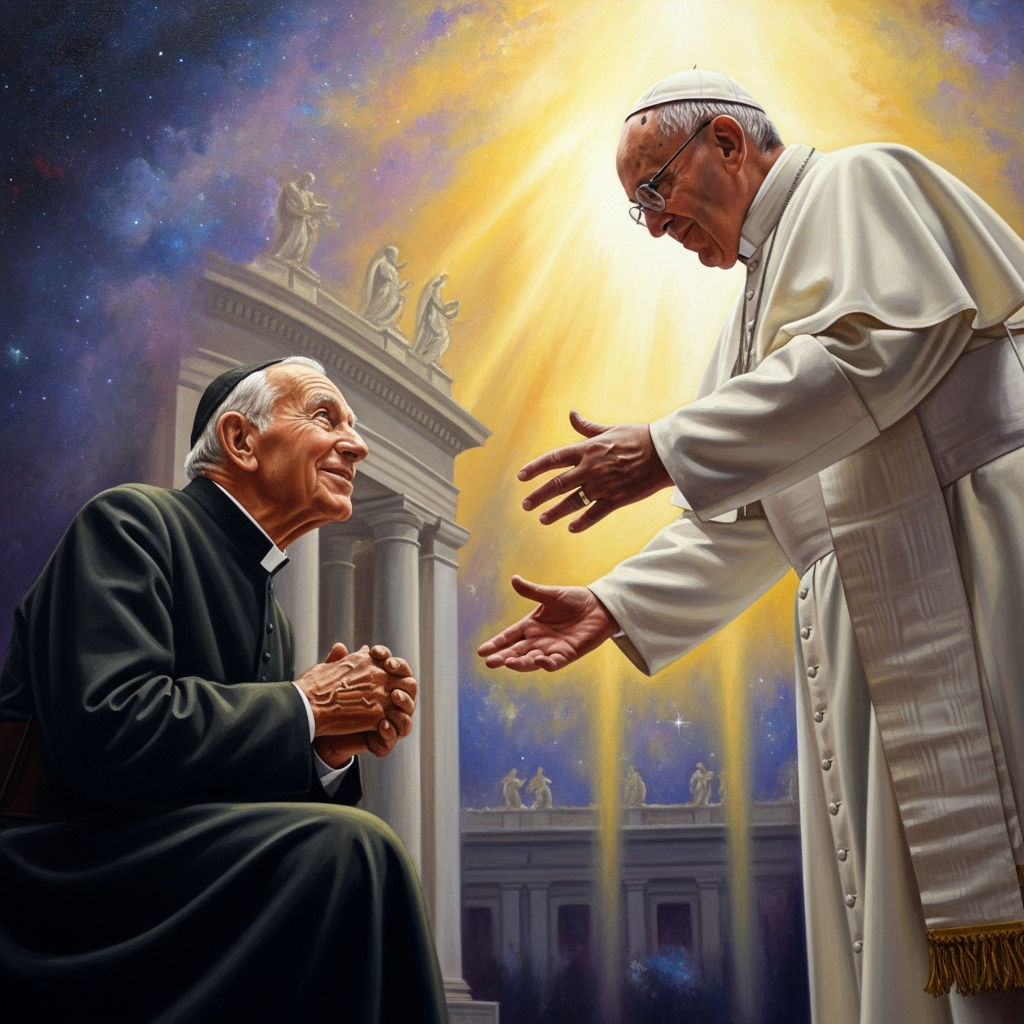
That same year, Gutiérrez is invited to speak at a Vatican conference. Pope Francis greets him. The Vatican photographer captures the meeting. The eighty-six-year-old Peruvian Dominican, leaning on his cane, stands beside the Argentine pope. Both are smiling. Forty-four years after A Theology of Liberation was first published, the Vatican has not condemned its author. It has invited him in.
The base communities he had watched in the Rimac barrio were still meeting. They are still meeting now, in some form, across Latin America, across Africa, across parts of Asia. They are smaller than they were at their peak in the 1980s. They are not, any longer, the great hope of the Latin American left. They are, however, the most enduring fact of late twentieth-century Catholicism: the poor reading the Bible in small groups by lamplight and discovering, again and again, that the book is about them.
Gutiérrez did not invent this. He noticed it, named it, and gave it theological respectability. He went up the hill, and he listened, and he wrote down what he heard.
The hill is still there. The reading is still happening.
Scenes
Father Gustavo Gutiérrez in the Rimac barrio of Lima, early 1960s — the hillside slums where the theology of liberation was first read out of the Bible by the people who lived there
Generating art… A base community gathered by lamplight — small groups of campesinos and urban poor reading Exodus together, without priestly mediation, recognizing themselves in the text
 Generating art…
 Gutiérrez meets Pope Francis at the Vatican, 2015 — after four decades under Vatican suspicion, the Jesuit pope welcomes the architect of liberation theology as a teacher
 Generating art…
 Echoes Across Traditions
Entities
- Gustavo Gutiérrez
- Oscar Romero
- Cardinal Joseph Ratzinger
- Pope Francis
- the base communities of Latin America
Sources
- Gustavo Gutiérrez, *A Theology of Liberation: History, Politics, and Salvation* (1971; English translation, 1973)
- Gustavo Gutiérrez, *We Drink from Our Own Wells: The Spiritual Journey of a People* (1984)
- Leonardo Boff and Clodovis Boff, *Introducing Liberation Theology* (1987)
- Paul E. Sigmund, *Liberation Theology at the Crossroads: Democracy or Revolution?* (1990)
- Gustavo Gutiérrez and Gerhard Müller, *On the Side of the Poor: The Theology of Liberation* (2015)