The Long Rise of Reverend Jones
1955 Indianapolis – 1972 San Francisco – 1977 Guyana · Indianapolis, Indiana → Ukiah and San Francisco, California → Jonestown, Guyana
Contents
Twenty-three years separate the young Methodist preacher integrating his Indianapolis storefront church in 1955 from the man with the microphone in the Guyanese pavilion. Both men were named Jim Jones. The slow descent between them is the American liberal Protestant tragedy.
- When
- 1955 Indianapolis – 1972 San Francisco – 1977 Guyana
- Where
- Indianapolis, Indiana → Ukiah and San Francisco, California → Jonestown, Guyana
Indianapolis, 1955.
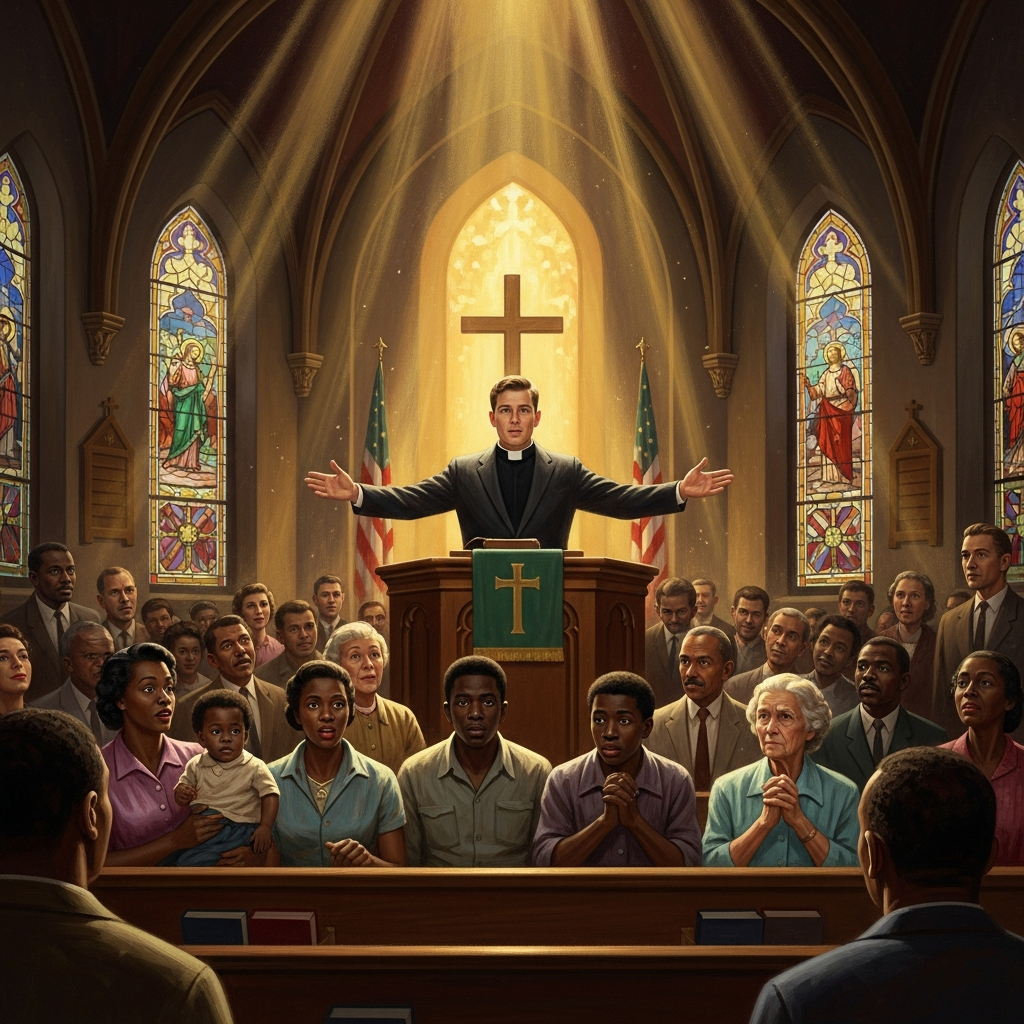
Jim Jones is twenty-four. He has the gentle Pentecostal cadence of his Indiana upbringing and a wife, Marceline, who is a registered nurse and a serious Methodist. He has just been given a small storefront congregation on the city’s near north side. The neighborhood is mixed. The church, by the unwritten rule of every Christian denomination in the segregated North, is not.
He integrates it on his second Sunday.
He invites Black families to worship. He preaches that the kingdom of God does not have a back pew. The white deacons threaten to leave. Some of them follow through. He persists. Within a year he has been cut by a knife outside the building, has had a swastika painted on the church door, has had a dead cat thrown onto the porch by people who do not want him doing what he is doing in the Indiana of George Wallace’s contemporaries. He persists through all of it. The congregation he builds is the most thoroughly integrated church in Indianapolis.
This is who he is. This is also, exactly and unbearably, who he is.
He studies Father Divine.
The Peace Mission, the great Black New Thought movement of the 1930s and 40s, fascinates him. He takes Marceline to Philadelphia to meet the elderly Father Divine in person. He watches the structure carefully — the communal hotels, the integrated dining halls, the absolute personal authority of the minister, the followers who address Father Divine as God. Most of what Jones will build later, he is taking notes on now. He is not yet building it. He is studying.
He preaches, in these years, a recognizable Social Gospel Methodism with Pentecostal energy. He runs a soup kitchen out of the church basement. He places elderly Black members of his congregation into white Indianapolis nursing homes that have never accepted Black residents — a one-man integration program, executed without permission, by simply showing up at the front desk with a parishioner and refusing to leave.
The mayor of Indianapolis appoints him to the Human Rights Commission in 1961. He is twenty-nine. He is, by any honest measure, one of the most effective civil rights workers in the city.
The first cracks come in 1965.
He is reading Esquire. The magazine has run a list of the safest places in the world to ride out a nuclear war. Ukiah, California, is on the list. Belo Horizonte, Brazil, is on the list. Jones is, by this point, deeply convinced that the bomb is coming, that segregationists in Indiana are going to kill him, and that his calling is to lead a community that will survive what is about to fall. He persuades a hundred and forty members to follow him to Ukiah. Most of them are Black. The Indianapolis paper covers the move as eccentric. It is.
The Ukiah years are the bridge. He builds a bigger congregation in the redwoods. He recruits middle-class white progressives — schoolteachers, social workers, the children of the New Deal — to add to the working-class Black core he brought from Indiana. The Temple becomes one of the most racially integrated communities in California, at a moment when nothing else in California is. The members give their savings, their pensions, their houses. He uses the money to fund the soup kitchens, the legal aid, the senior care homes, the drug rehabilitation programs. The programs are real. The money goes to them.
He also begins, in these years, to claim healings he has not performed. He plants confederates in the audience. He tells members he can read their minds when, in fact, his staff has been searching their garbage cans the night before. The fraud is small at first. The good works are large. Most members notice the second and not the first.
San Francisco, 1972.
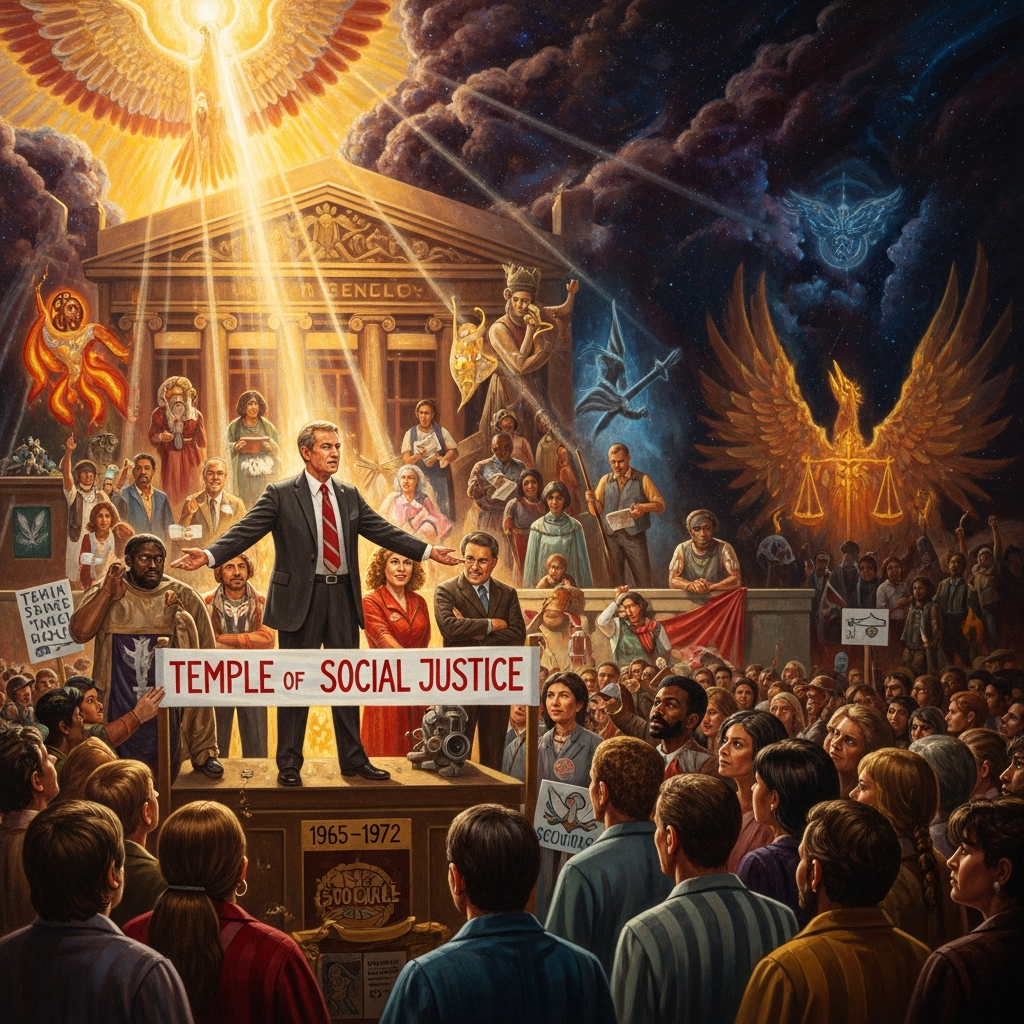
He moves the headquarters to a converted Scottish Rite temple at Geary and Fillmore. The Temple is now a political force. Willie Brown speaks at its services. Harvey Milk writes him admiring letters. George Moscone, running for mayor in 1975, accepts Temple volunteers by the busload to staff his phone banks; he wins by 4,400 votes. Jones is appointed chairman of the San Francisco Housing Authority. He is photographed with Rosalynn Carter. Angela Davis sends greetings to the congregation by telephone.
The Temple’s San Francisco Sunday services draw three thousand people. The dining hall feeds anyone who walks in. The legal team handles evictions for free. The fleet of Temple buses takes elderly members on weekly outings. There is, in the official record of the city of San Francisco for the years 1972 through 1977, no progressive cause that the Temple did not actively, materially support.
There is also, in the same years, a private Temple that the public Temple is concealing. The internal disciplinary system. The sleep deprivation. The forced confessions of imaginary crimes. The corporal punishments. The amphetamines in the pastor’s bedroom, accumulating. The affairs, coerced and uncoerced. The members beginning, quietly, to understand that they cannot leave.
The two Temples coexist for five years. Anyone who looks closely can see both. Almost nobody close enough to look closely is willing to.
The defectors begin to talk in 1977.
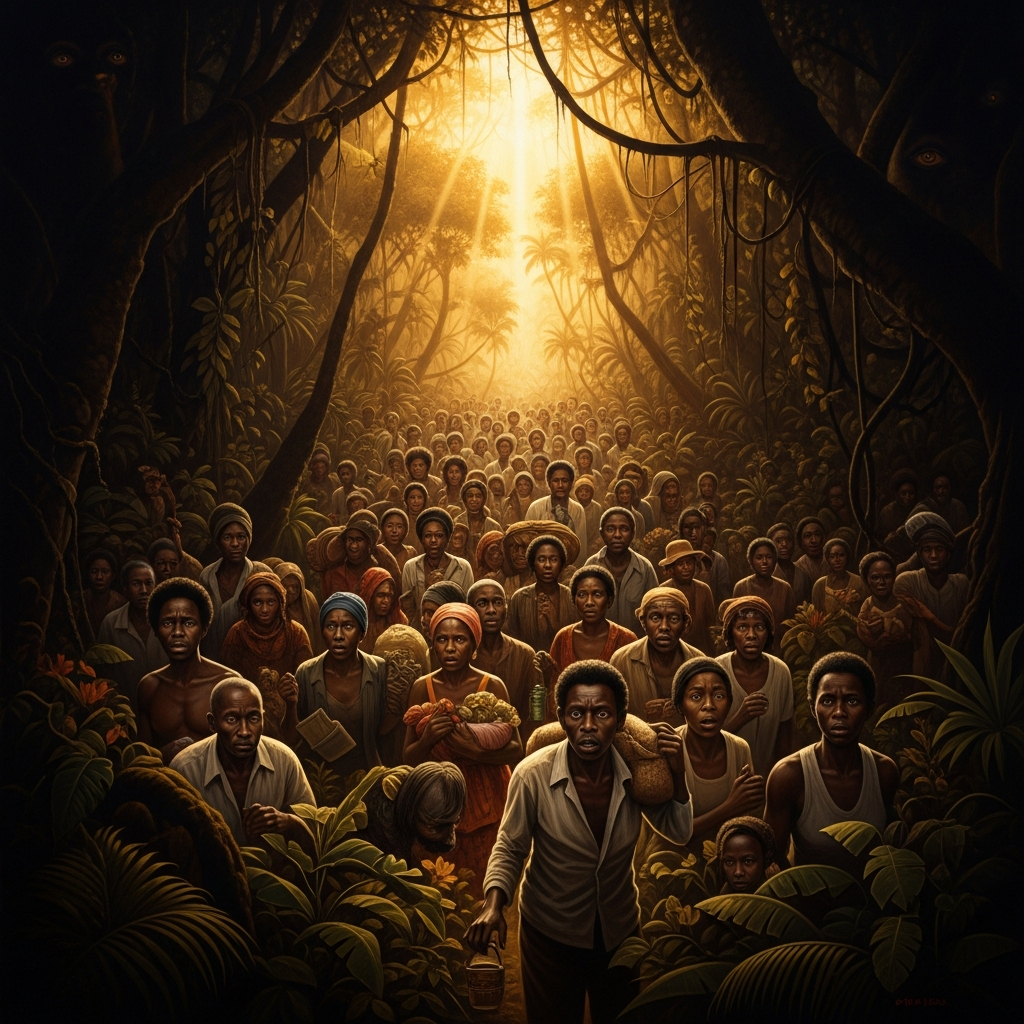
A magazine called New West runs a story. Former members describe the beatings, the forced confessions, the weapons. The article is careful and well-sourced. Jones reads it before publication and accelerates the move he has been planning for two years — a community he has been building in the jungle of Guyana, a country whose prime minister he has befriended, a place where the Temple will be free, he tells the membership, of American persecution.
He calls it the Promised Land. He calls it Jonestown. The first members move in 1974. The mass exodus comes in the summer of 1977 — almost a thousand members onto chartered planes within ninety days, leaving the San Francisco temple half-empty and the city’s progressive establishment quietly bewildered.
Inside the jungle, the second Temple eats the first. There are no journalists. There are no defectors. There are no relatives showing up at the office to ask after their mothers. The amphetamines escalate. The sermons run six hours. The all-night White Nights rehearsing mass suicide begin in the spring of 1978. By the time Congressman Leo Ryan’s plane lands at Port Kaituma in November, there is no longer any community in the clearing that could have refused what the man at the microphone was about to demand.
The man who walked into the Indianapolis storefront in 1955 would have refused it. He would have horsewhipped the man at the microphone.
Both men were named Jim Jones. That is the tragedy.
This is the harder story than the famous one. The famous story is the tape. The harder story is the twenty-three years before the tape, in which a damaged man with genuine moral gifts did genuine moral work, and built a community that did genuine moral work, and slid by degrees small enough that nobody could exactly name the moment toward the clearing in the jungle.
The American liberal Protestant tradition has not entirely metabolized Jonestown, and one reason is that the metabolizing is uncomfortable. The Temple did the things liberal Protestantism said it wanted done. It integrated. It fed the hungry. It housed the elderly. It elected the right people. It marched with Cesar Chavez. The lesson cannot, therefore, be that social-gospel ministry leads to mass death; it does not, in the overwhelming majority of cases. The lesson is narrower and more uncomfortable: that personal authority, when it is permitted to grow without check inside a community of genuine moral commitment, can hollow that community from the inside, slowly, and the people who love the community most will be the last to see what is happening.
The book of Jeremiah is unsparing about what happens to prophets. They begin in fire and end, sometimes, in ashes. The prophet’s distinguishing mark, in the Hebrew tradition, is not infallibility — it is that the word that came genuinely from God in chapter one can be drowned by the human voice of the prophet himself by chapter twenty. The community’s task is to keep listening for the difference. The Temple lost the ability to do that, and so did most of the people watching it from outside. That loss is what the second story, the one that ends with the tape, was finally the consequence of.
The flowers Marceline had planted at the Geary Street temple were still blooming in November 1978 when the news came back from Guyana. Somebody watered them, that week, out of habit. Then they stopped.
Scenes
Indianapolis 1955: a twenty-four-year-old white preacher integrates his congregation in a city where the Klan still meets openly
 Generating art…
 Ukiah and San Francisco, 1965-1972: the Temple becomes a genuine social-justice powerhouse with the mayor's office on speed-dial
 Generating art…
 Guyana 1977: the move to the jungle, the paranoia consolidating, the community sealed off from witnesses who might still have spoken to it
 Generating art…
 Echoes Across Traditions
Entities
- Jim Jones
- Marceline Baldwin Jones
- the Peoples Temple congregation
- Father Divine
- the San Francisco progressive establishment
Sources
- Tim Reiterman, *Raven: The Untold Story of the Rev. Jim Jones and His People* (Dutton, 1982)
- Jeff Guinn, *The Road to Jonestown* (Simon & Schuster, 2017)
- John R. Hall, *Gone from the Promised Land: Jonestown in American Cultural History* (Transaction, 1987)
- Rebecca Moore, *Understanding Jonestown and Peoples Temple* (Praeger, 2009)
- The Jonestown Institute archive at SDSU; oral histories from former members and surviving family