Don't Call Me a Saint
1933 – 1980 · the Catholic Worker houses of hospitality · New York City — Mott Street, St. Joseph House, and the Catholic Worker houses of hospitality across the United States
Contents
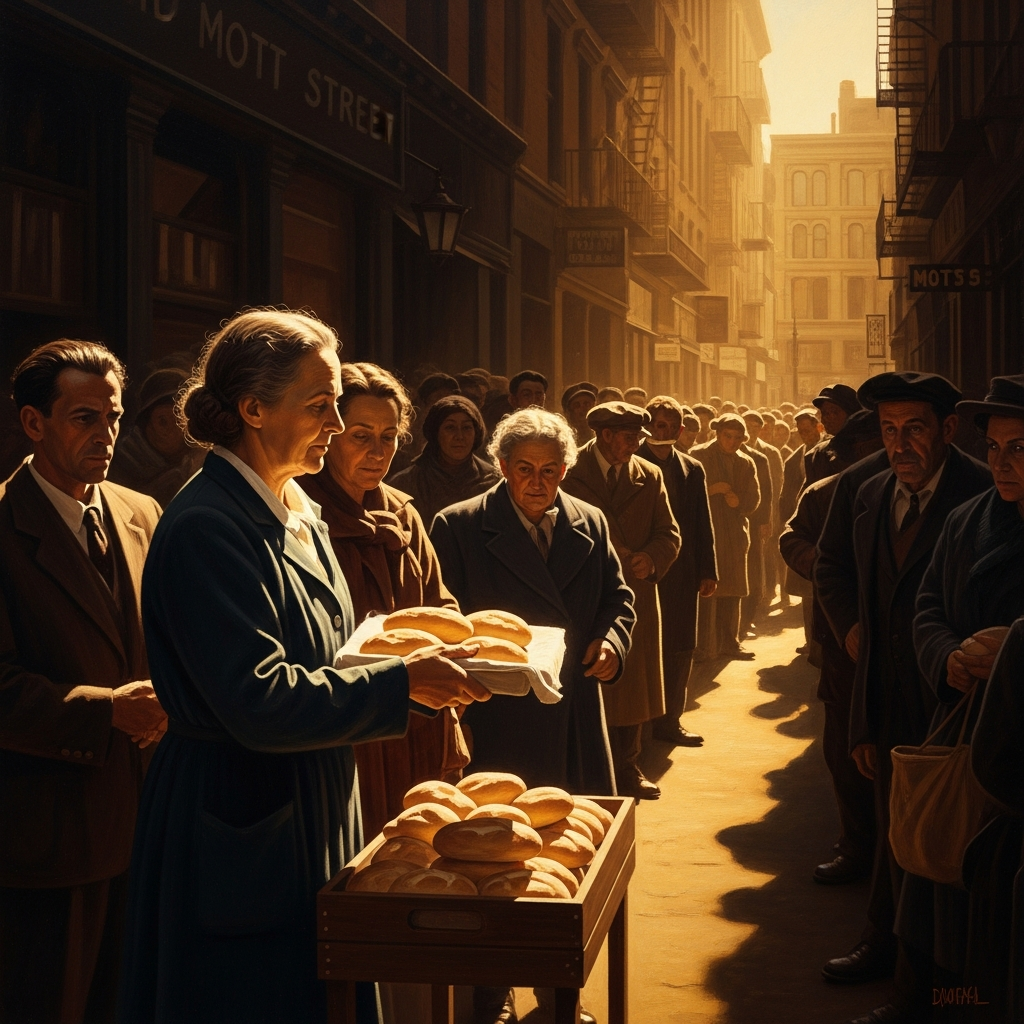
On Mott Street in lower Manhattan, a converted radical in a secondhand coat stands in the bread line she has been standing in for thirty years, ladling soup to men who smell of the street, running a newspaper that the FBI tracks and a house that the Archdiocese tolerates and calling both the practice of a single, embarrassing, irrefutable idea: the Gospel is about the poor and the poor are standing right here.
- When
- 1933 – 1980 · the Catholic Worker houses of hospitality
- Where
- New York City — Mott Street, St. Joseph House, and the Catholic Worker houses of hospitality across the United States
The soup is never enough.
This is the fact she has absorbed into her body over thirty years — that the pot empties before the line does, that the line extends further down Mott Street in January than it does in October, that the men who come to the door are not a problem to be solved but a condition to be met, daily, with what is available. She has learned not to see this as defeat. The Catholic Worker is not a solution to poverty. It is a place to practice the corporal works of mercy while the economic structures that produce poverty remain in place and are resisted by other means.
She ladles soup. She does not call it anything. She calls it soup.
She was not always Catholic.
This is the fact that troubles both her radical friends and her Catholic ones. She was a socialist, a Wobbly sympathizer, an anarchist fellow-traveler, a bohemian in Greenwich Village who drank with Eugene O’Neill and went to jail for women’s suffrage in 1917 and lived with a man she loved outside the Church. She converted in 1927, after the birth of her daughter Tamar, from a conviction she could not explain satisfactorily then or later: that the beauty she kept experiencing — in music, in the bodies of children, in the anarchist solidarity of workers who had nothing and gave it — was pointing toward something the Church had been naming for two thousand years.
Her Communist friends did not forgive her. They understood conversion as capitulation. She understood it as intensification. The Church she entered was the Church of the slums — the masses at five in the morning in lower East Side churches full of immigrant workers, the Church that was, in its actual body, composed of the poor she was already serving.
She did not leave the left. She brought it inside.
Peter Maurin finds her in December 1932.
He is a French peasant philosopher, a wandering teacher who has been riding freight trains and sleeping in flophouses and developing a vision of a Catholic social order built on personal responsibility, farming communes, and what he calls round-table discussions for scholars and workers. He is, in many respects, a madman. He is also correct about everything important. He tells her: start a newspaper. She starts it on May 1, 1933 — May Day, the workers’ holiday — in Union Square, where she and a handful of helpers sell it for a penny a copy to the crowd assembled for the Communist rally.
The Catholic Worker costs a penny a copy from 1933 until today. It has never cost more. She does not believe in charging the poor for ideas.
Within a year, the paper has a circulation of a hundred thousand. Within a year, people are showing up at the Mott Street address asking for help. She opens the house. She does not know how to run a house of hospitality. She learns. She runs seventeen of them by the end of the decade.
She does not make a distinction between the bread line and the picket line.
This is the thing that confuses the institutional Church, the thing that makes her simultaneously impossible to dismiss and impossible to fully endorse. A daily communicant, daily mass without exception for fifty years, the rosary in her pocket at the rally — and also: arrested with the United Farm Workers in California at seventy-five, handcuffed alongside Caesar Chavez. Fasting in solidarity with Vietnamese civilians during the American bombing. Refusing to pay federal income tax because the federal government spends it on weapons. Writing editorials in the Catholic Worker opposing the Korean War, the Vietnam War, nuclear testing, the death penalty, the House Un-American Activities Committee.
The FBI opens a file on her in the 1950s. It is five hundred and seventy-three pages long. COINTELPRO tracks the Catholic Worker houses. J. Edgar Hoover writes that her paper smacks of Communist doctrine. The same paper is published on the masthead with a cross and runs the prayer of Saint Francis.
She is amused by neither side’s confusion. She finds the politics obvious from the Gospel and the Gospel obvious from the politics.
Cardinal O’Connor calls her a saint in the 1980s.
She has heard this before. She has been hearing some version of it since the 1940s — the canonization-by-adjective that the American Church uses to contain its radicals. Make them holy, make them statues, put them in the stained glass — this defuses the critique. You cannot argue with a saint. You can only venerate one.
She has a line for it, and she delivers it with the patience of a woman who has been asked the same question many times: Don’t call me a saint. I don’t want to be dismissed so easily.
The line is not false modesty. She means it precisely. A saint is someone whose demands on you are suspended by their holiness — you admire them, you light a candle, you leave the soup line to someone else. She does not want to be admiré. She wants to be imitated. The soup line is open. The paper ships every month. The houses need volunteers. Imitation is not optional.
She dies on November 29, 1980.
She is eighty-three years old. She dies in her room at Maryhouse on East Third Street, the women’s house of hospitality she opened in 1974. She has been in poor health for years and has spent the last years largely in her room, writing when she can, receiving visitors, listening to the sounds of the house below. She receives last rites. She dies as she has lived — inside the Church, inside the bread line, inside the argument.
The cause for her canonization is opened by the United States Conference of Catholic Bishops in 2000. The Vatican’s Dicastery for the Causes of Saints gives her the title Servant of God. The process continues. The Catholic Worker continues to publish at a penny a copy. The houses continue to feed people. The FBI file is declassified and available at the National Archives.
The Church has always had trouble with its radicals — the people who read the Sermon on the Mount and conclude that it is a policy document. Dorothy Day read it and concluded that the poor have a right to the soup, that the right is not charity but justice, and that the worker who makes the soup for thirty years is the one whose theology is actually being tested.
She converted not from politics to religion but from politics to the politics of the Gospels, which she found more radical than the socialism she had practiced and more demanding than the anarchism she had theorized. The houses of hospitality are still open. The bread line is still there. The paper still costs a penny.
She is still right.
Scenes
Dorothy Day at the Mott Street bread line, mid-twentieth century — the daily practice behind the daily paper
Generating art… St
 Generating art…
 Dorothy Day arrested while picketing with the United Farm Workers, California — one of more than a dozen arrests in her lifetime
 Generating art…
 Echoes Across Traditions
Entities
- Dorothy Day
- Peter Maurin
- the Catholic Worker
- the Mott Street house
- Cardinal John O'Connor
Sources
- Dorothy Day, *The Long Loneliness: An Autobiography* (1952)
- Dorothy Day, *Loaves and Fishes* (1963)
- Robert Ellsberg, ed., *By Little and By Little: The Selected Writings of Dorothy Day* (1983)
- Jim Forest, *All Is Grace: A Biography of Dorothy Day* (2011)
- Dorothy Day, *The Catholic Worker* (newspaper, 1933–present)