The Dark Night of Calcutta
1948 – 1997 · the half-century interior crisis revealed posthumously · Calcutta — the gutters of Kalighat, Nirmal Hriday hospice, the slum chapels of the Missionaries of Charity
Contents
For nearly fifty years the small Albanian nun the world calls a saint feels nothing — no presence, no consolation, no Jesus — and keeps walking the gutters of Calcutta anyway, lifting the dying onto cots, smiling for the cameras, and hiding her abandonment in letters her superiors are sworn to burn.
- When
- 1948 – 1997 · the half-century interior crisis revealed posthumously
- Where
- Calcutta — the gutters of Kalighat, Nirmal Hriday hospice, the slum chapels of the Missionaries of Charity
The voice comes once, on a train.
September tenth, 1946. Sister Mary Teresa Bojaxhiu of the Loreto convent in Calcutta is on a railway carriage to Darjeeling for her annual retreat. She is thirty-six years old. She is a Yugoslav-born teaching nun in starched white. Christ speaks to her with a clarity she will later describe as inarguable. Come, be my light. Carry me into the holes of the poor.
She writes it down in her notebook in the careful hand of a woman who knows her superior will read it. Archbishop Périer doubts it for two years. He examines her. He examines the locutions. He finally permits her to leave Loreto and start her new order in 1948.
She goes into the slums. She begins.
And the voice never speaks again.
The silence starts almost immediately.
She writes to Archbishop Périer in 1953: Please pray specially for me that I may not spoil His work and that Our Lord may show Himself — for there is such terrible darkness within me, as if everything was dead. It has been like this more or less from the time I started the work.
She is, by every external measure, succeeding. She is gathering postulants. She is finding houses. She is feeding, washing, and bandaging the dying. She is meeting with Indira Gandhi and Pius XII and the Nobel committee. The world is watching the small woman in the blue-bordered sari and seeing exactly what she wants it to see — the bride of Christ in radiant fidelity.
What the world is not seeing is that the bridegroom has gone silent.
She tells almost no one.
Father Joseph Neuner, an Austrian Jesuit, becomes one of two confessors who knows. She writes to him in 1961: In the darkness… Lord, my God, who am I that You should forsake me? The child of your love — and now become as the most hated one. The one You have thrown away as unwanted, unloved. I call, I cling, I want — and there is no One to answer. Where I try to raise my thoughts to Heaven, there is such convicting emptiness that those very thoughts return like sharp knives and hurt my very soul.
Neuner writes back. He gives her the older script. This is the dark night of John of the Cross. The absence is itself the work. The desolation is the participation in the cross.
She copies the explanation into her own letters as though learning a foreign language. She begins to call the darkness the kiss of Jesus. She does not stop carrying the dying.
The letters were never meant to be read.
She instructs her superiors, repeatedly and in writing, to destroy them. She does not want her interior to become public. She does not want pious readers turning her abandonment into a poster. She wants the work to speak and her soul to remain hidden in the wound.
After her death in 1997, the cause for canonization opens. Father Brian Kolodiejchuk, the postulator, gathers her correspondence as Vatican procedure requires. He finds her instructions to burn. He finds the letters anyway. He concludes — and the Congregation for the Causes of Saints concurs — that her sanctity cannot be honestly told without them.
Come Be My Light is published in 2007. It is the most important spiritual document of the twenty-first century thus far, and the one she would have refused to authorize.
Christopher Hitchens, who wrote a polemic against her in 1995, reads the letters and writes that they confirm his suspicion: she was a cynical fraud who did not even believe in her own God. The Catholic press writes that they confirm her holiness: she persevered without consolation, the truest fidelity. Both readings miss what the letters actually say.
What they say is harder.
She says she does not feel God. She says she keeps acting as if she did. She says she is not pretending — she is enduring. She says the smile in the photographs is real but it is a smile she has put on the way a soldier puts on a uniform, daily, for fifty years, in a war the photographer cannot see.
She says, in the most devastating line, that her work is the only place she still meets him: if I ever become a saint — I will surely be one of “darkness.” I will continually be absent from Heaven — to light the light of those in darkness on earth.
She is canonized September 4, 2016, by Pope Francis in St. Peter’s Square. The canonization is the formal Roman judgment that the dark night was not absence of God but the deepest possible mode of his presence — God removing the felt sweetness of God so that the love would be love and not its consolation. It is the John of the Cross verdict.
Whether or not the verdict is correct, the work she did in those decades is fact. The hospice at Kalighat. The leper colony at Titagarh. The houses on six continents. The unbathed dying lifted onto a clean mattress in their last hour by a nun who could not feel the Christ she carried them to.
The dark night is not depression and it is not doubt. It is what the contemplative tradition calls the third stage of prayer — when the consolations God gives the beginner are withdrawn so that the soul learns to love God without payment. John of the Cross described it in the sixteenth century. Mother Teresa lived it in the twentieth.
The crisis was a crisis only by mistake. The script she was inside was older than her century, older than her order, older than the Spanish Carmelites. It went back to Job and to Gethsemane and to the cry from the cross. The mistake was the public image of the radiant saint. She had not chosen the image. She lived the actual life beneath it.
Half a century of service to a silence — and the silence, the older mystics insisted, was not nothing.
Scenes
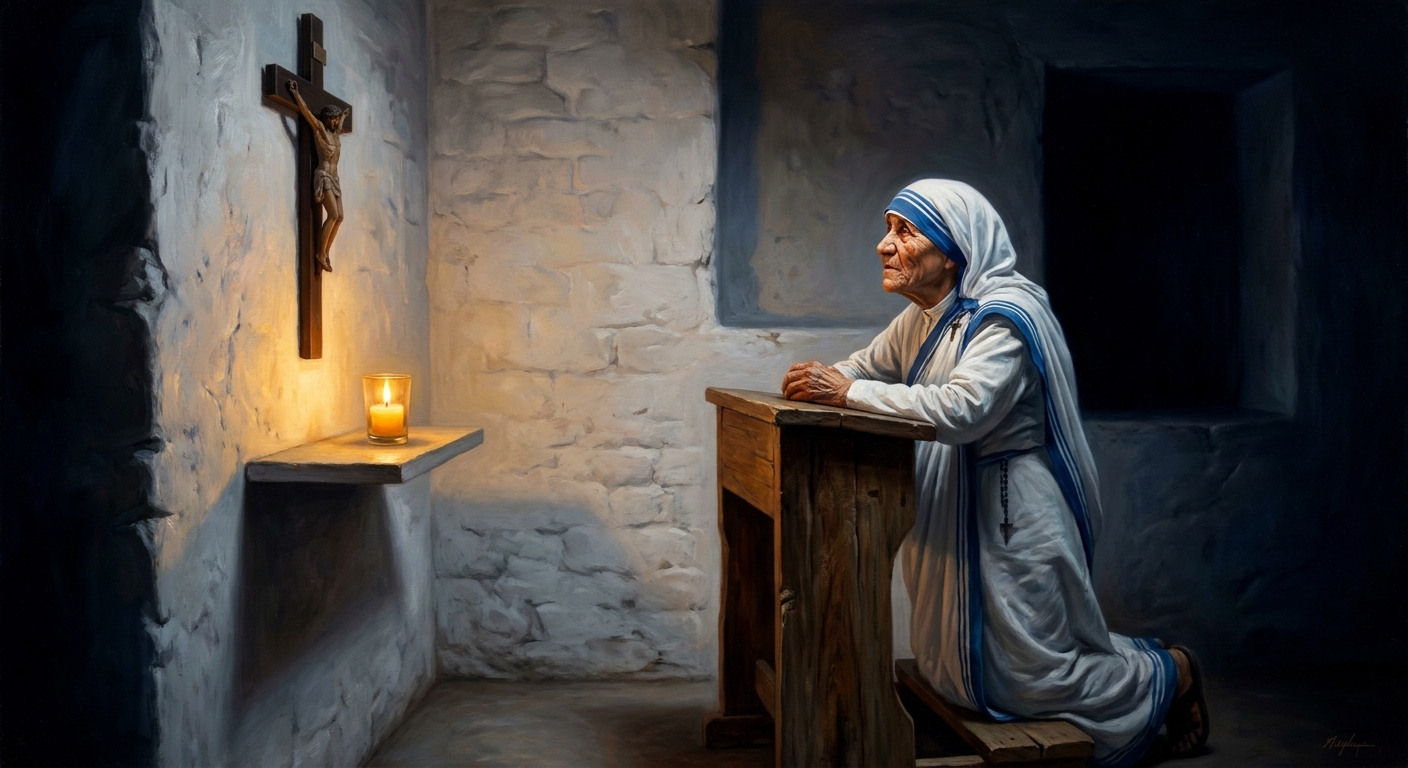
Mother Teresa in the chapel at the Missionaries of Charity motherhouse — kneeling in a silence she will describe to her confessor as a wall
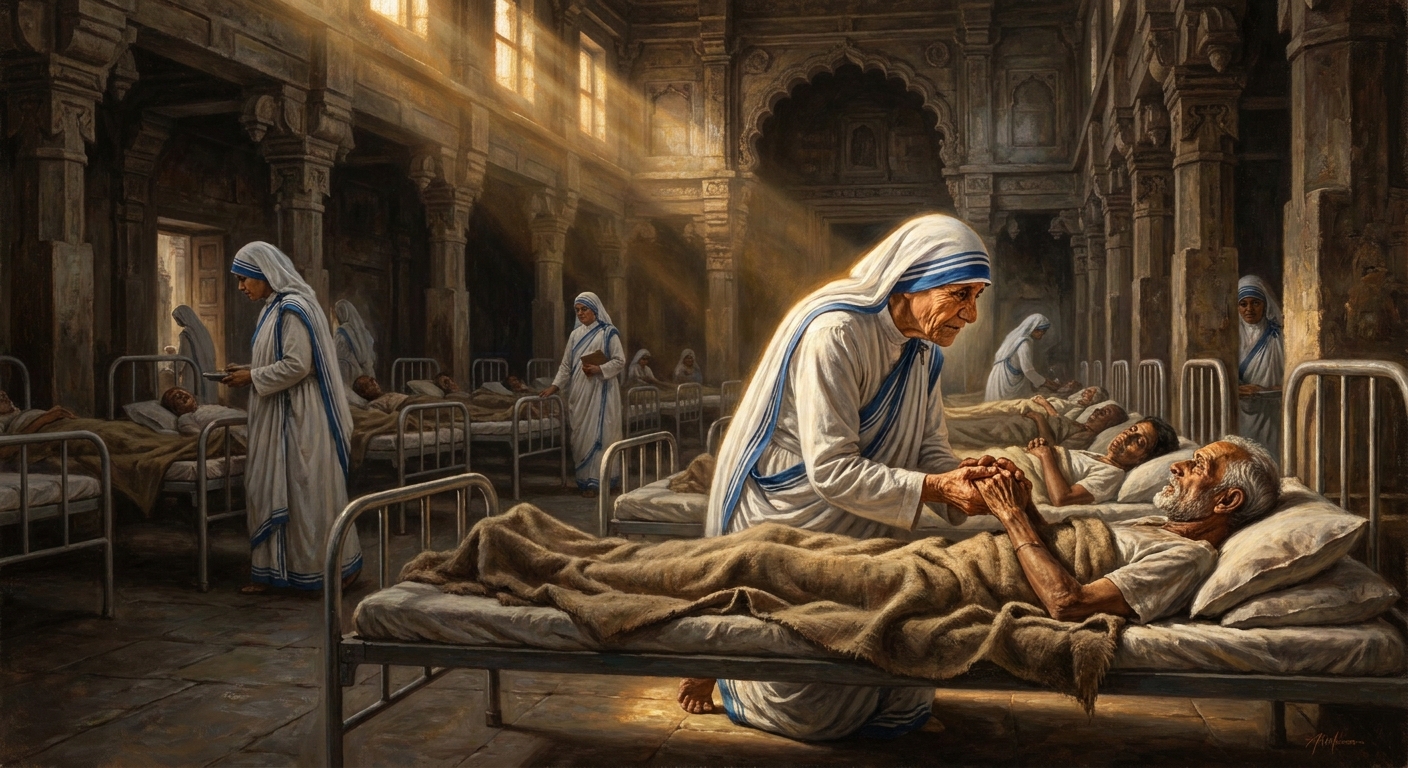
Generating art… Nirmal Hriday — the Home for the Dying at Kalighat, Calcutta, opened 1952 in a former Kali temple
 Generating art…
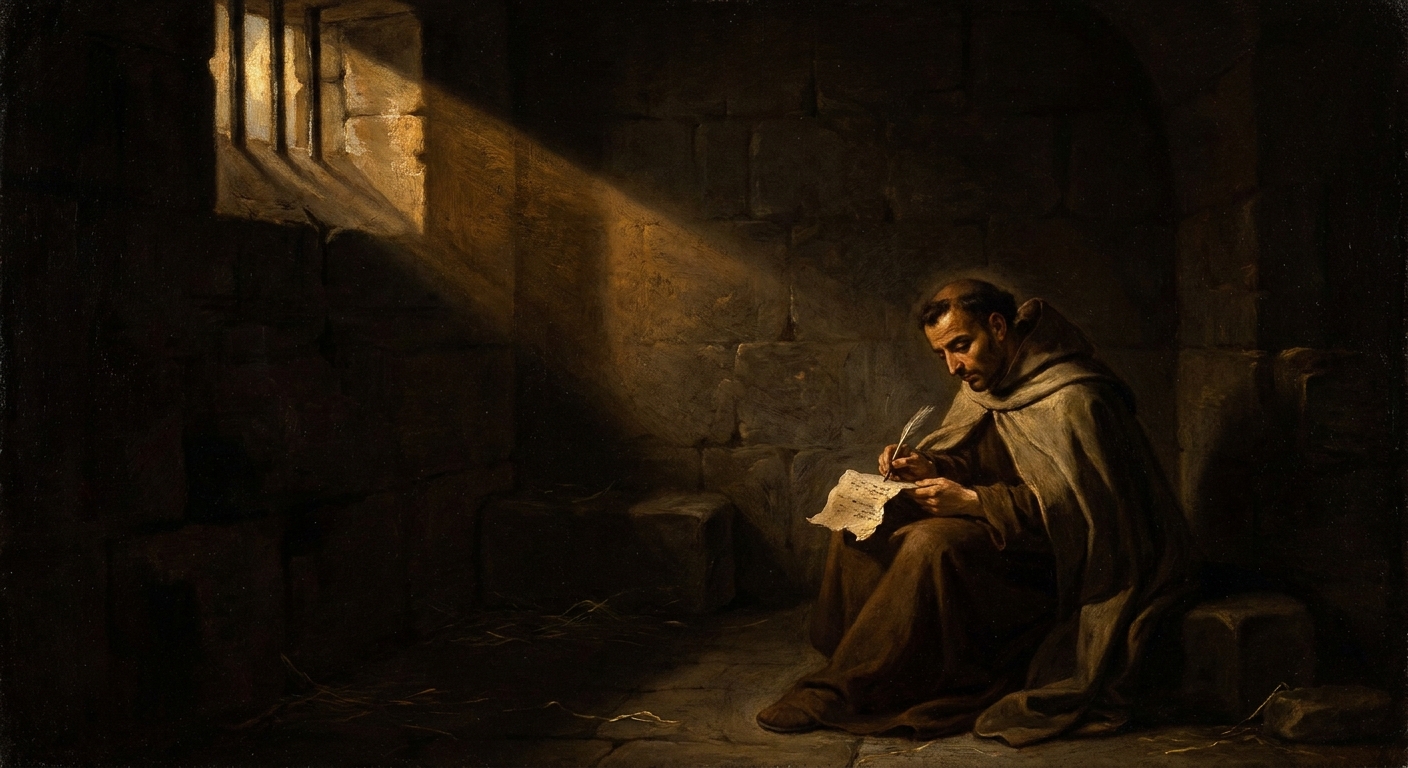
 John of the Cross writing the *Dark Night* in his cell, sixteenth-century Spain — the older script she lived inside
 Generating art…
 Echoes Across Traditions
Entities
- Mother Teresa of Calcutta
- Jesus Christ
- Father Joseph Neuner
- Archbishop Périer
- the Missionaries of Charity
Sources
- Mother Teresa, *Come Be My Light: The Private Writings of the Saint of Calcutta* (2007), ed. Brian Kolodiejchuk MC
- Kathryn Spink, *Mother Teresa: A Complete Authorized Biography* (rev. ed. 2011)
- Anne Sebba, *Mother Teresa: Beyond the Image* (1997)
- Carol Zaleski, 'The Dark Night of Mother Teresa,' *First Things* (May 2003)
- John of the Cross, *Noche Oscura del Alma* (~1579, trans. Kavanaugh & Rodriguez 1991)