Joan of Arc
1425–1431 · the Hundred Years' War · Domrémy, Orléans, Reims, Rouen
Contents
A teenage peasant girl in Domrémy hears the voices of saints, leads an army to relieve Orléans, crowns a king at Reims, and is burned alive at nineteen by the Church she will later be made a saint of.
- When
- 1425–1431 · the Hundred Years' War
- Where
- Domrémy, Orléans, Reims, Rouen
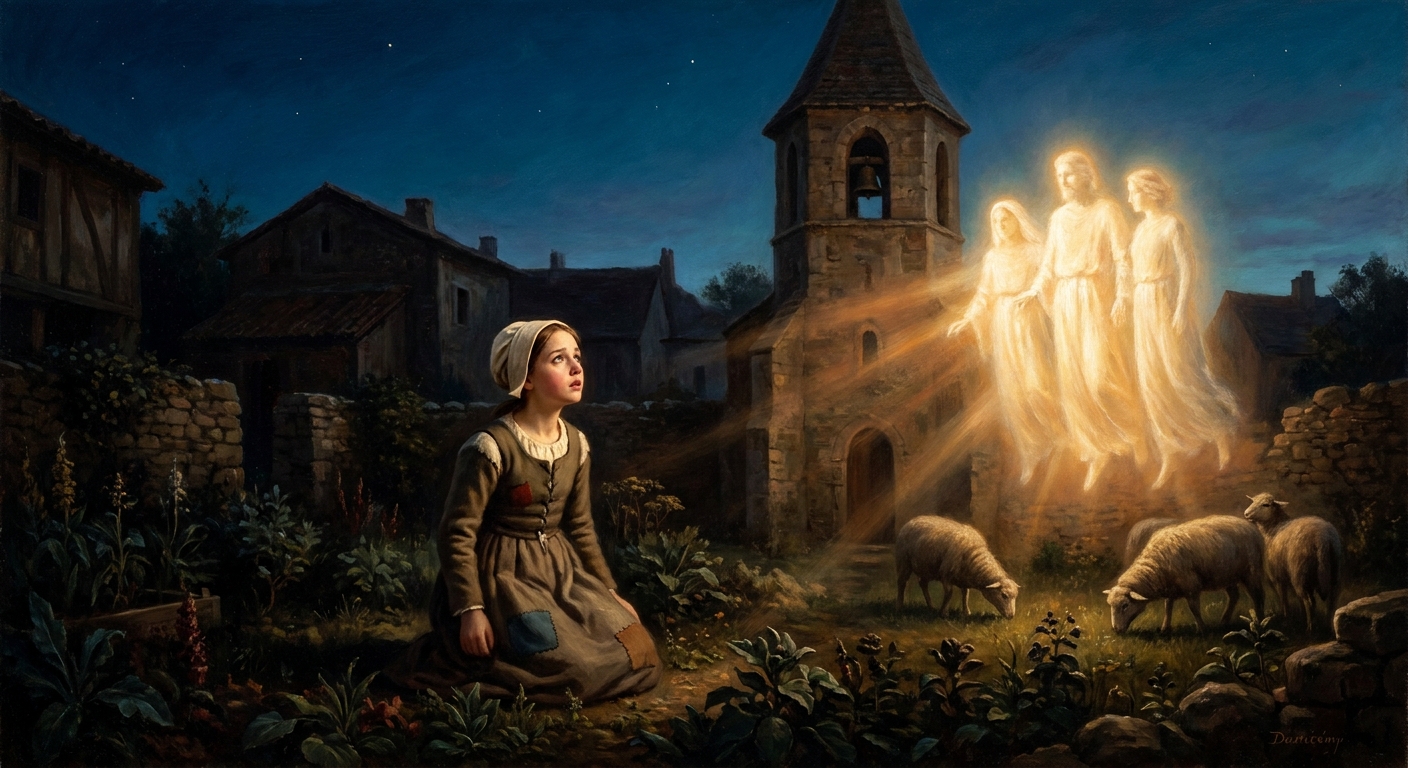
The voices come to her in the garden.
She is thirteen, or thereabouts — the records are not precise about peasant births in Domrémy. The light through the trees behaves strangely, and then Saint Michael is speaking. Then Saint Catherine. Then Saint Margaret. Three voices, three commands, a single impossible instruction: drive the English from France. Crown the Dauphin. God has chosen you.
She does not ask why her. That is the first thing you need to understand about her. She does not doubt the voices or argue with their choice. What she doubts is whether any man in France will believe her.
She is right to doubt that. It will take years.
France in 1425 is a country being eaten alive. The English and their Burgundian allies hold Paris, hold the north, hold the Loire. The Dauphin Charles — not yet king, not yet crowned, his legitimacy questioned by everyone including his own mother — lurks in the south with a court that has stopped believing in him. Orléans, the last major Loire fortress standing between the English and the rest of France, is under siege. The professionals have looked at it and looked away.
Joan looks at it and starts walking toward it.
It takes her two years to get an audience with the Dauphin. She crosses hostile country, disguised in men’s clothes for the road, talks her way past commanders who laugh at her and then — something — let her through. She arrives at Chinon in February 1429. Charles, who has heard she is coming, hides himself among his courtiers to test her. She walks straight to him.
This is the moment the Dauphin’s skepticism begins to crack.
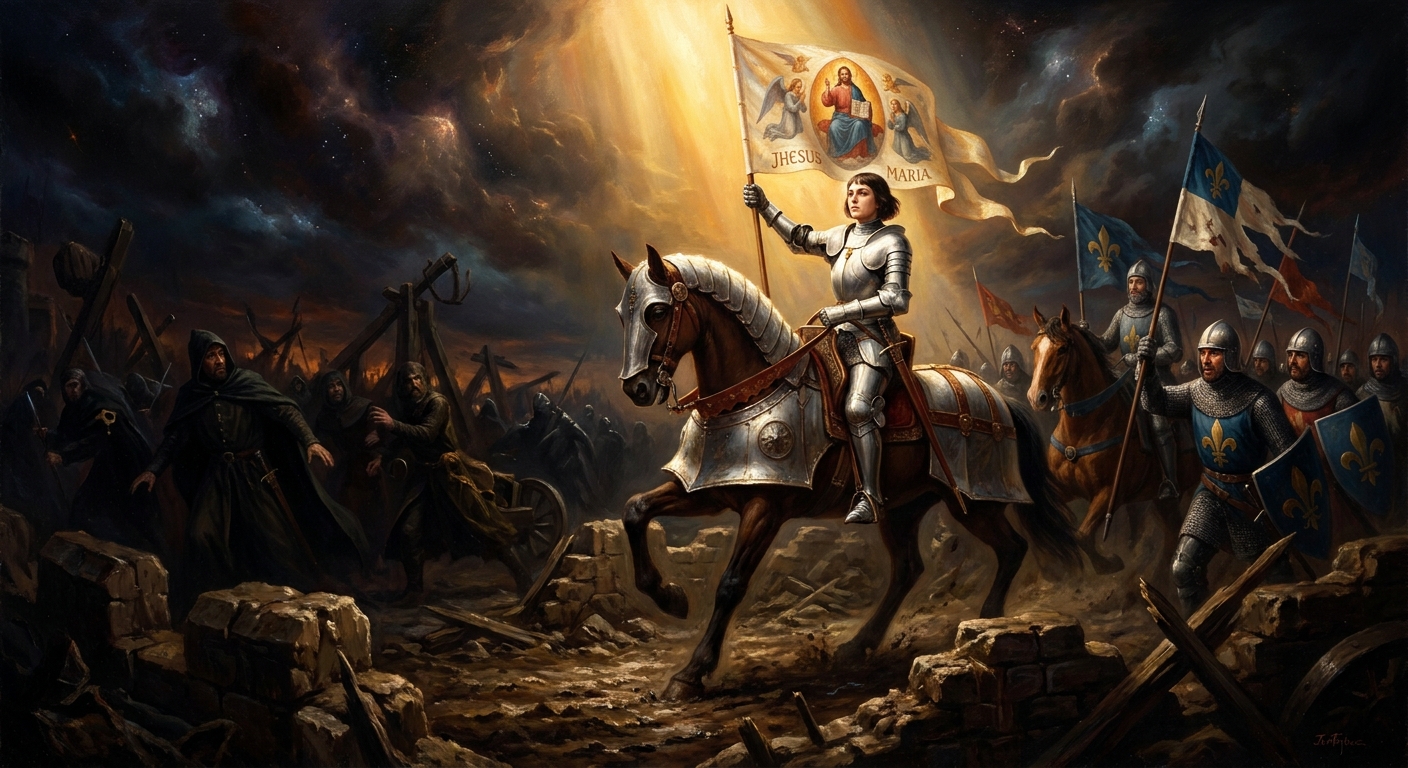
He gives her theologians to examine her. They examine her for three weeks and find nothing demonic. He gives her armor, a horse, an army, and the banner she designs herself: white, with lilies, the name of Jesus, and two angels. She is seventeen years old.
The relief of Orléans takes nine days.
Nine days. The English have held that siege for seven months. Professional commanders — seasoned, equipped, experienced — have circled the problem and gone nowhere. Joan rides in under her banner, re-supplies the city, leads assault after assault on the English fortifications with the kind of reckless forward pressure that experienced soldiers call suicidal and that, here, simply works. She is wounded by an arrow through the shoulder during the assault on Les Tourelles. She pulls it out herself. She goes back in.
On May 8, 1429, the English withdraw.
She is not finished. She pushes Charles toward Reims — deeper into contested territory, through town after town that opens its gates as she approaches, because something has shifted in France and everyone can feel it. Reims is the traditional city of coronation. Getting there means cutting through English-held land. She does it anyway.
On July 17, 1429, Charles VII is crowned King of France in the Cathedral of Reims. Joan stands beside him holding her banner.
“It has borne the burden,” she says, when someone asks why her banner is at the altar. “It is only right it should have the honor.”
After Reims, the mission fragments.
Charles negotiates. He is a political animal and he has what he needed — the crown, the legitimacy, the symbol. Joan wants to push to Paris. Charles hesitates, delays, signs truces she didn’t agree to. She attacks Paris anyway, in September, and is wounded again and pulled back. The momentum breaks.
At Compiègne in May 1430, she is unhorsed and captured by Burgundian forces. She is sold to the English for ten thousand livres. The ransom is equivalent to the annual revenue of a French county. The English know exactly what they are buying.
The trial begins in January 1431 in Rouen.
It is run by Bishop Pierre Cauchon, who is being paid by the English and who has his own reasons to want her destroyed. The charge is heresy. The specific charges are multiple: she claims to have direct divine communication, bypassing the Church hierarchy; she wore men’s clothing, which canon law forbids; she refuses to submit her visions to Church authority. There are seventy counts in the first indictment. They are eventually condensed to twelve.
She has no lawyer. She has no advisor. She faces trained theologians, alone, in sessions that last hours, on questions designed to trap her regardless of how she answers. The transcripts survive, and they are among the most extraordinary documents of the medieval period.
“Do you know whether you are in God’s grace?”
The question is a trap: if she says yes, she claims certainty that belongs only to God, which is presumption. If she says no, she admits her mission is ungodly. She is illiterate. She has never studied theology. She answers without hesitating.
“If I am not in God’s grace, may God put me there; if I am, may God keep me there.”
The court recorder notes that the judges fell silent.
She holds for months. In April she recants — signs a document she may not have fully understood, agreeing to submit to Church authority, to abandon the men’s clothing, to accept that her voices were demonic. The English are furious. The recantation means she cannot be burned; she can only be imprisoned for life.
Four days later, the guards report she has put the men’s clothing back on.
This is called relapse. Under medieval law, a relapsed heretic cannot be spared. Whether she resumed the clothing deliberately — as an act of defiance, or because it was the only protection she had in a cell with English soldiers — is something the rehabilitation trial forty years later will ask and not fully resolve. The transcripts suggest she said the voices came back and told her she had done wrong to recant.
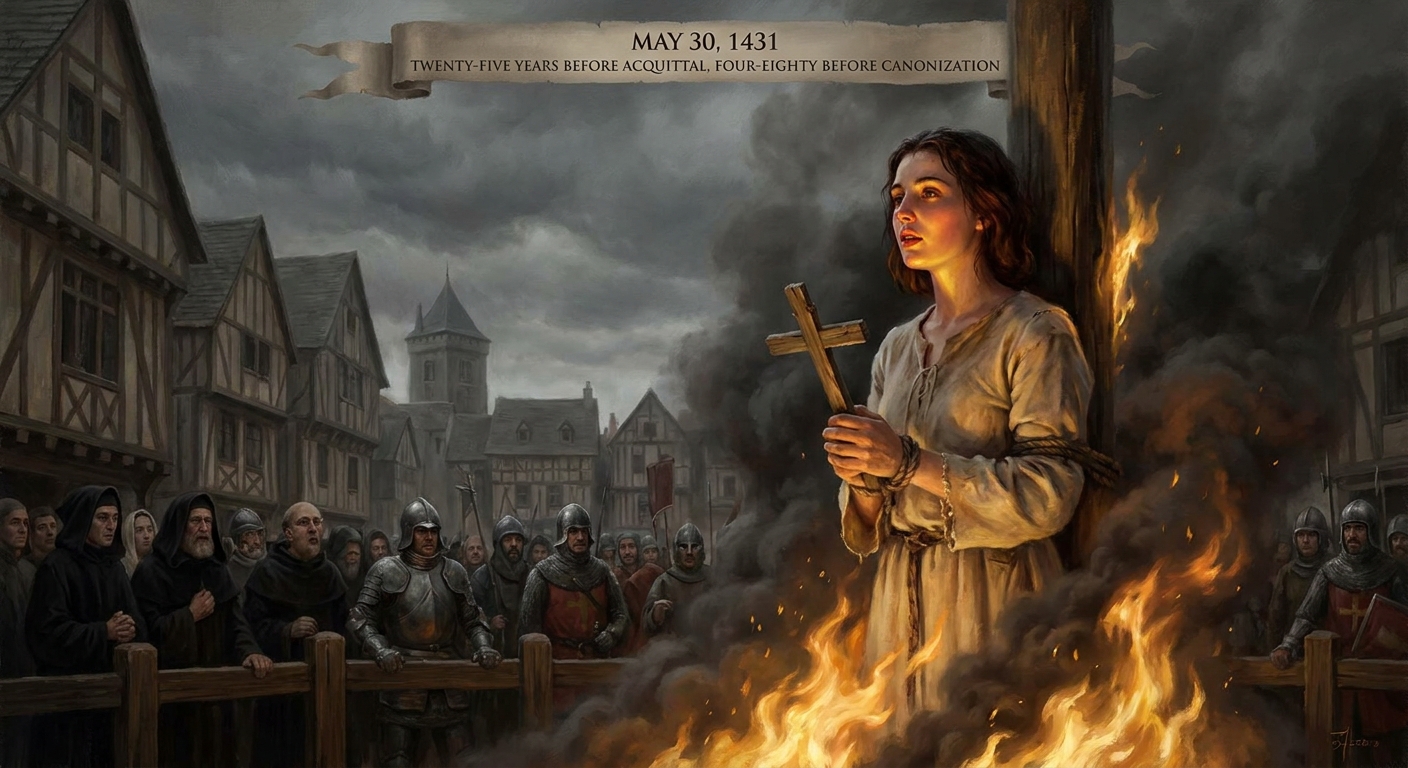
She is condemned on May 29, 1431. She is burned in the marketplace of Rouen on May 30. An English soldier makes a small cross from two sticks and holds it up where she can see it through the flames. She asks for it. She asks for it to be held in front of her.
She is nineteen years old.
Twenty-five years later, in 1456, a papal commission reopens the case. It interviews two hundred witnesses. It examines the original transcripts. It finds procedural irregularities, evidence suppressed, charges manufactured. Every count against her is annulled. She is declared innocent.
The English soldiers who watched her burn said afterward that they had killed a saint.
It takes the Church another four hundred and sixty-four years to agree. She is canonized on May 16, 1920.
What the trial is actually about is the question that runs under all of it: who is authorized to hear God?
The bishops say: we are. The Church mediates between the divine and the human. A peasant girl does not receive direct commissions from heaven. That is not how the hierarchy works. If she claims it, she is either lying or deceived by demons, and either way she must be corrected.
Joan’s answer, held across months of interrogation without flinching: the voices are real, they are from God, and no human authority — not bishop, not pope, not king — stands between her and what she was told to do.
She is burned for that answer. And then, five centuries later, placed on the altar for it.
The Church did not resolve the contradiction. It canonized it.
Scenes
Domrémy, 1425 — in the garden and the fields, a peasant girl hears three saints speak her name and give her a mission no general has managed to complete
 Generating art…
 Orléans, May 1429 — the Maid rides beneath her white standard into a siege that has held for seven months; nine days later the English are gone
 Generating art…
 Rouen, May 30, 1431 — at nineteen, burned in the marketplace by the Church she served; she asks for a cross, and an English soldier makes one from two sticks
Generating art… Echoes Across Traditions
Entities
- Joan of Arc
- Charles VII
- Saint Michael
- Saint Catherine
- Saint Margaret
Sources
- *Trial of Joan of Arc* (transcripts, 1431; rehabilitation transcripts, 1456)
- Régine Pernoud, *Joan of Arc by Herself and Her Witnesses* (1962)
- Mark Twain, *Personal Recollections of Joan of Arc* (1896)
- Helen Castor, *Joan of Arc: A History* (2014)