The Smallest Book
c. 1418-1427 CE · Monastery of Mount Saint Agnes, Zwolle, Netherlands
Contents
Thomas à Kempis, an Augustinian canon in the Netherlands, copies the Bible four times by hand and between the copying writes the most widely read Christian book after the Bible itself. Its central argument is a provocation aimed directly at the universities: knowledge without humility is nothing. The man who chose deliberate smallness writes the larger spiritual act.
- When
- c. 1418-1427 CE
- Where
- Monastery of Mount Saint Agnes, Zwolle, Netherlands
He is copying the Gospel of John.
It is not the first time. It will not be the last. He is a canon of the Augustinian monastery of Mount Saint Agnes near Zwolle, in what is now the Netherlands, and he has spent most of his adult life in the scriptorium — the room set aside for the work that God has apparently assigned him: the exact reproduction, by hand, letter by letter, of holy texts. He has copied the Bible four times. He will copy it a fifth. He copies Augustine, Bonaventure, Bernard. He copies the chronicles of his house. He copies everything.
Between the copying, he writes.
The man who will write the most widely read Christian book after the Bible was not meant for a scriptorium. He was meant for the university. His father was a metalworker in the town of Kempen in the Rhineland; his mother ran a school. In 1392, when Thomas is twelve, his older brother sends him to Deventer, to the school run by the Brethren of the Common Life — the community founded by Gerard Groote, a rich man’s son from Deventer who had given away everything, who had read Ad Herennium and Aristotle and the mystics, and had decided, in the end, that the point was not learning but love.
Groote is dead by the time Thomas arrives, but his idea is very much alive. The school at Deventer is excellent — it teaches Latin grammar and rhetoric and the classics with genuine rigor. What makes it different is not the curriculum but the atmosphere: an assumption, in the air of the place, that education is for the transformation of the person and that any transformation that produces pride rather than humility has gone wrong somewhere. The Brethren are not anti-intellectual. They are anti-scholastic in a specific sense: they distrust the kind of knowledge that stays in the head.
Thomas absorbs this entirely. He stays at Deventer for seven years.
He could go to a university. The University of Paris is sending its graduates out to the parishes and cathedrals of Europe with theological training of extraordinary sophistication and personal humility of extraordinary rarity. He has seen the university men. He knows what they know. He also knows how they hold what they know — the way certainty sits in a man who has been trained by disputation to defend a position against all comers, who has learned to win arguments, whose chief intellectual virtue is the ability to refute.
He does not go to the university. He goes north, to the monastery his brother has joined at Agnetenberg. He spends the rest of his long life there. He dies in 1471 at the age of ninety-one, which means he spends seventy years in the same house. He becomes sub-prior. He copies manuscripts. He writes.
The Imitation of Christ is not one book. It is four. Book One on the interior life. Book Two on the interior conversion. Book Three — the longest — on the inner conversation with Christ, a dialogue form he borrows from the mystical tradition. Book Four on the Eucharist. He assembles them between roughly 1418 and 1427. He does not think of himself as an author in the modern sense; he is a compiler of wisdom, a man who has read the mystics and the fathers and the scripture and is giving back what he has gathered in a form that can be used.
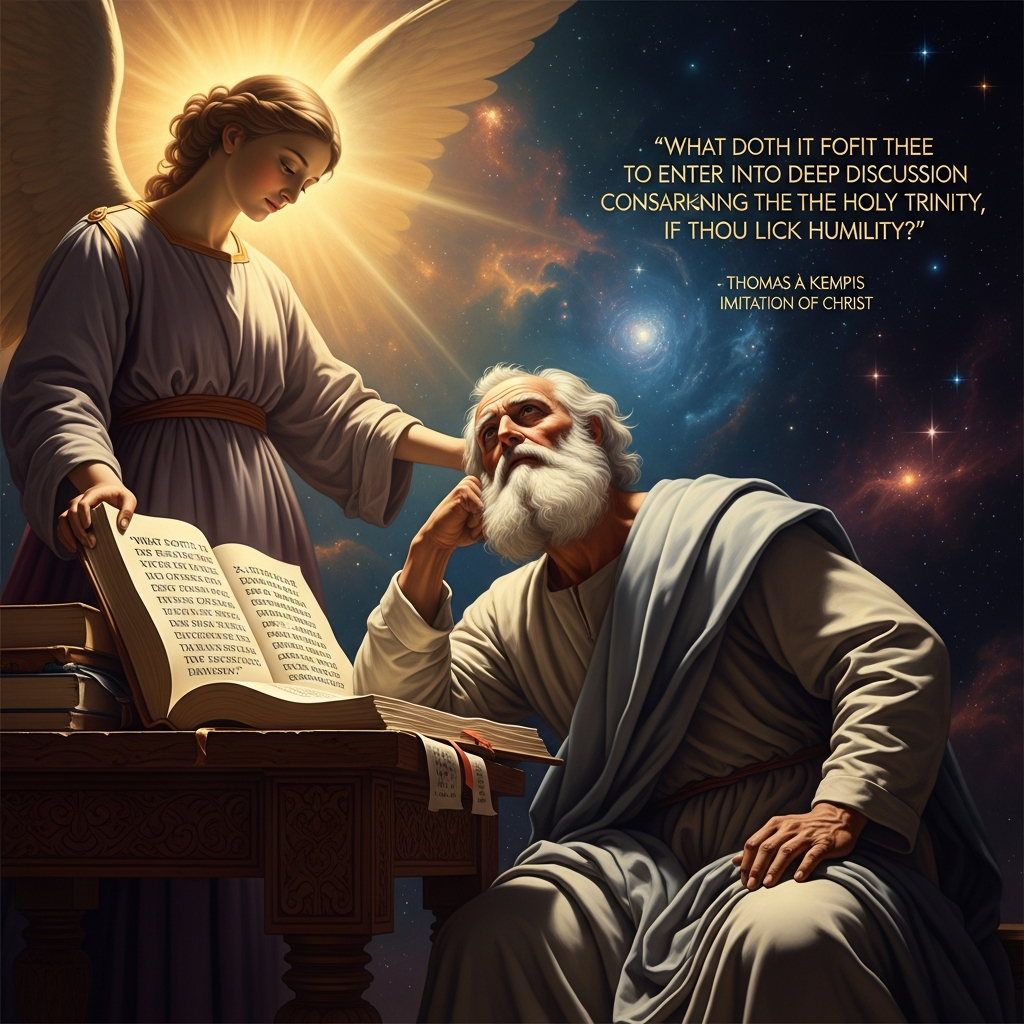
The first sentence of the first chapter is a direct quotation from Aristotle — All men by nature desire to know — followed immediately by a question: But what doth it profit thee to enter into deep discussion concerning the Holy Trinity, if thou lack humility?
He begins with Aristotle in order to dispose of him. This is deliberate. The Imitation is aimed at the man who knows everything, who can cite chapter and verse of the natural philosopher and the theologian and the mystic, and who has used all of this learning to construct a very comfortable intellectual structure inside which his pride lives undisturbed. Thomas has met this man. He has probably been, in moments, this man. He knows what the learning feels like from inside when it is not doing its proper work.
The central image of the Imitation is the cell.
Not the cell as prison — the cell as the place where the work happens. Thomas returns to it again and again: go to thy cell, remain in thy cell, love thy cell. The cell is the interior life. It is the room where you cannot hide from yourself, the room where the performances that carry you through the social world — the wit, the learning, the reputation, the ability to win arguments — fall silent, because there is no audience. What remains in the cell is what you actually are.
He writes: I would far rather feel contrition than be skilful in defining it. This is the sentence the university men cannot forgive. Contrition is a condition of the soul. Definition is an achievement of the mind. Thomas is saying that the achievement is worth less than the condition — that the man who can write three thousand words on the phenomenology of penitence and has not felt it has learned nothing, and the man who cannot define it at all but weeps in the night has learned everything.
This is a provocation. He intends it as one.
He also intends it as consolation.
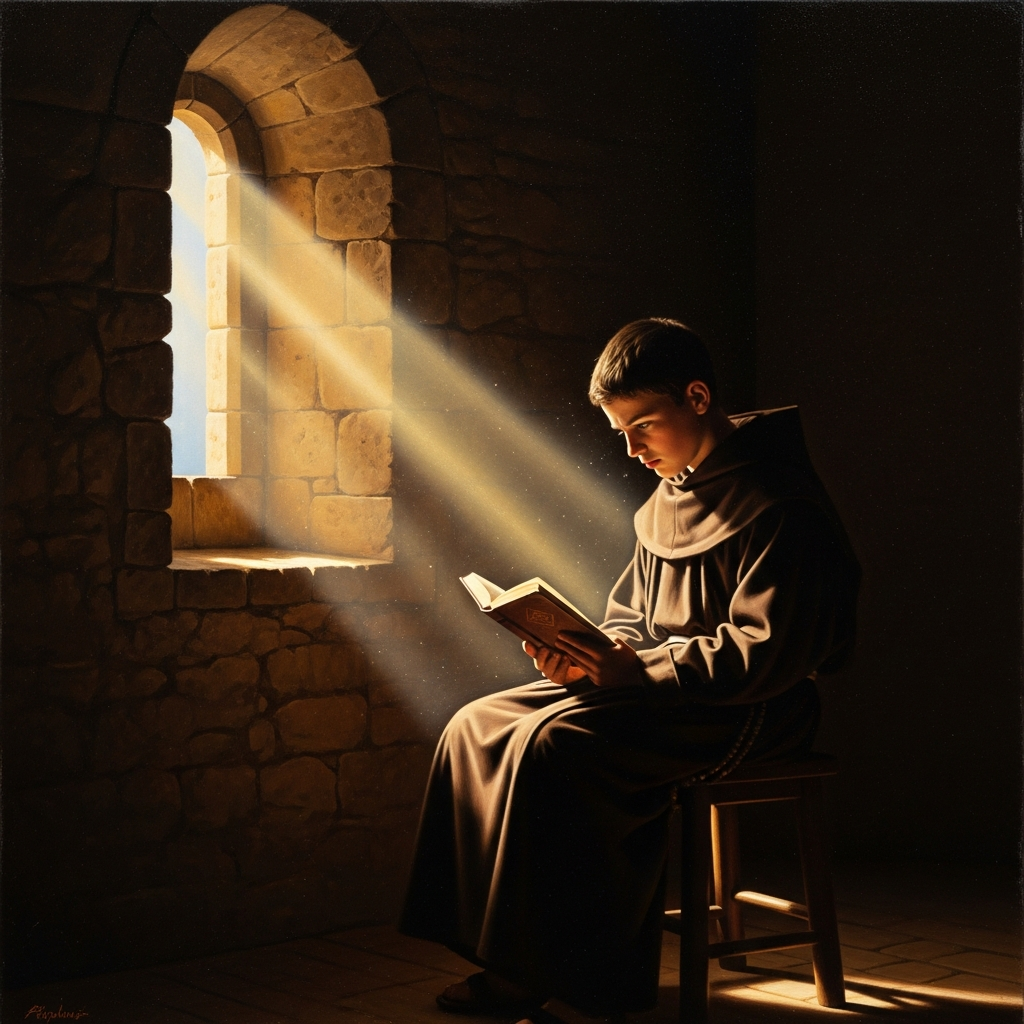
The Imitation was read by novices, by lay brothers, by the women of the devout houses who had no access to the university and never would. He addresses it, in its opening dedication, to a young man — someone new to the life, someone who does not know yet whether the path he has chosen leads somewhere. The book tells him: you have everything you need. The only equipment required for the interior life is the will to enter it. The knowledge that looks like a prerequisite is, in fact, an obstacle that the clever must work harder to remove.
He writes: What doth it profit thee to discourse learnedly of the Trinity, if thou be void of humility? He is not against discourse. He knows discourse. He is saying that discourse without the ground of humility is a kind of sustained self-deception — the accumulation of words about God that fills the space where the experience of God might otherwise begin to form.
The book spreads immediately. Within a decade of its composition it is circulating in manuscript through the monasteries and devout houses of the Netherlands, then Germany, then France. By 1500 it has been translated into French, German, Italian, Dutch, Spanish. By 1600 it is in English, Portuguese, Polish, Czech. By 1900 it is in every language in which European Christianity has established itself, including Japanese. Ignatius of Loyola reads it during his convalescence at Loyola in 1521 and reads it every day for the rest of his life. Thomas More reads it and it shapes the Dialogue of Comfort Against Tribulation. John Wesley reads it and notes in his journal that it is one of the books that formed him.
None of this surprises Thomas, who is not alive for any of it, and who would have found the information about his own influence somewhat beside the point. He wrote the book to be used. He wrote it small deliberately — each chapter brief, each sentence pointed, nothing that requires a long session of study to absorb. It is a manual for interior work, not a monument to his learning.
He is, in this, entirely consistent. He chose deliberate smallness. The small book in the small cell in the monastery near Zwolle where he copied the Bible four times and wrote, in the margins of the large work, the text that would outlast everything.
He made himself as small as possible — the cell, the scriptorium, the manuscript, the hand moving across the page — and in making himself small he found what he was looking for: not the satisfaction of having learned a great deal, but the quiet that comes after you have stopped needing to.
Scenes
Thomas in the scriptorium at Mount Saint Agnes, a candle burning low at his left hand, the quill moving through another page of the Gospel of John
 Generating art…
 The Imitation open to its most famous line — What doth it profit thee to enter into deep discussion concerning the Holy Trinity, if thou lack humility?
 Generating art…
 A novice in his cell, reading the small book by the light that comes through the stone window — the exact reader Thomas imagined
 Generating art…
 Echoes Across Traditions
Entities
- Thomas à Kempis
- Gerard Groote
- the Brethren of the Common Life
Sources
- Thomas à Kempis, *The Imitation of Christ*, trans. Leo Sherley-Price (Penguin, 1952)
- Thomas à Kempis, *The Imitation of Christ*, trans. William C. Creasy (Ave Maria Press, 1989)
- R.R. Post, *The Modern Devotion: Confrontation with Reformation and Humanism* (Brill, 1968)
- John Van Engen, *Sisters and Brothers of the Common Life: The Devotio Moderna and the World of the Later Middle Ages* (University of Pennsylvania Press, 2008)
- Albert Hyma, *The Christian Renaissance: A History of the Devotio Moderna* (Century, 1924)