The Goose and the Swan
July 6, 1415 · Constance, Holy Roman Empire · The cathedral square, Constance — the imperial city where the Council had been seated since 1414
Contents
Jan Hus, lured to the Council of Constance under imperial safe-conduct, refuses to recant and is burned at the stake — leaving behind a prophecy that a swan will rise where the goose was roasted.
- When
- July 6, 1415 · Constance, Holy Roman Empire
- Where
- The cathedral square, Constance — the imperial city where the Council had been seated since 1414
He arrives in Constance in November under a sealed parchment from the Emperor.
Sigismund’s safe-conduct names him Magister Johannes Hus de Bohemia and promises free passage to and from the Council, regardless of the verdict. Hus folds the parchment into his cloak and crosses the Alps with three Bohemian knights as escort. He is forty-three. He has been preaching at Bethlehem Chapel in Prague for thirteen years — in Czech, not Latin — and the city behind him has half-emptied its churches to follow him.
The Council has been seated for a year. Three rival popes claim Peter’s chair. The cardinals need a heretic to prove they still have the authority to burn one.
Hus does not yet understand that he is the proof.
They arrest him within three weeks.
The cell is in a Dominican monastery on an island in the Rhine, below the waterline. The damp climbs the walls. He develops a fever that nearly kills him before the trial begins. When he asks why the Emperor’s safe-conduct has not protected him, the cardinals explain — patiently, as if to a child — that fides non est servanda haereticis. Faith need not be kept with heretics. The parchment is a piece of paper. He is a category.
He writes letters to his Bohemian friends on whatever scraps reach him. Pray for me. Stand firm in the truth you have learned. Do not be afraid of those who can kill the body.
Outside, the council fathers eat venison and argue about which pope to depose first.
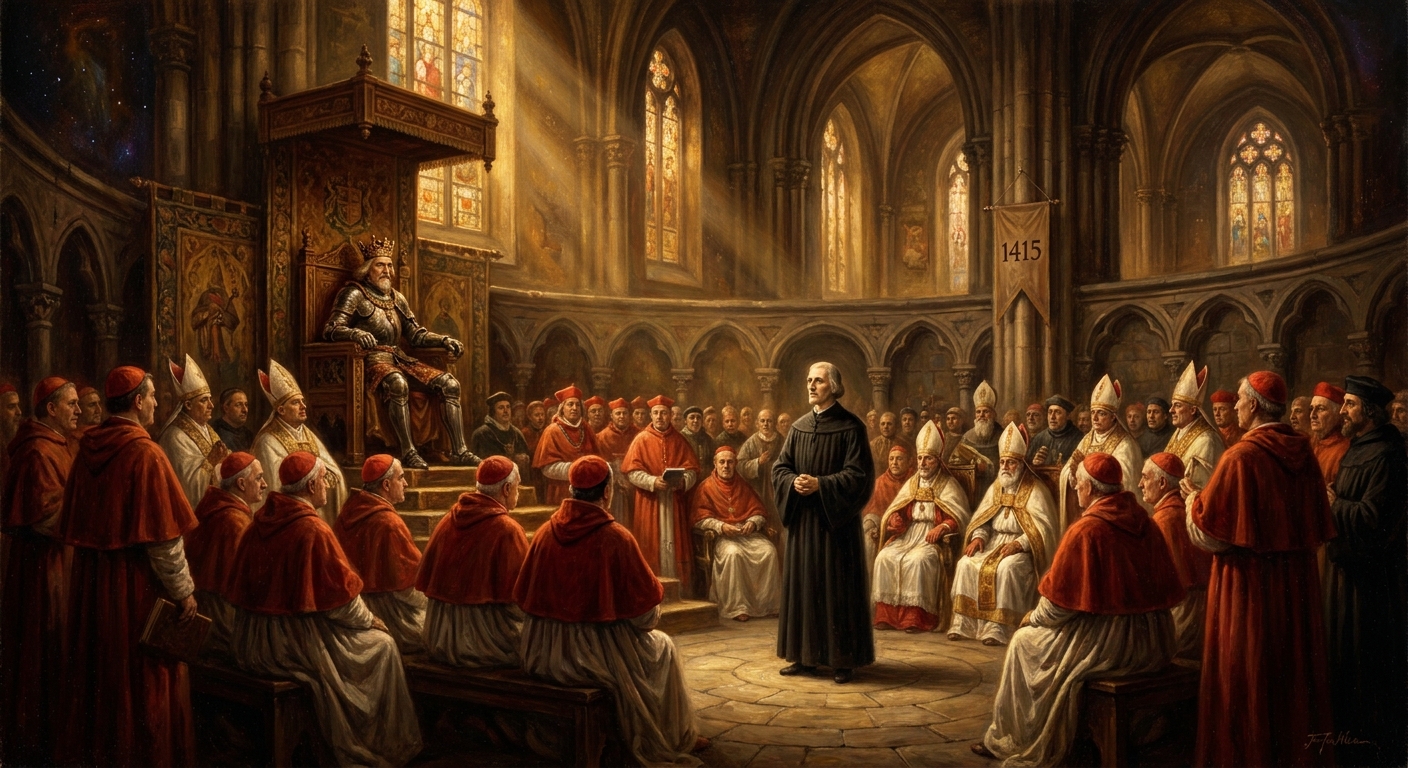
The trial runs for weeks. They read him propositions extracted from his books — some genuine, some twisted, some Wycliffe’s not his — and demand he abjure each one.
He answers the same way every time: show me from Scripture or sound reason that I am wrong, and I will recant. The cardinals find this answer maddening. They are not a debating society. They are a tribunal. The point is the abjuration, not the argument.
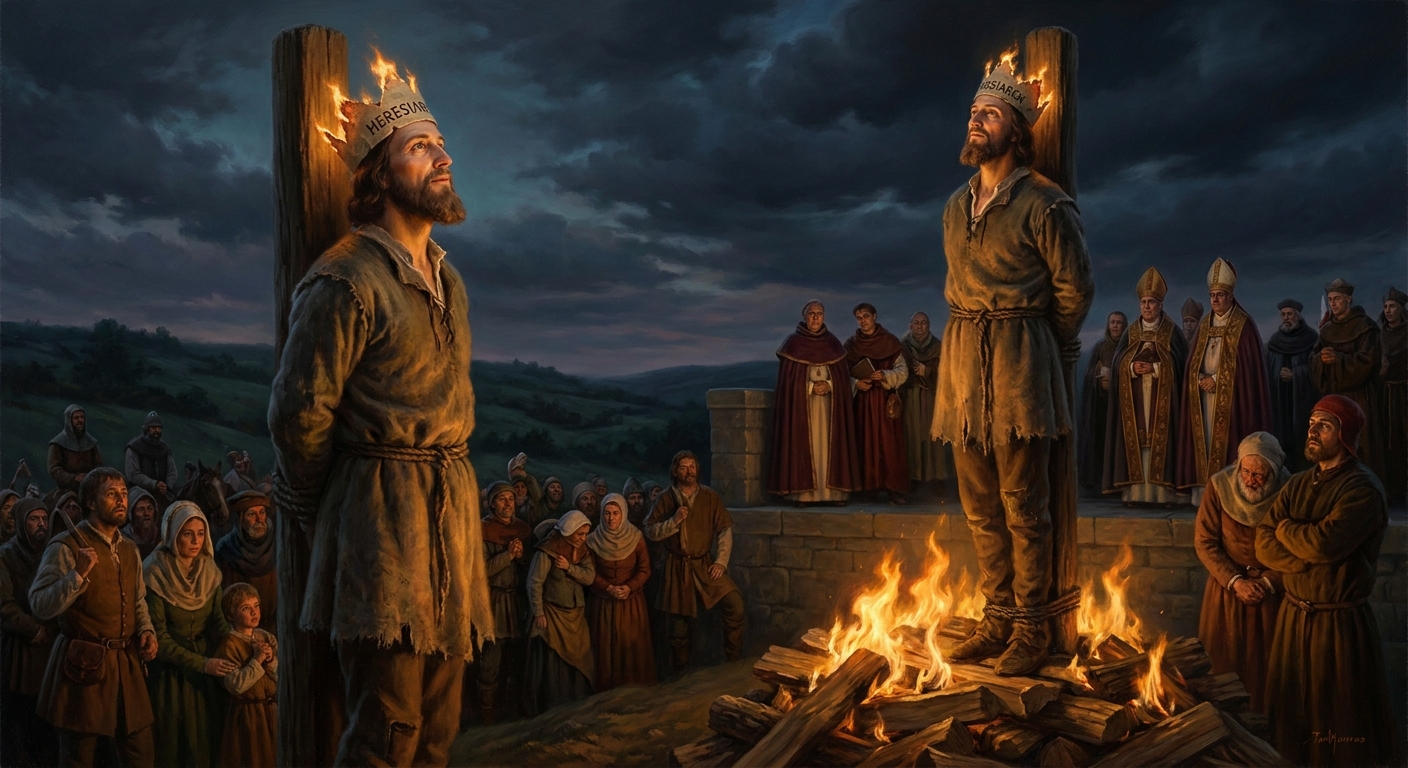
On the morning of July 6, they bring him to the cathedral. The Mass is sung over him as if he were already dead. They strip him of his priestly vestments piece by piece — chasuble, stole, alb — and tonsure him with shears, scraping the crown of his head bare. They place a paper crown on his head painted with three demons and the word HAERESIARCHA.
He says, My Lord Jesus Christ wore a crown of thorns for me. I will gladly wear this lighter one for him.
They lead him through the streets, past the bishop’s palace where his own books burn in a bonfire fed all morning. He sees the smoke and laughs — a single, surprised sound — and tells the soldier nearest him that they will not so easily burn the hearts of the faithful in Bohemia.
At the meadow outside the city walls, a stake has been driven into the ground. They tie him to it with wet ropes and chain his neck. They pile straw and faggots around him to the chin. The imperial marshal, in Sigismund’s name, offers him one last chance to abjure.
He looks up at the sky over Lake Constance — the same sky that arches over Prague — and says, In the truth of the Gospel I have written, taught, and preached, I will today gladly die.
The torch is brought.
The fire takes a long time.
The wood is green in places. The wind is wrong. He sings Christe Fili Dei vivi, miserere mei — Christ, Son of the living God, have mercy on me — until the smoke takes his voice. The crowd is silent. Even the soldiers do not speak.
When his body is consumed they break the bones with iron bars and burn them again, and a third time, and rake the ashes into wagons and dump them into the Rhine downstream of the city. They are thorough. They want no relic. They want no shrine. They want no Bohemia.
But the river runs east. The river runs back toward Prague.
Within four years, his followers will throw the Catholic councilors of Prague out of the New Town Hall windows — the First Defenestration — and the Hussite Wars will begin, and five papal crusades will break against Jan Žižka’s wagon-fortresses, and Bohemia will not be Catholic again for a hundred years.
The prophecy is recorded by his disciples after the fact. Whether he said it at the stake or in his cell or only in their hearts is impossible to determine.
Hus, in Czech, means goose. You are roasting a goose now, he is said to have said, but in a hundred years there will rise a swan, whom you will not be able to roast or boil.
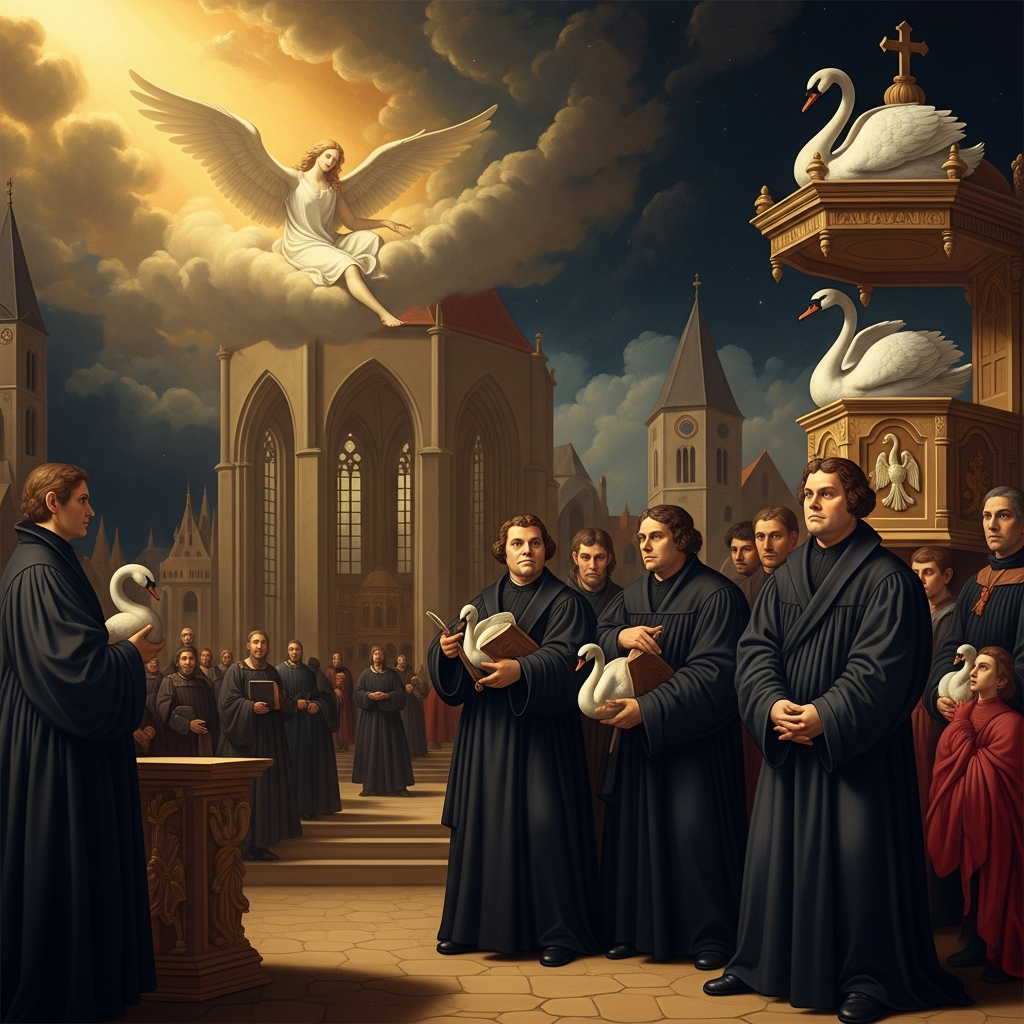
In 1517 — one hundred and two years later — an Augustinian monk in Wittenberg nails ninety-five theses to a church door. He reads Hus’s letters and weeps. He calls himself a Hussite without knowing it. He adopts the swan as his emblem. The Lutheran churches of Saxony begin carving swans into their pulpits, and they carve them still.
Whether Hus prophesied or not, the cardinals at Constance had made the prophecy true the moment they revoked the safe-conduct. They had taught Christendom that the church would not keep its word. After that, only the date of the swan’s arrival was uncertain.
Hus dies for an idea the Council was not prepared to argue with: that the church can err, that scripture in the vernacular belongs to the people who speak it, that an emperor’s word should bind the emperor.
The fire on the meadow was supposed to settle the question. It did the opposite. It made the question portable. Every Reformation generation after — Tyndale, Calvin, Wesley, the Anabaptists at Münster, the Covenanters in Scotland — would carry the smell of Constance in its memory.
A goose, roasted in a meadow by Lake Constance, became the patron bird of every reformer who came after. The swan was always going to follow.
Scenes
Jan Hus stands before the Council of Constance, July 1415
 Generating art…
 Tied to the stake outside the city walls, the paper crown of demons on his head, Hus sings the Kyrie until the smoke takes his voice
 Generating art…
 A century later, Lutheran churches across Saxony carve swans into their pulpits
 Generating art…
 Echoes Across Traditions
Entities
- Jan Hus
- Sigismund, Holy Roman Emperor
- Council of Constance
- John Wycliffe
- Martin Luther
Sources
- Matthew Spinka, *John Hus: A Biography* (Princeton, 1968)
- Thomas A. Fudge, *The Trial of Jan Hus: Medieval Heresy and Criminal Procedure* (Oxford, 2013)
- Peter of Mladoňovice, *Relatio de Mag. Joannis Hus causa* (eyewitness account, 1415)
- Howard Kaminsky, *A History of the Hussite Revolution* (1967)