
Margery Kempe and the Gift of Tears
c. 1373-after 1438 CE — Margery's life; *The Book of Margery Kempe* dictated c. 1430s; key visionary year c. 1413 · King's Lynn, Norfolk → Norwich (visit to Julian) → Jerusalem and the Holy Land → Rome → Santiago de Compostela → Aachen → back to Lynn
Contents
Margery Kempe of Lynn cannot stop crying. She cries at sermons. She cries in churches. She cries in Jerusalem on the Mount of Calvary so violently that her fellow pilgrims abandon her on the road. She cries because Christ's Passion is happening inside her, every time, undiminished by repetition. She is a married woman with fourteen children, a failed brewer, an illiterate visionary, and the most disruptive English mystic of her century. In old age she dictates her experiences to a scribe. The result is the first autobiography in the English language.
- When
- c. 1373-after 1438 CE — Margery's life; *The Book of Margery Kempe* dictated c. 1430s; key visionary year c. 1413
- Where
- King's Lynn, Norfolk → Norwich (visit to Julian) → Jerusalem and the Holy Land → Rome → Santiago de Compostela → Aachen → back to Lynn
She is forty when it begins, but the ground has been shifting under her for twenty years.
Margery Burnham was born in King’s Lynn around 1373, the daughter of John Burnham, who served as mayor of the town five times and as alderman of the prestigious Trinity Guild. Lynn is a North Sea port — wool out, wine and Baltic timber in, fish from Norway, cloth from Flanders — and the Burnhams are at the center of its merchant class. She marries John Kempe, also of the merchant class but less prosperous than her father, around 1393. She is twenty. He is older. The marriage is conventional. She begins to bear children.
The first child nearly kills her. She develops what she will later call, looking back through the lens of her conversion, a strange illness after the difficult labor: she sees devils with mouths like flames coming out of the bedroom walls. She tries to confess a sin — what sin she does not specify even to her later scribe, only that it had been weighing on her since girlhood — but the priest cuts her off mid-confession, and after that she falls into what we would now call a postpartum psychosis and what the fifteenth century called possession. It lasts months. She raves. She tries to bite herself. She tries to kill herself. They tie her to her bed.
Then Christ appears at the foot of the bed. She describes him in her Book with the precision of someone who has been over the memory many times: a fair young man clad in a mantle of purple silk, sitting upon her bedside, looking upon her with so blessed a face that she was strengthened in all her spirits. He says: Daughter, why hast thou forsaken me, and I forsook never thee? He sits there a long time. Then he goes upward into the air. After he goes, she is sane again.
She tries to go back to ordinary life.
She runs a brewery. Lynn, like most market towns, brews most of its beer in private establishments, and a woman of Margery’s standing brewing professionally is unusual but not unrespectable. The brewery fails — the yeast will not rise, three batches in a row, and the staff quit, taking it as a sign — and she takes a financial loss her husband does not entirely conceal his irritation about. She tries a horse mill. The horses refuse to turn the wheel. The mill fails. She takes another loss.
By her own account, told to the scribe with full self-recognition twenty years later, she had been living for vanity. She had been wearing fashionable clothes — gold pipings, slashed sleeves, tippets — and had been proud of her household, proud of her merchant lineage, proud of her clothes, proud of being the mayor’s daughter even though she was no longer the mayor’s daughter, only the wife of a less prosperous man. The brewery and the mill are, in her telling, divine corrections. She is being shown that she is not in charge.
She continues to bear children. By the time the conversion completes, she has had fourteen.
The conversion takes years.
It is not a single event. It is a slow series of things: a vision in church one summer afternoon during which she is overwhelmed by what she will call unspeakable melody, after which ordinary life seems flat to her. A growing aversion to sex with her husband, who does not understand and who pulls rank — he is the husband; the law and the church are with him — until one summer, on the Friday before Midsummer, she reaches a crisis. She has been fasting. He has been irritated. She is walking with him on the road from York to Bridlington and he asks her, half-joking and half-cornered, whether she would rather have him dead or break her vow of chastity. She tells him to ask God. He goes away angry. They eventually negotiate — Mistress Margery will go on living with him as a sister, will pay his debts, and they will eat together on Fridays — and the marriage settles into a strange kind of peace that survives until his death.
She begins to weep.
It begins as ordinary devotional weeping — the sort of compunction tears that the medieval tradition recognizes as a gift of tears, a charism of the Holy Spirit, written about by the Desert Fathers and by Bernard of Clairvaux and by every spiritual writer of the twelfth century. But hers does not stop where theirs stops. She cries at sermons until people complain. She cries in church until the priest asks her to leave. She cries on the road. She cries at the sight of a small child, because she is thinking of the Christ child. She cries at the sight of a tall man, because she is thinking of Christ on the cross. She begins to roar — she uses the word herself, roryng, the sound of an animal in pain — and the roaring goes on for hours.
This is not metaphor. This is not poetic license. This is what is happening in her body, every day, in churches and in markets and in the streets of Lynn, and it makes her impossible to live with.
She decides to go to Norwich to consult Julian.
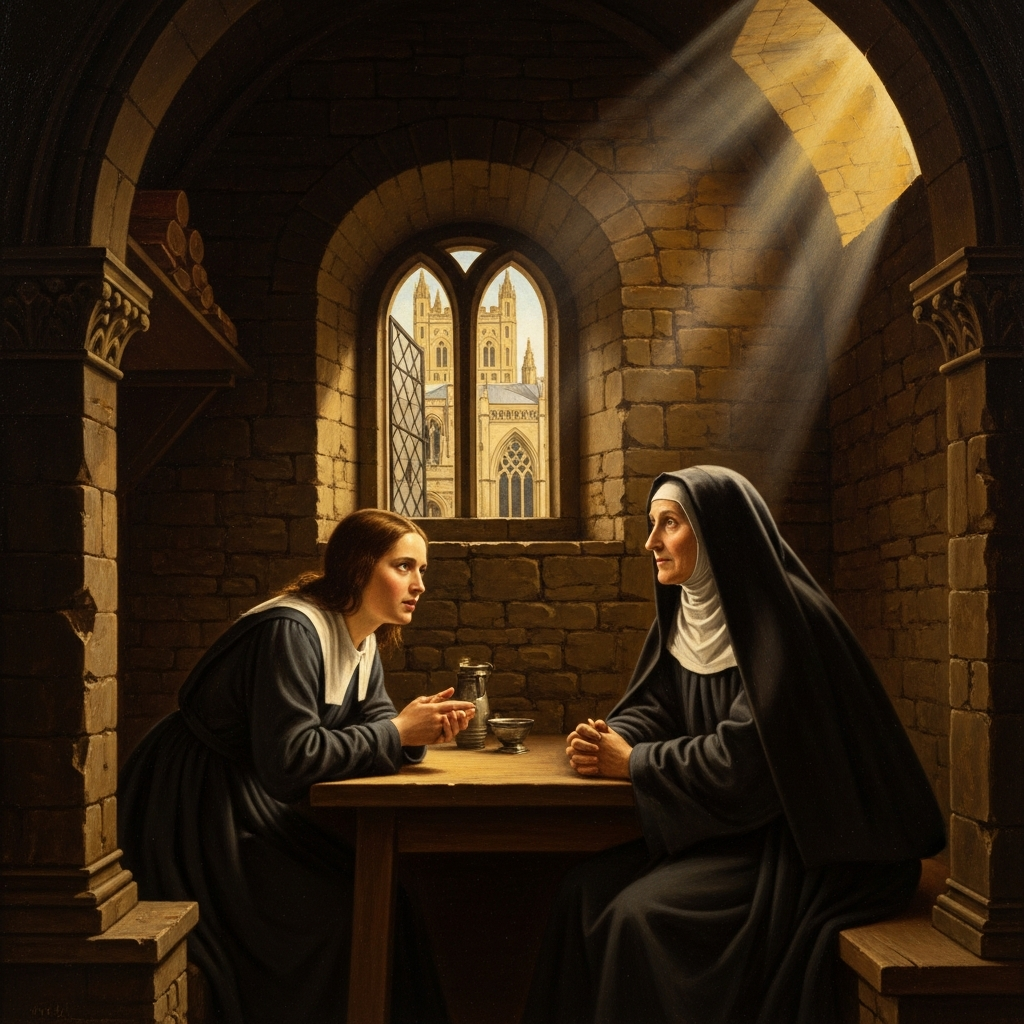
Julian of Norwich is at the anchorhold attached to St. Julian’s Church, immured there since around 1393, eighty years old by Margery’s visit, the most respected mystic in East Anglia. Anchorites speak with visitors through a small window cut into the wall. Margery comes to the window. She tells Julian everything: the visions, the weeping, the marriage, the years of confusion, the question of whether she is a fraud or a saint or a sick woman or someone the devil has reached.
Julian listens for many days. Then she says — Margery quotes her in the Book — I trust your tears come from the Holy Ghost. The more reproof, sister, that you suffer for the love of God without your own fault, the higher your reward. Believe nothing that turns you away from love.
Margery leaves Norwich changed. She has been authorized, by the most authoritative female voice in England, to trust her own experience. She returns to Lynn. The weeping intensifies. She begins to plan a pilgrimage.
She goes to Jerusalem in 1413.
She travels by ship from Yarmouth to the Low Countries, then overland to Venice. She is forty. She has never been outside East Anglia. She speaks no language but English. She joins a pilgrim party. The pilgrim party hates her almost at once — she will not eat meat, she weeps at meals, she insists on speaking about Christ at every opportunity, she refuses to sit still — and they abandon her at Constance and again at Bologna and again at Venice, and each time she finds her way back, alone, to the next port, the next caravan.
In Jerusalem the Franciscan friars who guide pilgrims around the holy sites take the parties to Calvary. On the Mount of Calvary, in the Church of the Holy Sepulchre, on the rock that the Christian tradition holds to be the rock where the cross stood, Margery falls on her face. The Passion is suddenly and entirely present to her. She sees, she will say, the body of Christ on the cross. She sees the wounds. She sees the women standing below. She sees the soldier piercing the side. She sees it as if she were there, with the immediacy of someone watching a real event.
She begins to scream. The scream goes on. The Franciscans cannot calm her. The other pilgrims are appalled. She bangs her body against the floor. She tears at her clothes. The scream continues for what the Book says is a very long time.
Then it stops. She is helped up. They walk back to the inn. The next day she goes back to Calvary. The same thing happens. It will happen, in churches across Europe, every time she sees a crucifix, for the next twenty-five years. She is given a name for it by other pilgrims and by hostile clergy: the roaring. It becomes the chief evidence used against her in the heresy trials.
She is interrogated three times for Lollard heresy on her way back to England.
The Lollards — the followers of John Wycliffe — were the great heresy of fifteenth-century England, and the church was burning them. The 1401 statute De Heretico Comburendo gave the bishops the legal authority to send heretics to the stake. Margery knows this. She knows that her habits — preaching publicly, quoting scripture in English, claiming direct access to Christ, weeping at sermons — match the profile the church uses for Lollard women.
She is brought before the Archbishop of York. He examines her. She quotes scripture at him. He tells her she has not got the wit of a goose. She replies that the Lord Jesus Christ has more wit than all the clerks of the world together. She is brought before the Archbishop of Canterbury. She speaks to him for the entire afternoon. He finds her orthodox. She is brought before the Bishop of Worcester. She is found orthodox there too. Each time the verdict is the same: not Lollard, not heretic, just strange, just too much, just a woman the institution does not know what to do with.
She survives every trial. She returns to Lynn. She continues to weep. She continues to roar in church. She continues to wear white — the color of a virgin, which she is not, and which is a public theological provocation that the local clergy cannot quite suppress because she has the documentation now, the certificates from the bishops who examined her and let her go.
In her sixties she begins to dictate the Book.
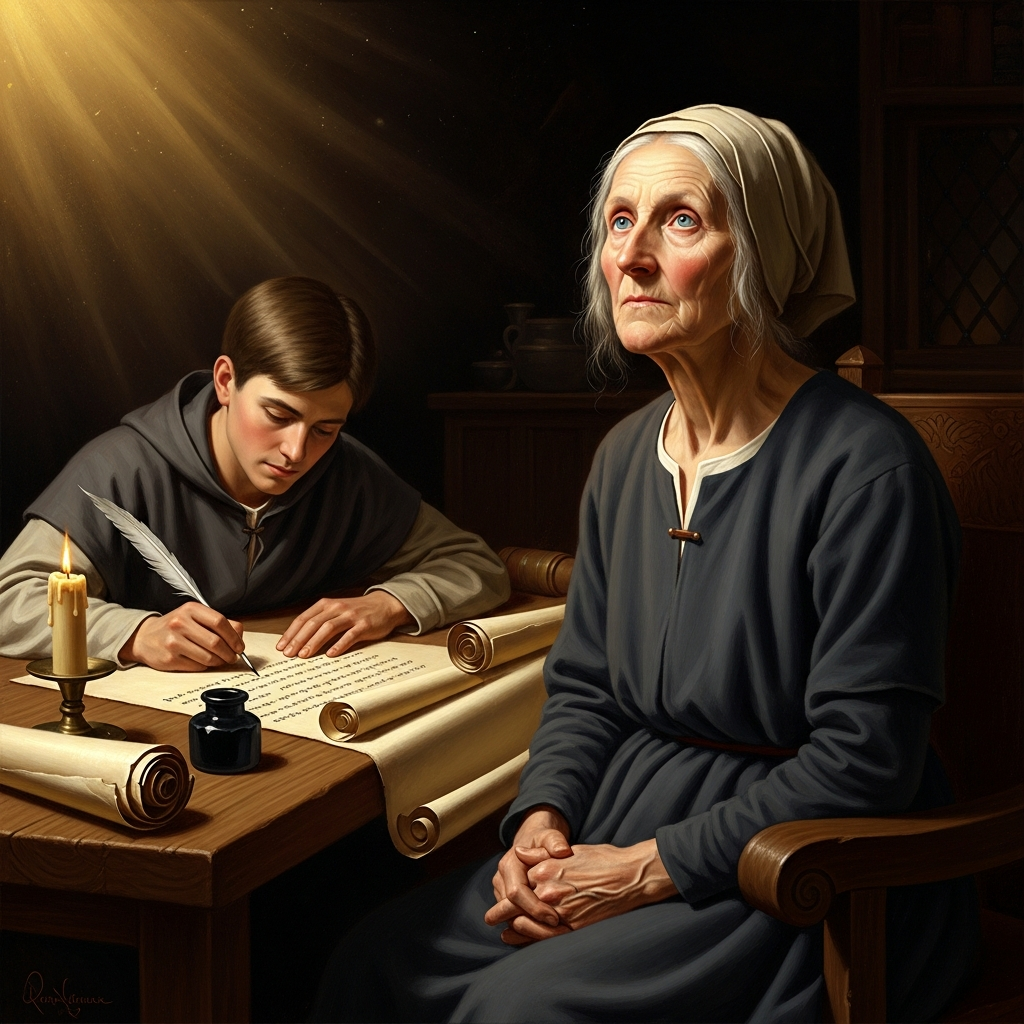
She cannot read or write. The first scribe is an Englishman who has lived in Germany; he writes in a hand and a dialect so eccentric that when he dies the manuscript is almost unreadable. A priest in Lynn tries to read it after his death and gives up. He is approached by Margery. He reluctantly agrees to copy out the difficult manuscript and write down what she still wants to add. He works on it for years. The result is an astonishing document — incoherent in places, repetitive, episodic, apparently shapeless, but actually structured around the central question Margery has been answering since she was twenty: what does it mean to be a married middle-aged Englishwoman who has fallen in love with Christ?
The Book tells the story chronologically and circles back. It does not pretend that everything was understood at the time. It admits doubt. It admits the spite of neighbors and the irritation of priests and the weariness of John Kempe and Margery’s own moments of failure. It is more honest than any spiritual autobiography written in English before it.
The manuscript disappears for centuries. The only surviving copy is held in private hands. In 1934, Hope Emily Allen identifies it in the library of the Butler-Bowdon family. The Early English Text Society publishes it in 1940. It changes the medieval-studies field overnight. The first autobiography in English, a thousand years later, is read for the first time by a wide audience.
Margery Kempe is the inconvenience the medieval church could not tidy up. She insisted on the validity of her interior life. She insisted on the right to be heard. She insisted that her tears were a gift, not a symptom, and she gathered enough institutional authority — through Julian’s blessing, through three archbishops’ acquittals, through her own dogged self-defense — to make the insistence stick.
She did not lead a movement. She did not found an order. She did not write theology. She wept, and she walked, and she dictated. The body of evidence she leaves us is small — one manuscript, dimly preserved, almost lost — but the testimony it contains is the loudest argument the late medieval church ever heard for the proposition that the Spirit blows where it lists, that the laywoman in the marketplace can be addressed by the same Christ who addressed the desert fathers, and that an institution that cannot find a place for such a woman has misunderstood its own founder.
Scenes
On the Mount of Calvary in Jerusalem, Margery falls on her face and screams
Generating art… In Norwich, at the anchorhold built into the wall of St
 Generating art…
 In old age, in Lynn, the priest sits with parchment and ink while Margery dictates
 Generating art…
 Echoes Across Traditions
Entities
- Margery Kempe
- John Kempe
- Christ
- Julian of Norwich
- Archbishop Henry Chichele
- Archbishop Thomas Arundel
- the anonymous priest of Lynn (her second scribe)
Sources
- Margery Kempe, *The Book of Margery Kempe* (c. 1430s); ed. Sanford Brown Meech and Hope Emily Allen for the Early English Text Society (1940)
- Barry Windeatt (trans.), *The Book of Margery Kempe* (Penguin, 1985)
- Lynn Staley (ed. and trans.), *The Book of Margery Kempe* (Norton Critical Edition, 2001)
- Clarissa Atkinson, *Mystic and Pilgrim: The Book and World of Margery Kempe* (Cornell University Press, 1983)
- Karma Lochrie, *Margery Kempe and Translations of the Flesh* (University of Pennsylvania Press, 1991)
- Anthony Goodman, *Margery Kempe and Her World* (Longman, 2002)