Tsongkhapa Reforms the Dharma
1357–1419 CE (Tsongkhapa's life); Ganden Monastery founded 1409 · Amdo (northeast Tibet) → Lhasa → Ganden Monastery on Drogri Mountain
Contents
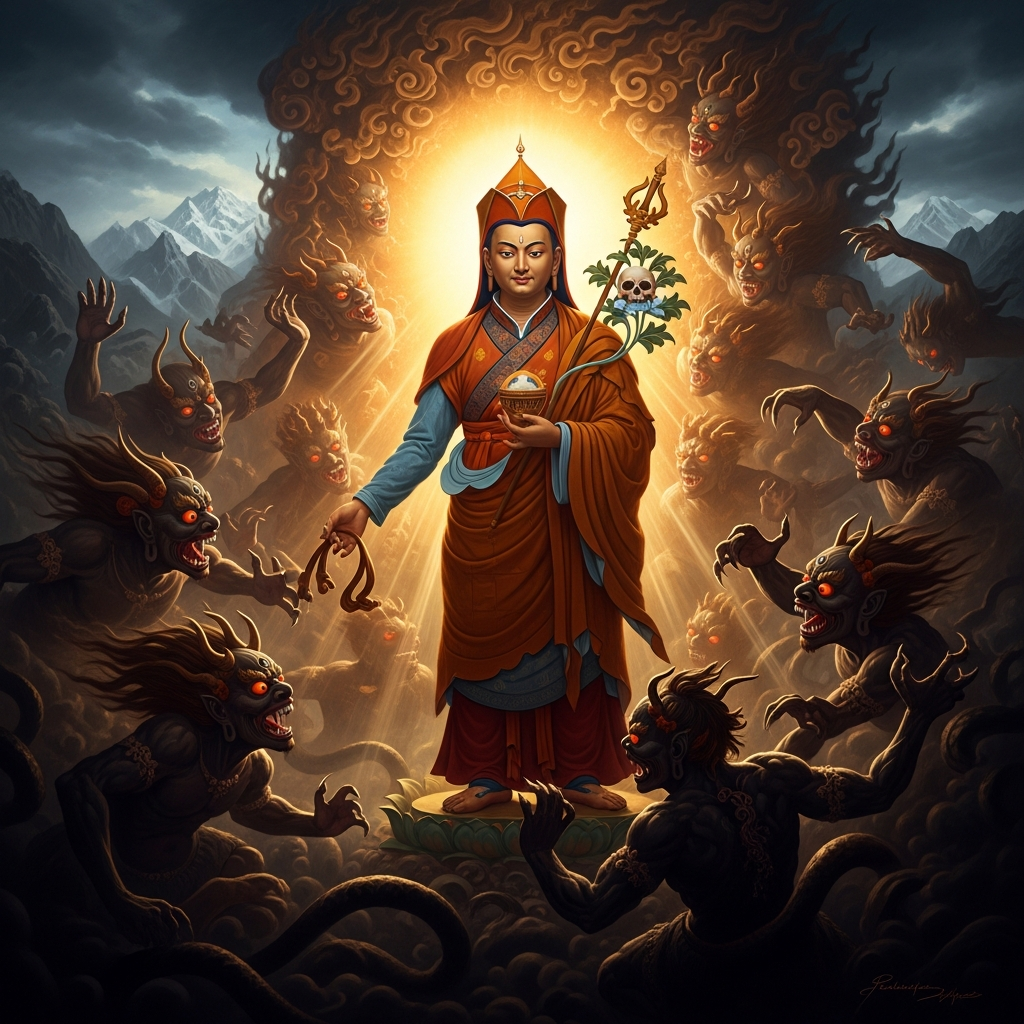
A boy from the high grasslands of Amdo studies under every available master, sees the bodhisattva of wisdom in vision, writes the most systematic treatise on the Buddhist path ever composed in Tibetan, and founds a monastery on a windswept mountain that will eventually govern Tibet.
- When
- 1357–1419 CE (Tsongkhapa's life); Ganden Monastery founded 1409
- Where
- Amdo (northeast Tibet) → Lhasa → Ganden Monastery on Drogri Mountain
He is born in the high grasslands.
The place is Tsongkha, in the Amdo region of far northeastern Tibet, near the great salt lake Kokonor. The year is 1357. The boy’s father is a tribal chieftain named Lumbum Gé. The boy is the fourth of six sons. The legend his hagiographers will later tell is that, the night before his birth, his mother dreamed that a brilliant white light entered her body through the crown of her head, and that on the morning of the birth a sandalwood tree sprouted near the family tent — a tree that would, decades later, when the boy had become a teacher, be revered at Kumbum monastery as marking the precise spot where he came into the world. The leaves of that sandalwood, the local people say, bore the natural form of the seed-syllable AH.
The boy is given the name Lobsang Drakpa — Excellent Renown of Good Mind. He is called Tsongkhapa, the man from Tsongkha, only later, by the monks of central Tibet who cannot easily pronounce his Amdo dialect. He is ordained as a novice at three years old by the wandering teacher Choje Dondrub Rinchen, who recognizes in the boy the qualities the lineage has been waiting for. By the time he is seven he has taken the upasaka vows. By the time he is sixteen he has left Amdo for central Tibet to begin the formal study that will occupy the rest of his life.
He studies under everyone.
This is the deliberate choice. Tibetan Buddhism in the fourteenth century is a fragmented landscape. There is Sakya, with its rigorous logic and its political alliance with the late Mongol khans. There is Kagyu, with its fierce yogic lineages descending from Marpa and Milarepa. There is Nyingma, the Old School, with its termas — the hidden treasure texts attributed to Padmasambhava, slowly being revealed by tertöns across the centuries. There is Kadam, the austere school founded on the teachings of the Indian master Atisha, focused on the gradual lam rim — stages of the path — instruction. Each school has its monasteries, its lineages, its specialties, its disagreements with the others. Most monks affiliate with one and stay there.
Tsongkhapa does not. From the age of sixteen until he is approaching forty, he travels from monastery to monastery — Sakya, Drikung, Tsurphu, Reting, Sangphu, Bodong — receiving every empowerment, every textual transmission, every lineage of practice that he can find. He studies the Pramana logic of Dharmakirti under one master, the Madhyamaka philosophy of Nagarjuna and Candrakirti under another, the Abhidharma metaphysics under a third, the tantric systems of Guhyasamaja and Cakrasamvara under a fourth, the medical tantras under a fifth. He becomes, before he is forty years old, the most thoroughly trained monk in the Tibetan tradition.
He is not collecting. He is looking for the structure.
He is also looking with growing dismay.
What he sees in the great monasteries of central Tibet, in the late fourteenth century, is institutional decline. The Vinaya — the monastic code of discipline — is being honored in name and ignored in practice. Many monks keep concubines. Some keep them openly. The tantric practices, which the Indian masters always insisted should be undertaken only by carefully prepared students under direct guidance, are being performed in public, treated as folk-magic, used to threaten political enemies. The empowerments are being sold for cash. The monasteries are entangled in feudal alliances; the abbots are second sons of noble families parked in the cloister to wait for inheritance. The dharma the boy from Amdo had walked across half of Tibet to find is being practiced, in many places, by men who have not actually taken it seriously in three generations.
Tsongkhapa does not denounce. He does not split. He does not lead a faction. He goes into retreat.
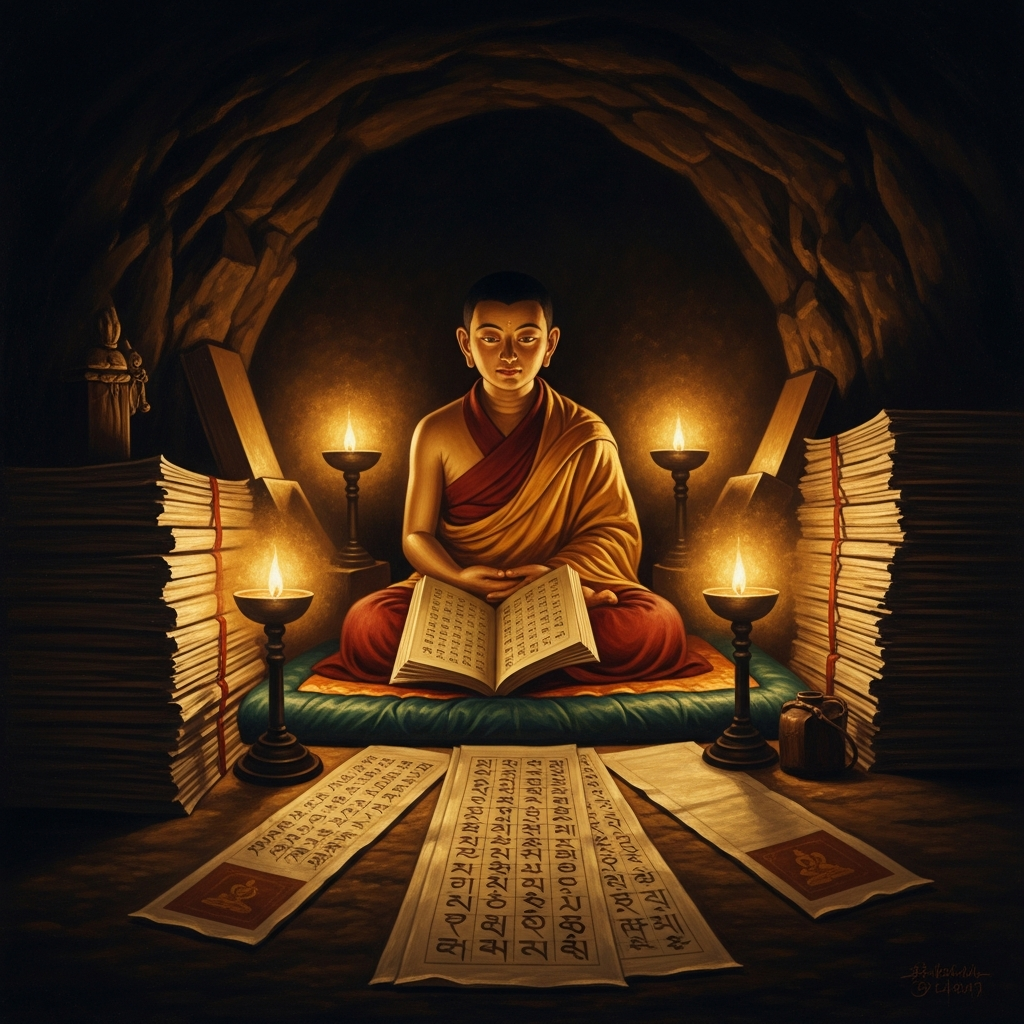
He spends nine years in retreat.
The location is Wölkha, a high valley in central Tibet. He goes with eight chosen disciples. The retreat schedule is famously severe. They perform 3.5 million prostrations between them. Tsongkhapa himself prostrates so many times that the slab of stone in front of his retreat hut bears, to this day, the marks of his hands and feet. They perform 1.8 million mandala offerings. They recite millions of mantras. They study, in tightly structured cycles, every text Tsongkhapa has gathered over his decades of training. They eat poorly. They sleep little. They are doing what monks have always claimed to do and very few actually do.
In the middle of the retreat, the visions begin.
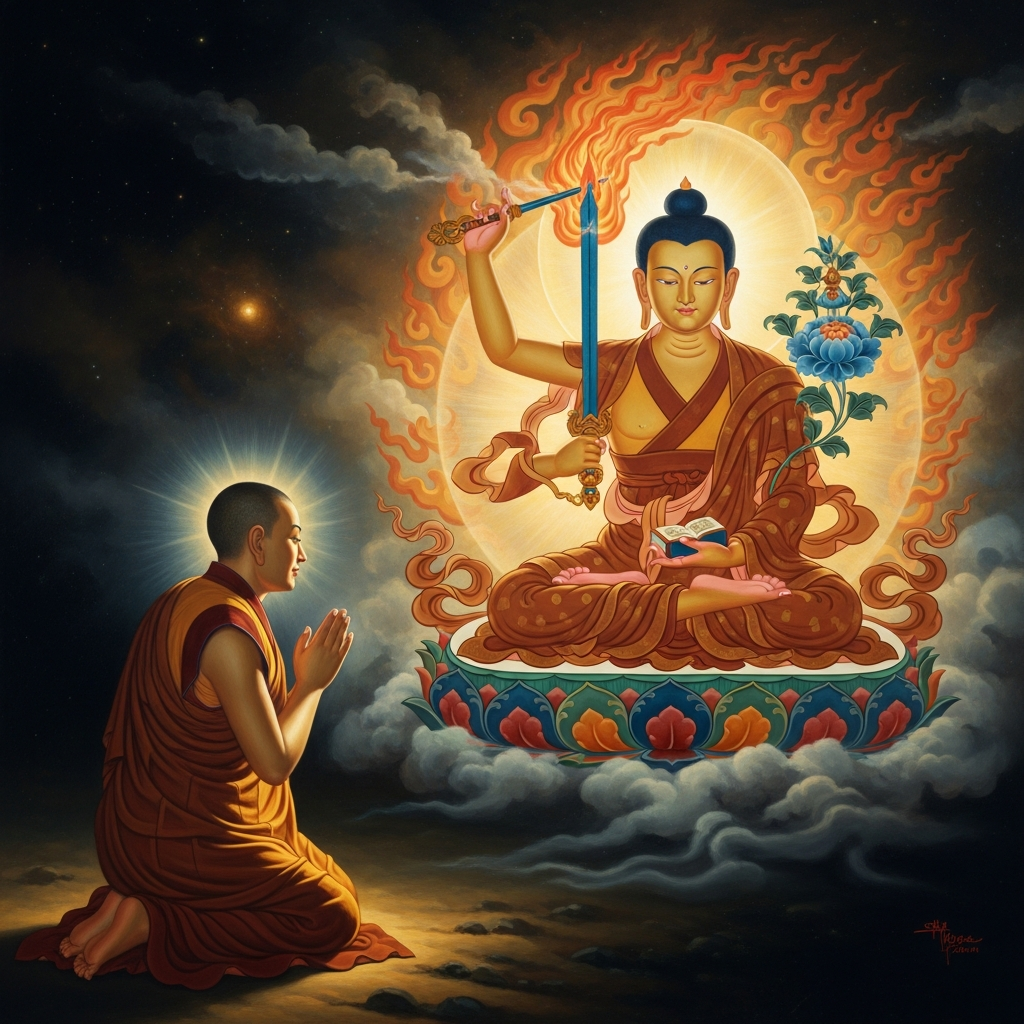
Tsongkhapa sees Mañjuśrī — the bodhisattva of transcendent wisdom, the youthful figure with the flaming sword in his right hand and the Prajnaparamita Sutra in his left. The visions are not poetic. They are pedagogical. Mañjuśrī teaches him directly. He clarifies points of Madhyamaka philosophy that Tsongkhapa has been struggling with for years. He corrects readings of Candrakirti. He explains the precise distinction between the two truths — conventional and ultimate — that has been at issue in Tibetan philosophy since Madhyamaka was first imported from India in the eighth century. Tsongkhapa, in retreat, takes notes. He writes down what the bodhisattva tells him.
The notes will become the philosophical core of his later work. Whatever one believes about the metaphysics of the visions, the textual argument they license is rigorous. Tsongkhapa emerges from the Wölkha retreat in 1397, forty years old, with a settled view of the entire Buddhist path — what depends on what, what supports what, in what order practices should be undertaken, what mistakes destroy the work — that no Tibetan teacher had previously assembled.
He sits down to write.
The book is called the Lam Rim Chenmo — The Great Treatise on the Stages of the Path to Enlightenment. He completes it in 1402.
It is enormous. In the standard translation it runs to three volumes and well over a thousand pages. It is structured around the basic Atisha-derived schema of the three scopes of practitioner — small, middle, and great — but Tsongkhapa fills in every level with the full philosophical apparatus of Madhyamaka and the full ethical apparatus of bodhisattva training. He addresses, with surgical precision, the standard misunderstandings of emptiness — the ones that lead to nihilism on one side and to substantialism on the other. He insists, against fashionable Tibetan positions of his day, that emptiness does not mean rejection of the conventional, that the conventional truth must be respected even as it is recognized as empty, and that any practice that uses the doctrine of emptiness to license the abandonment of moral precepts has fundamentally misread Nagarjuna.
The treatise is a manual. It is also a polemic. Without ever naming his contemporaries, Tsongkhapa is making it clear what proper practice looks like — and by implication what he sees around him is not it.
He follows the Lam Rim with the Ngag Rim Chenmo — the Great Treatise on the Stages of Mantra — which does for tantra what the Lam Rim did for sutra: provides a comprehensive systematization, with explicit warnings about the mistakes that have crept into Tibetan tantric practice. Together the two treatises become, for the school he is about to found, the equivalent of Summa Theologica: the work to which everything else refers.
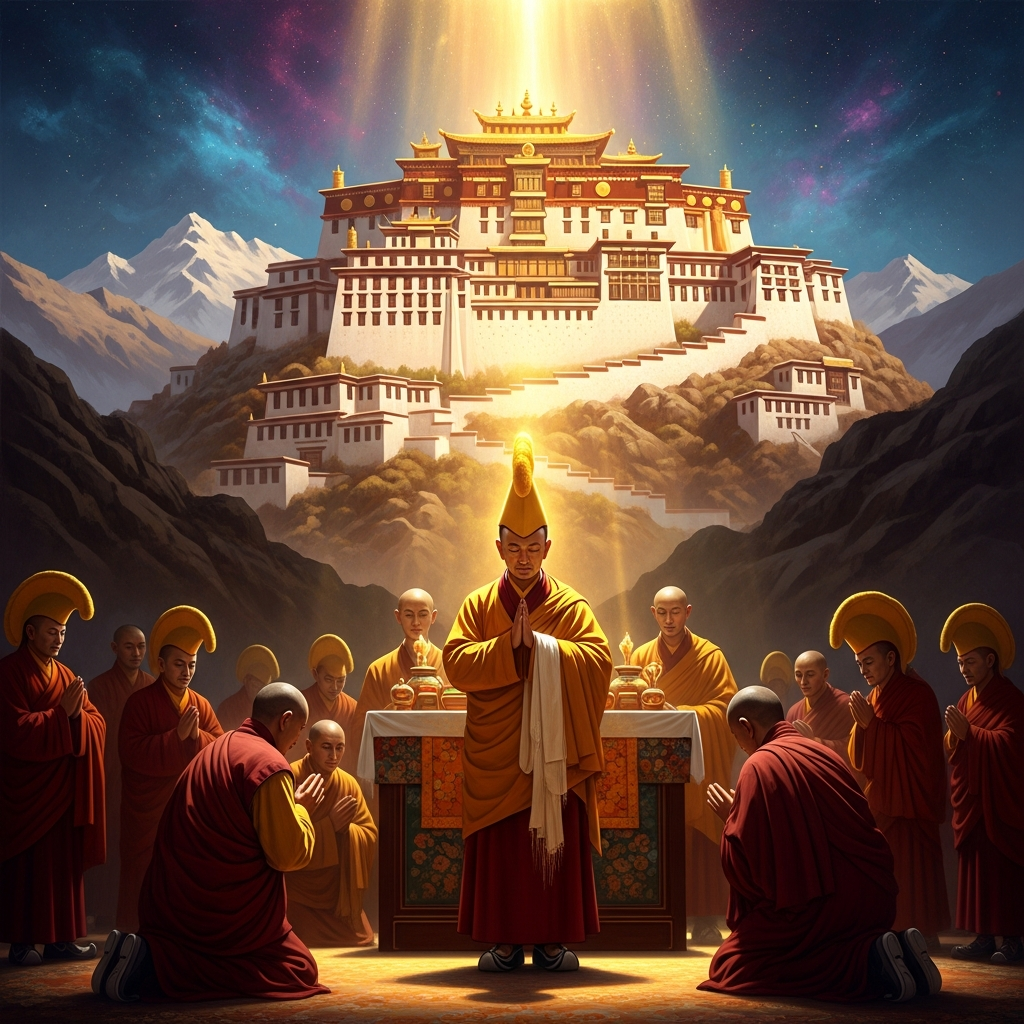
He arrives in Lhasa for the New Year of 1409.
The capital has not seen anything like it in a generation. Tsongkhapa, with the support of the lay patron Miwang Drakpa Gyaltsen, organizes the Mönlam Chenmo — the Great Prayer Festival — at the Jokhang temple. For fifteen days, monks from every school in central Tibet gather at the holiest shrine in the country. Tsongkhapa offers, in the name of all sentient beings, an unprecedented set of offerings to the Jowo statue of the Buddha at the heart of the Jokhang. He preaches the Lam Rim to the assembled monks. The festival becomes, instantly, the largest religious event in the Tibetan calendar; it will be performed annually until the Chinese suspend it in 1959, and after the Tibetan diaspora it will be revived in Dharamsala and held there to this day.
Tsongkhapa does not stop in Lhasa. He has been planning, throughout the festival, what comes next. Several days after the festival ends, he leads his closest disciples east of the city, up the slopes of Drogri Mountain, to a site where the views run for a hundred miles in every direction. He plants his staff in the ground.
Here, he says, we will build.
The monastery he founds is named Ganden — Tushita, after the heaven where the bodhisattva Maitreya is said to await his future buddhahood. Construction begins immediately. The first buildings — the assembly hall, the residences, the kitchens — are completed within a year. Tsongkhapa moves his community there. He becomes the first Ganden Tripa — holder of the throne of Ganden — and the school he is founding takes its formal name from this monastery: Ganden-pa, the Ganden tradition. Later it will be called Gelug — the Virtuous Ones. The yellow hat the Gelug monks wear, which becomes the school’s visual signature, is consecrated at Ganden during these first years.
The monastery grows. The school grows.
Tsongkhapa’s students fan out across Tibet. Jamyang Choje, his disciple, founds Drepung Monastery on a hillside west of Lhasa in 1416. Jamchen Choje founds Sera Monastery north of Lhasa in 1419. Together with Ganden, these become the gden gsum — the Three Seats of the Gelug school — and they will, at their height in the seventeenth and eighteenth centuries, house more than ten thousand monks each. The educational system Tsongkhapa designed — beginning with logic and debate, moving through five major textual cycles (Pramana, Prajnaparamita, Madhyamaka, Abhidharma, Vinaya), culminating in the Geshe degree after fifteen to twenty years of study — becomes the standard of Tibetan monastic education and remains so to this day.
He has another student, much younger, who will not become famous in his lifetime. The boy’s name is Gendun Drup. He is born in 1391 to a family of nomadic herders in Tsang. He becomes Tsongkhapa’s disciple in his teens, founds Tashilhunpo Monastery in 1447 long after his master’s death, and dies in 1474 having lived a life of relatively modest renown. Two centuries later, when the institution of the Dalai Lama is established by the fifth Dalai Lama Ngawang Lobsang Gyatso under the protection of the Mongol khan Gushri, Gendun Drup will be retroactively recognized as the first Dalai Lama. The current Dalai Lama, the fourteenth — Tenzin Gyatso, born in 1935 in Amdo, the same region where Tsongkhapa was born — is the direct lineal descendant of that first quiet student of Tsongkhapa’s, six hundred years removed.
Tsongkhapa dies at Ganden on the twenty-fifth day of the tenth month of 1419. He is sixty-two. The legend says that as he died, light filled his cell, that the snows on the surrounding peaks turned to flowers, that his body shrank to the size of a cubit and rose into the air. The monks of Ganden enshrine his body in a silver stupa in the Yangpa Chen hall of the monastery. The stupa stands for five hundred years. In 1959, Ganden is destroyed in the Chinese cultural revolution; the stupa is broken open; Tsongkhapa’s bones are scattered. A small portion is rescued by his attendants and carried into exile in India. The monastery is partially rebuilt in the 1980s. The exiled Ganden has been reconstituted at Mundgod in southern India, where the Three Seats of the Gelug school all now operate in exile.
The Tsongkhapa story is the story of how reform actually works.
He does not split. He does not denounce. He does not declare the existing schools illegitimate. He studies them all — every one of them, more thoroughly than any of their own adherents — and on the basis of that study writes treatises, founds a monastery, and establishes a curriculum that simply, by being more rigorous and more textually grounded than the alternatives, becomes the dominant tradition. The other schools survive. They are not destroyed. They continue to this day. But the gravity of Tibetan Buddhism shifts toward Ganden because Ganden has done the work.
The structural parallel with the Protestant Reformation in Europe a century later is real and accidental. Both reformers say: go back to the texts. Both reformers say: the institutions have drifted. Both reformers found new institutions that become politically powerful in ways the founders did not foresee. Tsongkhapa, who would be appalled by the political entanglements of the Dalai Lama institution four centuries after his death, nonetheless made it possible. The boy from the Amdo grasslands who walked to central Tibet to find a teacher ended up training half the country.
The flaming sword of Mañjuśrī cuts ignorance. The yellow hat is worn. The bell at Ganden, before its destruction, rang every dawn for five hundred years. It is ringing again.
Scenes
The young Tsongkhapa in retreat in the mountains of central Tibet, surrounded by pecha — long Tibetan manuscript leaves — under the bodhi-light of butter lamps
 Generating art…
 Mañjuśrī appears in vision, wielding the flaming sword of wisdom that cuts through ignorance
 Generating art…
 1409
Generating art… Echoes Across Traditions
Entities
- Tsongkhapa
- Mañjuśrī
- Gendun Drup (First Dalai Lama)
- the 14th Dalai Lama
- the Gelug school
Sources
- Tsongkhapa, *Lam Rim Chenmo* (trans. Lamrim Chenmo Translation Committee, 3 vols., Snow Lion, 2000–2004)
- Robert Thurman, *The Life and Teachings of Tsongkhapa* (1982)
- Thubten Jinpa, *Self, Reality and Reason in Tibetan Philosophy: Tsongkhapa's Quest for the Middle Way* (2002)
- Georges Dreyfus, *The Sound of Two Hands Clapping: The Education of a Tibetan Buddhist Monk* (2003)
- Turrell Wylie, *The Geography of Tibet According to the 'Dzam-gling-rgyas-bshad'* (1962)