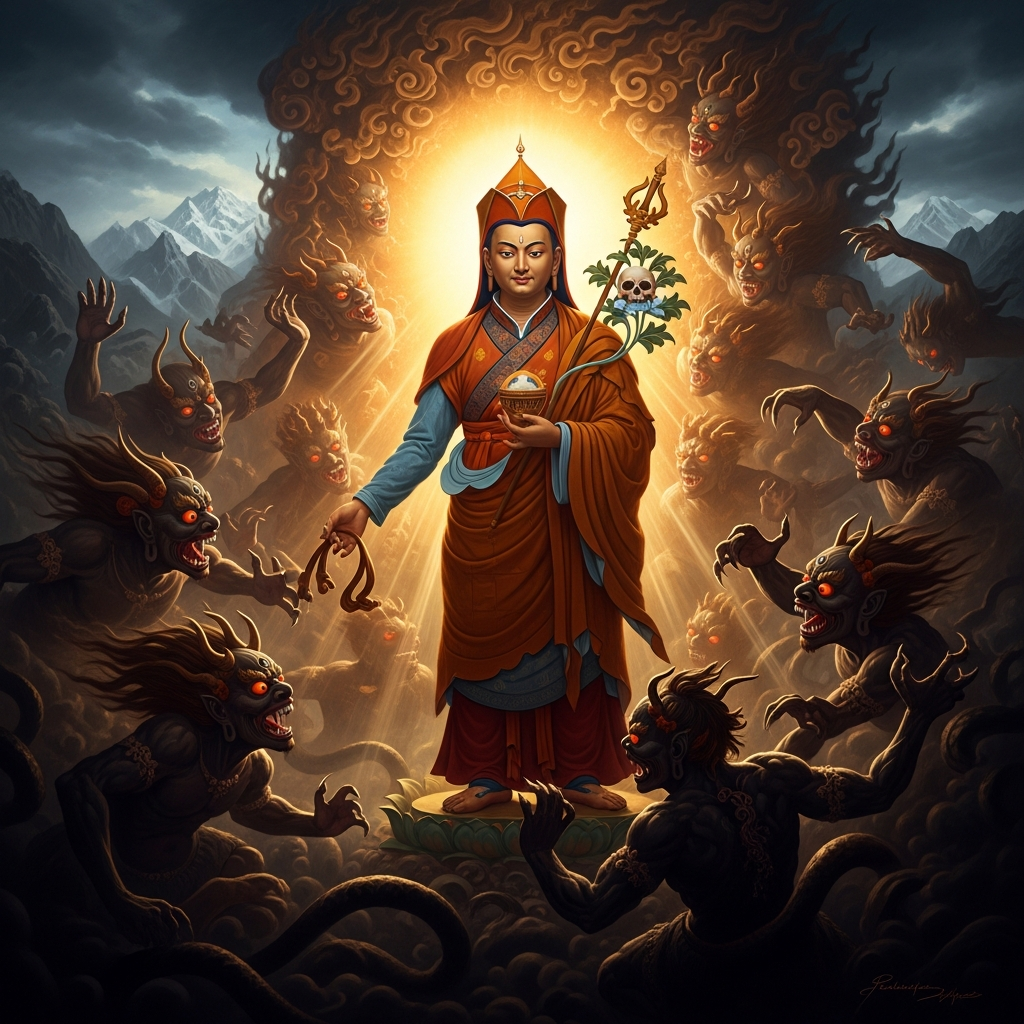
Padmasambhava Binds the Mountain
c. 762-779 CE · Tibet · Yarlung Dynasty · Tibet — from the Mangyul pass on the western border to Samye monastery in the Yarlung valley
Contents
Padmasambhava arrives in Tibet around 775 CE at King Trisong Detsen's invitation and finds every pass, lake, and valley blocked by gods and demons who will not allow Buddhism to take root. He does not destroy them. He subjugates each one by name and binds it as a protector of the dharma — turning the indigenous spirit world into the guardian army of the new religion.
- When
- c. 762-779 CE · Tibet · Yarlung Dynasty
- Where
- Tibet — from the Mangyul pass on the western border to Samye monastery in the Yarlung valley
The scholar arrives first.
Shantarakshita, abbot of Nalanda, the most distinguished Buddhist philosopher in India, reaches the Tibetan court at Trisong Detsen’s invitation around 762 CE. The king is young — barely twenty — and has made a political decision his ministers despise: he will import Buddhism from India and make it the religion of Tibet. He has reasons of state, reasons of culture, reasons of personal conviction. He invites Shantarakshita to come and teach.
The mountains do not receive him.
Within weeks of Shantarakshita’s arrival, earthquakes shake the capital. A lake bursts its banks and floods cultivated fields. The red-rock cliffs above the valley split open and pour scree onto the roads. Three of his translators fall ill with fevers that do not break. The Bön priests of the court — the indigenous shamanic clergy, who read every disaster in terms of spirit-offense — explain with satisfaction: the lha, the mountain gods, are offended. The du, the demons of the high places, are retaliating. Tibet has its own spirit world, organized and hierarchical, and it has not consented to this invasion.
After a year, Shantarakshita retreats to India. Before he leaves, he tells the king: there is one man I know whose method works differently. He is from Oddiyana. Find him.
The man from Oddiyana is Padmasambhava — the Lotus-Born, born not from a womb but spontaneously on a lotus blossom in the middle of Lake Dhanakosha in the Swat Valley, a fully formed child holding a vajra and a skull-cup of blood. This is the tradition’s claim, and the tradition is specific about it because the manner of birth matters: he was not bound by the ordinary logic of embodiment, had never been inside the womb’s darkness, did not carry its residue. He was a different kind of being using a human form.
He trained at Nalanda. He spent decades in charnel grounds — the cremation fields where Tibetan and Indian tantric practitioners go to learn the practices the monasteries do not teach: the rituals of wrathful deities, the meditations on death and dissolution, the conjuring and subjugation of spirits by someone who has thoroughly confronted their own fear. When the king’s messenger finds him, he is in a charnel ground in the Kathmandu valley called Yangleshö, generating heat in the cold.
He agrees to come.
He enters Tibet through the Mangyul pass on the western border. He has no retinue. He is riding a horse.
The first confrontation happens on the pass itself.
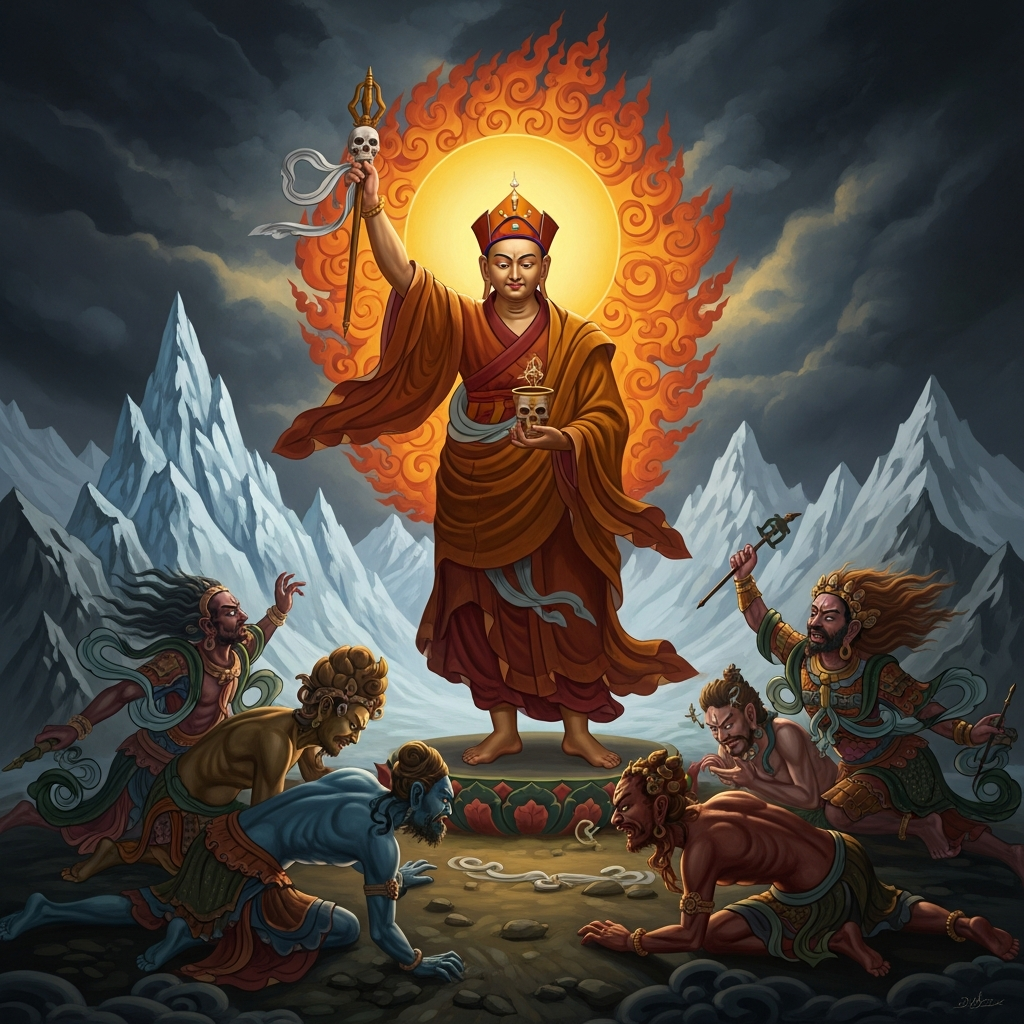
A glacier spirit — a du, in the Bön taxonomy — has been holding that pass against travelers for a generation. Three of the king’s previous emissaries failed to cross it. It comes for Padmasambhava as weather: blizzard rolling down the col out of clear sky, temperature dropping faster than altitude explains, the air itself becoming hostile and directed, as intentional as a raised hand.
He stops his horse.
He does not recite a peaceful mantra. He recites the Vajrakilaya — the wrathful ritual of the diamond dagger — and the syllables are not prayer but command. The phurba, his ritual dagger, points at the center of the storm. The texts say the blizzard freezes mid-fall. Each flake hangs in the air. The spirit is forced from the weather into a form — compelled, the way water is compelled through a narrowing channel — and it kneels in the snow and asks for mercy.
He grants mercy.
But mercy in this tradition has a shape. You are not destroyed. You are conscripted. From this hour you are the guardian of this pass — not its adversary but its dharmapala, its dharma-protector. Every traveler you once buried you will now shelter. Every emissary of the dharma you blocked you will now escort. You will serve a religion that does not yet exist on this mountain. Refuse, and I will dissolve you into the seed-syllables of your own name.
The spirit takes the vow. He names it. The horse moves on.
He does this mountain by mountain. The Padma Thang Yig, the Lotus Chronicle, catalogs them: lake spirits who had been drowning pilgrims for centuries, sky-burial demons who resented the intrusion of Indian liturgy, nagas of the boiling springs at Yangpachen who believed the new religion was incompatible with their sovereignty over the underground rivers.
Each one he meets as he meets the glacier spirit: not with destruction but with demonstration. The principle is consistent. The being before him has power. He has more power. But power, in the Vajrayana understanding, is not its own justification — it is a capacity to be directed. He is not here to eliminate the spirit world of Tibet. He is here to redirect it.
The twelve Tenma goddesses are the supreme test of the method.
They are the most powerful indigenous spirits of Tibet — twelve women who hold the twelve directions and the twelve months, who have been the lords of the Tibetan plateau since before any human dynasty, who eat travelers who offend them and have been doing so for as long as anyone’s grandfather can remember. They are not minor demons. They are the landscape itself expressed as personhood: rock, wind, lake, and lightning given faces and names and appetites.
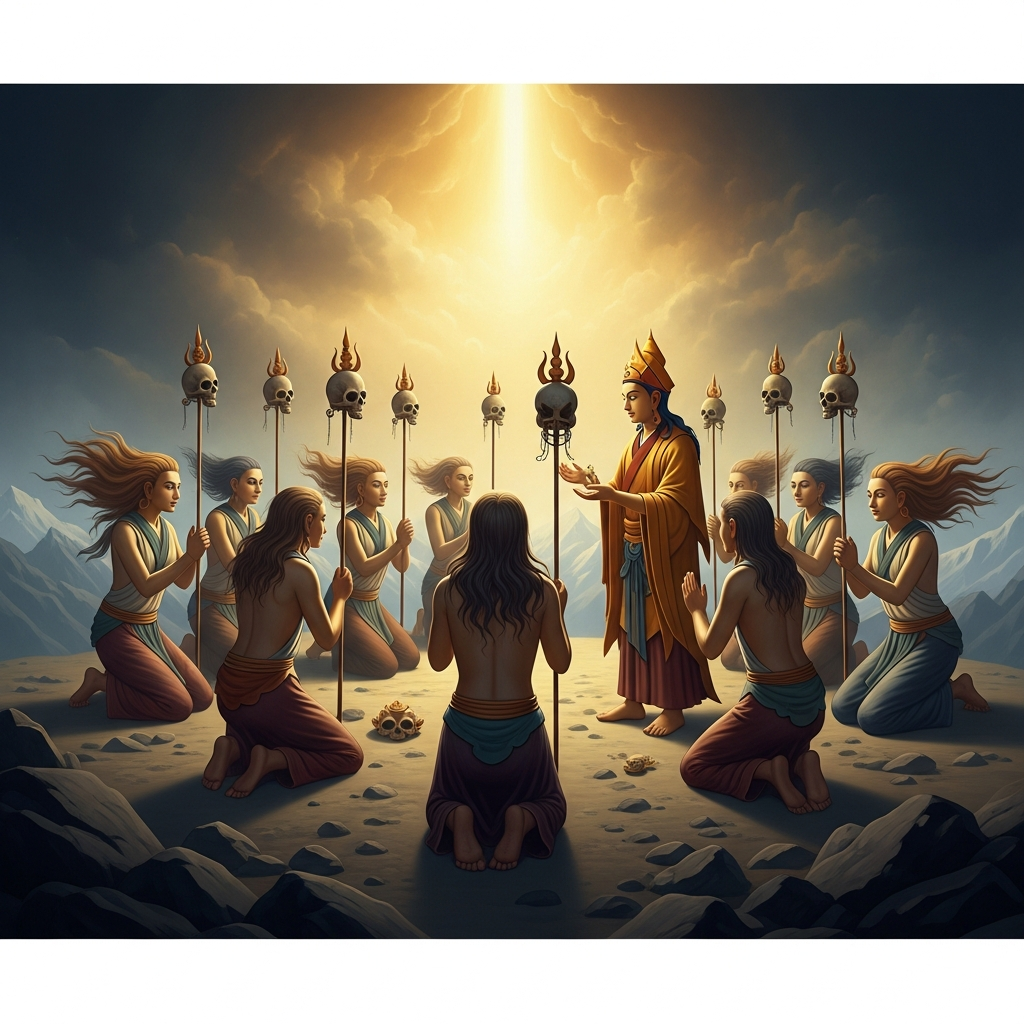
They meet him on the slopes of Mount Hepori in a circle of bone-fires. They are in their full manifestation: each one enormous, each one wearing the pelts and skulls of her prey, each one holding the weapon of her station. They demand his liver.
He sits down.
He begins to explain, with the terrifying patience of someone who has spent decades in charnel grounds and is not alarmed by this, the mechanics of karma. Every liver they have eaten is a debt. The debt will mature. The only way to clear a debt is to stop accumulating it and to redirect the capacity that generated it toward something that builds merit instead. He offers them a job that uses exactly what they are — ferocious, territorial, directional, inexhaustible — while no longer accruing the consequences.
Become protectors. Your hunger will be redirected: you will consume the obstacles to dharma, not its travelers. Every enemy of the teaching that approaches Tibet will find you in its path. You will be more powerful under this arrangement than you are now, because you will be operating in alignment with the deepest law of things rather than against it.
The youngest Tenma kneels first. Then, one by one, the others. He gives each one a samaya name — a vow-name, the name she will answer to for as long as the vow holds. He writes them into the new pantheon with their original Tibetan identities intact.
They are still invoked, by those names, in every Nyingma ritual today.
What he is doing, across these weeks of travel from the western border to the Yarlung valley, is constructing a religion that has deep roots.
The Christian missionaries working in northern Europe in the same century — Boniface, Willibrord, later Ansgar — are cutting down the sacred trees to prove the gods have no power. It is a coherent strategy: demonstrate that the sacred object is just wood, that the god dwelling in it cannot protect it, that the missionaries’ God is more powerful. It works, roughly. But it leaves a wound. The European peasant who watches his sacred oak fall keeps burying iron talismans under his threshold because you cannot simply legislate a thousand years of spiritual attention out of existence.
Padmasambhava does it the other way. The mountain is still sacred. The lake-spirit is still in the lake. The glacier demon is still on the pass. They have simply taken a vow, been given dharmic functions, been woven into the new liturgy with their original names. The Tibetan farmer who builds a stupa on the hill is building it where his grandfather left offerings, and the spirit his grandfather propitiated is now, officially, the stupa’s protector.
Bön survives. The indigenous shamanic religion of Tibet does not disappear under Buddhist pressure — it persists beside it, arguing and borrowing and being borrowed from, across twelve centuries of productive friction. The demons are still there. They are just employed.
He arrives at the site of Samye in the Yarlung valley.
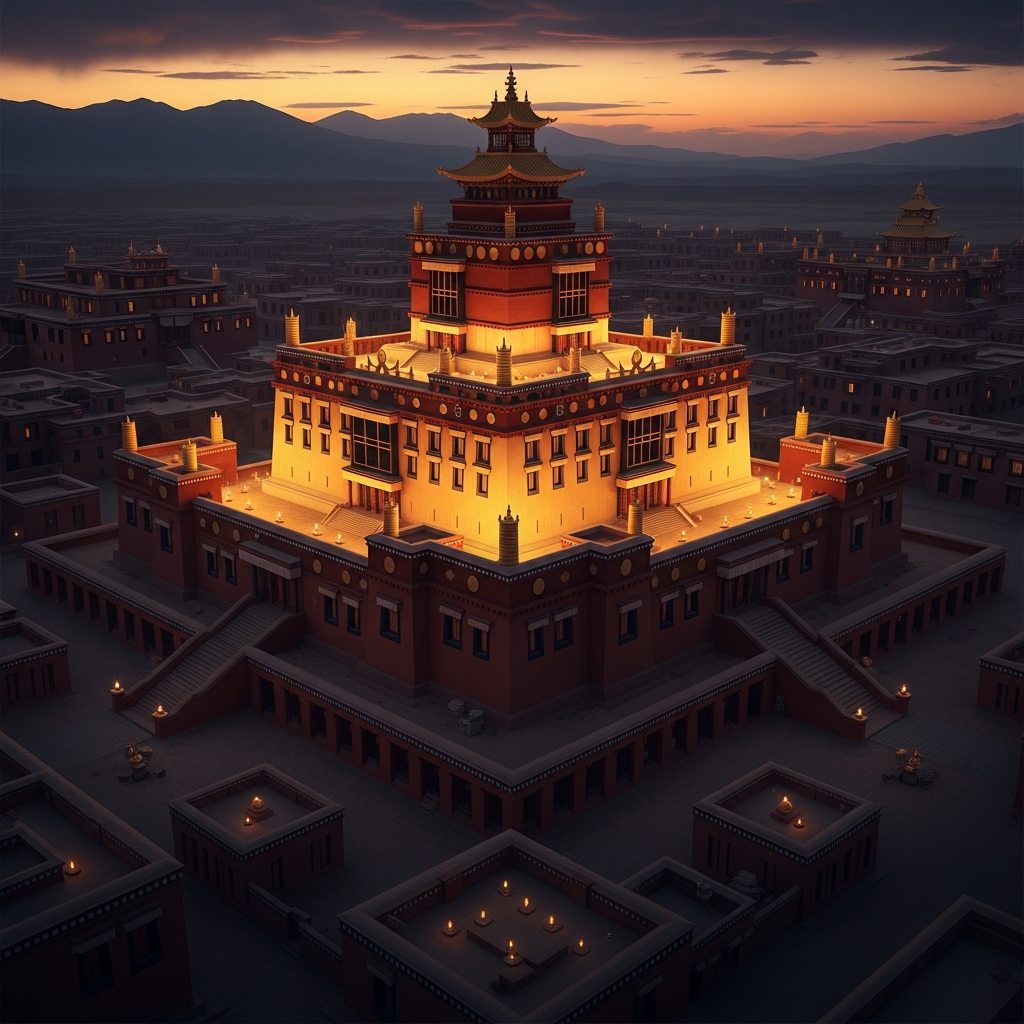
Trisong Detsen has chosen the location. Shantarakshita has returned from India, summoned again now that the spiritual climate of Tibet has been negotiated into a working arrangement. The three of them preside over the construction of the first monastery in Tibetan history. Samye is built as a mandala: a central temple for Mount Meru, four temples at the cardinal points for the continents, eight smaller temples for the subcontinents, two representing sun and moon. Three storeys, each in a different national style — Indian at the base, Chinese above, Tibetan at the crown — to declare in architecture that the dharma has come from all directions and will speak in all languages.
Construction begins. The texts say the demons tear down at night what the builders raise by day. He walks the perimeter each evening, calling each bound spirit to its post. You took the oath. Stand watch. The walls hold.
Samye is consecrated, by traditional reckoning, in 779 CE. The first seven Tibetan monks are ordained inside it. Padmasambhava names them. The line that begins with those seven runs, unbroken, to the present.
Before he leaves — the texts say he rides out on a horse that simply steps into the air above a mountain pass near Gungtang and walks southwest until it disappears — he hides his teachings.
Not in libraries. Not in texts. In rocks, in lake beds, in the minds of Yeshe Tsogyal and a hundred other disciples who have absorbed transmissions too dangerous or too advanced for the current age. Termas — hidden treasures — to be discovered by tertons, treasure-finders, in future centuries when the dharma needs what those teachings contain.
The Bardo Thödol — the text that reached the West as The Tibetan Book of the Dead — is one of them. It was discovered by the terton Karma Lingpa in the fourteenth century in the face of a cliff in the Gampo hills of central Tibet. The cliff, it turns out, was one of the locations Padmasambhava had bound by oath six hundred years earlier. The spirit that guarded it had been waiting.
The spirit was holding the book.
The wrathful protector deities that crowd every Tibetan thangka painting — the bull-headed Yamantaka, the six-armed Mahakala in his crown of skulls, the twelve Tenma at their cardinal directions — are, almost without exception, the demons Padmasambhava bound. They retain their original Tibetan iconography: the fangs, the bone ornaments, the necklaces of severed heads. Buddhist India had no use for this imagery. Tibet kept it, intact, because the beings wearing it had been there before Buddhism arrived and were now under contract.
Pehar, the great spirit-king of central Tibet, was bound at Samye and became the oracle-deity of the Nechung monastery — the state oracle of Tibet, consulted by the Dalai Lamas on matters of governance, until the fourteenth Dalai Lama fled to India in 1959 and the oracle accompanied him into exile.
The Nechung oracle still operates. In Dharamsala.
The vow is still in force.
Scenes
Padmasambhava at a high mountain pass in Tibet, vajra scepter raised in his right hand, skull-cup in his left, a halo of flame behind him
 Generating art…
 On the slopes of Mount Hepori, the twelve Tenma goddesses kneel in a circle around Padmasambhava, each pressing her skull-topped staff to the earth in the gesture of offering
 Generating art…
 Samye monastery seen from above at dusk, its mandala plan lit by butter lamps in every window — the central tower representing Mount Meru, the four temples at the cardinal directions representing the continents, every building watched by a bound spirit who once tried to prevent its construction
 Generating art…
 Echoes Across Traditions
Entities
- Padmasambhava
- Guru Rinpoche
- King Trisong Detsen
- Shantarakshita
- Yeshe Tsogyal
- the twelve Tenma goddesses
- Pehar

Sources
- *Padma Thang Yig* (the *Lotus Chronicle*, attributed to Yeshe Tsogyal, redacted 14th century by Orgyen Lingpa)
- Yeshe Tsogyal, *The Life and Liberation of Padmasambhava* (trans. Kenneth Douglas and Gwendolyn Bays, Dharma, 1978)
- Matthew Kapstein, *The Tibetan Assimilation of Buddhism* (Oxford University Press, 2000)
- Sam van Schaik, *Tibet: A History* (Yale University Press, 2011), ch. 1-2
- Robert Beer, *The Handbook of Tibetan Buddhist Symbols* (Shambhala, 2003)
- Rene de Nebesky-Wojkowitz, *Oracles and Demons of Tibet* (Mouton, 1956)