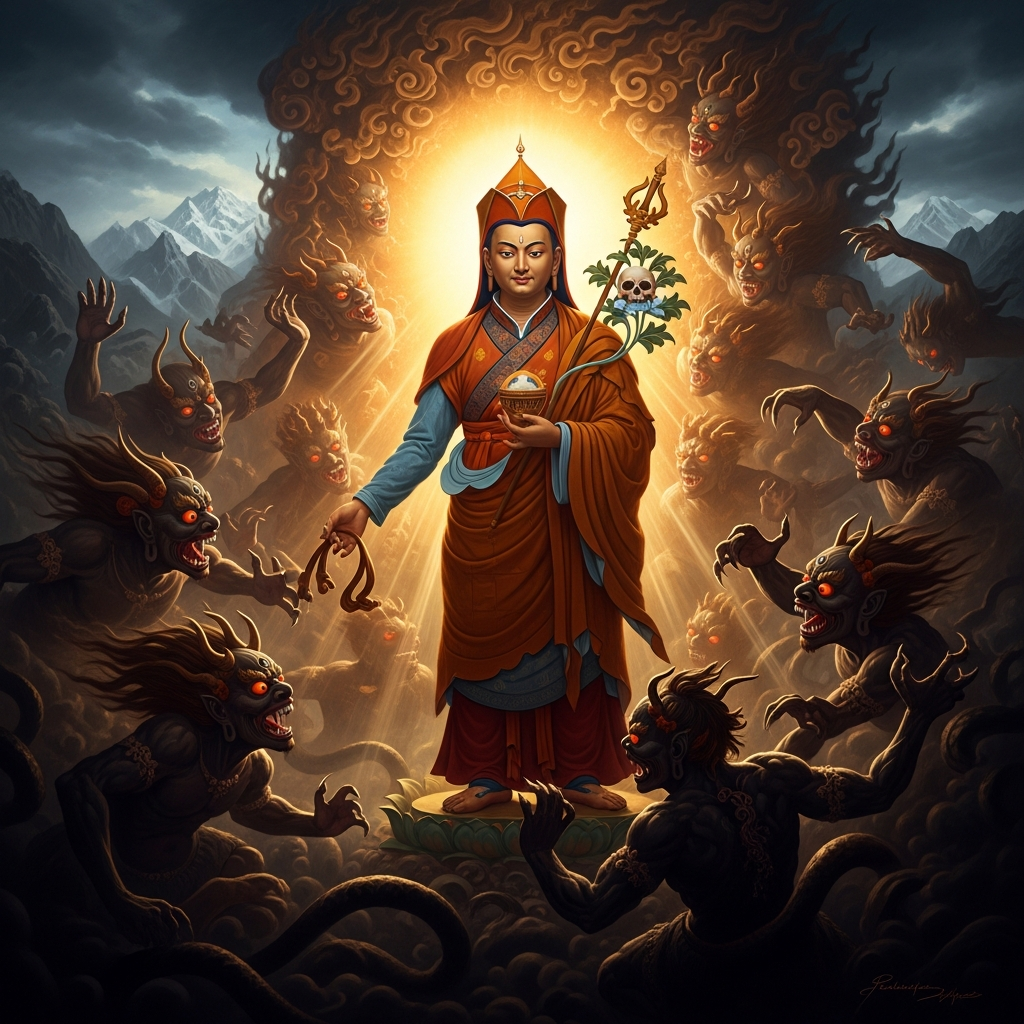
Gesar Rides the Wind Horse
c. 11th century CE and earlier · mythic time; still living · The kingdom of Ling, eastern Tibet (Kham); the demonic kingdoms of Hor, Jang, and Mon
Contents
Gesar of Ling, the divine warrior-king, is born supernatural into a marginalized family, humiliated, exiled, then called back by a great horse race to become king of Ling. He wages a lifetime of campaigns against the forces of evil and demonic kingdoms. The Gesar Epic is the longest epic poem in the world — still growing, still performed, still being revealed through living bards.
- When
- c. 11th century CE and earlier · mythic time; still living
- Where
- The kingdom of Ling, eastern Tibet (Kham); the demonic kingdoms of Hor, Jang, and Mon
He is born, the first thing, in disgrace.
The divine origin story — Gesar is a being from the heavenly realms who has agreed to take birth in the human world at a time when the forces of evil are overrunning Tibet from every direction — is held in the tradition simultaneously with the human birth story, which is one of the more inauspicious in the literature. His father is of noble line but reduced circumstances. His mother is a goddess who has taken human birth, but she appears as an ordinary woman of the margins, not someone whose child will be recognized immediately as a divine emissary.
He is born as Joru. Not Gesar yet — that name comes later, after the horse race, after the recognition, after the authority has been given a shape that the name can hold. He is born as Joru, the difficult child: large-headed, odd-eyed, behaviorally unlike other children in ways that can be read as sacred or as troubling depending on who is doing the reading. The relatives who read him as troubling are in the majority.
He is mischievous in the specific way of beings who operate from a perspective that ordinary social hierarchies cannot accommodate. He steals, but what he steals is usually distributed to those who need it. He fights, but what he fights is usually something that was threatening someone smaller. He refuses to defer to social superiors in ways that are genuinely unsettling to a community organized around deference. He is, in the taxonomy of the epic, a trickster-hero in his early years — the divine figure who appears in degraded form, whose power is visible only in flashes, who must endure the full contempt of his social context before the moment of revelation.
The uncle Trotung, who is one of the powerful men of Ling, orchestrates the exile.
Trotung is not simply a villain — the tradition is complex enough to show him as a man of genuine ability and genuine smallness, a leader who cannot tolerate the presence of someone who might exceed him. He reads Joru correctly: this child is going to be a problem. The prophecies circulating about him — the seers have been saying things about the boy, things about horses and kingship and campaigns against the demonic kingdoms — are dangerous to the current order if they are correct and embarrassing if they are wrong.
He makes the case for exile to the council of Ling. The boy must go. There are reasons of state. There are reasons of decency. His presence is disruptive.
The council, which contains both those who believe the prophecies and those who are tired of the disruption, agrees.
Joru goes into exile with his mother in the wilderness to the north of Ling, a region of wind and thin pasture and genuine hardship, which is the Tibetan plateau’s version of the desert. He is still a boy. He goes without bitterness in the outward visible sense — the texts show him acquiescing with the equanimity of someone who knows the exile is temporary because he can see how the story ends.
He builds weapons in exile. He practices. He receives instructions — in visions, from Padmasambhava who appears to him in the wilderness, from his divine mother who teaches him the practices that will make the campaigns possible. He is being prepared for something. He knows what it is. He waits.
The horse race is announced to choose a king for Ling.
The council has maneuvered itself into a political crisis through the usual combination of ambition and miscalculation. They need a legitimate way to determine leadership, and they settle on a horse race — the most prestigious competition on the Tibetan plateau, where horsemanship is both a practical skill and a sacred one, where the quality of the horse and the quality of the rider are understood as reflections of the quality of the person. The winner of the race will be king. The winner’s choice of wife will be Sengcham Drugmo, the most beautiful and accomplished woman in Ling.
The exile is recalled for the race. Any man of Ling, technically, may compete.
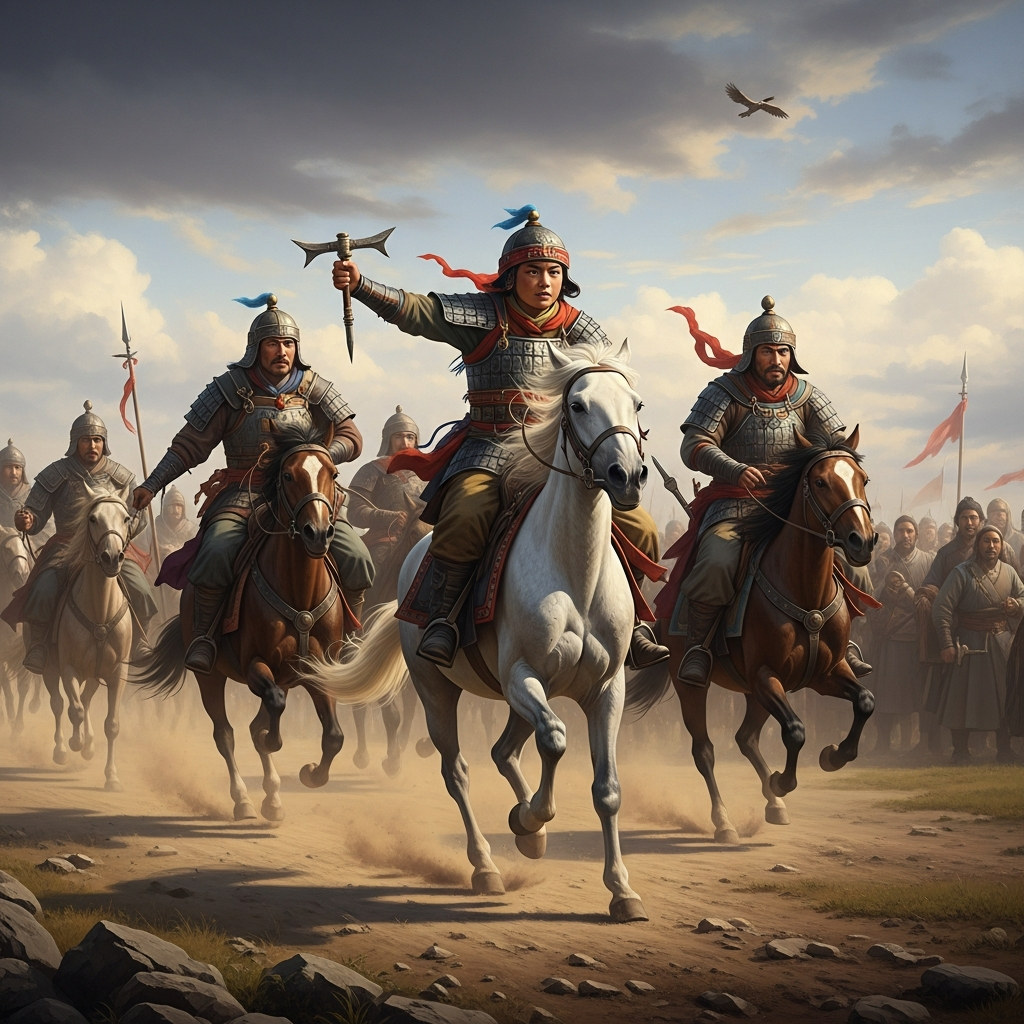
Joru arrives from the wilderness. He arrives in the condition of someone who has been living in the wilderness: rough, inadequately clothed for the occasion, riding a horse that, to the assembled nobility of Ling, does not look like a racing horse. Kyang Go Karkar — the White Turquoise Dragon, his horse — is white and large and was assembled from divine materials in the origin stories of the tradition, but he can look, to eyes that are not looking carefully, like an ordinary horse. The nobles laugh at Joru. Trotung makes jokes. The mockery is the tradition’s way of establishing that the recognition that is about to happen will be genuine rather than foregone.
The race begins.
The other riders have trained horses and trained bodies and the full benefit of years of the plateau’s horsemanship culture. They ride well. The race is competitive until it is not. Joru and Kyang Go Karkar do not so much win the race as reveal that the race has a different scale than anyone except Joru realized. The horse runs like something the plain itself is expressing — like wind that has taken the form of a horse rather than a horse that has learned to run quickly.
He crosses the finish line. He is king.
He is king and his name is now Gesar, and the name comes with authority that the mockery of five minutes ago cannot survive.
He takes Sengcham Drugmo as his queen and establishes himself at Ling with the specific combination of authority and restlessness that the warrior-bodhisattva brings to any position of stability. He is king. He is also a being who came from the divine realms specifically to wage campaigns against the forces that are dismantling the dharma and the human communities that sustain it. Kingship is not the destination. It is the platform.
The campaigns begin.
The structure of the Gesar epic, across the many chapters that constitute its different versions, is a series of military and magical campaigns against adversary kingdoms: Hor in the north, ruled by the demonic king Lutzen, who has abducted Sengcham Drugmo; Jang in the east; Mon in the south; and the various demonic forces that work through and between the human kingdoms. Each campaign has the structure of a Tibetan Buddhist cosmos — the demonic adversaries are not simply warlords but expressions of the three poisons (greed, hatred, delusion) given political form, and the campaigns against them are simultaneously military and spiritual.
The Hor campaign — the rescue of Sengcham Drugmo from Lutzen the demonic king — is the most elaborated in most traditions. Lutzen is a being of enormous power and genuine malevolence. The campaign to defeat him requires not just military prowess but the full range of Vajrayana practice: the invocation of protector deities, the visualization of wrathful forms, the deployment of sacred objects that transform the battlefield into a mandala of confrontation.
Gesar wins. He wins every campaign. This is not a surprise, doctrinally — the bodhisattva principle establishes that a being who has taken birth for the specific purpose of defeating evil will not be finally defeated by evil. The question is not whether he wins but what it costs and what it requires.
The bards are the living tissue of the epic.
There is no authoritative written version of the Gesar Epic in the way there is an authoritative text of the Iliad. The epic exists in hundreds of versions, collected across Tibet, Mongolia, Bhutan, Ladakh, and the Himalayan borderlands. These versions agree on the broad outline and diverge on the details in ways that reflect the specific landscape, lineage, and community of each telling. The Mongolian Geser epic is recognizably related to the Tibetan Gesar epic in the way that cousins are related: shared ancestry, distinct development.
What makes the epic categorically unlike any other major world epic is the living bards.
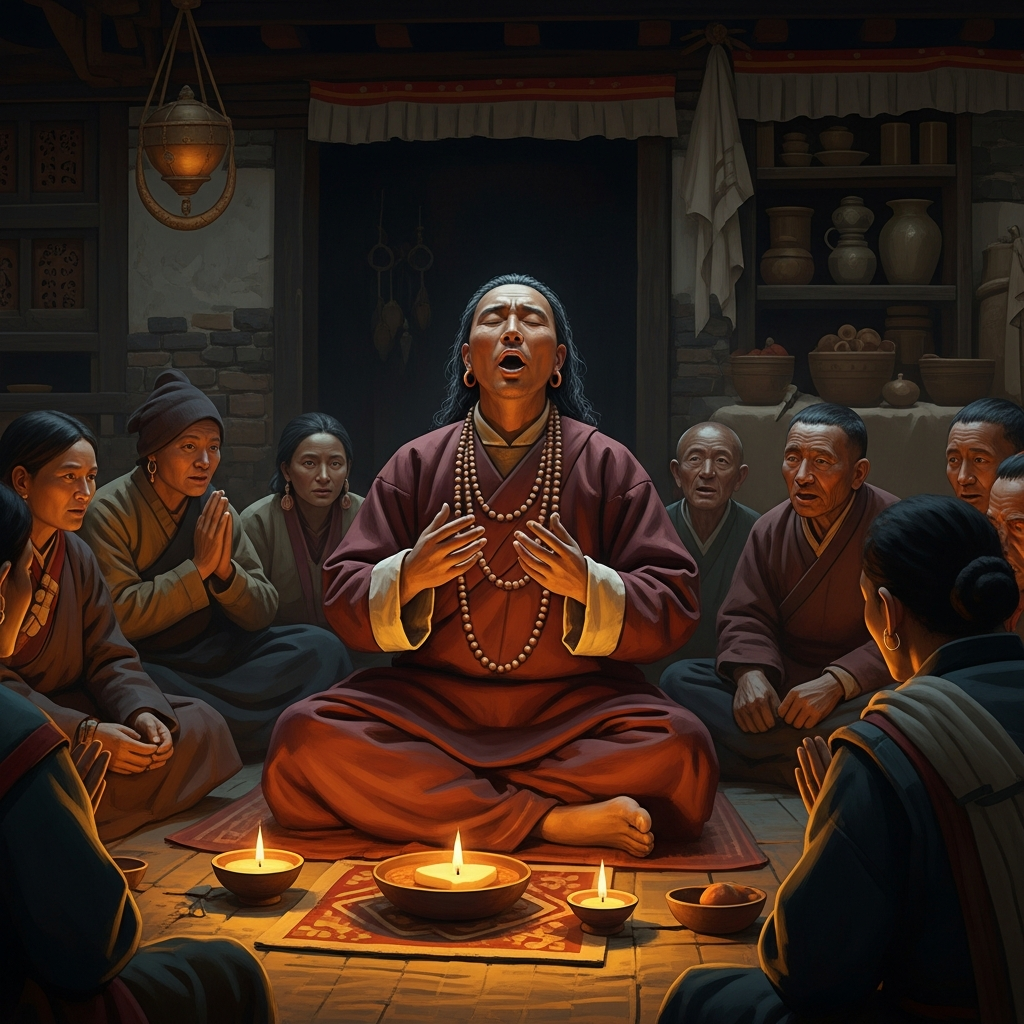
They are called sgrun mkhan pa — story-holder, epic-holder — and the genuine ones receive new chapters of the Gesar Epic through trance. They go into a state that is described as inspiration in the literal sense — something enters them — and they chant material they have not prepared, in verse forms of the traditional meter, for hours or days at a time. They are sometimes illiterate. They can be tested: scholars record their chanting, find the passages do not repeat, find the narrative is internally consistent with chapters the bard claims never to have heard, find the verse forms are correct.
The tradition’s explanation is straightforward: Gesar is still present. He is still available to the bards who have the capacity to receive him. New chapters of the epic are revealed because Gesar himself is still generating them — the epic is not a record of a completed life but a transmission from a being who is still active.
This is not a premodern metaphysics that has not yet been updated. The living bards continue to appear in the twenty-first century. New chapters are still being received.
He does not die in the conventional sense.
The later chapters of the epic describe Gesar’s eventual withdrawal from the human world, but the withdrawal is not death — it is return to the divine realm from which he came, which he remains available to leave again if the need arises. The tradition is explicit about this: Gesar is not a historical figure who lived and died. He is a bodhisattva who incarnated, completed a phase of his work, and withdrew — without, however, withdrawing his availability. He is like the Dalai Lama in this respect: the human form is temporary, the bodhisattva is not.
There is a Tibetan tradition that Gesar will return at the end of the current age to wage a final campaign against the forces of evil — a cosmological cleanup that will prepare the ground for the next cycle of the dharma. This is not understood as metaphor. It is understood as the conclusion of the story that began when he agreed to take birth in Ling, now extended across a timeframe longer than human history.
The Gesar Epic is, in most scholarly estimates, the longest epic poem ever composed: longer than the Mahabharata, longer than the Iliad and Odyssey combined, longer than the Manas of Kyrgyzstan. Estimates of its total length, across all versions, range from five hundred thousand to a million lines.
It is still growing.
In 2002, a Tibetan bard named Sangdag Rinchen entered trance in a monastery in Kham and chanted for eleven days without stopping, producing more than two hundred thousand lines of new Gesar Epic material that were recorded and verified by scholars who accompanied him throughout. He said, when he came out of the trance, that he had not composed any of it. He said Gesar had been speaking.
The horse race happened on a plain in eastern Tibet that is still identified by local communities. The horse’s hoofprints, they say, are still in the rock.
Scenes
Gesar — still called Joru, the ragged child — races across the highland plain on his white horse Kyang Go Karkar
 Generating art…
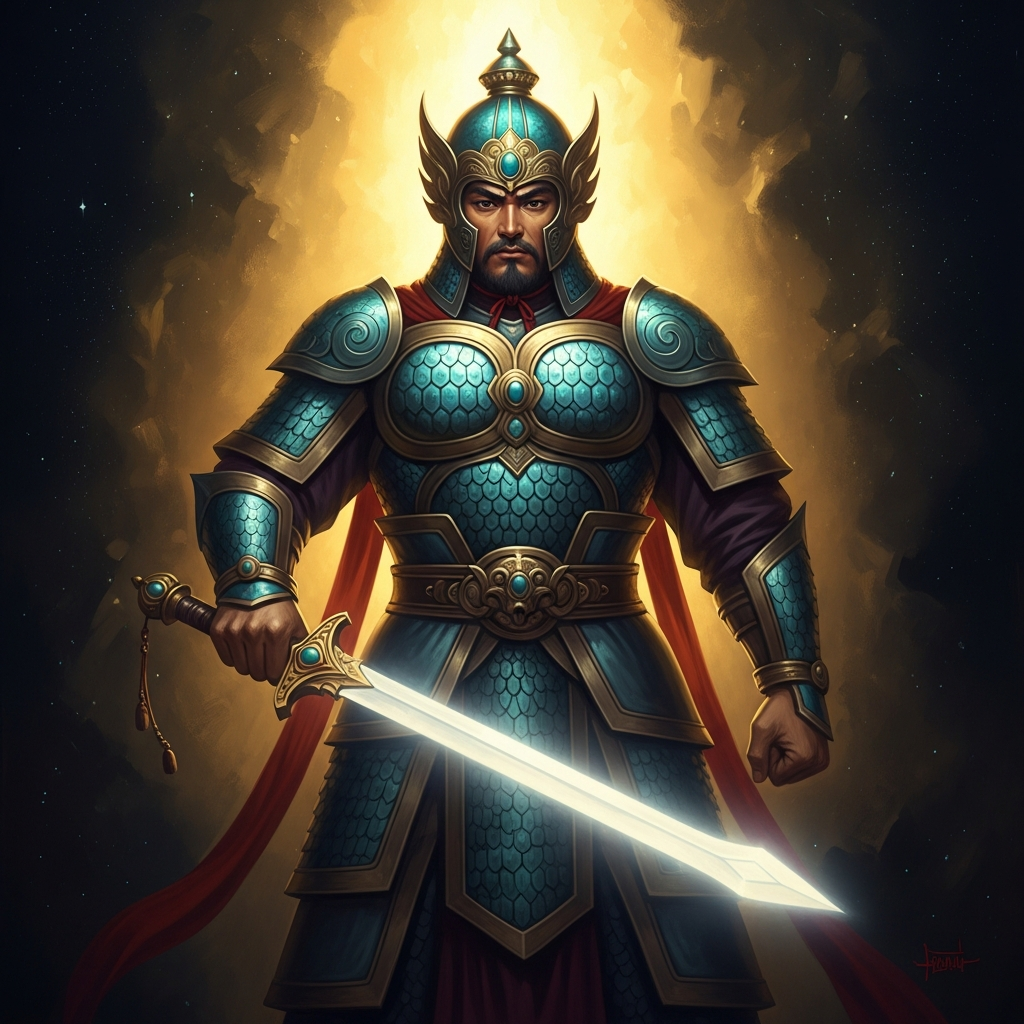
 Gesar of Ling in full divine armor — his turquoise-inlaid helmet, his bright sword, his warrior's cloak streaming in the Tibetan wind
 Generating art…
 A living bard in a Tibetan village, eyes closed, in trance, his hands moving as he chants the Gesar Epic
 Generating art…
 Echoes Across Traditions
Entities
- Gesar of Ling
- Joru
- Thubpa Gawa
- Sengcham Drugmo
- Kyang Go Karkar
- Padmasambhava

Sources
- Robin Kornman, Sangye Khandro, and Lama Chönam, trans., *The Epic of Gesar of Ling* (Shambhala, 2012)
- Alexandra David-Neel and Lama Yongden, *The Superhuman Life of Gesar of Ling* (Rider, 1933; reissued Shambhala, 1981)
- Rene de Nebesky-Wojkowitz, *Oracles and Demons of Tibet* (Mouton, 1956)
- Geoffrey Samuel, *Civilized Shamans: Buddhism in Tibetan Societies* (Smithsonian, 1993), ch. 17
- Tenzin Gyatso (Dalai Lama XIV), preface to Kornman et al., *The Epic of Gesar of Ling* (Shambhala, 2012)
- Carole McGranahan, 'Empire Out of Bounds: Tibet in the Era of Decolonization,' in *Imperial Formations* (SAR Press, 2007)