Naropa Follows the Madman South
c. 1016-1040 CE · Bengal and the plains of northern India · Nalanda University, Bihar; the plains and rivers of Bengal; Phullahari
Contents
Naropa, brilliant scholar-abbot of Nalanda University, abandons his position after a vision and spends years searching for his teacher Tilopa. When he finds him, Tilopa tests him twelve times — each trial an apparent cruelty or absurdity. After the twelfth, Tilopa strikes Naropa with a sandal and Naropa awakens.
- When
- c. 1016-1040 CE · Bengal and the plains of northern India
- Where
- Nalanda University, Bihar; the plains and rivers of Bengal; Phullahari
He is the most important Buddhist scholar of his century and he cannot answer a simple question.
The question comes in the form of a vision, or perhaps an encounter with an actual woman — the texts do not distinguish, which is part of the point. He is in his study at Nalanda, surrounded by texts he has mastered across two decades of scholarship: the Vinaya, the Abhidharma, the Prajnaparamita sutras, the tantric commentaries. He is abbot. He is celebrated. Students come from across the Buddhist world to study with him. He is, in every institutional measure available to his tradition, at the summit.
An old woman appears. She is hideous in the specific way of figures who appear in visionary encounters to test something: warts, yellow teeth, rheumy eyes, a smell of decay. She looks at the texts spread before him and she asks: do you understand the words, or the meaning?
He pauses. He has been answering questions about texts for twenty years. He answers this one honestly: the words.
She begins to weep with happiness. She says: there is someone who can teach you the meaning. His name is Tilopa. Go south and find him.
He leaves Nalanda. He does not tell the other scholars why he is leaving. He does not wait for a propitious day. He walks out of the most important library in the Buddhist world with the clothes on his back and a question he cannot answer.
The search takes years.
The texts describe it as a series of encounters with figures who are and are not Tilopa — wandering siddhas, beggars, fisherfolk, madmen at crossroads — each of whom deflects his question with a gesture that means: look again. Look harder. Look past what you think a teacher looks like. He is trained to recognize authority by its institutional markers: the scholar’s robe, the monastery, the lineage document. Tilopa has none of these. Tilopa is a fisherman who sits on riverbanks cooking fish and eating them alive, sometimes with the fish still writhing. Tilopa is a man who sleeps in the mud and does not bathe and shouts things that make no grammatical sense.
He does not, on first encounter, recognize him.
He recognizes him eventually the way you recognize your own breath after you have been breathing in a new direction for long enough that you can feel the difference. Tilopa looks up from his fish and meets Naropa’s eyes and what passes between them is not a transmission exactly — it is a recognition that precedes any transmission, the mutual acknowledgment that this is the encounter that has been generating all the preparation.
Tilopa goes back to his fish. He says: follow me.
The twelve trials begin.
The hagiographic account in Guenther’s translation is exhaustive and strange in the way that genuine accounts of this kind of training are always strange: the details are too specific to be invented and too bizarre to be taken literally and so they exist in a third register that the tradition calls namthar — liberation story — in which external events and internal states are treated as the same thing.
The first trial: Tilopa tells Naropa to steal food from a wedding feast and give it to him. Naropa does. He is beaten by the wedding guests. He lies on the ground in pain. Tilopa restores him.
The sixth trial: Tilopa tells Naropa to jump from the top of a high tower. Naropa jumps. He is broken when he hits the ground. He is in tremendous pain. Tilopa restores him.
The ninth trial: Tilopa sits by a bonfire and tells Naropa to carry him across a marsh on his back. Naropa does. Tilopa makes himself heavier at each step. By the midpoint of the marsh Naropa is carrying a weight that should not be possible. He is still carrying it. He does not put it down.
The eleventh trial: Tilopa spots a brahmin performing a ritual in a field and tells Naropa to take the brahmin’s wife. Naropa does. He is nearly killed by the brahmin’s relatives. He lies broken in the field. Tilopa restores him.
The texts are specific that Naropa is physically restored after each trial — the injuries are real, the healing is real — and they are equally specific that the restoration is not the point. The point is what happens in the moments between the injury and the restoration, when Naropa lies on the ground in pain with no certainty that Tilopa will come, that any of this has a purpose, that the man he is following is actually a teacher rather than a sadist.
What happens in those moments is: he stays.
The logic of the trials, articulated retrospectively by the Kagyu tradition, is precise once you see it.
Naropa is the most accomplished scholar of his generation. He has organized his entire psyche around scholarly competence: the ability to understand, to remember, to analyze, to argue, to teach. These are genuine virtues. They are also, in the Vajrayana diagnosis, a sophisticated form of ego-structure. The self that can answer questions about the Prajnaparamita has used those answers to build a fortress, and the fortress, however beautifully furnished, is still a confinement.
The trials do not teach Naropa something he does not know. They take away the thing he is using to avoid knowing it. Each injury strips another layer of the scholarly identity: the dignity of the learned man, the entitlement of the recognized master, the self-protection of the careful thinker. The theft, the beatings, the jumps, the impossible weights — each one is aimed at a specific strut in the structure.
When the structure falls, what is left is what was always there before the structure was built.
This is the Kagyu understanding of mahamudra — the Great Seal, the direct recognition of mind’s nature. You cannot arrive at it by accumulation. You arrive at it by subtraction. And the subtraction, in Naropa’s case, required twelve specific demonstrations of willingness to lose what the accumulation had built.
The twelfth trial is different from the others.
There is no physical danger. Tilopa simply sits with Naropa in a field for a long time without speaking. The texts suggest this lasted days. Naropa has been following this man across Bengal for years. He has been beaten, broken, humiliated, and restored. He has stolen and been punished. He has jumped and fallen. He has, across these years, systematically given up every marker of identity he arrived with.
Tilopa removes his sandal.
He strikes Naropa across the face with it.
The texts say Naropa loses consciousness. When he regains it, the landscape is different. Not physically different — the field is the same field, Tilopa is still sitting there — but the relationship between Naropa’s awareness and what it is aware of has changed. The awareness is still present. What is no longer present is the membrane between the awareness and everything else, the assumption of a separate observer standing apart from the observed. It has dissolved.
This is mahamudra — not as a description but as an event. Tilopa has transmitted it through twelve years of trials and one blow of a sandal.
After the transmission, Tilopa teaches formally.
For many days — some accounts say a week, some say a month — he transmits the entirety of the Kagyu tantric lineage: the Six Yogas, the mahamudra pointing-out instructions, the transmission texts that Marpa will later carry to Tibet. Naropa absorbs everything. His scholar’s memory, which seemed like the problem, is now the asset: he can hold the transmissions because he has held texts all his life, and now the texts and the meaning are the same thing.
He teaches. He teaches for decades — at Phullahari, at various sites across Bengal and Bihar. Students come from India and from Tibet. Marpa makes the journey three times and carries the Kagyu lineage north. Naropa’s own teaching generates the Kalachakra transmission and the Vajrayogini cycle, both of which become primary practices in the Tibetan traditions.
He does not go back to Nalanda. There is nothing there that he needs.
The twelve trials are still taught as a unified structure in Kagyu monasteries — not as history to be admired but as a template to be understood. The trials are the method. The method is: the teacher identifies what the student is using to protect themselves from the transmission they came for, and systematically removes it, trial by trial, until there is nothing between the student and what was always there.
Marpa will apply this method to Milarepa, with the four towers.
Milarepa will apply it to Gampopa, whose intellectual attainment is his particular fortress.
The sandal passes from teacher to student.
It is always the same sandal.
Scenes
Naropa at his desk in Nalanda, surrounded by manuscripts, his scholar's robe immaculate
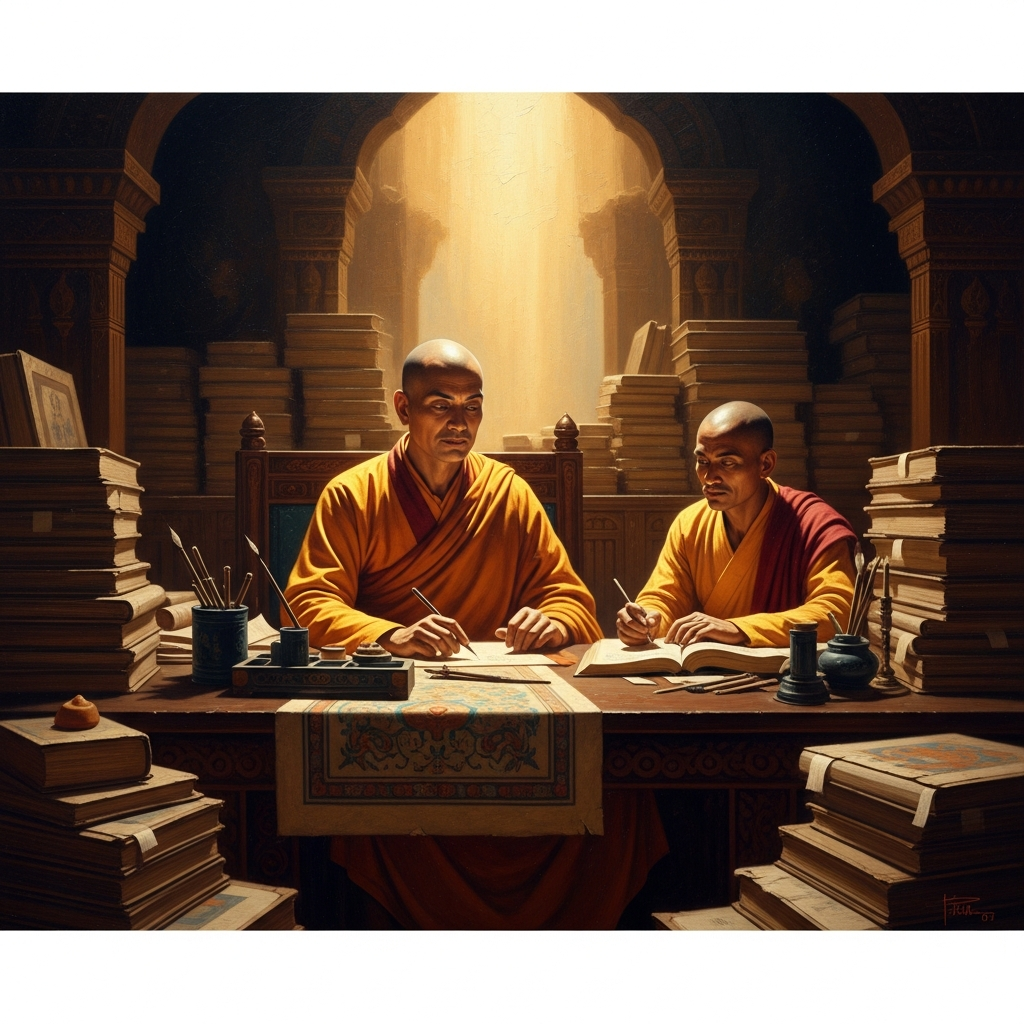 Generating art…
 Tilopa strikes Naropa across the face with his sandal at the moment of transmission
 Generating art…
 Naropa, his body broken from one of the twelve trials, lies on the bank of a river in Bengal
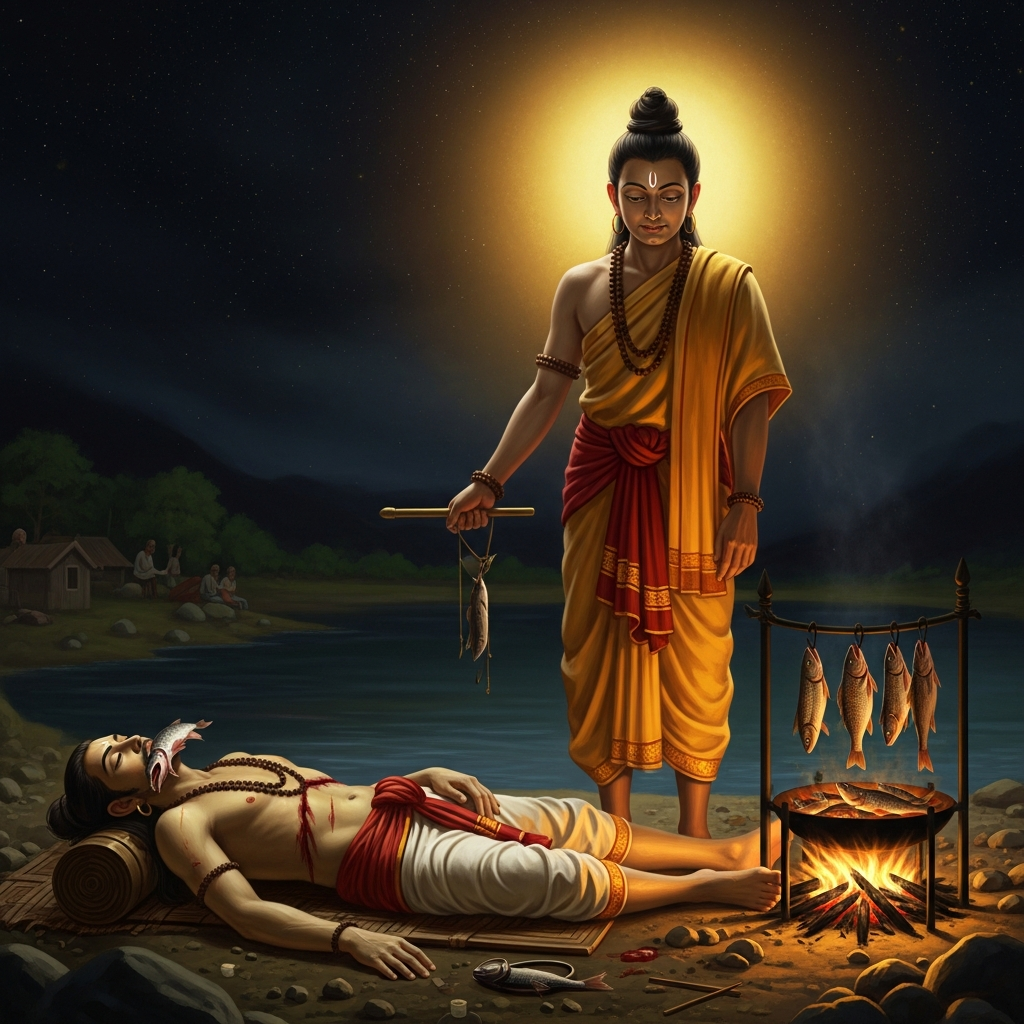 Generating art…
 Echoes Across Traditions
Entities
- Naropa
- Tilopa
- Vajravarahi
- the old hag
Sources
- Herbert V. Guenther, *The Life and Teaching of Naropa* (Oxford University Press, 1963; reissued Shambhala, 1986)
- Nalanda Translation Committee, *The Life of Marpa the Translator* (Prajnaparamita Press, 1982)
- Chogyam Trungpa, *Journey without Goal: The Tantric Wisdom of the Buddha* (Shambhala, 1981)
- Reginald A. Ray, *Indestructible Truth: The Living Spirituality of Tibetan Buddhism* (Shambhala, 2000)
- Glenn H. Mullin, *The Kagyu Masters: 'Unparalleled Teachers of Tibet's Diamond Way'* (Snow Lion, 2005)
- Donald S. Lopez Jr., *Religions of Tibet in Practice* (Princeton University Press, 1997)