The Scholar in the Army
Ghaznavid Empire · 1017-1030 CE · Ghazni, the Punjab, Varanasi, Mathura, Kanauj — the contested frontier between the Islamic world and the Sanskrit civilization of northern India
Contents
The polymath al-Biruni accompanies Mahmud of Ghazni's invasions of India not as a soldier but as a scholar — learning Sanskrit, interviewing Brahmin priests, reading the Vedas, and writing the most accurate account of another civilization composed by any medieval observer.
- When
- Ghaznavid Empire · 1017-1030 CE
- Where
- Ghazni, the Punjab, Varanasi, Mathura, Kanauj — the contested frontier between the Islamic world and the Sanskrit civilization of northern India
He is there under compulsion.
When Mahmud of Ghazni conquers Khwarezm in 1017, he takes al-Biruni back to Ghazni the way a king takes a prize stallion or a master craftsman — not as a slave exactly, but not as a free man either. Al-Biruni is forty-four years old and already the most accomplished scientist in the Islamic world. He has determined the earth’s circumference by an original geometric method from a mountaintop in the Salt Range. He has written about the specific gravity of metals, the rotation of the earth, the history of Khwarezm, the mathematical operations of astrology. He speaks Arabic and Persian, writes in both, and has enough Greek to read the originals.
What he does not know is Sanskrit. He is about to spend thirteen years learning it.
The Ghaznavid invasions of India give him access to the subcontinent’s interior — access he would never have negotiated independently, because the political frontier between the Ghaznavid state and the Hindu kingdoms to the south is a wall that scholars cannot cross on their own. He crosses it behind the army. He is not a soldier. He carries a writing case and a set of astronomical instruments. He is compiling a book.
He learns Sanskrit from Brahmin priests, and this is harder than it sounds.
Sanskrit in 1017 is not just a language — it is the sacred language of a civilization, guarded by a priestly caste that has specific rules about who may study the Vedas, who may hear them recited, and what happens to those who study them without authorization. A Muslim polymath accompanying a conquering army has no obvious claim to Brahmin instruction.
But al-Biruni has something the Brahmin scholars recognize: genuine curiosity, technical competence, and the patience to sit with a difficult text rather than demanding an easy summary. He does not ask the Brahmins to simplify. He asks them to explain precisely. He brings his own expertise in mathematics and astronomy to the conversation, so that when a Brahmin astronomer describes a calculation al-Biruni disagrees with, he can say exactly where the disagreement lies and why — not dismissing the calculation but engaging it on its own terms.
Within a few years he reads Sanskrit without help. He reads the Vedas, the Puranas, the Bhagavad Gita, Patanjali’s Yoga Sutras, the mathematical and astronomical texts of Brahmagupta and Aryabhata. He translates Euclid’s Elements into Sanskrit and Patanjali’s Yoga Sutras into Arabic. He compares Indian astronomical calculations with Greek ones and with his own observations, noting where each tradition has made advances the others have missed.
The Kitab al-Hind begins with a methodological statement that is unlike anything else in medieval literature.
He tells the reader, explicitly, what this book is and what it is not. It is a description of Hindu doctrine and practice as he has found it, primarily through reading the original Sanskrit texts and interviewing Brahmin scholars. It is not a polemic. It is not a refutation. It is not a report prepared for the caliph on the practices of a conquered people. Al-Biruni wants to understand Hinduism from inside its own logic, using its own vocabulary, before he says anything about it from outside.
He is not shy about disagreements. When he finds an astronomical calculation in the Surya Siddhanta that contradicts observation, he says so with full mathematical detail. When he finds that popular Hindu religious practice diverges from the philosophical texts, he distinguishes between them rather than judging either by the standard of the other. When something baffles him — the caste system, the rules of ritual purity, the cosmological time scales — he says it baffles him and speculates carefully about why it might make sense within its own framework, without claiming to have resolved the difficulty.
He is fifty-seven years old when he writes the Kitab al-Hind. He has been thinking about methodology for his entire career.
His account of Hindu philosophy is not an outsider’s simplification. It is a philosopher’s reading.
He engages the Samkhya system, the Vedantic non-dualism, the Vaishnava cosmology with the same analytic tools he uses on Greek and Islamic philosophy — asking about metaphysics (what kinds of things exist?), epistemology (how do we know?), cosmology (what is the structure of the universe?), and ethics (how should one live?). He finds genuine parallels with the Greek and Islamic philosophical traditions he already knows, and he notes them without forcing the parallels beyond their actual evidence.
He writes: The Hindus believe that God is one, eternal, without beginning and without end, self-subsisting, ruling everything. His will has nothing opposing it, and there is nothing outside him. He then quotes Patanjali’s definition of God from the Yoga Sutras. He then compares this with Plato’s account of the Demiurge and al-Kindi’s definition of God in Islamic philosophy. He is doing comparative theology in 1030 CE with a precision that European scholars will not achieve until the 19th century.
He also measures things. He takes astronomical observations across northern India to determine latitudes. He surveys the geography. He records crop types, river systems, the distribution of cities, the routes between them. He measures the depth of wells and infers the water table. He is simultaneously a humanist — reading philosophy and interviewing priests — and a natural scientist, never confusing the two modes but never treating them as incompatible.
He notes the social and political barriers with the same precision he notes the intellectual achievements.
The caste system troubles him. He describes it accurately, compares it structurally with analogous social stratifications in the Islamic world, and then says flatly that the restrictions on knowledge — the rules preventing lower castes from learning Sanskrit, the restrictions on who may read the Vedas — damage the civilization that enforces them, because knowledge withheld from half the population cannot develop as freely as knowledge available to all.
He notes that the mutual ignorance between Islamic and Hindu civilization is not entirely the Hindu side’s responsibility. The conquests have not produced dialogue; they have produced resentment and defensive withdrawal. Brahmin scholars who might have been willing to teach al-Biruni in different circumstances are unwilling in these ones, and he understands why. He writes: I can only describe what I actually found. I cannot describe what might have been findable under different political conditions.
This acknowledgment of structural limitation — the researcher accounting for the conditions of his own research — is unusual in any century. In 1030 it is essentially unparalleled.
He lives for twenty-three years after the Kitab al-Hind, writing the Masudic Canon (a monumental astronomical encyclopedia), a treatise on mineralogy with specific gravity measurements, a pharmacological encyclopedia correlating Arabic, Greek, Persian, Sanskrit, and Syriac drug names, a treatise on India’s historical chronology, and a history of ancient civilizations.
He grows old in Ghazni, far from the Khwarezm that was his home. He never returns. The court he serves — Mahmud’s son Mas’ud, then Mas’ud’s successors — provides the resources but not the freedom he would have chosen. He makes use of what is available.
He writes, near the end of his life, to the philosopher Ibn Sina — a letter about the nature of heat and cold, an argument about Aristotelian physics conducted at the highest level of technical precision between two of the greatest minds of the age. Ibn Sina’s replies survive. They disagree on several points. They agree that the argument is worth having.
The scholar who learns the enemy’s language and reads the enemy’s sacred books and concludes that the enemy is not an enemy but a civilization with a different solution to the same permanent human problems — this is, in every age, the rarest kind of intellectual courage, rarer than military courage, rarer than political courage, because it offers no public reward and requires the abandonment of the satisfying clarity that hostility provides.
Scenes
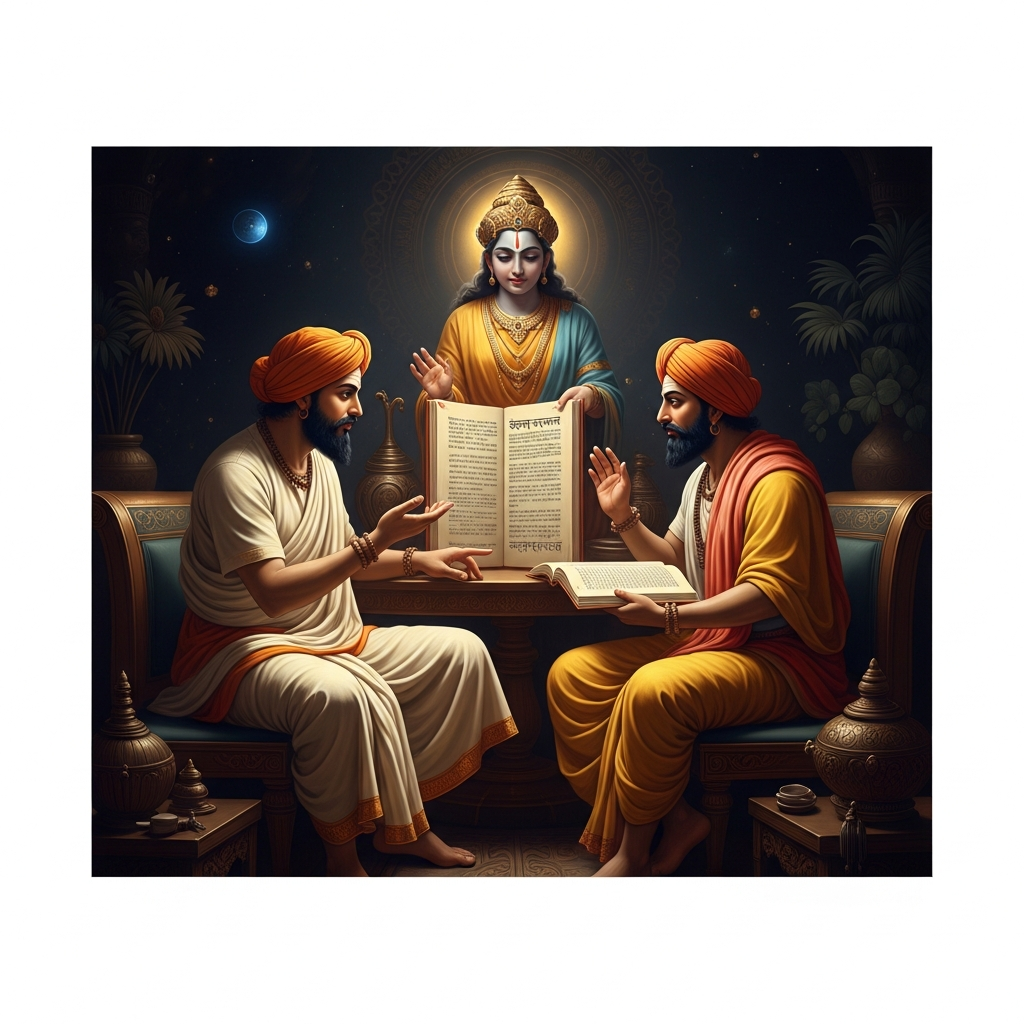
Al-Biruni sits with a Brahmin pandit in the Punjab, a Sanskrit astronomical text between them, asking questions in a language he has spent three years learning — the scholar who joins the army to read its enemies' books
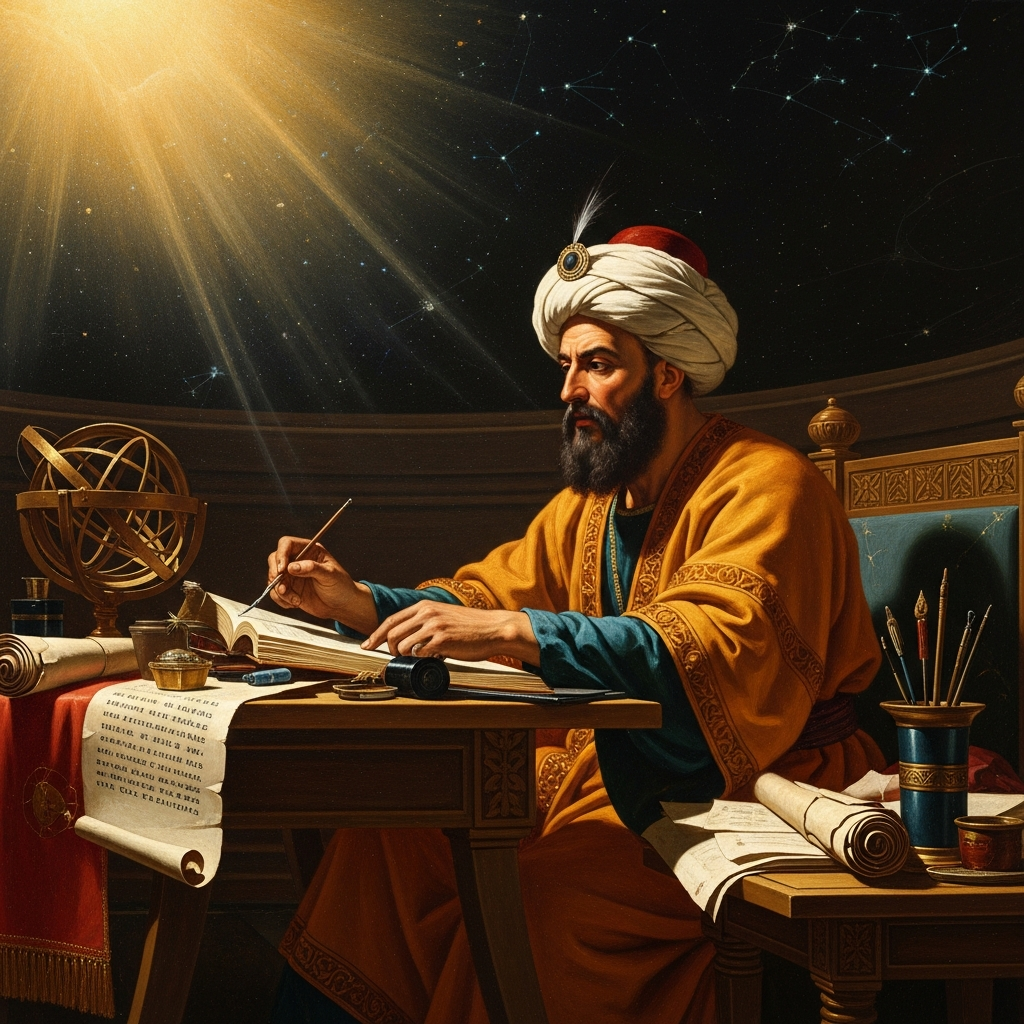
Generating art… At a portable writing table, al-Biruni compares the Hindu astronomical tables with his own observations, marking where the Indian calculations diverge from the data and where they are more accurate than the Greek tradition
 Generating art…
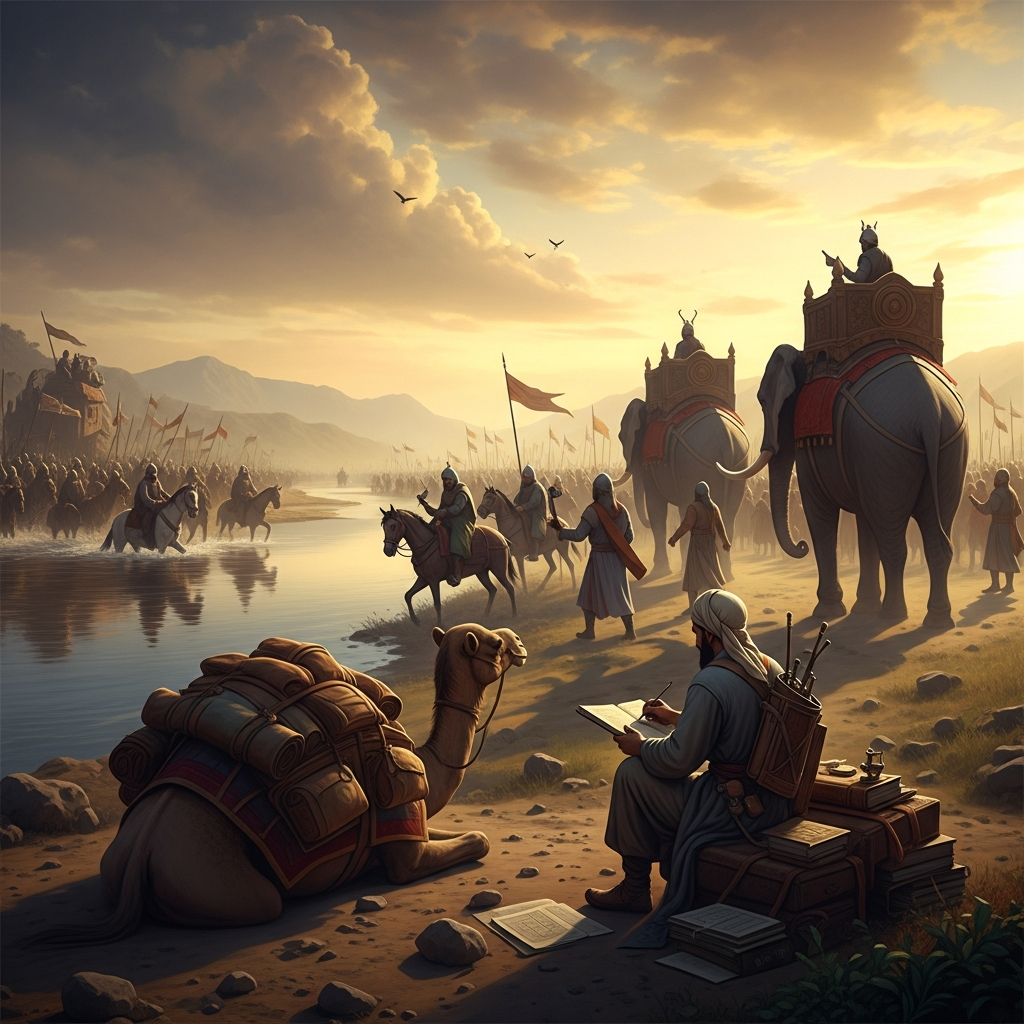
 The Ghaznavid army crosses a river into the Punjab — and behind the cavalry and war elephants, a lone scholar with a camel-load of manuscripts and writing equipment makes notes on the terrain, the flora, and the astronomical latitude
 Generating art…
 Echoes Across Traditions
Entities
- Abu Rayhan al-Biruni
- Mahmud of Ghazni
- the Brahmin priests of northern India
- Patanjali (whose yoga sutras al-Biruni translates)
- the Kitab al-Hind (Book of India)
Sources
- Al-Biruni, *Kitab Tahqiq ma lil-Hind* (Book of India), c. 1030 — translated by Eduard Sachau as *Alberuni's India* (1888)
- Al-Biruni, *Qanun al-Mas'udi* (Masudic Canon) — the astronomical encyclopedia dedicated to Mahmud's son Mas'ud
- Al-Biruni, *Kitab al-Tafhim* (Book of Instruction in the Elements of Astrology) — also in Persian
- Edward C. Sachau, introduction to *Alberuni's India* (Trubner, 1888) — still the best English introduction
- S. H. Nasr, *An Introduction to Islamic Cosmological Doctrines* (Harvard, 1964) — the intellectual context
- Muzaffar Iqbal, *Islam and Science* (Ashgate, 2002) — on al-Biruni's scientific method