The Night of Power
610 CE · Ramadan, Cave of Hira, Mount Jabal al-Nour · Cave of Hira, Mount Jabal al-Nour, near Mecca
Contents
In a cave on Mount Hira, 610 CE, a forty-year-old merchant named Muhammad is seized by the angel Jibril and commanded to recite — and the world is never the same.
- When
- 610 CE · Ramadan, Cave of Hira, Mount Jabal al-Nour
- Where
- Cave of Hira, Mount Jabal al-Nour, near Mecca
The cave is narrow enough that a man cannot fully stretch his arms.
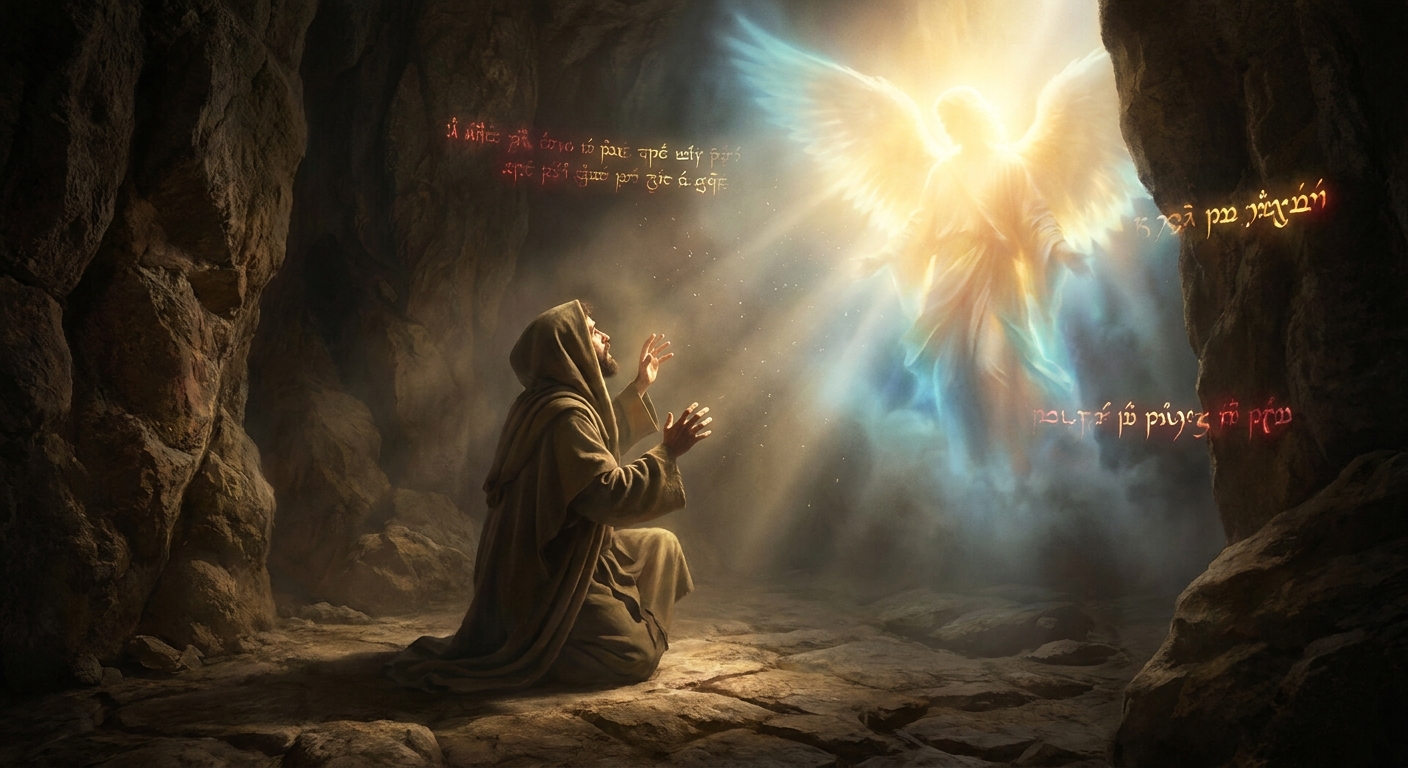
That is deliberate. Muhammad has chosen it because it is narrow, because it is high — a cleft in the rock near the summit of Jabal al-Nour, the Mountain of Light, above the noise and corruption of Mecca below. He comes here during Ramadan each year to fast and think and be still. He is forty years old. He is a merchant, a husband, a man known among his people as al-Amin — the trustworthy one. He is also a man who cannot look at the Kaaba, draped now in its 360 idols, without feeling something turn in his chest like a knife.
Tonight the sky outside the cave mouth is enormous with stars. Mecca sleeps. The desert breathes.
He does not hear the angel coming.
The grip is the first thing — a pressure around his body like the whole world squeezing inward, like being crushed inside a fist. He cannot breathe. He cannot think. He hears one word, in a voice that does not sound like a voice so much as a thing that has always existed:
Iqra.
Recite.
“I cannot recite,” he says. He means it. He is not being modest — he is ummi, unlettered, a man who has never been trained in the art of sacred speech. He is a merchant, not a priest. The Quraysh have priests for this. The Jews have their rabbis. He has no business being here.
The grip tightens. The pressure builds until something beneath the ribs becomes a sound, until the sound becomes light, until he understands, in a way that bypasses language entirely, that the command is not a request.
Iqra bismi rabbika alladhi khalaq.
Recite in the name of your Lord who created.
Khalaqal insana min alaq.
Created the human being from a clinging substance.
The words come through him like water through a crack in stone — not from his mind, not from his memory, but from somewhere else, somewhere behind the world. He is not composing. He is receiving. The distinction is absolute.
Then the angel releases him.
He runs.
There is no other word for it. Muhammad ibn Abdullah, respected merchant of the Quraysh, husband and father and man of known good sense — he scrambles down the mountain in the dark, certain of one thing: that something has entered him that was not there before, and he does not know whether it is revelation or possession or madness.
The old Arabic stories have a word for men who are seized this way. Majnun. The jinn-touched. The mad. He runs because he has just felt the grip of something vast, and vastness is terrifying before it is holy.
At the bottom of the mountain he thinks of the cliff. He thinks: if this is what I think it is, I cannot bear it. If this is not what I think it is, I cannot bear that either.
He turns for home.
Khadijah is awake.
She is always awake when he returns from the mountain, because fifteen years of marriage have taught her when her husband’s silences are empty and when they contain everything. She sees him in the doorway — trembling, pale, wrapped in the particular stillness of a man who has gone somewhere he cannot name — and she does not ask what happened. Not yet.
She wraps him in a cloak. She brings him close.
Zammiluni. Zammiluni.
Cover me. Cover me.
That is all he says for a long time. She holds him the way you hold someone who is shaking with cold when there is no cold, and she waits. This is its own kind of courage: to sit inside another person’s terror without flinching, to offer your body as a shelter while they find their words.
When he finally speaks — when he tells her everything, the cave, the grip, the words that came through him like water, the terror on the mountain — she does not reach for explanation. She does not offer reassurance the way a person offers it when they believe the other person is wrong. She reaches for something harder: recognition.
“By God,” she says, “He will never humiliate you. You uphold kinship ties. You carry the burden for the weak. You help the destitute. You are generous to guests. You come to the aid of those afflicted by disaster.”
She is not saying you must be fine. She is saying I know who you are, and what you are is exactly the kind of person this would happen to.
Then she takes him to her cousin, the Christian scholar Waraqah ibn Nawfal, who listens to the account and turns pale himself.
“That is the Namus,” Waraqah says — the divine Messenger, the same presence that came to Moses. “He has come to you.”
The revelations do not stop.
For twenty-two years, in fragments and floods, in times of crisis and times of peace, in verse that arrives like a downpour and verse that settles like dew, the words continue. The Quran is not dictated in a single night. It is delivered across two decades, responsive to a community forming itself in real time: laws, consolations, warnings, stories of the prophets before him, commands about justice and charity and the nature of God, who is one, indivisible, closer to you than your jugular vein.
But the hinge of it all is a cave on a mountain, in the middle of the night, in the last ten days of Ramadan. A man who cannot read. A command he cannot obey. A grip that will not release him until the words come through.
Recite. In the name of your Lord who created.
The first word of the Quran, the word that set everything in motion, is not believe or submit or fear. It is read. It is recite. It is an act of the mind and the tongue, a command to engage — as if God’s first instruction to humanity’s new messenger is: use your voice.
Muslims call this night Laylat al-Qadr, the Night of Power — or, more precisely, the Night of Decree. The Quran says it is better than a thousand months. It falls somewhere in the last ten nights of Ramadan; the exact date is uncertain, which is considered intentional. You cannot schedule holiness. You can only stay awake and watch.
Every year, across the world, hundreds of millions of people spend those ten nights in prayer, reading the Book that came through one man’s terror and one woman’s calm, carrying the weight of the first Iqra like a torch passed across fourteen centuries.
The grip. The dark. The words that came from behind the world.
And Khadijah, holding him while he shook.
The revelation began with force. It survived because of tenderness. That is the part that does not make it into the doctrine, but it is the part that is most true.
Echoes Across Traditions
Entities
- Muhammad
- Jibril
- Khadijah
- Allah
Sources
- Qur'an 96:1-5 (*Surah al-Alaq*, the first revelation)
- Qur'an 97 (*Surah al-Qadr*, the Night of Power)
- Ibn Ishaq, *Sirat Rasul Allah* (Biography of the Prophet)
- al-Tabari, *Tarikh al-Rusul wa'l-Muluk* (History of the Prophets and Kings)
- Reza Aslan, *No God But God* (2005)
- Karen Armstrong, *Muhammad: A Prophet for Our Time* (2006)