Contents
Ali ibn Abi Talib — the Prophet's cousin, son-in-law, fourth caliph, and first Imam of Shia Islam — is struck with a poisoned sword during the dawn prayer and spends two days dying. He uses them to instruct his sons not to take revenge, and to ensure his assassin is treated justly.
- When
- 661 CE
- Where
- Great Mosque of Kufa, Iraq
It is the nineteenth of Ramadan, and the mosque is dark before the sun.
Ali ibn Abi Talib rises for the dawn prayer in the Great Mosque of Kufa the way he has risen ten thousand times — with the deliberateness of a man who understands that prayer is not a thing you fit into a morning but a thing around which you arrange everything else. He is sixty-two years old. He has been caliph for five years. He has spent those five years in battle: the Battle of the Camel against Aisha, the Battle of Siffin against Muawiyah, the long slow attrition of the Kharijite insurgency. He is tired in the way that only men who have been right for twenty years and outmaneuvered for twenty years can be tired.
He takes his place. He begins.
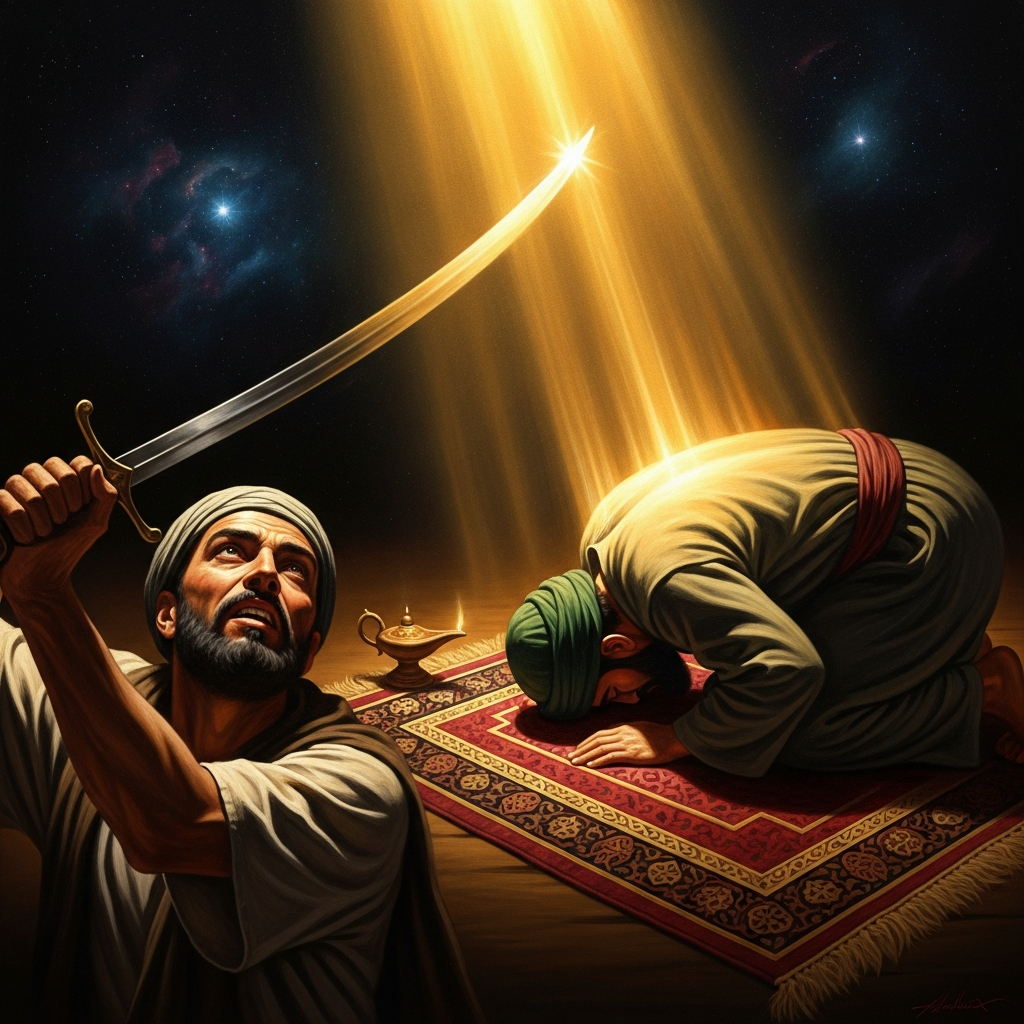
The sword comes in the moment of prostration.
Ibn Muljam al-Muradi is a Kharijite — one of the secessionists who broke from Ali’s army at Siffin because Ali agreed to arbitration rather than fighting to the last man. The Kharijites believe that Ali compromised the sovereignty of God by submitting to human judgment. They have decided that Ali, Muawiyah, and the arbitrator Amr ibn al-As must all die on the same night, so that the community of Islam can begin again, pure and undivided, as they imagine the time of the Prophet was.
Their theology is wrong in ways that will take centuries to articulate. Their swords, however, are real.
Ibn Muljam has dipped his blade in poison and waited in the mosque for three days, folded into the early-morning crowds, watching. He strikes Ali across the forehead in the moment of sajda — the lowest point of the prostration, the moment closest to the earth, the moment that represents in the body’s language the total submission the prayer is about.
The wound is deep. The poison is already working.
Ali is carried to his house. He does not lose consciousness immediately. He has time — two days, as it turns out — and he uses them with the methodical care he has brought to everything.
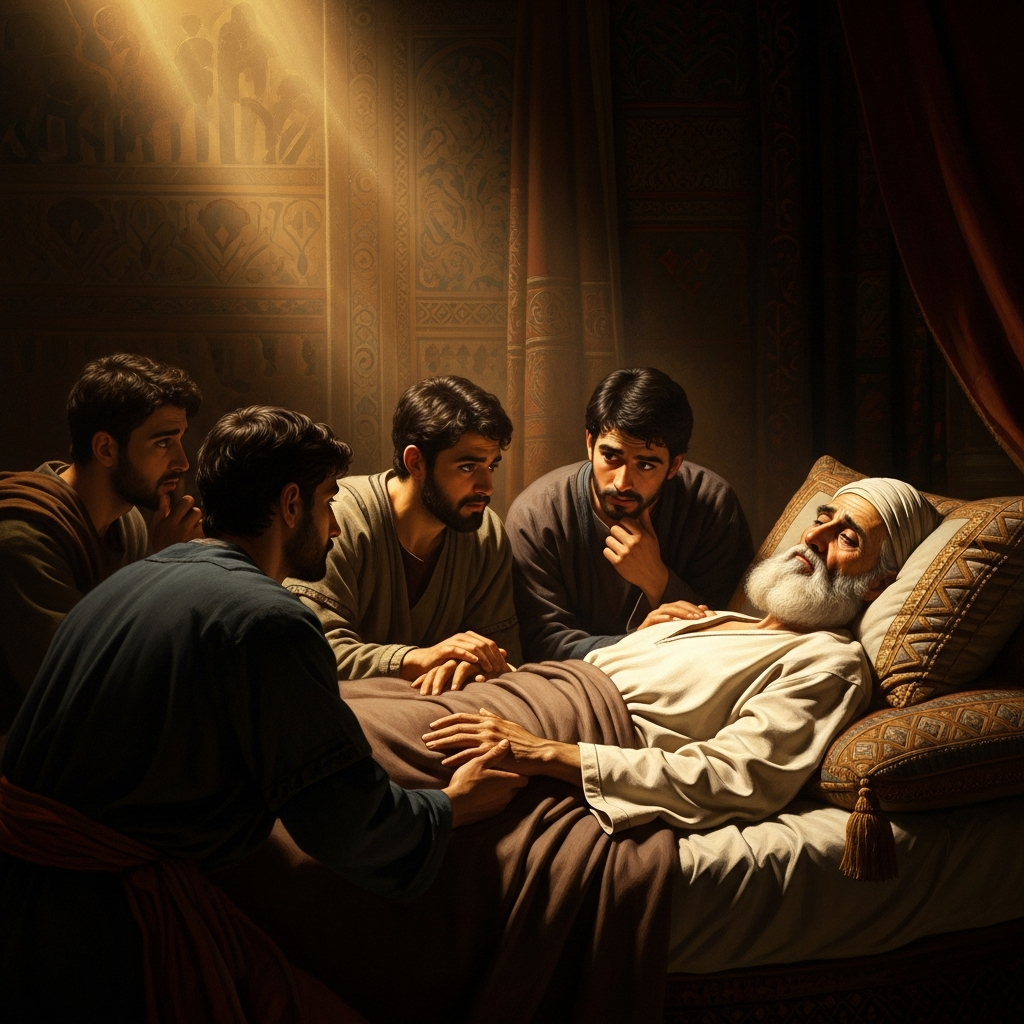
His sons Hasan and Husayn are summoned. They come and stand at his bedside the way young men stand at the bedside of fathers they cannot afford to lose, which is to say with their faces arranged and their hands not knowing what to do.
He speaks to them about Ibn Muljam.
He tells them: the man is in your custody now, and you must feed him and water him and keep him in good condition. If I die, you may take one equal retaliation — one blow, as he struck me one blow. You may not torture him. You may not mutilate him. You may not kill anyone else on his behalf or on mine. If God chooses to heal me, then I will decide what to do with him; that is my right, including pardon.
Hasan and Husayn listen to this instruction. The man in the next room poisoned their father with a sword during the dawn prayer. Their father is explaining the limits of permissible response.
There is a theology in this, and it is not abstract. Ali has spent his entire political life arguing that governance must be grounded in something beyond the will of whoever is currently strongest. He argued it against Abu Bakr’s election, against Umar’s appointment, against Uthman’s nepotism, against Muawiyah’s army. The argument cost him the caliphate three times. Now, dying, he applies the same argument to his own murder: the punishment must fit the act, not the grief.
He also tells his sons not to begin a war.
This is the harder instruction, and they know it. The Shia — the community that has formed around Ali’s claim, the people who believe that the Prophet designated him at Ghadir Khumm and that the community ignored it — are primed for something. The death of the Imam could become a call. It could become Karbala nineteen years before Karbala.
Ali tells them no.
He is not naive about what will happen without him. He has spent twenty years watching the community choose expedience over the right. He knows Muawiyah will consolidate in Syria. He knows the caliphate will pass to Muawiyah’s son, and that Muawiyah’s son is not a man the Prophet would have recognized as a leader. He knows all of this and still tells his sons: do not begin a campaign of revenge on my account.
The instruction is not passivity. It is the same logic that governed everything: act on principle, not on passion. Wait for the moment when resistance is witness rather than mere violence. If that moment comes, stand in it fully. But do not manufacture it.
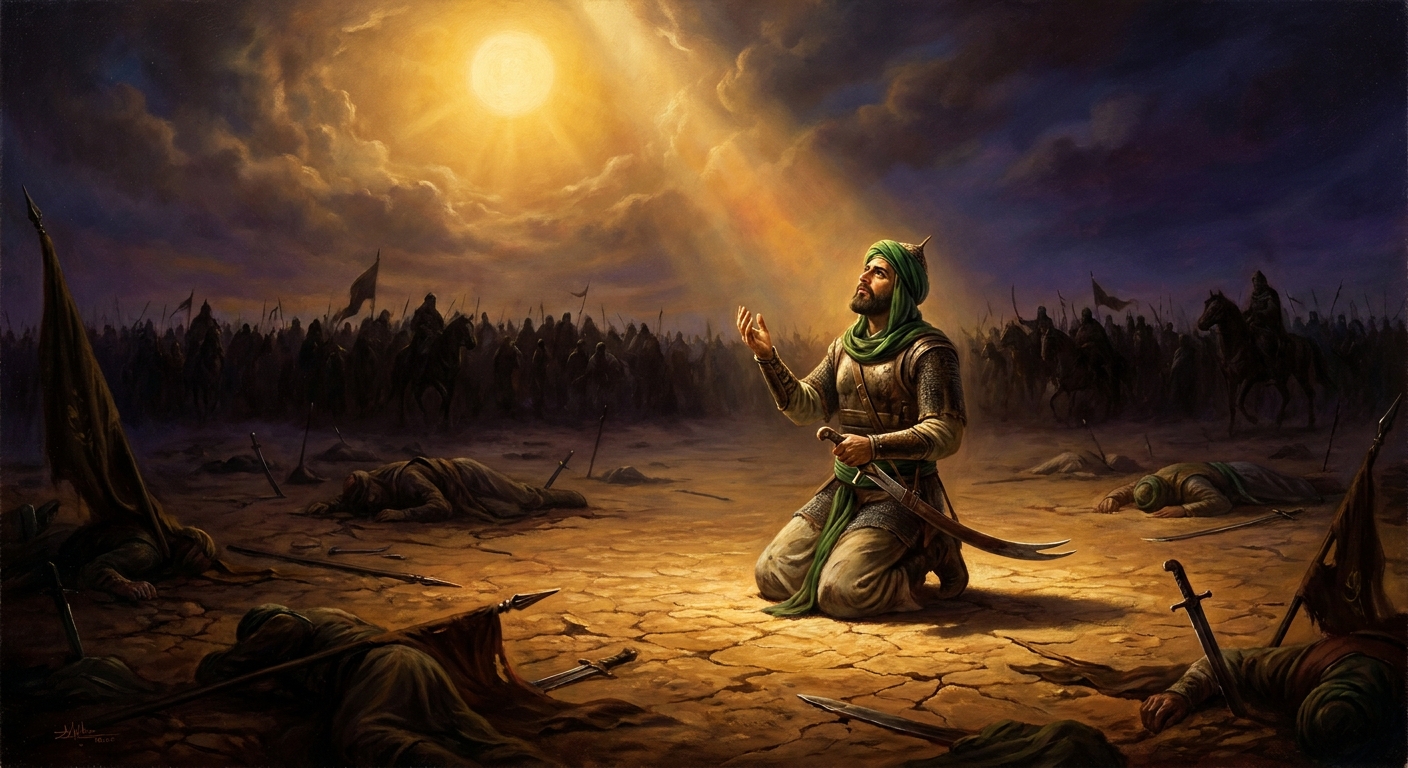
Husayn will spend the next twenty years learning what his father meant. He will learn it completely at Karbala, in 680 CE, when he takes his seventy-two companions into the plain and demonstrates what principled refusal costs.
On the twenty-first of Ramadan, Ali ibn Abi Talib dies.
His last words, recorded in multiple sources, are the Shema of Islam — the testimony of the faith: La ilaha ill’Allah, Muhammad rasul Allah. There is no god but God. Muhammad is the Messenger of God. He says it twice, clearly, in a voice the people near him can hear.
Then he is gone.
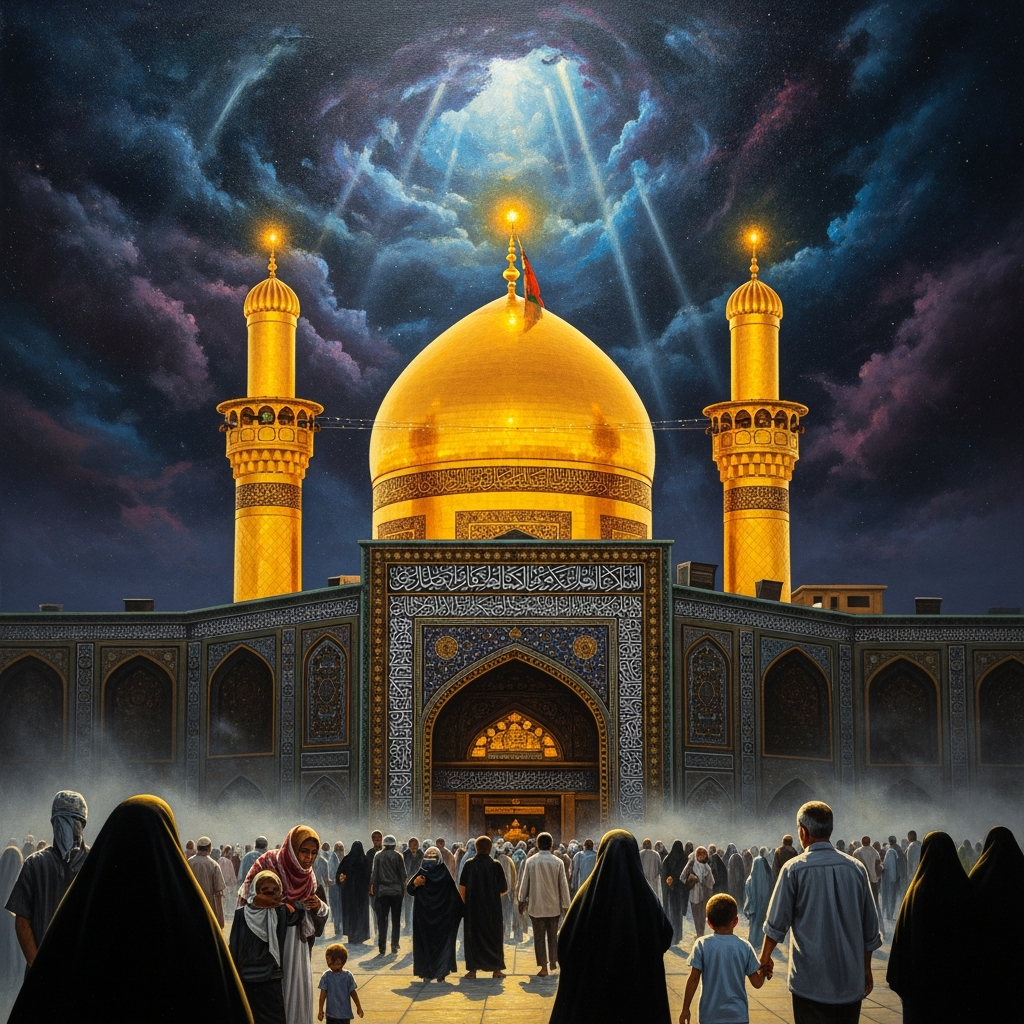
He is buried at Najaf — or rather, the exact location of his burial is kept secret for generations, because his followers fear the Umayyads will desecrate the tomb. The secret does not hold. By the eighth century the site is known. By the ninth century there is a shrine. By the twentieth century the golden dome of the Imam Ali Mosque at Najaf is one of the most recognizable structures in the Islamic world, and forty million pilgrims a year walk through its gates.
The Shia bury their dead with their faces oriented toward Najaf.
Ibn Muljam is executed — one blow, as instructed. The Kharijite conspirators in Medina and Syria fail or are caught. The coordinated strike against the three principals comes to nothing. Muawiyah lives and rules for another twenty years. The caliphate passes to his son Yazid, as Ali foresaw.
None of this surprises anyone who was paying attention.
What does not fit cleanly into the political history is the quality of Ali’s dying. He is the man the Shia believe was robbed of his rightful inheritance four times — by Abu Bakr, by Umar, by Uthman, and finally by the sword of a man who killed him precisely because he was too willing to negotiate. He is the man who fought three civil wars to hold a caliphate he spent trying to govern justly and lost anyway to a man whose entire claim rested on military force. He dies in a mosque during a prayer.
And what he does with his two days of dying is instruct his sons in the limits of legitimate punishment and the discipline of non-escalation.
There is a way to read this as defeat. There is another way to read it as the entire argument, finally clear.
The theological controversy about Ali’s caliphate has never closed, and perhaps the Shia are right that it never will. What is not controversial is the manner of the dying. Even sources hostile to his cause record the instructions to his sons without editorial comment — they are simply too precise, too obviously premeditated, to be the invention of partisans. A man who was making things up would have given Ali a battlefield death, or a deathbed curse, or a dramatic final command to rise and avenge. What we have instead is a man carefully arranging the legal parameters of his own murder’s aftermath, because he believed that the law applied even here, especially here, most of all here.
He spent his life arguing that the caliphate belonged to whoever God designated, not whoever seized it. He died enforcing the same principle on his own grave.
Scenes
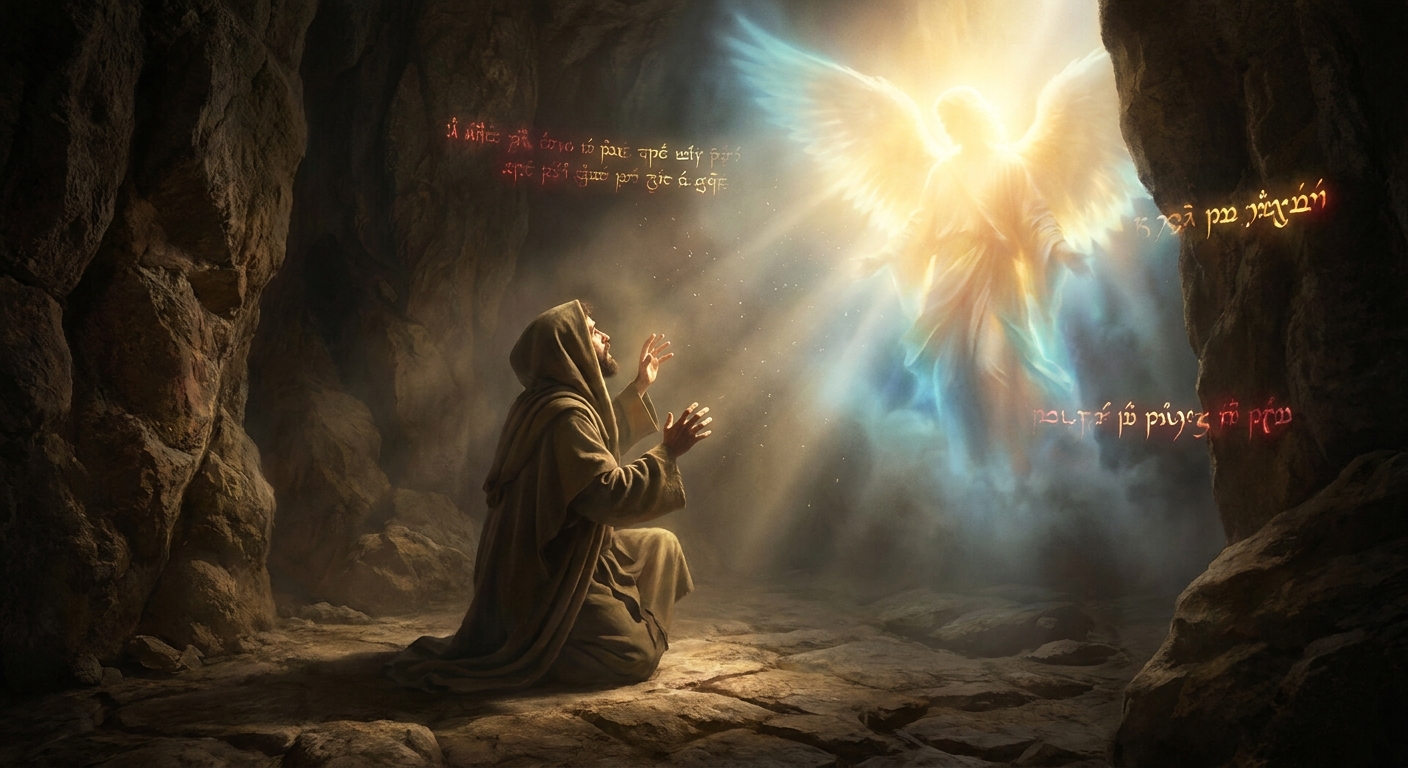
Ibn Muljam's sword finds Ali in the prostration of dawn prayer — the man who spent his life arguing for the caliphate dies doing the one thing no one contested: praying
 Generating art…
 Lying on his deathbed, Ali tells his sons that Ibn Muljam is to receive one blow only — not torture, not war — because God alone judges the heart
 Generating art…
 The golden dome of Najaf rises over the tomb of Ali ibn Abi Talib, the third holiest site in Islam — pilgrimage destination for forty million people a year
 Generating art…
 Echoes Across Traditions
Entities
- Ali ibn Abi Talib
- Ibn Muljam al-Muradi
- Hasan ibn Ali
- Husayn ibn Ali
- Fatima al-Zahra
Sources
- al-Tabari, *Tarikh al-Rusul wa al-Muluk* (History of Prophets and Kings), vol. 17
- Ibn Sa'd, *Kitab al-Tabaqat al-Kabir*
- Wilferd Madelung, *The Succession to Muhammad* (Cambridge, 1997)
- Hossein Nasr, *Ali ibn Abi Talib* (2011)
- Seyyed Hossein Nasr, *The Heart of Islam* (2002)