The Illiterate Patriarch
c. 661 CE · Huangmei, East Mountain Monastery, Tang Dynasty China — and the southern road
Contents
A woodcutter who cannot read the sutras hears one sentence at a market and walks north to inherit the robe of Chan — winning a midnight poem-contest he was never allowed to enter.
- When
- c. 661 CE
- Where
- Huangmei, East Mountain Monastery, Tang Dynasty China — and the southern road
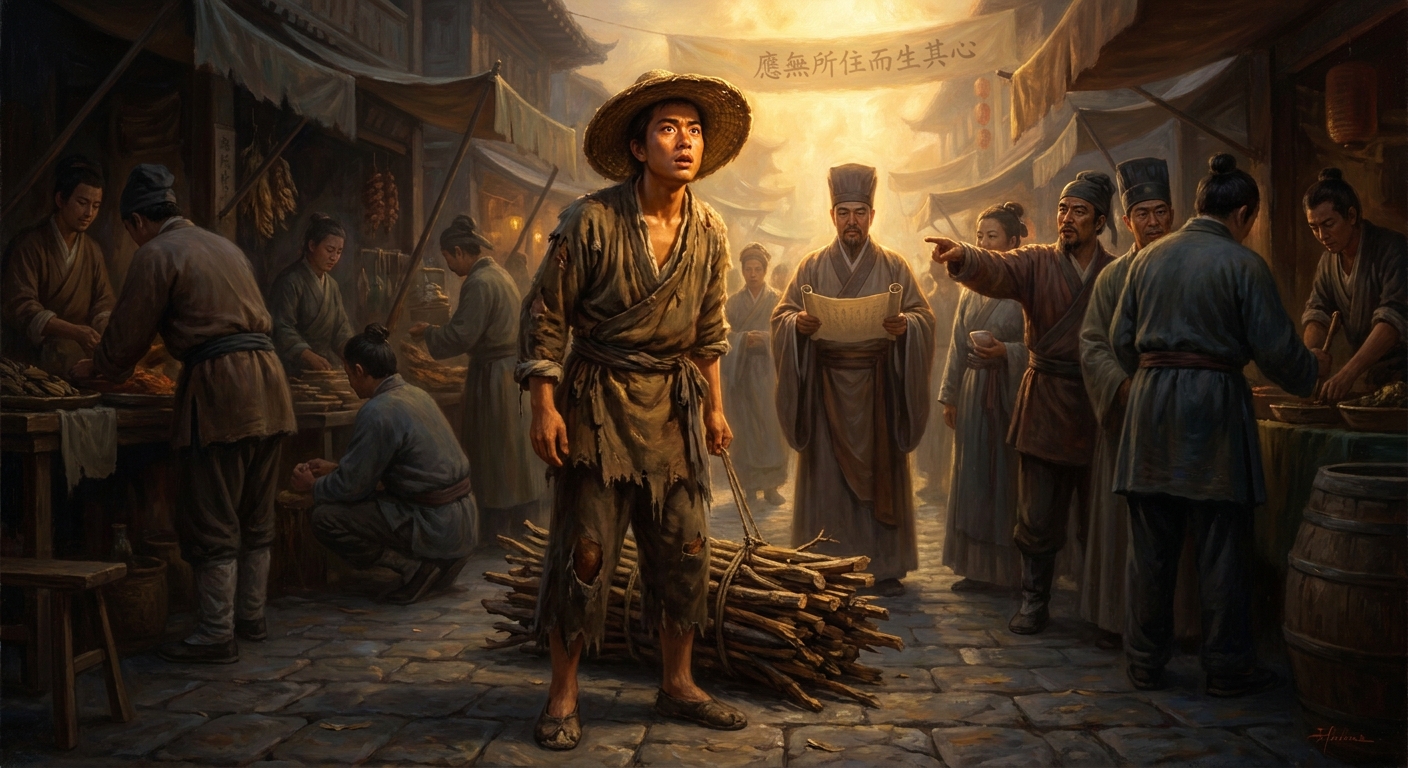
He is selling firewood at the market in Guangzhou.
His father died young. He cannot read. He cannot write his name. He carries bundles of split pine on his back from before dawn until the coins are enough to feed his mother, and he has done this every day of his adult life. He is twenty-three. He has never been further from his village than this market.
A traveler outside an inn is reciting the Diamond Sutra. Huineng walks past him, then stops. Then walks back. The traveler has reached a single line:
“One should produce a mind that does not abide in anything.”
The bundles slide off his shoulders. He does not feel them go.
He stands in the road for a long time. When he can speak, he asks the traveler where this teaching comes from. Huangmei. East Mountain. The Fifth Patriarch, Hongren.
He goes home. He arranges for his mother. He starts walking north.
He arrives at the monastery thirty days later, road-dusty, illiterate, southern-accented in a way the northern monks find funny. Hongren receives him in the courtyard.
“Where are you from? What do you want?”
“I am a commoner from Lingnan,” Huineng says. “I have come to seek nothing but to be a Buddha.”
The monks laugh. Hongren does not.
“Lingnan? You are a barbarian. How can a barbarian become a Buddha?”
“In men there is north and south,” Huineng says. “In Buddha-nature there is no north and south. The body of a barbarian and the body of a monk differ. In Buddha-nature, what difference?”
Hongren looks at him for a long moment. Then he sends him to the threshing room. Go pound rice. Say nothing.
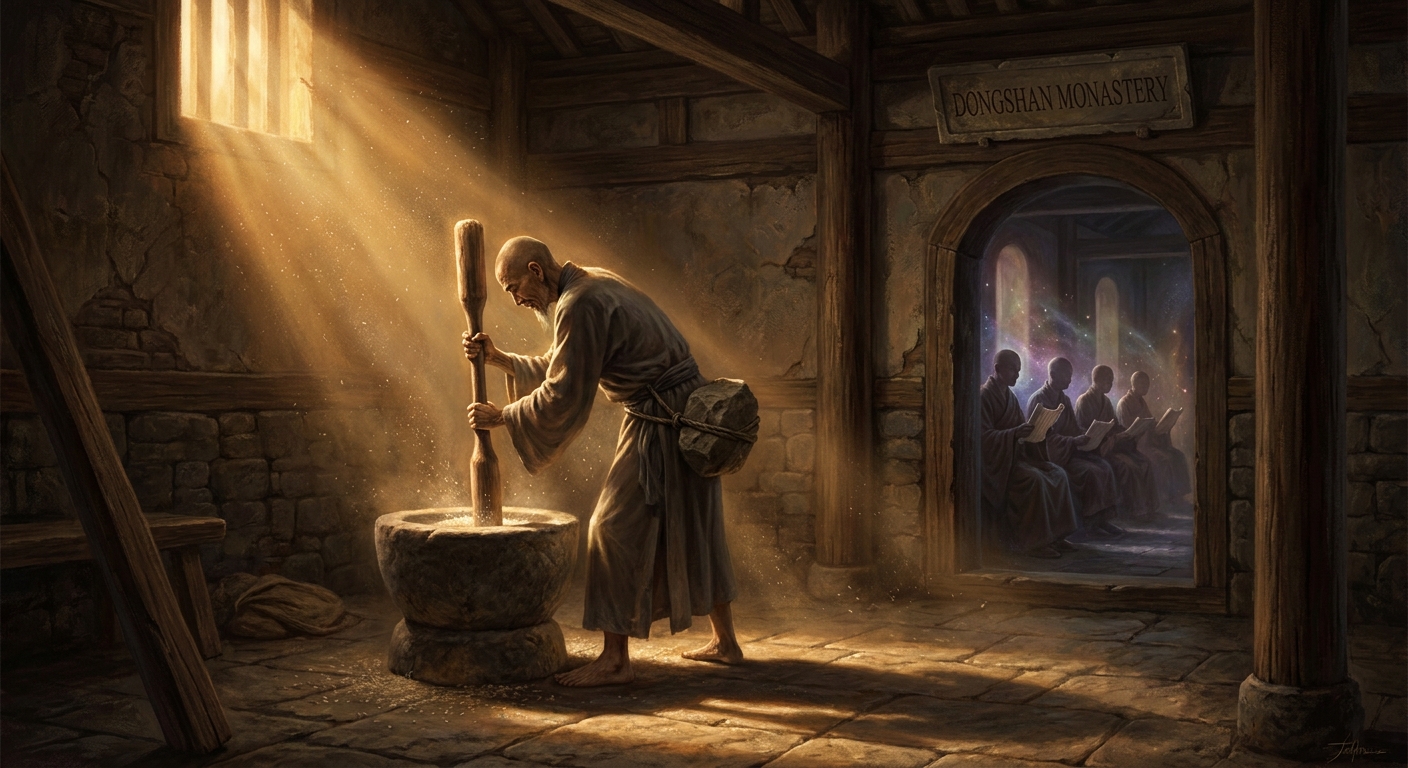
For eight months Huineng pounds rice.
He is small. The pestle is heavy. He ties a stone around his waist to add the weight his body lacks, and he treads the lever from before dawn until after dark. The grain falls. The husks rise. He does not see the patriarch again. He does not enter the meditation hall. The other monks pass him on their way to study and do not greet him. He is a peasant in a back room. The other monks are students.
Then one morning the announcement: the patriarch is old. He will choose a successor. Each monk is to compose a poem demonstrating his understanding. The robe and bowl of Bodhidharma will pass to the one whose verse touches the truth.
Everyone assumes Shenxiu will win. Shenxiu is the head monk. Shenxiu has read everything. Shenxiu’s calligraphy is a marvel. The other monks decide there is no point competing — they will simply admire whatever Shenxiu writes.
Shenxiu writes his poem on the corridor wall by lamplight, anonymously, so that if it is wrong he can disclaim it.
The body is the bodhi tree. The mind is a bright mirror’s stand. Always strive to polish it. Let no dust alight.
The monastery reads it at dawn. The monks recite it. Hongren sees it and tells everyone to learn it. He praises it publicly. Shenxiu, listening from his cell, allows himself to breathe.
Then Hongren goes alone to Shenxiu’s room.
“You have not yet entered the gate,” the old man says. “Go away and think for a few days. Bring me another verse.”
Shenxiu cannot. Shenxiu has nothing else to bring. He sits in his cell for the next three nights and the verse will not come, because the verse he wrote was the truest thing he knew, and it is not enough.
A boy passes the threshing room reciting Shenxiu’s poem.
Huineng stops the lever. He listens. He asks the boy to lead him to the wall. He cannot read it himself, so he asks a passing monk to read it aloud to him, and then to read his own response back, and then to write it next to Shenxiu’s, since Huineng cannot write.
Bodhi originally has no tree. The bright mirror also has no stand. Originally there is not a single thing — Where can dust alight?
The corridor empties. The monks gather. They read the second verse, then the first, then the second again. Someone says, who wrote this? Someone else says, the barbarian in the threshing room. The laughter is thinner this time.
Hongren arrives. He reads the verse. He scuffs it off the wall with his sandal.
“This is not yet enlightenment either,” he says loudly, and walks away.
That night, he sends for Huineng.
The monastery sleeps. Hongren teaches Huineng the Diamond Sutra by lamplight, line by line, until they reach the same passage Huineng heard at the market — one should produce a mind that does not abide in anything — and at that line, this time, the floor of the floor opens.
Huineng’s tears do not fall on the sutra. They fall through it.
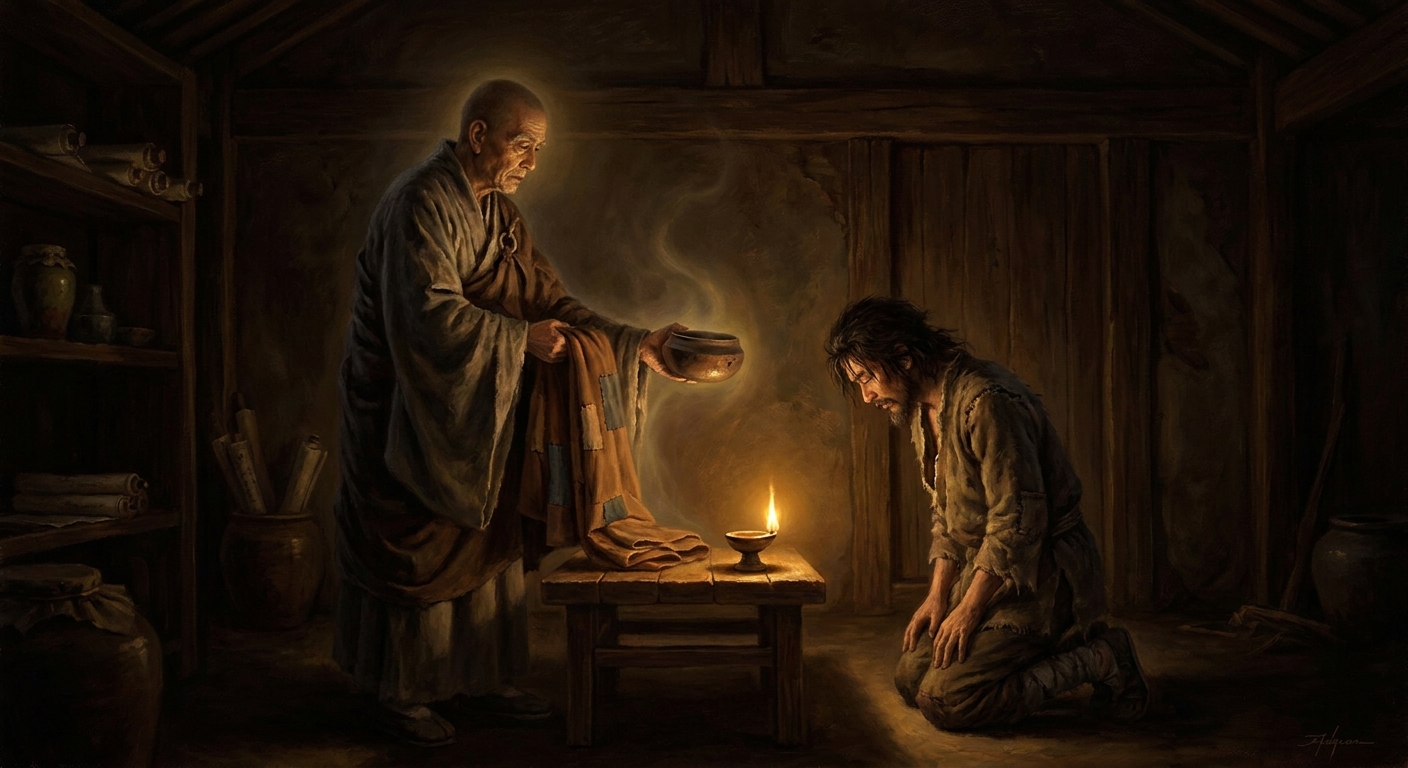
Hongren takes the robe and bowl Bodhidharma carried out of India a hundred and fifty years before. He places them in Huineng’s hands.
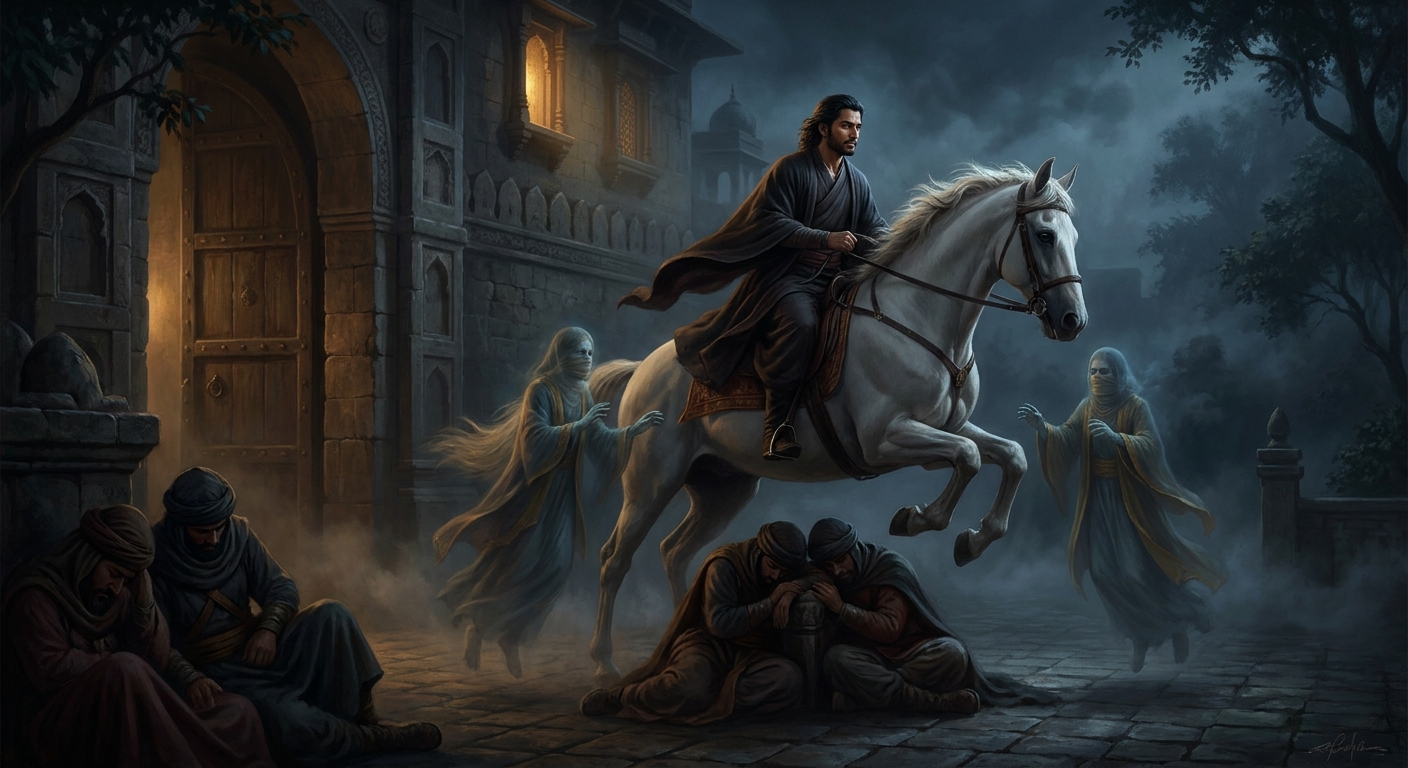
“You are now the Sixth Patriarch. The robe is the proof — but the robe is also the danger. Men have killed for it. Leave tonight. Go south. Hide. Do not teach for fifteen years. When the time is ripe, the dharma will find its mouth.”
Hongren walks him to the river himself, ferries him across in the dark, and does not turn back until the southern shore is a shadow.
For fifteen years Huineng disappears.
He lives among hunters in the mountains, eating the wild greens cooked at the edge of their meat pots so as not to break the precept against killing. The robe stays hidden in a wrapped bundle. He says nothing about who he is. The monks left behind at East Mountain — Shenxiu chief among them — believe the patriarchate has gone to him; the Northern School builds itself on Shenxiu’s gradual-polishing teaching. For a generation it is the orthodoxy of the Tang court.
When Huineng finally surfaces, at a temple in Guangzhou where two monks are arguing whether it is the flag or the wind that moves, he says simply:
“Not the flag. Not the wind. Your minds are moving.”
The monks turn. They see who is speaking. The Southern School begins.
Huineng’s victory was not over Shenxiu. Shenxiu was a great teacher; his Northern School was real Buddhism. Huineng’s victory was over the assumption that the dharma could be earned by literacy, status, or seniority — that it owed itself to the credentialed.
The Sixth Patriarch could not read. He won the contest. The robe went south on the back of an illiterate woodcutter, and from that night every Zen lineage in East Asia became a lineage that, somewhere in its bones, knew the credentials were optional.
The mirror has no stand. The dust has no place to alight. The barbarian becomes a Buddha because Buddha-nature does not check the paperwork.
Scenes
A woodcutter at the market freezes mid-step
 Generating art…
 Eight months in the threshing room
 Generating art…
 The Fifth Patriarch hands him the robe and bowl by lamplight
Generating art… Echoes Across Traditions
Entities
- Huineng
- Hongren (Fifth Patriarch)
- Shenxiu
Sources
- *Platform Sutra of the Sixth Patriarch* (*Liuzu Tan Jing*) — Dunhuang manuscript redaction, c. 780 CE
- Philip B. Yampolsky (trans.), *The Platform Sutra of the Sixth Patriarch* (1967)
- John R. McRae (trans.), *The Platform Sutra* (BDK English Tripitaka, 2000)
- Heinrich Dumoulin, *Zen Buddhism: A History, Vol. 1: India and China* (1988)
- Bernard Faure, *The Will to Orthodoxy: A Critical Genealogy of Northern Chan Buddhism* (1997)