The Kitchen Worker Who Became the Sixth Patriarch
c. 638–713 CE · The monastery of Huangmei in Hubei Province, China; later Caoxi in Guangdong
Contents
An illiterate wood-carrier in the kitchen of a Chinese monastery hears a poem read aloud, dictates a four-line answer, and walks out of the night with the robe and bowl of the patriarchs hidden under his shirt.
- When
- c. 638–713 CE
- Where
- The monastery of Huangmei in Hubei Province, China; later Caoxi in Guangdong
He arrives at Huangmei carrying his mother on his back.
He is a wood-carrier from Lingnan, the deep south, the region the imperial court calls the land of barbarians. He cannot read. He has never read. His father died when he was three and he has been selling firewood in the markets of Canton for as long as he can remember to keep his mother alive. One afternoon outside the inn of a wealthy merchant, he hears a stranger reciting a sutra in the courtyard, and the line he hears is from the Diamond Sutra — one should give rise to mind that is not fixed anywhere.
He stops on the road. The bundle of firewood on his back is suddenly heavy in a different way. He asks the stranger where the sutra came from. Huangmei, the man says. Hongren is the Fifth Patriarch. He teaches there.
The merchant, hearing the wood-carrier’s questions, gives him ten taels of silver — enough to settle his mother for years. Hui-neng walks north. He walks for thirty days. He arrives at the monastery on Huangmei mountain in the spring of his thirty-fourth year.
Hongren receives him in the audience hall. The patriarch is in his sixties, severe, surrounded by his senior disciples. He looks at the rough southern man in front of him and asks the standard question:
Where are you from. What do you want.
I am from Lingnan, Hui-neng says. I want to be a buddha.
The senior monks laugh. A barbarian from the south who has never seen a temple, asking to be a buddha. Hongren does not laugh. He looks at the wood-carrier for a long moment and asks:
A man from Lingnan. How can a barbarian become a buddha?
A buddha-nature has no north or south, Hui-neng answers. My southern body and the body of the patriarch are not the same. But how could the buddha-nature be different?
Hongren says nothing. He sends the new arrival to the kitchen.
Hui-neng spends eight months in the kitchen.
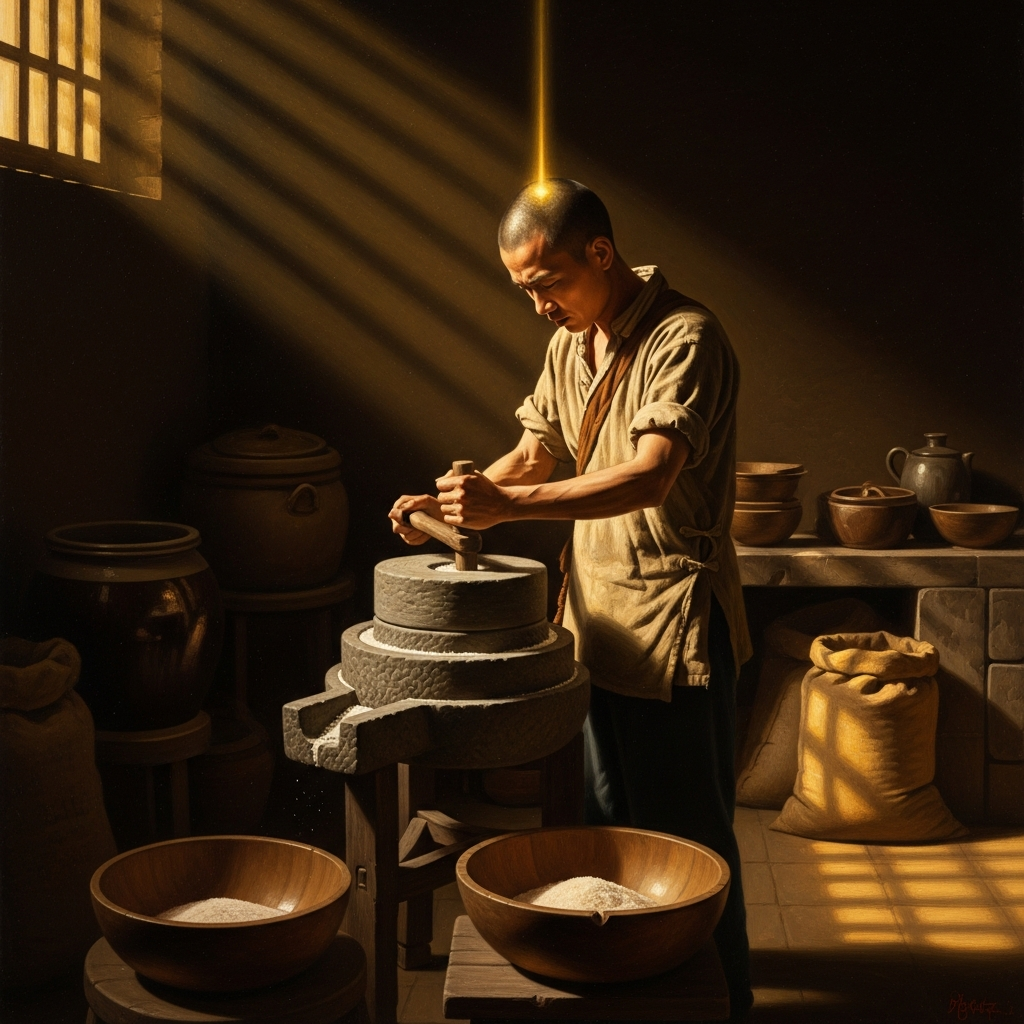
He grinds rice. He carries water. He splits firewood. He is so light that the stone of the grindstone is heavier than he is, so they tie a rock to his back to give him enough weight to push the wheel. No one speaks to him. He does not enter the meditation hall. He does not receive teaching. He is the wood-carrier who came north to be a buddha and who is, instead, grinding rice in a stone-floored kitchen for the monks who study the sutras.
He does not complain. He does the work.
In the eighth month, the patriarch summons every monk in the monastery.
I am old, Hongren says. The dharma must be transmitted. I want each of you to compose a gatha — a four-line verse — that demonstrates your understanding of the original mind. The one whose verse shows true insight will receive the robe and bowl. He will be the Sixth Patriarch.
The monastery erupts in conversation. Almost immediately, every monk agrees that there is no contest. The head monk is Shenxiu, the senior teacher, the man who has lectured to the assembly when Hongren was unwell. Shenxiu has memorized every sutra. He is the obvious heir. The other monks decide there is no point in trying. Whatever the head monk writes, they say, we will follow.
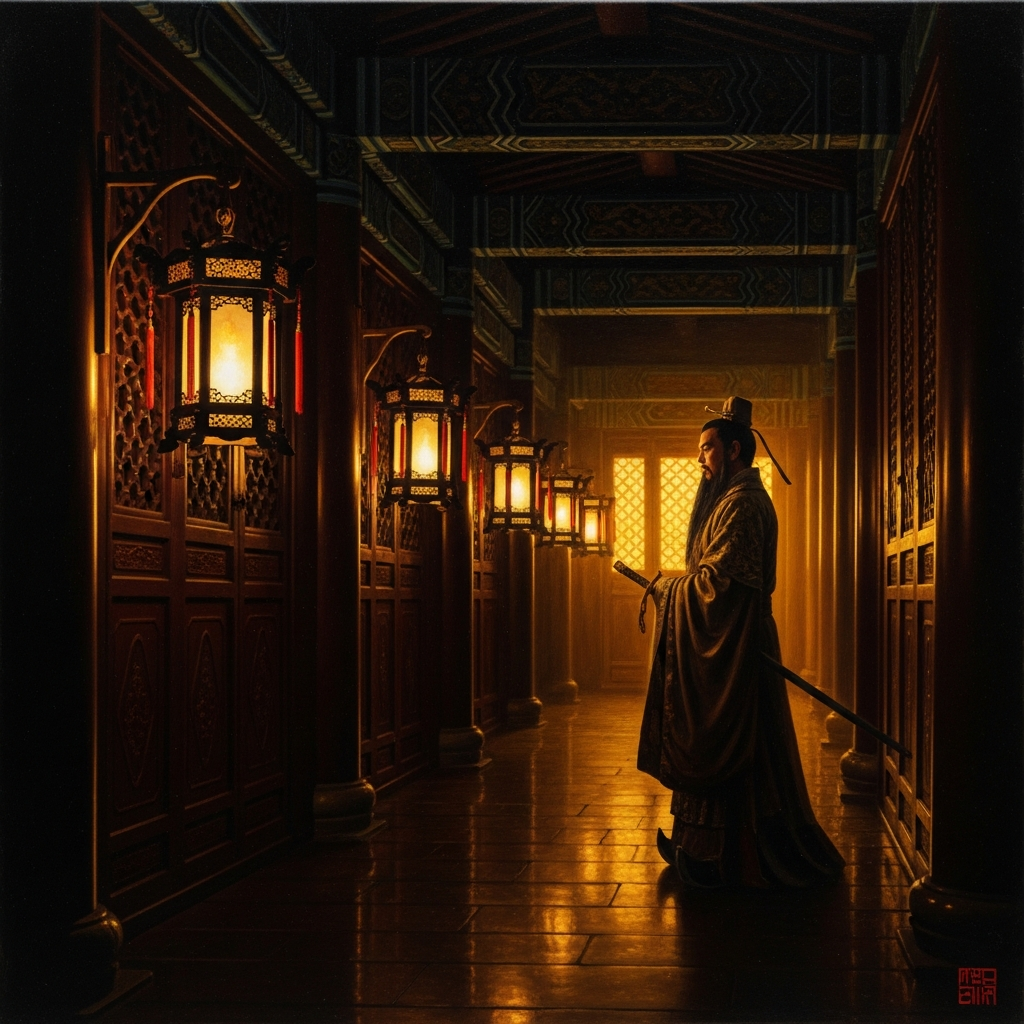
Shenxiu sits in his cell for four days. He writes a verse. He cannot quite bring himself to present it to the patriarch directly — what if it is wrong? — so in the middle of the night he goes to the corridor outside Hongren’s room, and on the long blank wall he writes in clear careful script:
The body is a Bodhi tree. The mind is like a bright mirror’s stand. Always wipe it diligently, So no dust can collect.
Morning comes. The monks see the verse. They recognize Shenxiu’s hand. They praise it through the corridors all day. Hongren reads it and says nothing.
That night Hongren goes to Shenxiu’s cell. Your verse, he says, is the verse of one who has not yet entered the gate. Compose another. Shenxiu sits for several more days. Nothing comes. The verse he wrote is the limit of what he has seen.
A novice walks through the kitchen reciting Shenxiu’s verse aloud.
Hui-neng, grinding rice, hears it. He asks the novice what he is reciting. The novice explains the contest. He explains the verse. He explains that everyone says Shenxiu will be the Sixth Patriarch.
Hui-neng listens. He grinds for another moment. Then he asks the novice to take him to the corridor wall. He says he wants to make an offering. He says he has a verse of his own.
The novice, amused, leads him.
The wall is high. Hui-neng cannot reach it; he cannot write in any case. He asks a nearby monk to take down the brush and inscribe his words for him. The monk, condescending and curious, agrees. Hui-neng stands beneath the wall in the corridor, and in the voice of a man who has not been to school he dictates four lines:
Bodhi has no tree. The bright mirror has no stand. Fundamentally there is not a single thing — Where could dust collect?
The monks gather. Some are stunned. Some are angry. The verse is plainer than Shenxiu’s — and harder. Shenxiu’s verse describes the work of polishing the mind. Hui-neng’s verse asks what mind is. The dust and the mirror are gone together. The whole frame has been pulled down.
Hongren arrives, reads the lines, and immediately rubs them out with his sleeve.
This, he says loudly, also has not entered the gate.
He turns to the assembled monks and walks away. The monks shrug and disperse. The wood-carrier returns to the kitchen.
That night the patriarch comes to the kitchen.
He finds Hui-neng at the grindstone in the dark. He taps the wood three times with his staff and walks back out. Hui-neng understands. At the third watch — three in the morning, the dead heart of the night — he goes to Hongren’s chamber.
The Fifth Patriarch is waiting. He has the Diamond Sutra on the low table. He begins to read it aloud, line by line, the way a teacher reads to a child. When he reaches the same line Hui-neng heard in the marketplace eight months ago — one should give rise to mind that is not fixed anywhere — the kitchen worker, sitting on the floor, drops everything he was holding inside himself, and the dropping is the recognition. He does not weep. He does not gasp. He simply sees what he has been seeing all along.
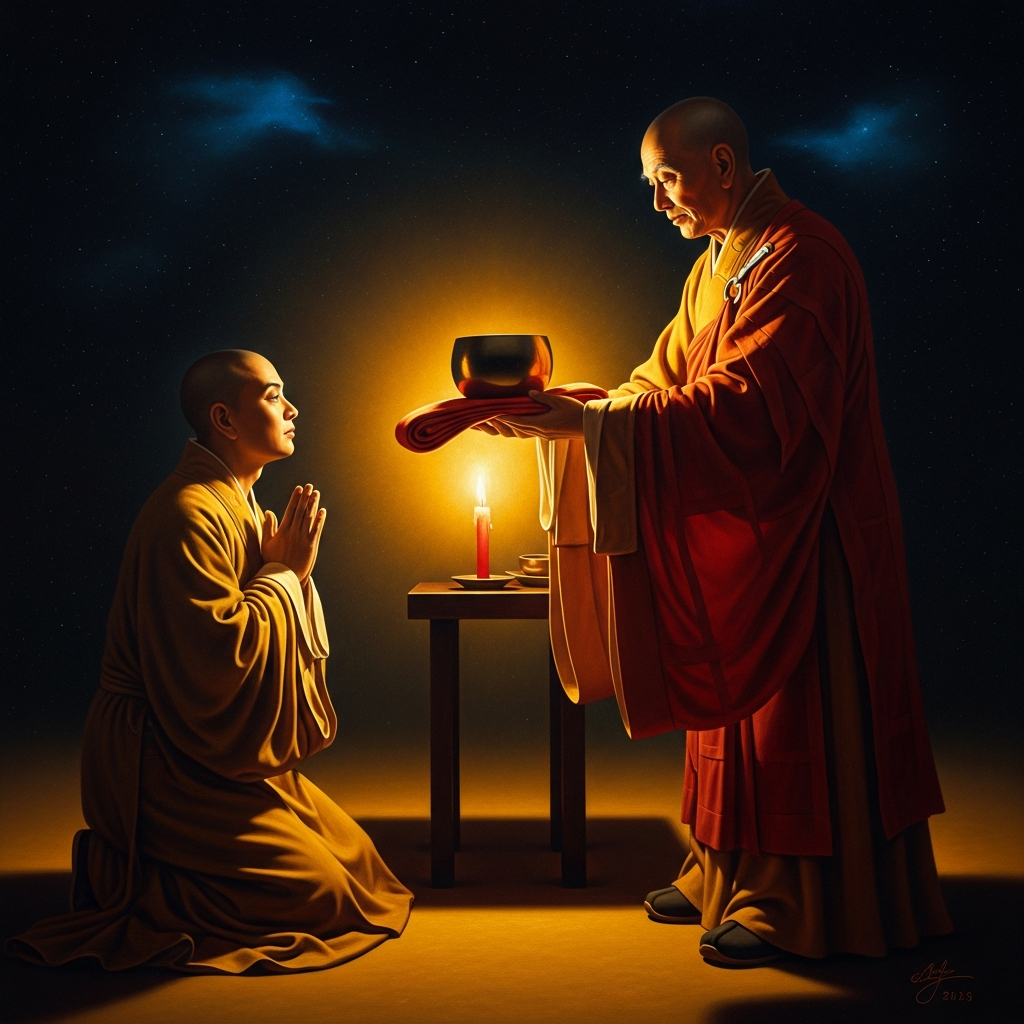
Hongren takes the patriarchal robe — woven cotton, a hundred and fifty years old, passed from Bodhidharma through five generations — and lays it across Hui-neng’s shoulders. He sets the wooden begging bowl in his hands.
The dharma, he says, is now in your keeping. You are the Sixth Patriarch.
He does not stop there. Listen carefully. The monks will kill you for this. Shenxiu’s followers will not accept that the inheritance has gone to a kitchen worker from Lingnan. You must leave tonight. You must go south. You must not preach for fifteen years. Hide. Live among hunters or laborers. Let the dharma ripen in you. When the time comes, the gate will open by itself.
The old patriarch walks the new patriarch down to the river. He takes the oars himself. He rows Hui-neng across to the southern bank. He does not let his successor row.
Allow me to row you, master, Hui-neng says.
When you are deluded, the teacher rows you, Hongren answers. When you are awakened, you row yourself.
He sets the kitchen worker on the southern bank with the robe and the bowl, turns the boat around, and rows back into the dark.
Hui-neng vanishes into the south for fifteen years.
He lives with hunters in the mountains of Guangdong. He cooks vegetables in the same pot they cook meat in, but lifts his portion out separately. He never tells anyone who he is. The robe and the bowl stay wrapped in cloth at the bottom of his pack.
When he finally surfaces, in the year 676 at the Faxing Temple in Canton, he is sitting in the back of a courtyard listening to two monks argue about a banner whipping in the wind. The banner is moving, one says. No, says the other, the wind is moving. Hui-neng cannot help himself. He stands up.
Neither the banner nor the wind is moving, he says. Your minds are moving.
The presiding teacher comes down from his seat. He looks at the unknown southerner. Who are you? he asks. Hui-neng opens the cloth bundle and takes out the robe.
The Sixth Patriarch has arrived.
He teaches at Caoxi for the next thirty-six years. The lectures his students write down become the Platform Sutra of the Sixth Patriarch — the only Chinese text in the entire canon ever awarded the title sutra, a word reserved, until then, for the recorded words of the Buddha himself. The doctrine of the Platform Sutra is the doctrine of the verse on the wall: fundamentally there is not a single thing. Sudden awakening. Original purity. No mirror to polish, because there was never any dust.
Shenxiu lives out his life in the north as the honored teacher of two emperors. His school is the Northern School of Chan — gradual cultivation, careful polishing, slow refinement. Hui-neng’s school is the Southern School — sudden recognition of what was already the case. The two schools coexist, debate, and eventually the Southern wins the historical argument so completely that all later Zen — every line in China, every line in Japan, every line in Korea, every line in Vietnam — descends from the kitchen worker who could not read.
When Hui-neng dies at Caoxi in 713 he is seventy-six. His body does not decay. The monks lacquer it. It is still seated, still in the lotus position, in a temple in southern China, fourteen hundred years after he stopped breathing.
The verse he dictated in the corridor that night is still being argued. The robe was taken into history with him and never given to a successor — the lineage afterward passes through the Platform Sutra and through the master-student encounter, not through the cloth. The line ends, in a sense, with him. The line begins, in a sense, with him.
The Hui-neng story is a founding myth and it is also a method. The founding myth is that the dharma is not the property of literacy or class or accumulated learning; it is available to anyone who can stop holding the mind in place. The method is the verse on the wall. Fundamentally there is not a single thing. The work is not to clean the mirror. The work is to notice that there is no mirror. The dust was always a story about the mirror.
This is the Southern School’s claim, and a thousand years of Chan and Zen are footnotes to it. The kitchen worker did not become the Sixth Patriarch despite being illiterate. He became the Sixth Patriarch because no library was in the way.
Scenes
Hui-neng in the kitchen at Huangmei, grinding rice with a stone tied to his back to add weight
 Generating art…
 The corridor wall by lantern light
 Generating art…
 The Fifth Patriarch hands the robe and bowl to the kitchen worker in the dead of night
Generating art… Echoes Across Traditions
Entities
- Hui-neng
- Hongren
- Shenxiu
- Platform Sutra
Sources
- *Platform Sutra of the Sixth Patriarch* (trans. Philip Yampolsky, 1967)
- John McRae, *Seeing Through Zen: Encounter, Transformation, and Genealogy in Chinese Chan Buddhism* (2003)
- T. Griffith Foulk, *The Ch'an School and Its Place in the Buddhist Monastic Tradition* (1987)
- Heinrich Dumoulin, *Zen Buddhism: A History — China and Japan* (1988)
- Bernard Faure, *The Will to Orthodoxy: A Critical Genealogy of Northern Chan Buddhism* (1997)