Husayn at Karbala
October 10, 680 CE · 10 Muharram 61 AH · Karbala, on the plain west of the Euphrates
Contents
On the plain of Karbala, October 680 CE, Husayn ibn Ali — grandson of the Prophet — refuses to submit to Yazid's authority, watches his companions and sons die one by one, and is killed alone in the sand. His death does not end the argument. It becomes the argument.
- When
- October 10, 680 CE · 10 Muharram 61 AH
- Where
- Karbala, on the plain west of the Euphrates
The water has been cut for ten days.
The Euphrates is there — close enough that the horses can smell it, close enough that a man running hard might reach it before an arrow did. But ten thousand soldiers stand between the river and the camp, and the orders are clear. No water reaches Husayn ibn Ali, grandson of the Prophet Muhammad, until he swears allegiance to Yazid ibn Muawiyah, caliph in Damascus.
Husayn does not swear.
He has been here before — not on this plain, but in this position. He is fifty-six years old, son of Ali and Fatima, raised in the household of revelation. He has watched his father murdered. He has watched his brother Hassan poisoned. He knows what happens to the Prophet’s bloodline when it stands inconveniently in the way of power. He came to Karbala anyway, answering the letters of Kufa’s people who said they would rise, who said they would stand with him, who were already dispersing back to their homes when his caravan arrived. He is not naive about what he has ridden into.
The companions who remain — seventy-two in total, men and women and children — know it too. He has told them plainly: anyone who wishes to leave in the night may leave. He releases them from their oaths. Some go. Those who stay know what the morning holds.
They stay.
The dying starts at dawn.
The companions go out one by one, in the convention of battle, each one fighting until the weight of numbers closes over him. Husayn watches from the camp. Each name that returns as a body is a man he has known since childhood, a man who chose this. He performs the prayers over the dead as they are carried back. There are many prayers.
His half-brother Abbas is the keeper of the water. When the thirst of the children becomes unendurable, Abbas rides for the Euphrates. He reaches it. He fills his waterskin. On the way back, they cut off his right hand. He transfers the skin to his left. They cut off that hand too. He carries it in his arms, pressing it to his chest with stumps, until an arrow takes him. He dies with the waterskin still mostly full, because he would not drink himself while the children had none.
His son Ali Akbar is eighteen years old. He looks like the Prophet — the face, the bearing, the voice. When he rides out, Husayn watches the way a man watches something he cannot stop and cannot look away from. Ali Akbar fights with the recklessness of someone who knows the mathematics and has made his peace with them. He is killed. Husayn walks to the body and does not speak for a long time.
Then the infant.
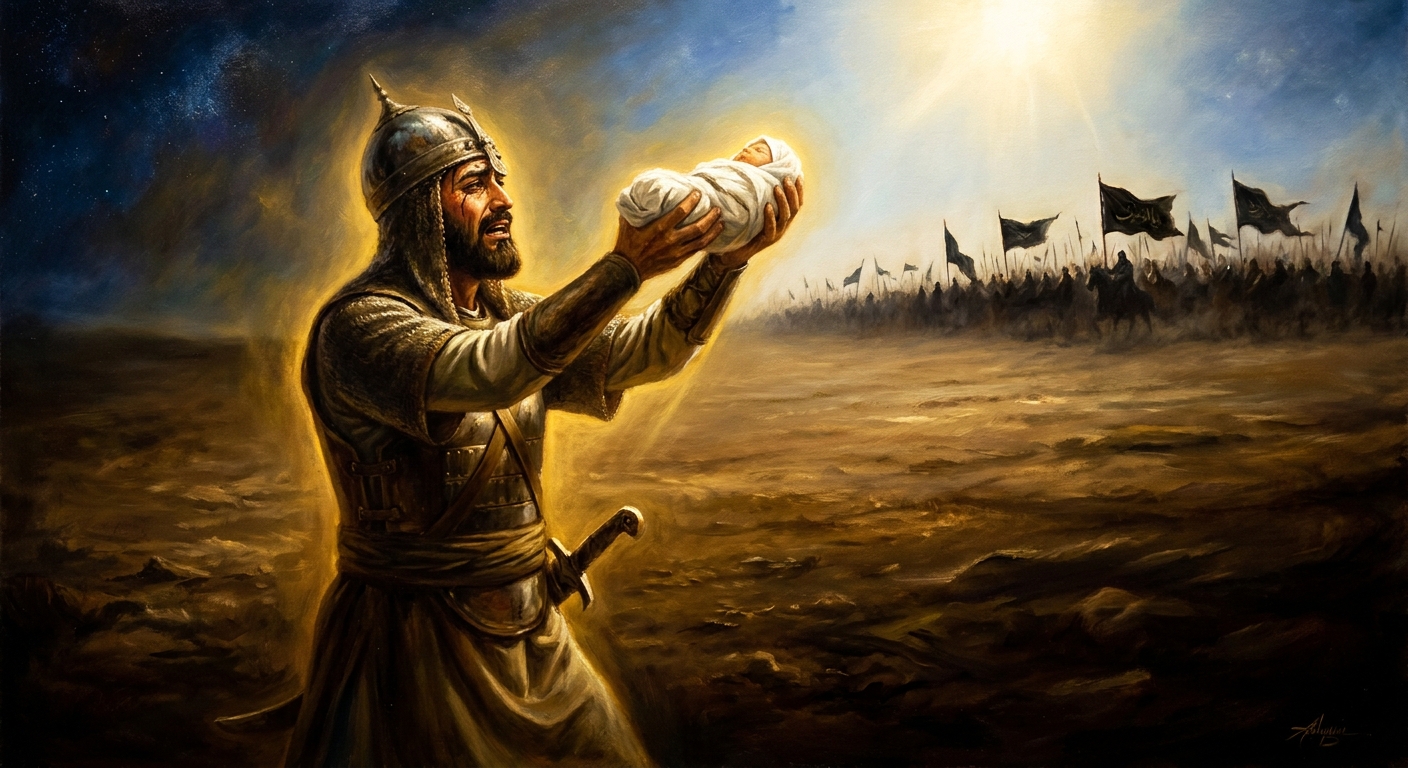
Ali Asghar is too young to have a name that history would remember if not for this day. He is a few months old. He has been crying from thirst, the way infants cry — without understanding, without argument, just the body’s honest report of what it needs. There is nothing in the camp left to give him.
Husayn wraps him in his cloak and walks toward the Umayyad lines.
He holds the child up. He speaks clearly, without anger, to the ten thousand: This child has committed no crime against you. He is an infant. He cannot swear allegiance or refuse it. Give him water.
The army is quiet for a moment. Some of the soldiers look at the ground.
Then an archer draws. The arrow crosses the space between them and takes Ali Asghar in the throat — a single shot, carefully aimed. The child dies in Husayn’s arms.
Husayn carries him back to the camp. He digs the grave himself, in the sand, with his hands.
There is a silence after this that the chronicles preserve without explanation. Al-Tabari records what happens next without recording how long Husayn stood at that small grave before he stood up again. It is not the kind of interval historians know how to measure.
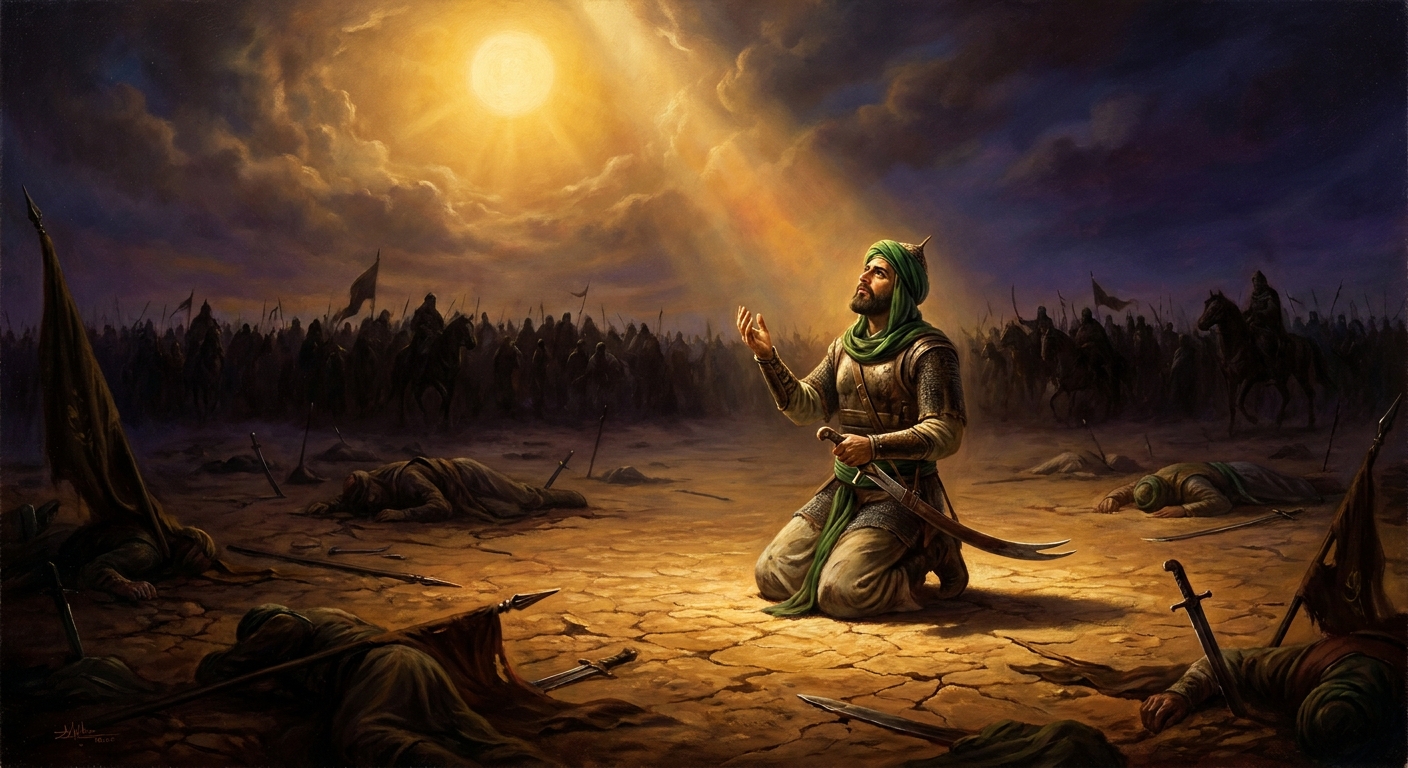
He arms himself. He prays. He goes out alone.
He fights with a grief that is past the point of grief — the place a man reaches when everything that could be taken has been taken, and what remains is not despair but something harder and quieter. He fights his way deep into the lines. He is wounded many times. He does not fall until he is struck from multiple sides at once, and even then the accounts say it takes a long time.
He is killed on the plain of Karbala, in the middle of the afternoon, on the tenth of Muharram in the sixty-first year after the Hijra.
His head is cut from his body and sent to Damascus. His body is left in the sand. The women — his sister Zaynab among them — are taken captive and marched to the Umayyad court, where Zaynab delivers a speech to Yazid of such controlled fury that the chronicles preserved it word for word for thirteen hundred years. She tells him: Do what you will. You cannot cut out what God has placed in us.
The consequences do not wait for the bodies to be buried.
The split between the community that accepts Umayyad authority and the community that calls them usurpers was already a theological argument. After Karbala it is a wound. The Shia — shi’at Ali, the party of Ali — carry this day not as a defeat to be avenged but as a permanent testimony: this is what illegitimate power does when confronted with legitimate witness. The martyrdom is the point. The refusal is the point. Husayn did not lose at Karbala. He said something at Karbala that cannot be unsaid.
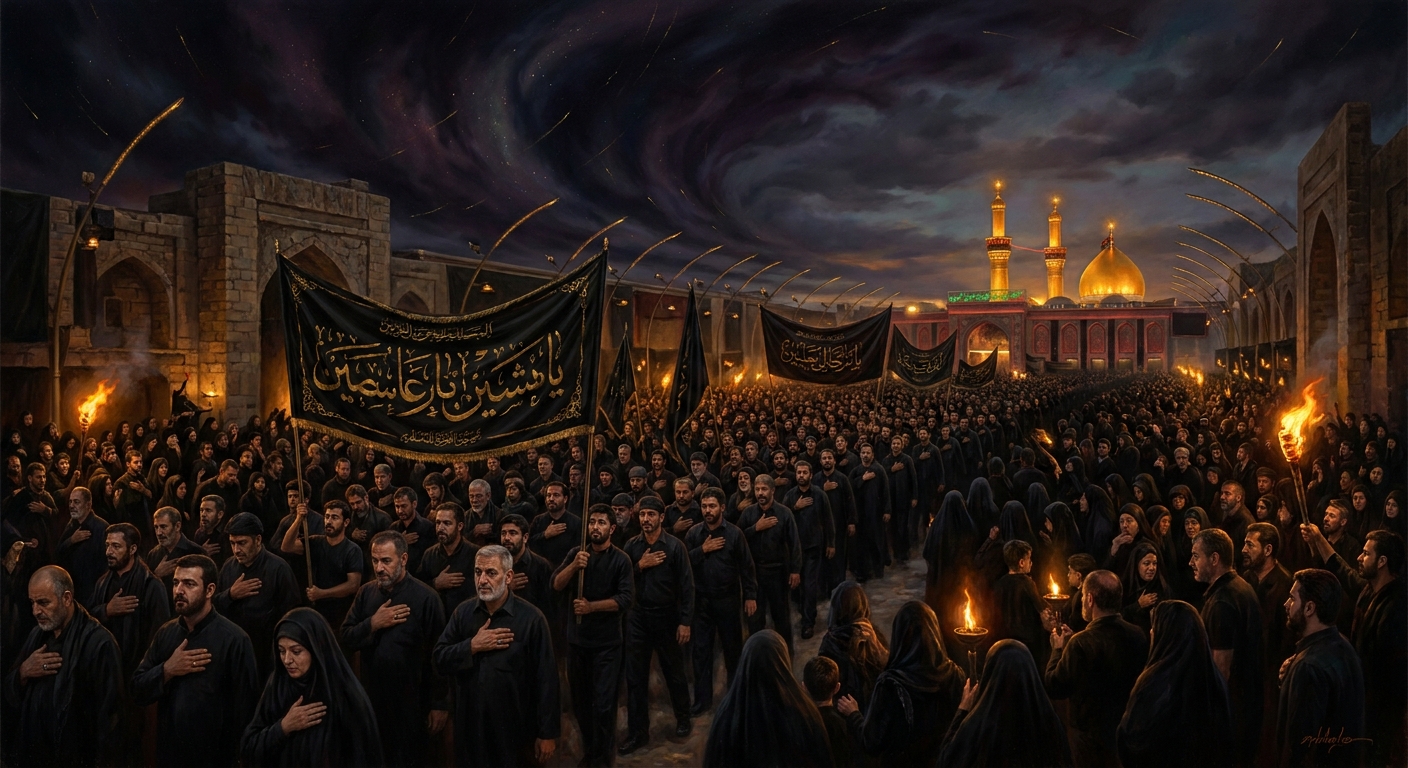
Every year on the tenth of Muharram — Ashura — a hundred million Shia mark this day. In Karbala itself, in Tehran, in Lahore and Beirut and Lagos and Detroit, people fill the streets. There is weeping, chest-beating, the recitation of elegies that have been refined over twelve centuries into some of the most formally elaborate grief literature in any language. There are passion plays — ta’ziyeh — where Husayn’s death is enacted and the audience, which already knows the ending, cries anyway, every year, because knowing does not make it not true.
The chant that rises from these processions is not a lament. It is a statement of principle:
Every day is Ashura. Every place is Karbala.
What happened at Karbala is not disputed. The numbers, the names, the sequence of the dead — Sunni and Shia historians agree on the facts. What is disputed is what the facts mean, and that dispute has never closed.
Husayn knew he could not win the battle. The evidence is in his behavior: releasing his companions from their oaths, carrying his infant son to the enemy lines, fighting alone at the end without apparent expectation of rescue. He was not attempting a military victory. He was performing something — a refusal so complete and so public that it could not be explained away. He was making an argument that would last longer than any army.
It has lasted thirteen hundred and forty-six years. The argument is still open.
Scenes
Husayn ibn Ali makes his last stand on the plain of Karbala, 10 Muharram 61 AH
Generating art… Husayn lifts his infant son Ali Asghar toward the Umayyad lines, asking for water
 Generating art…
 Ashura processions today — from Tehran to Karbala to Mumbai to Lagos — a hundred million people in the streets, chanting: Every day is Ashura
 Generating art…
 Echoes Across Traditions
Entities
- Husayn ibn Ali
- Yazid
- Ali Asghar
- Abbas ibn Ali
- Zaynab
Sources
- al-Tabari, *History* (Tarikh al-Rusul wa al-Muluk), vol. 19
- Ibn al-Athir, *al-Kamil fi al-Tarikh*
- Hossein Nasr, *The Heart of Islam* (2002)
- Mahmoud Ayoub, *Redemptive Suffering in Islam* (1978)
- Heinz Halm, *Shi'a Islam: From Religion to Revolution* (1997)