The Hijra
622 CE · the founding year of the Islamic calendar · Mecca to Medina, via the cave on Mount Thawr
Contents
622 CE. Forty assassins ring the Prophet's house with swords drawn. He walks out invisible, meets Abu Bakr in the dark, and rides north toward a city that will become the first Islamic state. A spider and two doves guard the cave. The calendar begins.
- When
- 622 CE · the founding year of the Islamic calendar
- Where
- Mecca to Medina, via the cave on Mount Thawr
The night of the assassination is a Thursday.
Thirteen years of preaching have reduced Muhammad’s position in Mecca to this: a house surrounded by forty men, one from each of the Quraysh clans, so that the guilt — and the blood feud — will be spread thin enough to survive. Abu Jahl has timed it for just before dawn, when the city is at its most asleep. The plan is sound. The men are armed. The only variable is the man inside.
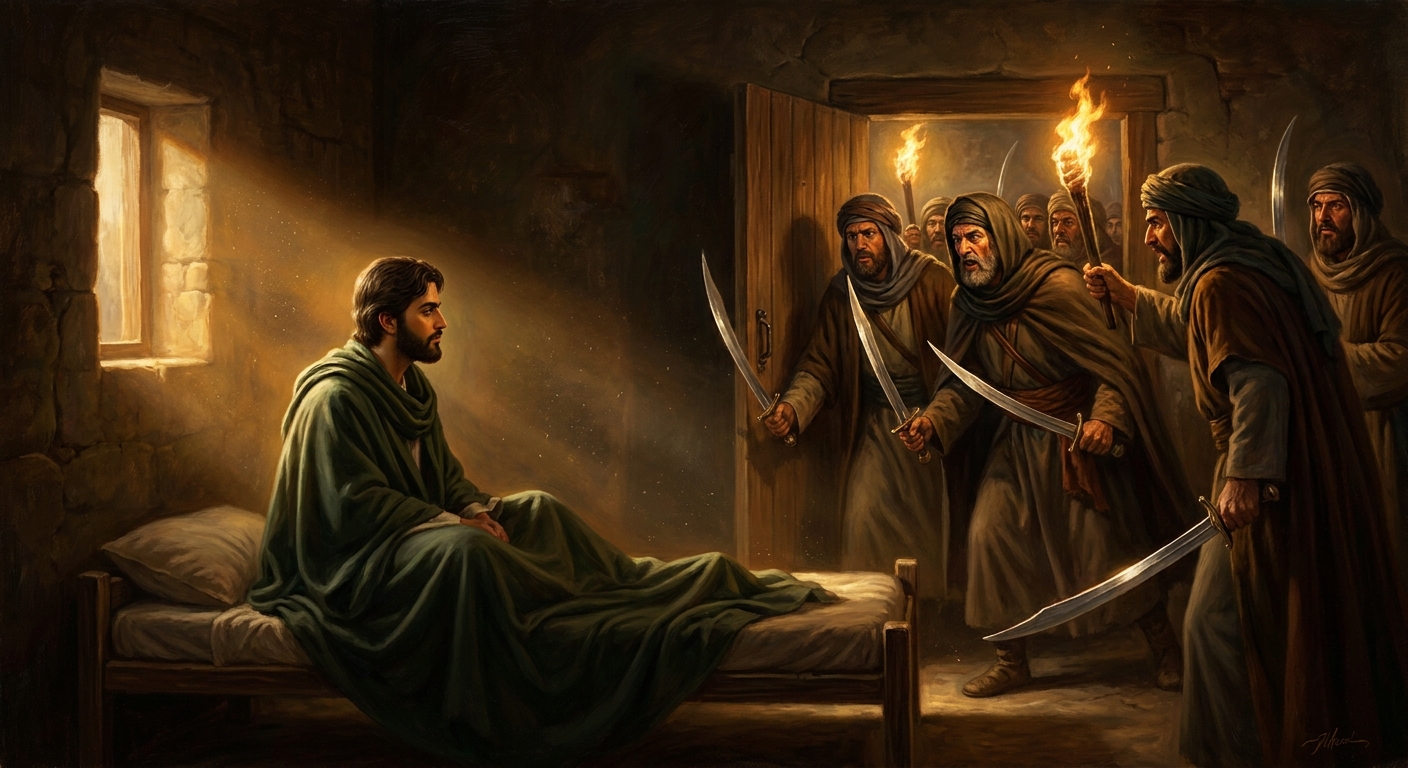
He calls his young cousin Ali into the room. He takes the green cloak from his own shoulders — the same cloak that has marked him for two decades in the marketplace, on the mountain, in the homes of his followers — and he wraps it around Ali’s frame.
Sleep here, he says. Let them see the cloak. They will wait.
Ali lies down in the Prophet’s bed without argument. He is the kind of young man who can be asked to be mistaken for a target, and he agrees. That quality will define his entire life.
Muhammad opens the door.
Forty men and their swords are thirty feet away. He steps into the street, recites a line from the thirty-sixth surah — We have covered them so that they cannot see — and he walks between them. Ibn Ishaq records it with the plainness of a man who was told the story by people who were there: the Prophet moved through the cordon and none of them saw him go. A handful of them are already asleep on their feet. He stoops and takes a handful of dust, recites the opening of the same verse, and scatters it across the ones who are still awake. They blink. They see each other. They do not see him.
Some traditions call this a miracle. Others say it was the dark, the timing, the cloak of an ordinary man moving with ordinary certainty. It is possible to hold both readings. The point the tradition insists on is not the mechanism but the fact: he passed through, and they did not stop him.
Abu Bakr is waiting outside the city, where they had arranged to meet. Two camels. Provisions for a week. He is among the first people who believed in Muhammad when belief cost something, and he is here now at the cost that has finally come due.
They turn south. Not north toward Medina — south, toward the barren mountain that nobody would think to search.
Mount Thawr rises above the Meccan plain like a held breath. The cave in its southern face is low-mouthed, dark, and barely large enough for two men and their fear.
They enter. They wait.
The Quraysh send a search party by dawn. Then another. They fan out across the roads to the north — the logical direction, the direction of Medina and the people who have invited Muhammad to govern their city. Reward money is announced: a hundred camels for anyone who delivers the Prophet back to Mecca, alive or dead. The riders cover the ground fast.
What they do not cover is the mountain to the south.
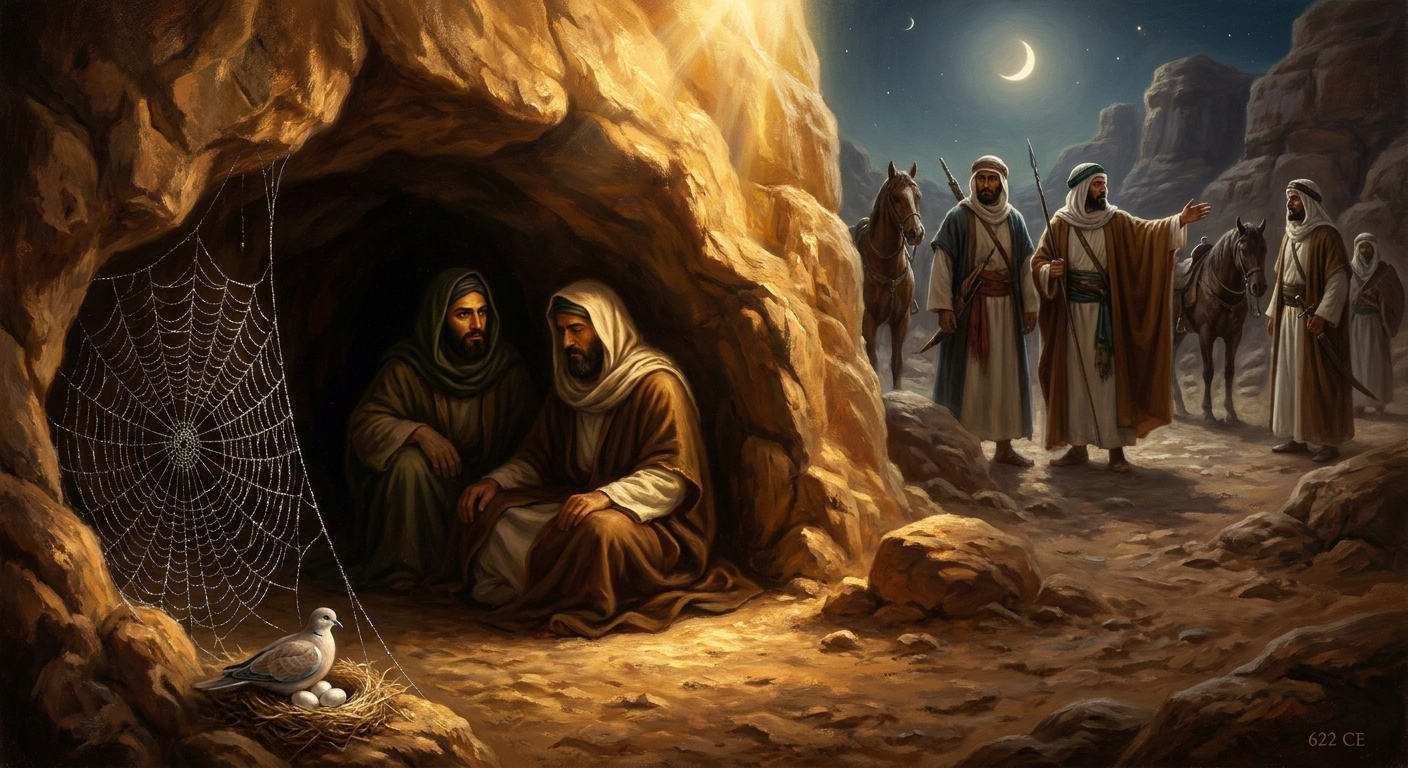
Three days pass in the cave. The tradition records that a spider worked through the night of their arrival and sealed the entrance with a web. Two doves nested at the threshold and laid eggs. When the search party finally sweeps around to Mount Thawr and a man walks to the cave mouth, he sees the web intact, the birds undisturbed, the ground unmarked. No one has entered here, he tells the others. They move on.
Abu Bakr, pressed against the rock, hears the footsteps come and go. He whispers his fear into the dark — there are only two of us — and the Prophet answers him with the line that Quran 9:40 will preserve: Do not grieve. God is with us.
It is not a boast. It is a man in a cave, telling another man in a cave, the only thing that is still true.
On the third night they leave. A guide named Abdullah ibn Urayqit leads them by the coastal route — longer, unmarked, where the search parties are not. Two hundred miles of desert, lava fields, and the kind of silence that presses against the ears. They ride at night and shelter in the heat of the day. The camels carry them with the indifference of camels.
Muhammad has spent thirteen years preaching one God in a city of three hundred and sixty. He has buried his employer, his protector, and his wife in the same year. He has watched his followers tortured in the streets of Mecca, beaten on the sand, pressed beneath stones. He has sent some of them ahead to Ethiopia and some of them ahead to Medina and waited behind as long as waiting was possible.
He is now fifty-two years old, riding through the dark toward a city that has asked for him.
The city receives him as cities receive someone they have been expecting.
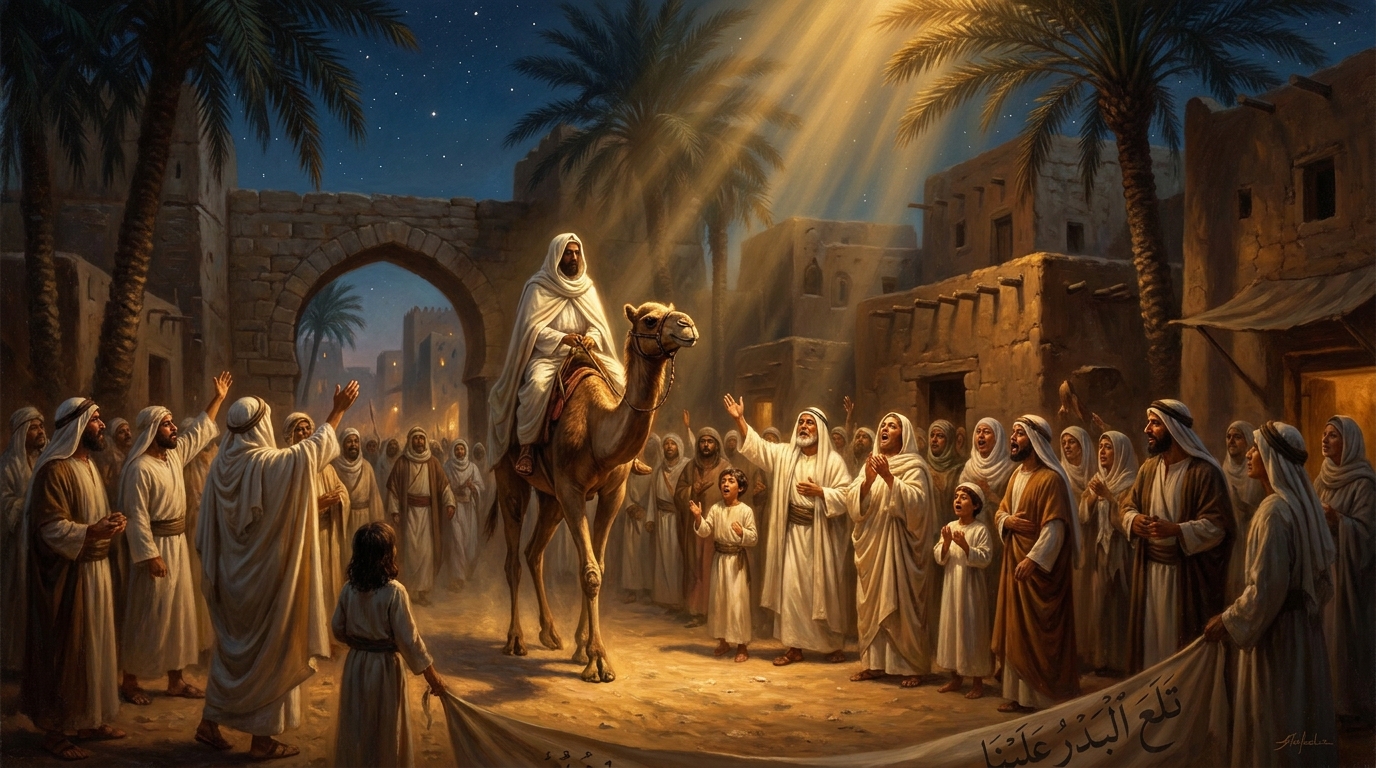
Yathrib — which will spend the rest of history being called Medina, the City, the way Rome is simply Rome — lines its road with people. They have heard he is coming. They do not know when, so they post lookouts each morning. When the party is spotted on the horizon, a boy climbs a rooftop and calls out, and the word moves through the streets faster than the camels.
The women sing. The children crowd the edges of the road. The tribal leaders compete to host him. His camel, tradition says, makes the choice for him: it kneels in the yard of Abu Ayyub al-Ansari, an ordinary man of modest means, and that is where Muhammad stays while his house is built.
He is no longer a preacher appealing to the conscience of a hostile city. He is an invited governor, a mediator, a head of a community that will very shortly become the structure of a state. The Constitution of Medina — the written agreement between the Muslim emigrants, the Medinan converts, and the Jewish tribes of the city — is drafted within months. It is one of the first written governing documents in Arabian history.
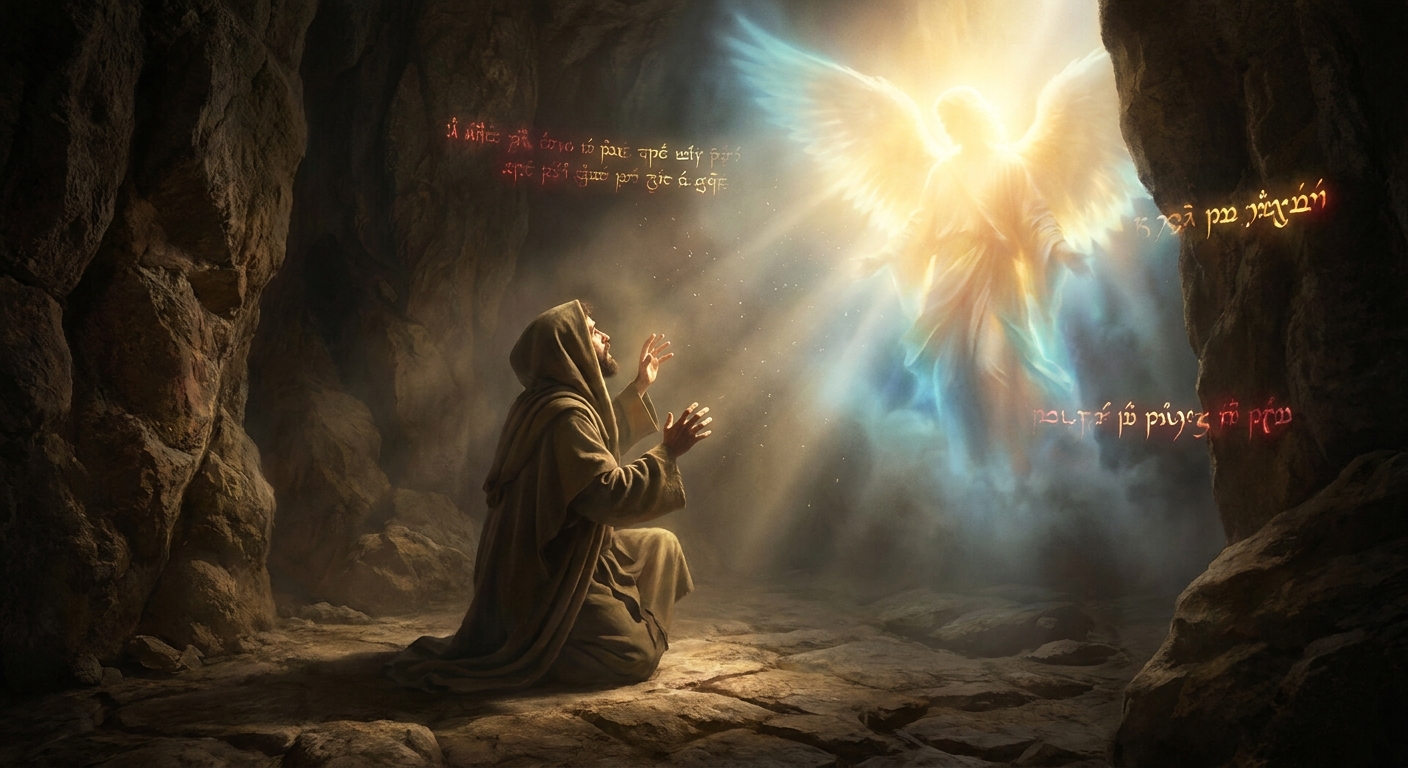
The Islamic calendar begins on the day of the Hijra. Not the day Gabriel first seized Muhammad in the cave on Mount Hira. Not the day he was born. The day he arrived in Medina, trailing dust from a spider’s web, is Day One.
The tradition understands something that is easy to miss: revelation is not the beginning. The beginning is the moment revelation becomes community. The moment the word stops being a voice in a cave and starts being the constitution of a city.
Year One. Anno Hegirae.
The spider has already gone back to its work.
The Hijra is one of the great political acts of the ancient world. A man with no army and no territory converts an invitation into sovereignty inside a single generation. By 630, eight years after he arrived in Medina with a handful of followers and two camels, Muhammad enters Mecca unopposed. The city that tried to kill him opens its gates.
The cave on Mount Thawr is still there. Pilgrims climb to it. The entrance is low, and you have to bow your head to enter — which may or may not be the point.
Scenes
Ali ibn Abi Talib sleeps in the Prophet's bed, wrapped in the green cloak, while forty swords wait outside the door
 Generating art…
 The cave on Mount Thawr, three days into the flight
Generating art… The people of Yathrib line the road into the city
 Generating art…
 Echoes Across Traditions
Entities
- Muhammad
- Abu Bakr
- Ali ibn Abi Talib
- Aisha
Sources
- Ibn Ishaq, *Sirat Rasul Allah* (The Life of the Messenger of God)
- al-Tabari, *Tarikh al-Rusul wa'l-Muluk* (History of the Prophets and Kings)
- Quran 9:40 (the cave)
- Quran 36:9 (the veil between Muhammad and his enemies)
- Reza Aslan, *No God But God* (2005)
- Karen Armstrong, *Muhammad: A Prophet for Our Time* (2006)