The Night Journey
Late Meccan period · c. 621 CE (the Year of Sorrow + 1) · from al-Masjid al-Haram in Mecca, to al-Masjid al-Aqsa in Jerusalem, through the seven heavens to the Sidrat al-Muntaha
Contents
A winged steed waits at the door of the Ka'ba — and Muhammad rides in a single night from Mecca to Jerusalem to the Throne, bargaining the prayers of his people down from fifty to five.
- When
- Late Meccan period · c. 621 CE (the Year of Sorrow + 1)
- Where
- from al-Masjid al-Haram in Mecca, to al-Masjid al-Aqsa in Jerusalem, through the seven heavens to the Sidrat al-Muntaha
He cannot sleep.
It is the year his wife Khadija died, and the year his uncle Abu Talib died, and the year the people of Ta’if drove him out with stones for offering them the message. The Year of Sorrow, the chronicles will call it. He is fifty-one. The Hijra is still a year away. He has nothing — no city, no army, no certainty that the revelation will outlast him by an afternoon.
He goes to the Hijr — the half-circle wall beside the Ka’ba — and lies down on the stone.
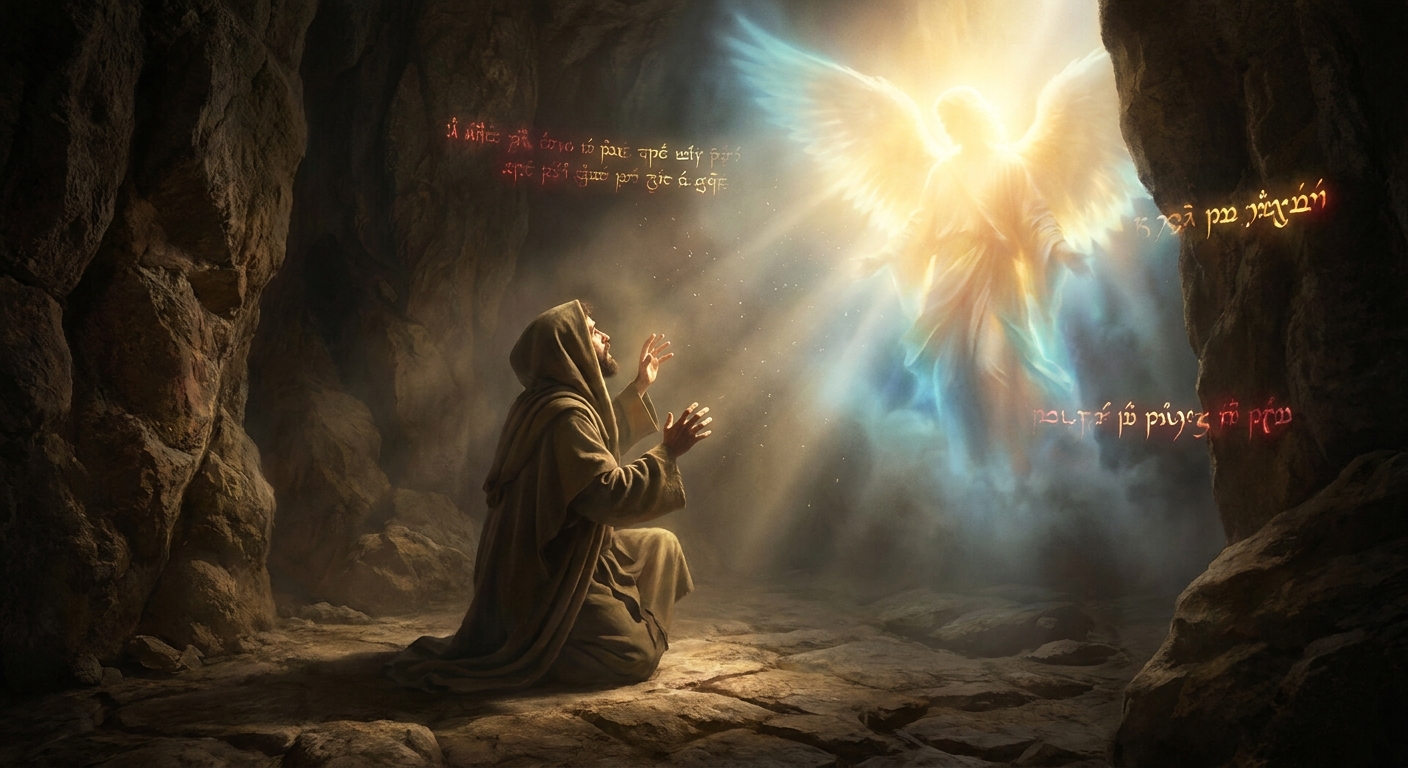
A voice. Then a hand at his shoulder.
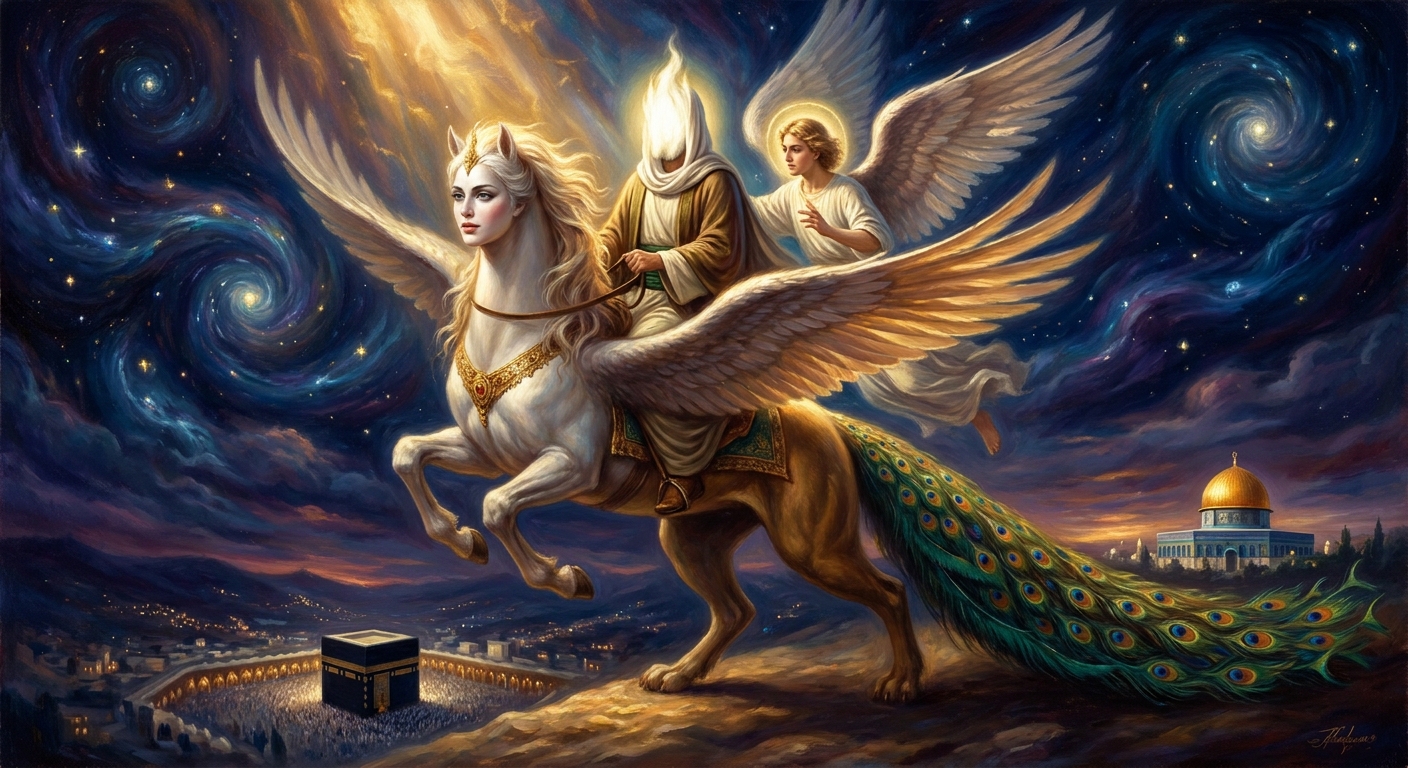
Gabriel — the angel who first squeezed him on Mount Hira until the words came — is standing over him with an animal he has never seen. White. Smaller than a mule, larger than a donkey. Wings folded back along its flanks. A face the chroniclers will spend a thousand years trying to describe and never quite agree on.
Mount, says Gabriel. Tonight you ride.
The steed is named Buraq — the lightning. Each stride lands at the horizon’s edge. They cross the Hijaz the way a thought crosses a face.
They stop, the chronicles say, at four places along the way. At Sinai, where Moses received the Torah. At Bethlehem, where Jesus was born. At a place where Muhammad smells perfume and Gabriel says: That is the grave of the woman who combed Pharaoh’s daughter’s hair, and chose to be burned with her children rather than deny the One God. Sanctity, Gabriel is teaching him, is geographic. The earth remembers.
They arrive at the Holy City before midnight.
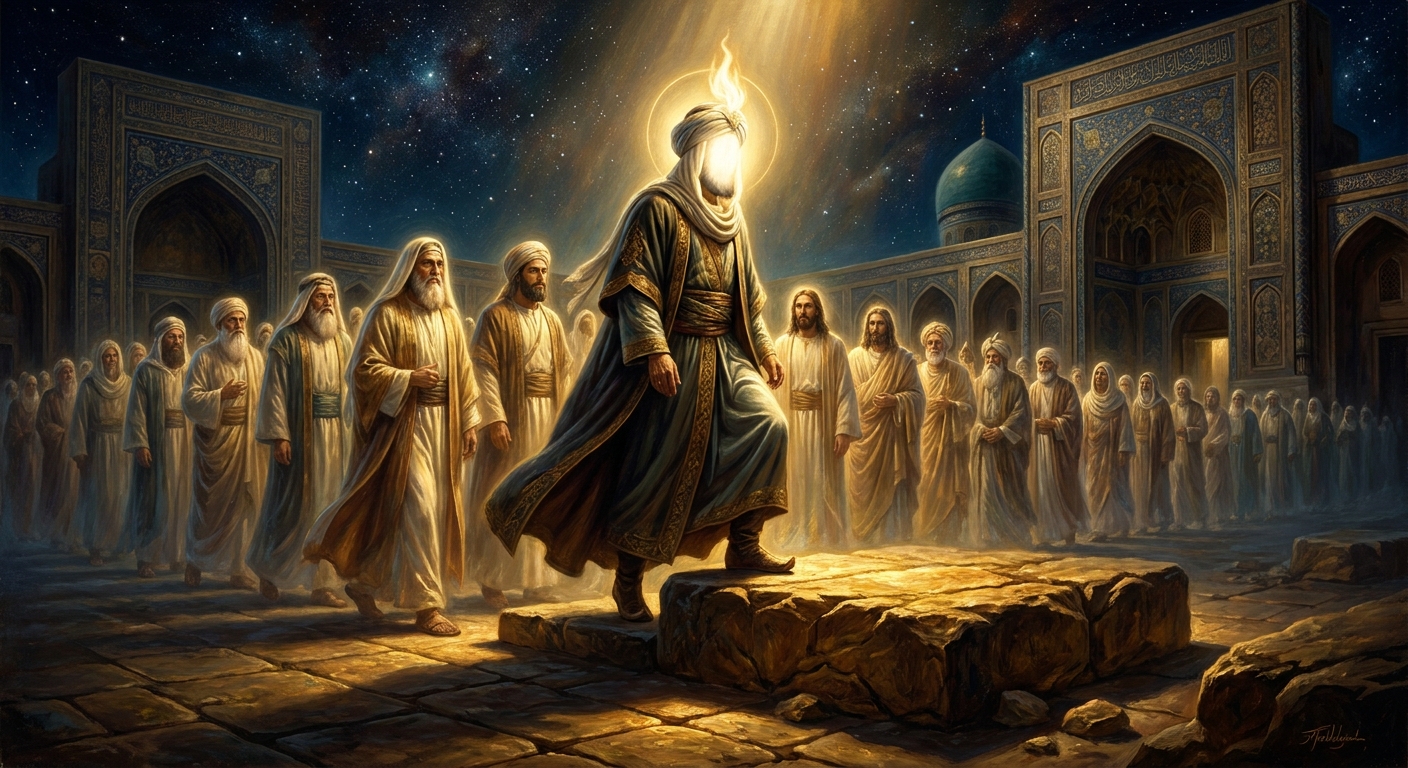
The Temple Mount is dark. The Romans have leveled the Second Temple six centuries ago. There is rubble where Solomon’s columns stood. Buraq lowers a knee and Muhammad dismounts and ties the reins to the ring set in the rock — the same ring, the isra tradition says, where every prophet before him tied his mount when he came to pray.
In the courtyard, the prophets are waiting.
They are standing in rows. Adam at the front, white-haired, taller than any of the others. Abraham beside him, and Moses, and Jesus, and David and Solomon and Noah and the names that fill the genealogies. They are translucent, the way memory is translucent.
Gabriel says: Lead them.
Muhammad steps forward. He calls the iqama. The prophets line up behind him as if behind their own future. He leads them in two prostrations on the Temple Mount, on the rock that David bought from Araunah the Jebusite, on the rock the Talmud calls the Even Shetiyah, the Foundation Stone of the world.
He is now, by this prayer, the imam al-anbiya’ — the prayer-leader of the prophets. The covenant has not been replaced. It has been gathered.
Gabriel brings him three cups: wine, milk, water.
He chooses milk.
You have chosen the fitra, Gabriel says — the original nature, the way you were made before you forgot. If he had chosen wine, the chroniclers add, his community would have gone astray.
Then the rock at his feet begins to rise.
The Mi’raj is not a metaphor in the early chronicles. It is a ladder — mi’raj literally means ladder — and the ladder is real, and the rock is the bottom rung, and the heavens lift him through one ceiling after another the way a diver rises through depths.
The first heaven: silver. The gatekeeper asks who comes. Muhammad, says Gabriel. Has he been called? He has. The gate opens. Adam is sitting there. To his right, the souls of the blessed; to his left, the souls of the damned. He weeps for the left and smiles for the right. He greets Muhammad as a son.
He climbs.
The second heaven, brass: Jesus and his cousin John. The third, pearl: Joseph, the most beautiful of men, the chronicles say, given half of all beauty. The fourth: Idris (Enoch), who walked with God and was no more, for God took him. The fifth: Aaron. The sixth: Moses, who weeps when Muhammad passes. Why do you weep, prophet of Israel? Because a man younger than I am sent after me, and his community will enter paradise in greater numbers than mine.
Moses keeps weeping. The chronicle does not console him. The chronicle simply notes it.
The seventh heaven: Abraham, leaning his back against the Bayt al-Ma’mur, the Frequented House, the celestial archetype of the Ka’ba, around which seventy thousand angels circle every day, and never the same angels twice.
Beyond the seventh, the Lote Tree of the Boundary. Sidrat al-Muntaha. The tree past which no creature passes. Its leaves are like the ears of elephants, says the hadith. Its fruit is like jars of clay. A river of pure water runs at its base, and a river of milk, and a river of wine, and a river of honey.
Gabriel stops. I cannot go further. If I take one step more, I will be consumed.
Muhammad goes on alone.
What happens past the Lote Tree the Qur’an describes in two ways and refuses to describe in any other.
The eye did not turn aside, nor did it transgress. He saw, of the signs of his Lord, the greatest.
The chroniclers are careful. Some say he saw God with his eyes. Some say with his heart. Some say the question is improper. ‘A’isha, his wife, when asked, said: He did not see Him. Whoever tells you he saw Him is lying. Ibn ‘Abbas said the opposite. The community has lived with the disagreement for fourteen centuries.
What is reported, in every chronicle, is the conversation about the prayers.
Pray fifty times a day, he is told. You and your people.
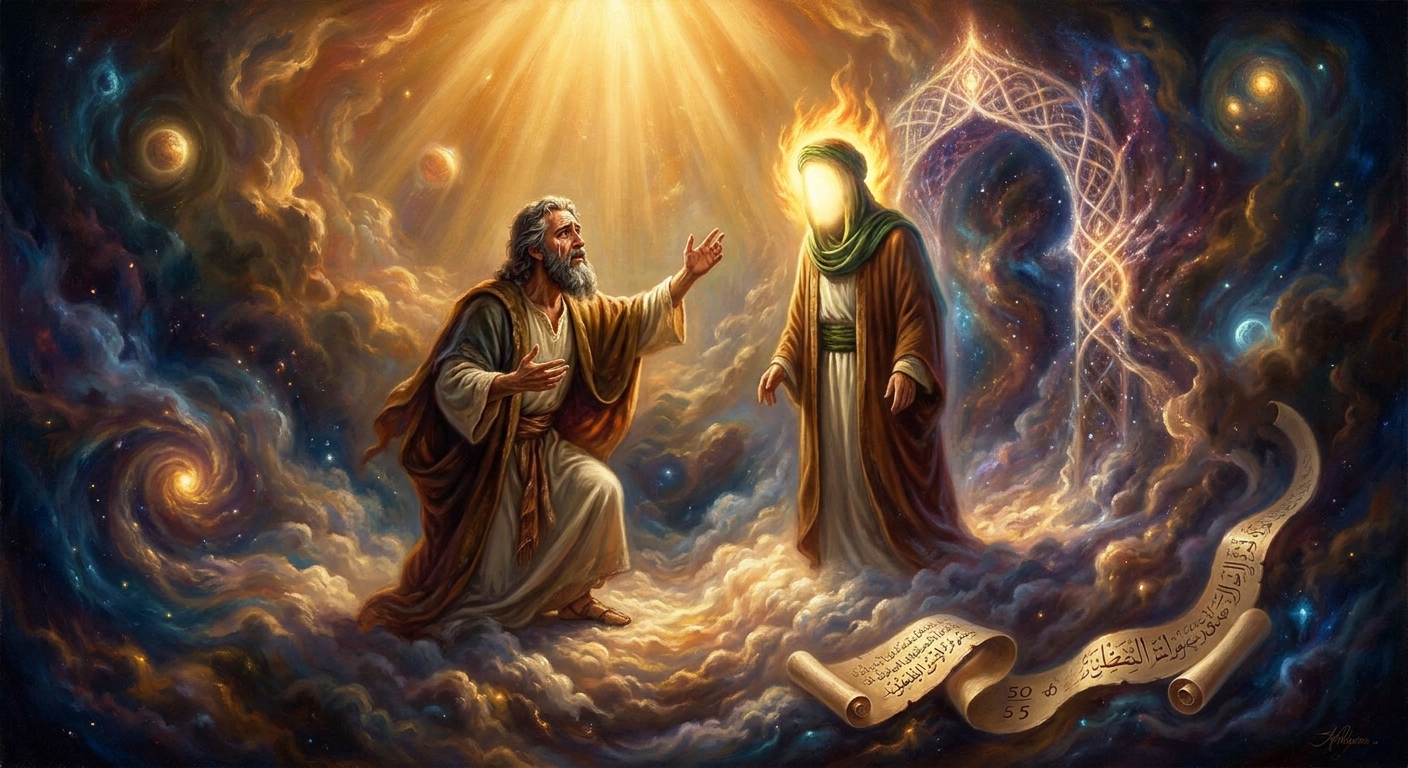
He descends. At the sixth heaven, Moses stops him. What did He give you? Fifty prayers a day. Go back. Your community cannot do fifty. I know — I tried, with mine, and they could not. Ask for less.
He ascends. He asks. It is reduced to forty.
He descends. Moses sends him back.
Thirty. Twenty. Ten.
Each time Moses, weeping for what Israel could not bear, sends him back to bargain again. Each time the prophet who lifted his community out of Egypt is interceding for the community of the prophet who has come after him. The chroniclers love this detail. The two prophets are in this together. The covenant is one covenant.
He returns at last with five.
Moses says: Go back. Even five is too many. I know my people. Yours are not made of harder stuff.
Muhammad shakes his head. I am ashamed to ask again.
A voice from above the Lote Tree: I have made it five. But the reward will be as for fifty. My word does not change.
He returns down the rungs of the ladder. He mounts Buraq. The steed crosses Sinai, the Hijaz, the desert, the night.
He is back on the Hijr beside the Ka’ba before dawn. The bed-stone, says the hadith, is still warm.
In the morning he tells the people of Quraysh. They laugh. They drag him to Abu Bakr — your friend says he went to Jerusalem and back in a night. Abu Bakr says: If he said it, it is true. That sentence earns him the name al-Siddiq — the Truthful — for the rest of Muslim history.
The doubters demand proof. Describe the Holy City. You have never been. He describes it stone by stone. He could have heard descriptions from caravans, the doubters say. Describe the caravan we have not yet seen returning from Syria. He describes it. The caravan arrives, on the day he predicted, with the colors of the lead camel exactly as he said.
Some convert. Some apostatize. The Hijra comes. The community begins.
The Mi’raj is the night that gives Islam its prayer-rhythm and its mystical grammar at the same time. The five salats a day are negotiated in this story. So is the Sufi vocabulary of ascent — every later mystic who climbs the seven heavens, who passes Gabriel at the Lote Tree, who sees with the heart what the eye refuses to turn aside from, is rewriting this night.
The Dome of the Rock will be built over the Foundation Stone in 691. The rock at the center is the rock the ladder rose from. The pilgrims who walk around it walk around the bottom rung of a vanished staircase.
Whether the journey was bodily or visionary is the oldest argument in Islamic theology, and the chroniclers have made peace with not solving it. What is not arguable is the arithmetic. The community prays five times a day. Fifty would have broken them. The Prophet bargained on their behalf in the seventh heaven, and Moses kept sending him back until the load was something a human shoulder could carry.
That is the kind of god, the story says, that the Qur’an is the message of: one whose first communication with the founder of the religion is a negotiation about how much He should ask.
Scenes
Wings folded against the desert sky, the lightning-steed Buraq carries the Prophet at horizon-stride speed across the Hijaz toward the Holy City
Generating art… On the Foundation Stone of al-Aqsa, Muhammad steps forward as imam and the translucent ranks of Adam, Abraham, Moses and Jesus line up behind him in prayer
 Generating art…
 At the threshold of the seventh heaven, Moses with tear-streaked face urges the Prophet up the ladder once more, bargaining the daily prayers down from fifty toward five
 Generating art…
 Echoes Across Traditions
Entities
- Muhammad
- Gabriel (Jibril)
- Buraq
- Adam, Jesus, Moses, Abraham
- the Lote Tree of the Boundary
Sources
- Qur'an 17:1 (*Subhana alladhi asra bi-'abdihi laylan*) and 53:1-18 (*the Lote Tree of the Boundary*)
- Ibn Ishaq, *Sirat Rasul Allah* (~760), trans. A. Guillaume, *The Life of Muhammad* (Oxford, 1955)
- Sahih al-Bukhari, *Kitab al-Salat*, hadith 349; Sahih Muslim, *Kitab al-Iman*, hadith 162-164
- Brooke Olson Vuckovic, *Heavenly Journeys, Earthly Concerns: The Legacy of the Mi'raj in the Formation of Islam* (Routledge, 2005)
- Frederick Colby, *Narrating Muhammad's Night Journey* (SUNY, 2008)