Contents
In a lamp-lit assembly in Basra, the great ascetic Hasan al-Basri preaches on the emptiness of worldly life and breaks a wealthy merchant who cannot stop weeping — and whose question after the sermon becomes the first systematic theology of Islamic voluntary poverty.
- When
- Early 8th century CE
- Where
- Basra, Iraq
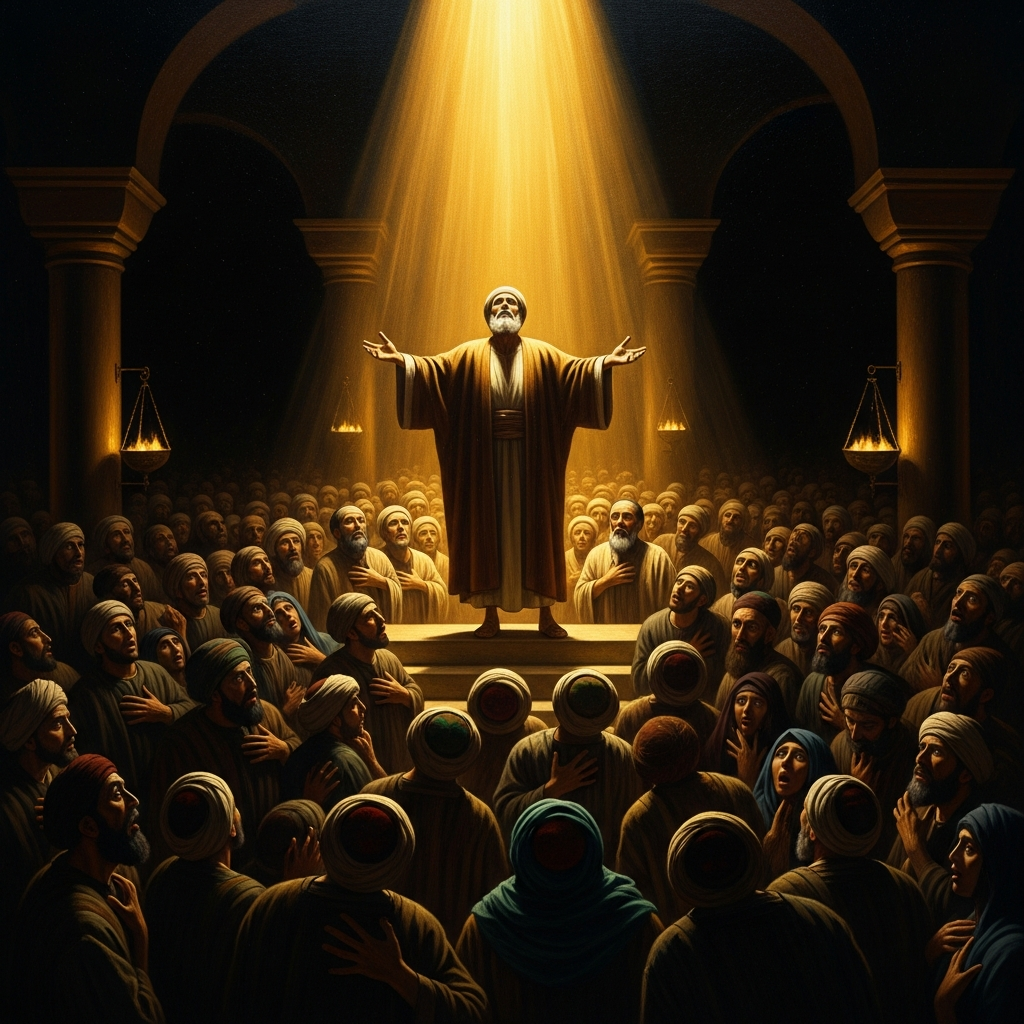
The hall fills before the lamp is lit.
This is how it has been for thirty years in Basra — men arriving early, pressing toward the front, sitting so close together that the heat of their bodies raises the room’s temperature before Hasan al-Basri has said a single word. He is in his late sixties now, born in Medina in 642, a child who knew the Prophet’s Companions personally — who sat at the knee of men who had stood at Badr and Uhud and the Trench. He carries that proximity the way a man carries a family name: with a responsibility he did not choose and cannot put down.
He enters without ceremony. He sits. For a moment he says nothing.
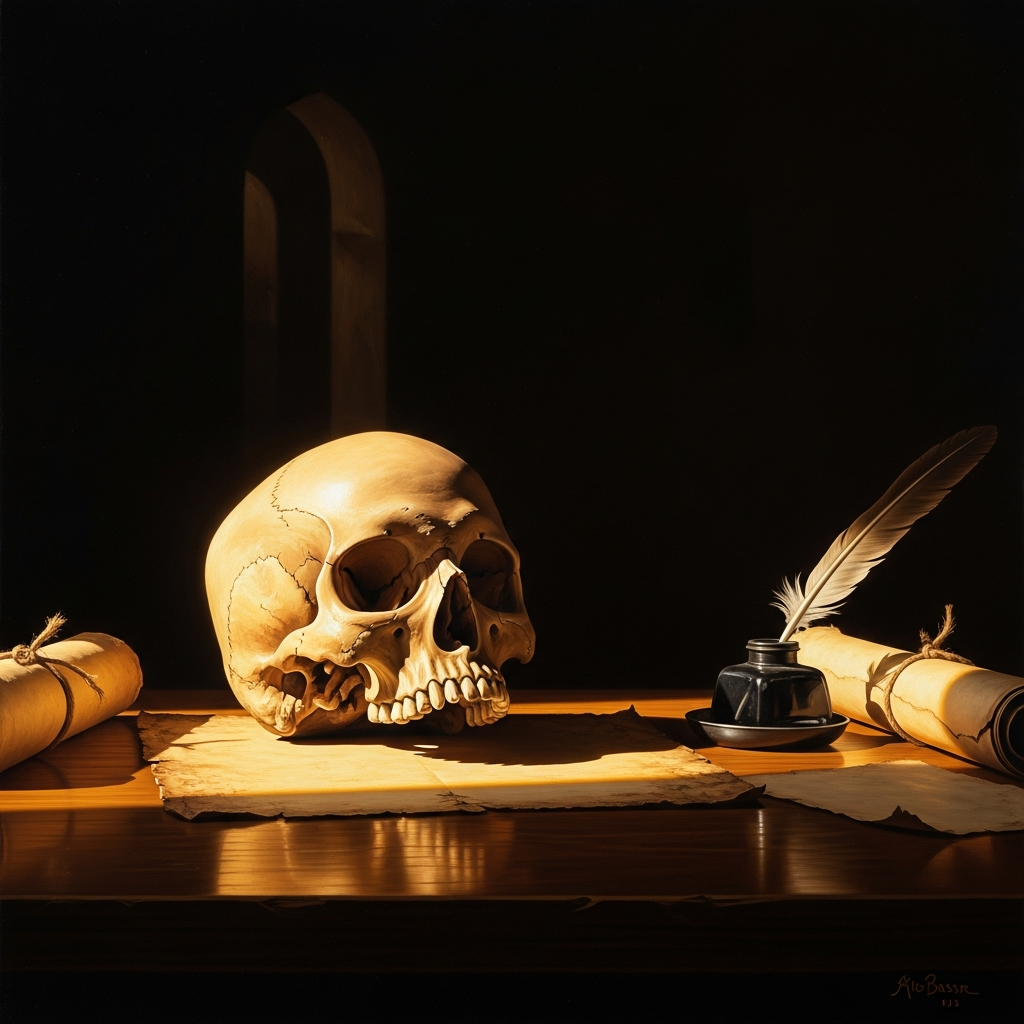
On his writing table at home, he keeps a human skull. Each morning he addresses it directly: You were once what I am. I will be what you are. This is not theater. The skull is part of his epistemology — a tool for knowing the thing the mind perpetually evades.
Tonight he will preach on the verse: The life of this world is nothing but play and amusement. And the home of the Hereafter — that is life, if they only knew. Surah al-Ankabut, 29:64.
He does not begin loudly.
The mistake most preachers make, he has observed, is to open at full volume — as if the soul needs to be startled into attention. What he has learned across decades of assembly is different: the soul needs to be eased into recognizing something it already knows and has been carefully not-knowing. You approach it gently. You let the words land before you push.
He begins with the verse in Arabic. He lets it sit. Then he says:
God does not call the world evil. He calls it play. Think about what play is. Play is real while it is happening. The child who plays is not pretending — his joy is genuine, his grief at losing the game is genuine, the stakes feel total. And then the game ends, and he comes inside, and the stakes are gone. Nothing has changed except the horizon.
Pause. The lamp flames hold their position.
The world is this. Your grief over your losses is real. Your satisfaction in your accumulations is real. God does not say you are lying when you feel these things. He says you are playing a game, and the game will end, and you will come inside.
There is a sound in the back of the hall.
The merchant has been sitting against the rear wall, near the door — the seat a man takes when he is not sure he will stay for the whole thing. He came because his business partner dragged him, and because Hasan’s reputation is not the kind a man in Basra can entirely ignore. He is prosperous. He has a large house, a fleet of river boats, a wife and four children, a respectable number of slaves. He gives to the poor at the required intervals. He fasts during Ramadan with something close to sincerity.
He is not prepared for this particular verse, on this particular evening, in this particular voice.
The sound he makes is not weeping exactly — it is the sound a man makes when something has punctured a pressure he did not know was pressurized. He presses his hand over his mouth. The men around him glance at him and then look away, the way people look away from genuine distress.
Hasan continues. He speaks about the nature of accumulation — how every dirham a man acquires adds weight, not lightness; how the wealthy man is not freer than the poor man but more encumbered; how the caravans passing through Basra carry not goods but attachment, and the attachment is what makes the journey long. He speaks without anger, without accusation. His tone is the tone of someone describing something he sees clearly and wants you to see too.
The merchant is weeping fully now. He is past the point of suppression.
The assembly closes. The lamp is not extinguished — someone always forgets. The men file out into the Basra night, debating quietly in the way that people debate after sermons, which is to say they have received something large and are discussing smaller pieces of it they can hold.
The merchant does not leave.
He stays in his corner until the hall is empty, then makes his way to where Hasan is still seated, collecting his thoughts or perhaps simply sitting, which is sometimes the same thing. The merchant’s face is wet. He is not embarrassed. He is past embarrassed.
He says: What do I do with my wealth?
He does not say: Should I give it away? He does not say: How much should I give? He asks the first question, which is the harder one.
Hasan looks at him for a moment.
He says: The question is not what you do with your wealth. The question is what your wealth does with you.
What follows is not recorded as a single conversation but as a series of sessions — the merchant returns, and Hasan speaks to him over weeks. What emerges from those sessions, and from what students like Malik ibn Dinar and Ayyub al-Sakhtiyani preserve afterward, is something more structured than sermon:
The world is not to be destroyed. The body needs what it needs. The question is not annihilation of having but annihilation of grasping — the specific movement of the heart that treats what it holds as necessary to its survival, that panics at the prospect of loss, that shapes its prayers around preservation rather than gratitude.
The merchant who holds his wealth with an open hand — who knows, in his chest and not just his intellect, that it is borrowed and will be returned — is freer than the merchant who clings, regardless of the sum involved. And the man who can hold it open-handed without holding it at all is freer still.
Voluntary poverty, Hasan tells him, is not an instruction for everyone. It is the path for those for whom attachment is so total that the only surgery is removal. For those with subtler attachments, a different discipline — more difficult in some ways, because the subtlety itself conceals the grasping.
The merchant asks: How do I know which I am?
Hasan says: Ask yourself what you would do if it were taken tomorrow. Whatever your body does in the first three seconds before your theology catches up — that is the answer.
The merchant does not strip himself of his wealth that night. This is not a story about dramatic renunciation. He becomes something rarer: a wealthy man who held his wealth differently, who reoriented his boats and his house and his four children around a different center of gravity. He becomes a student, and he becomes known in Basra for a generosity that is not the generosity of a man reducing his surpluses but the generosity of a man who genuinely does not believe the surplus is his to begin with.
Hasan al-Basri dies in 728 CE, at eighty-six, having never accepted payment for preaching, never moved into a larger house, never dressed in silk. He kept the skull on his desk until the end. His student Malik ibn Dinar inherits it — or the idea of it — and places his own skull on his own desk in his own city, and teaches students who place skulls on their desks in theirs.
The skull is not morbidity. It is methodology. It is the object that makes the one true abstraction concrete: you are going to die. This is the beginning of thinking clearly.
The tradition that flows from Hasan al-Basri is vast and contentious — ascetics and mystics and theologians all claim his lineage, as if he were a river whose source different cities wish to call their own. What they agree on is the quality of his attention: he paid more attention to the gap between what people claimed to believe and how they actually lived than any preacher of his generation. He made his audiences uncomfortable not with hellfire but with precision.
The weeping merchant is not named in the sources. He is every person who came to the assembly planning to listen and found themselves instead recognized — caught in the act of the very thing they had been carefully not-examining. Hasan al-Basri did not invent Islamic mysticism. He created the conditions under which a person might genuinely want what it offers: not paradise as reward but presence as a way of living, right now, in Basra, before the lamp goes out.
Scenes
The lamp-lit assembly in Basra: Hasan al-Basri speaks and the audience, which came prepared to listen, finds itself instead unable to breathe
 Generating art…
 A wealthy merchant in the back of the hall begins to weep during the recitation of the verse on play and amusement — and cannot stop when the others have gone home
 Generating art…
 On Hasan al-Basri's writing desk in Basra sits a human skull, its empty orbits addressed each morning with the same question: what did you know that I still do not?
 Generating art…
 Echoes Across Traditions
Entities
- Hasan al-Basri
- Malik ibn Dinar
- Ayyub al-Sakhtiyani
Sources
- Ibn al-Jawzi, *Sifat al-Safwa*
- Farid al-Din Attar, *Tadhkirat al-Awliya* (Memorial of the Saints), ~1220
- Annemarie Schimmel, *Mystical Dimensions of Islam* (UNC Press, 1975)
- Christopher Melchert, *Ahmad ibn Hanbal* (2006) — background on early Islamic asceticism
- Ahmet Karamustafa, *Sufism: The Formative Period* (Edinburgh, 2007)