Elegba and the Road That Exists Only When He Walks It
c. 700 CE–present (Yoruba orisha, active) · Lagos, Nigeria; the crossroads as theological location
Contents
Eshu/Elegba/Legba, the trickster orisha who opens and closes all roads, finds a devotee at a crossroads in Lagos who must choose between two futures and cannot choose either. Elegba offers not a solution but a reframe: the road is not the destination. The choice is not between roads. The choice is how you walk.
- When
- c. 700 CE–present (Yoruba orisha, active)
- Where
- Lagos, Nigeria; the crossroads as theological location
There is a woman standing at the crossroads of Ikorodu Road and a smaller road with no sign, in the hour after noon when the heat in Lagos presses down like something with weight and intention. She has been standing here for forty minutes. She knows which direction she came from. She does not know which direction to go.
The choice is not abstract. The choice is: her mother’s house, where her mother is dying and needs her and will need her for the months of dying that remain, and where the job in London that she has waited four years for will expire if she is not there in two days to sign the contract. London left. Mother stays. Stay means the job expires. Go means she is not there.
She has been standing at the crossroads for forty minutes because she is not stupid and she knows that neither option is wrong and neither option is survivable in the way she needs it to be, and she has been praying to Elegba because this is what you do when the road closes, and the road has closed.
Elegba is the youngest and the oldest. This is one of his contradictions, and he has many contradictions, and the contradictions are the theology.
He is depicted as a child — small, mischievous, laughing, with a hooked staff and sometimes a candy and sometimes a coin — because he is the principle of possibility before it solidifies into fact. A child can still go anywhere. A child’s roads are still open. He is also depicted as an ancient man, bent under the weight of a staff that is also the spine of the world, because he has been at every crossroads since the first crossroads, which is to say since there were roads at all, which is to say since human beings began going places and choosing between directions and needing an orisha to open the path.
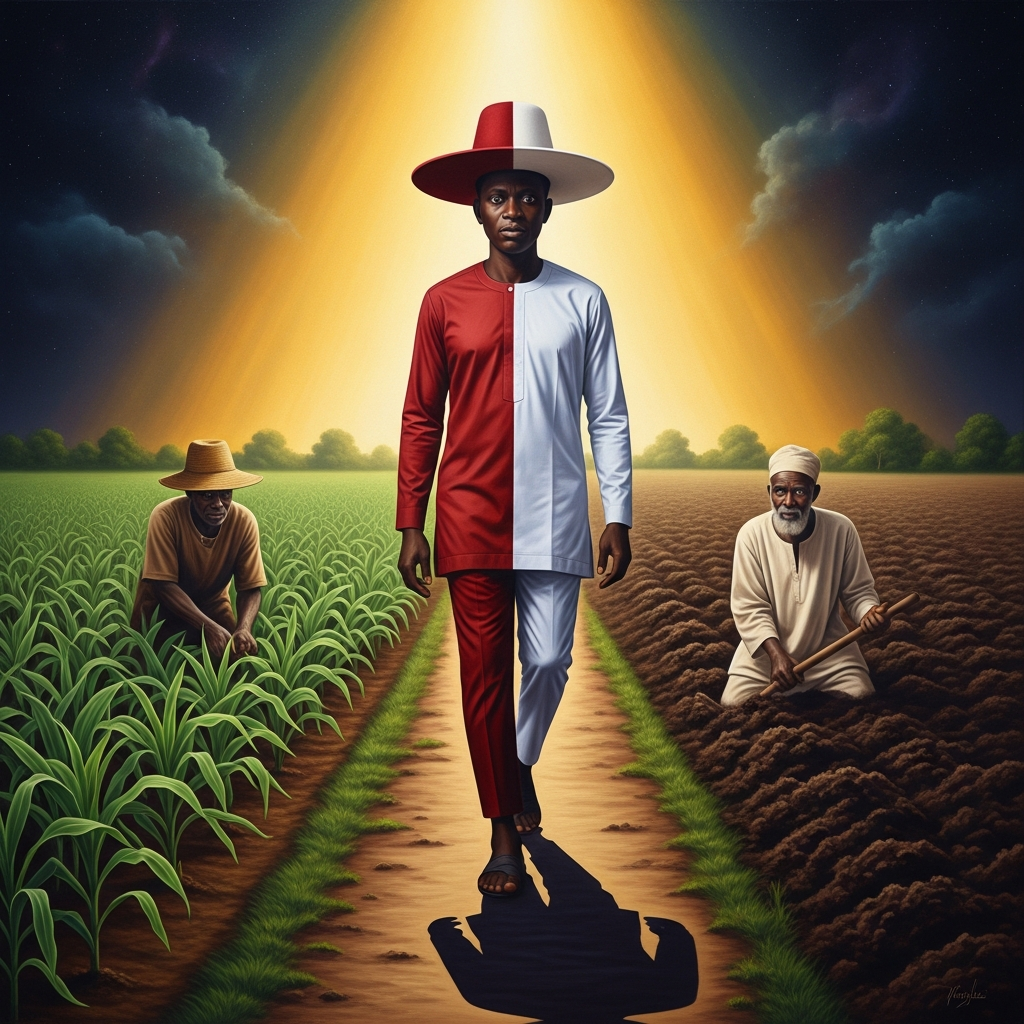
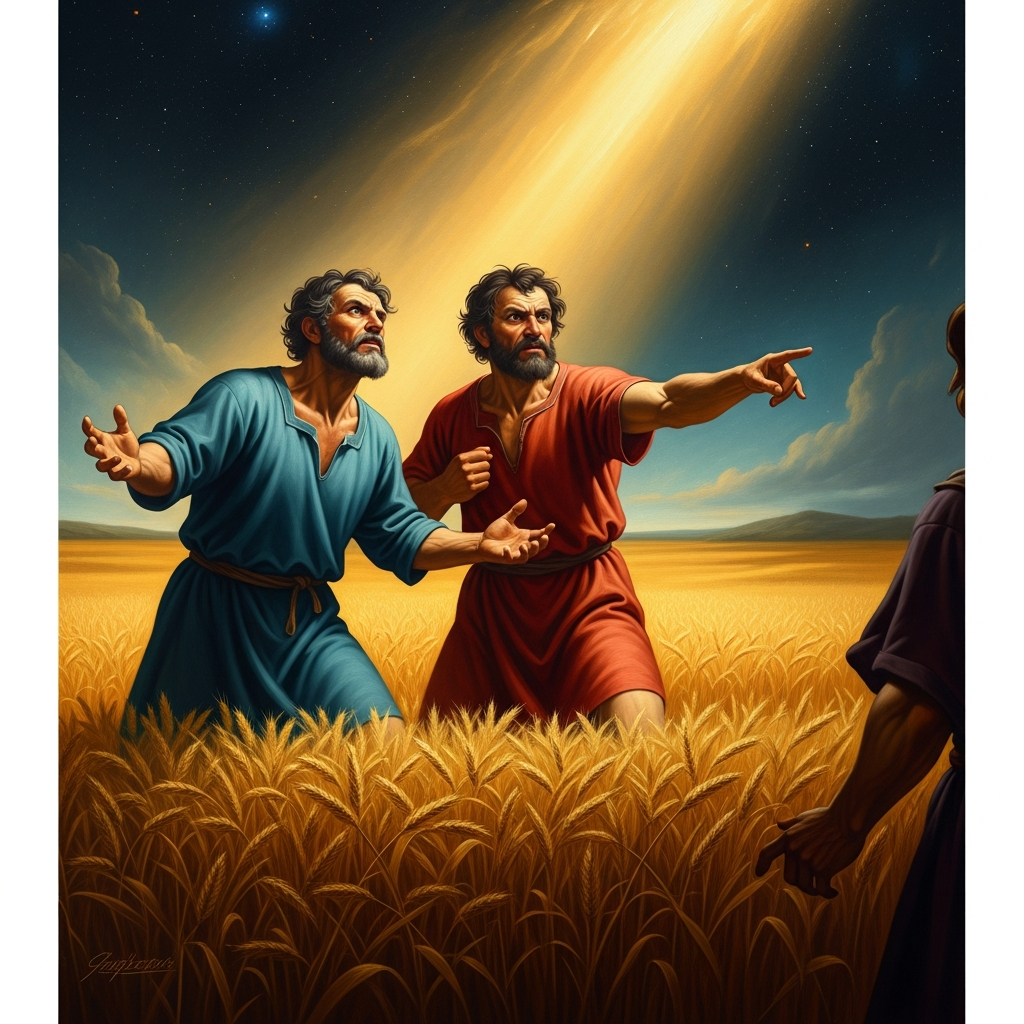
He wears a hat that is red on one side and black on the other. The famous story: he walks between two farmers, and one farmer says to the other, did you see the man in the red hat? The other farmer says, what red hat, it was black. They argue. They nearly come to blows. Elegba comes back — he always comes back, he is always circling the crossroads — and shows them both sides of the hat and laughs. Not at the farmers’ stupidity. At the structure of the situation, which is that both farmers are completely correct and completely right and also completely certain in a way that has nothing to do with truth.
This is the trickster function in Yoruba theology: not deception, but the demonstration that reality has more than one side, and that the side you are standing on does not exhaust the information available.
The woman at the crossroads does not hear him before she sees him. This is also one of his characteristics. He is there when you are not looking and then he is simply there when you are, and there is no transition you can point to.
He looks, today, like a young man in a yellow shirt with a stick he is using to draw something in the dust at the edge of the road. He does not look up. He says: you have been here a long time.
She says: I cannot choose.
He says: between which things?
She explains. He listens in the particular way of someone who has heard this before, which he has — every version of this before. The job or the family. The staying or the going. The duty to the future or the duty to the present. He listens, and then he says: you are asking the wrong question.
She says: what is the right question.
He says: what does it mean to walk the road honestly.
Elegba is the first orisha invoked in every Yoruba ceremony. Before Orunmila, who governs wisdom and divination. Before Shango, who governs thunder and justice. Before Yemoja, before Oxum, before Ogun with his iron and his clearing. Before any of them, the ceremony invokes Elegba, because without Elegba opening the road, nothing else can happen. The path is closed. The ceremony cannot begin. The orisha cannot arrive.
He is not the most powerful. He is the one who makes power possible. He is the hinge, the threshold, the gate that swings — not toward one destination or another, but from the state of being locked to the state of being open. The opening is his gift. The destination is yours.
This is the theology the woman at the crossroads is missing. She thinks the crossroads is the problem — that she is stuck because there are two roads and she can only take one. Elegba thinks the crossroads is the location, which is different from being the problem. You cannot get to either road from a place that is not a crossroads. The crossroads is where you have to be in order to go anywhere at all.
What does it mean to walk the road honestly? It means: whichever road you walk, walk it as someone who made a real choice and accepted the real cost. Not as someone who took the only option. Not as someone who had no choice. Not as someone who went to London because the dying was too hard to watch, or who stayed in Lagos because the job was too frightening to take. As someone who looked at both roads and said: I am walking this one. I accept what it costs. I am not going to spend the rest of my life on this road looking at the other one.
Elegba does not tell her which road. He does not have a preference. He is not the orisha of good outcomes. He is the orisha of open roads, and both roads are open, and both roads are real, and the road she walks will be real in proportion to how honestly she walks it.
He finishes drawing in the dust. She looks down. It is a crossroads sign — the Yoruba vévé, the vertical and horizontal lines, the same mark you put on altars and doors and thresholds to indicate that Elegba has been here, that the path is open.
He says: go or stay. He says: go and be completely there. Stay and be completely here. He says: the road does not exist until you walk it, and it will be what your walking makes it.
He stands up from the dust. He tucks the stick under his arm. He walks past her, up the road she has not yet chosen, and then he is not there anymore in the way that he was not there before she saw him — simply gone, the space where he was indistinguishable from the space that was always there.
She stands at the crossroads for three more minutes. Then she walks.
The road she walks opens in front of her as she walks it. This is not a metaphor. This is what Elegba’s theology means: the road exists in the walking. The destination is not there yet. It is being made by the fact of her feet on the ground, choosing her with each step as she chooses it.
There is no correct crossroads choice. This is the first thing Elegba teaches and the last thing people believe. The crossroads is not a test with a right answer. It is a location where the roads are visible — both of them, all the sides of the hat at once — and the teaching is that you can see both and still walk, that seeing both does not have to mean paralysis, that the trickster orisha who shows you both sides of the hat is not mocking you but offering you the most honest thing available: the knowledge that the road you choose will be real because you walk it honestly, and the road you did not choose will be real somewhere else, in the life of the person you did not become, and both of those people will have been you, and only one of them is yours to walk.
Scenes
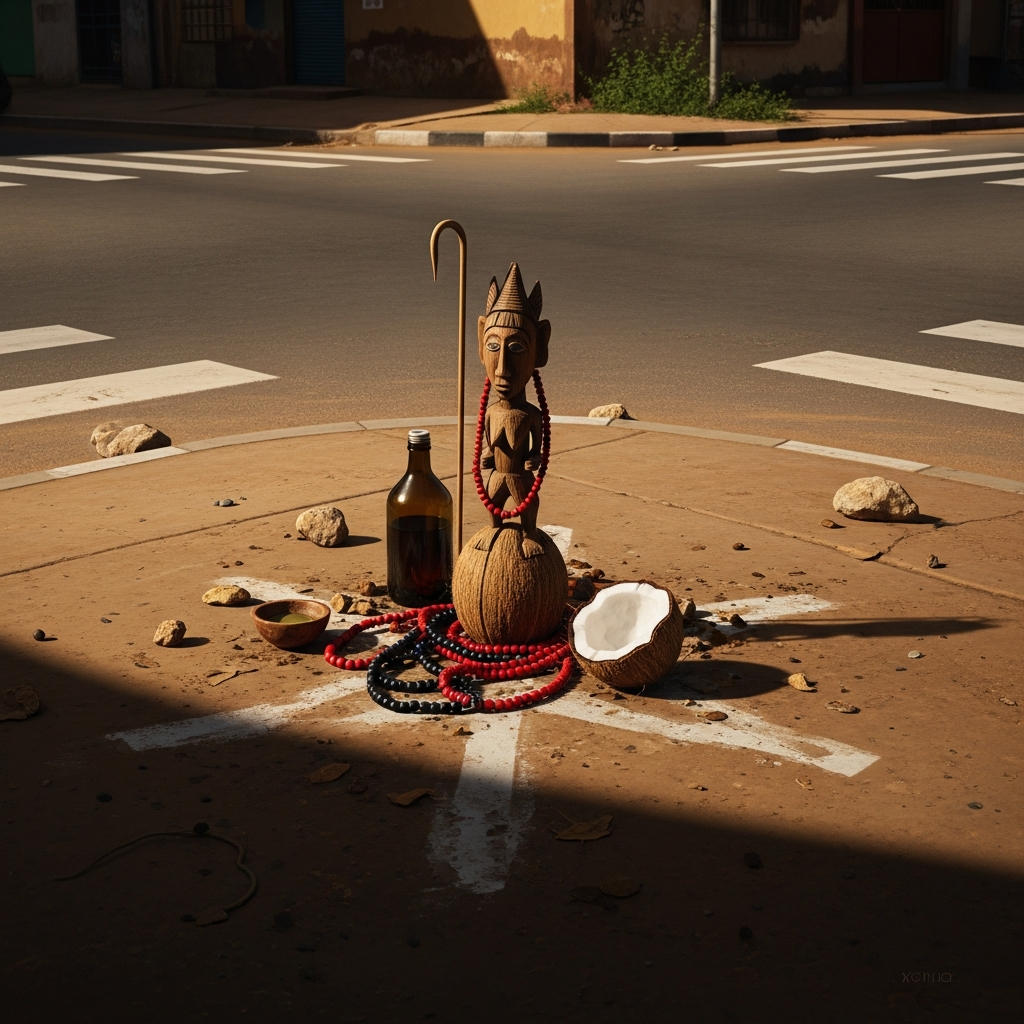
A crossroads in Lagos at midday, the intersection of two dusty roads marked by a small shrine: a carved wooden figure with a hooked staff, surrounded by palm oil offerings, red and black beads, a coconut cracked open at its base
 Generating art…
 The myth of the two farmers: two men in a field disputing furiously over what color the stranger's hat was
 Generating art…
 Elegba as a child — the aspect he sometimes wears, small and mischievous, with a lollipop and a coin and an enormous laugh
 Generating art…
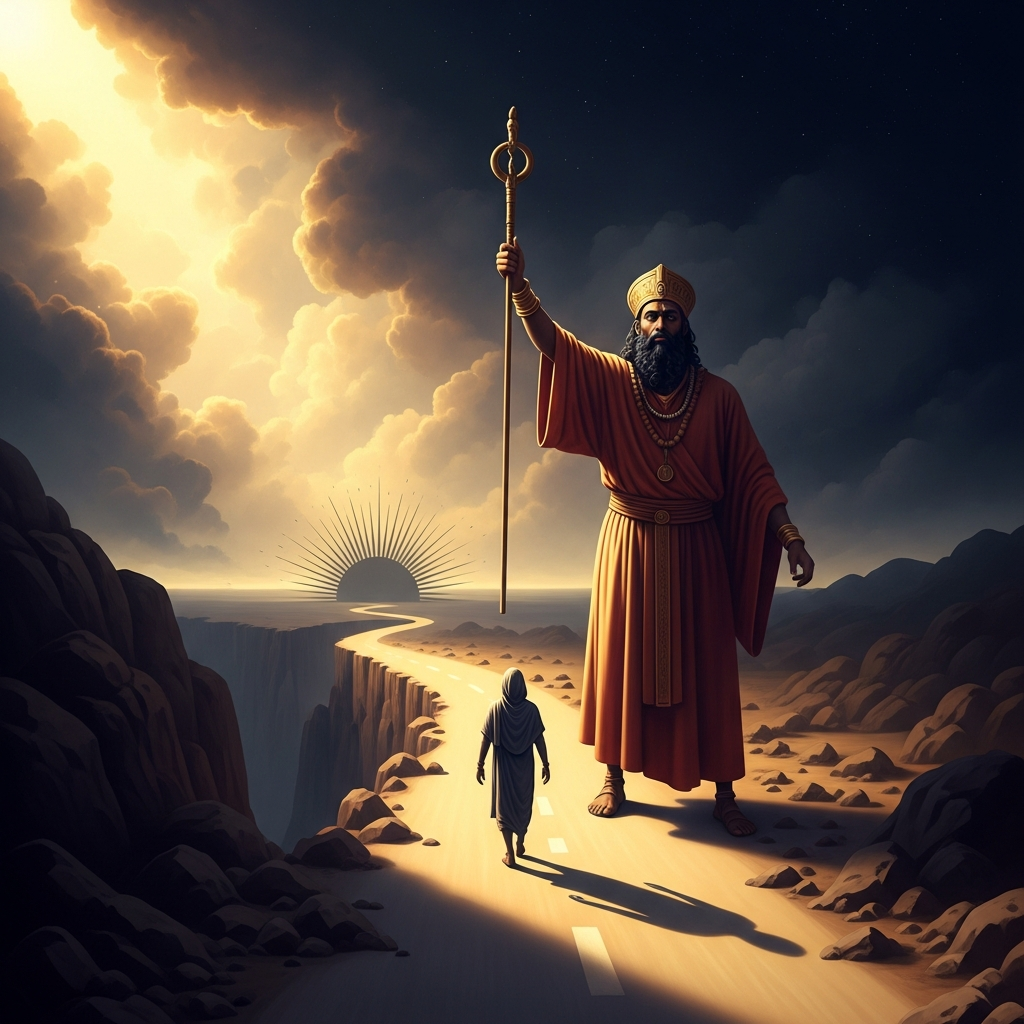
 Elegba at the moment of opening: his staff raised, and ahead of him the road that was not there a moment ago — not a new road but a road that was always there, revealed
 Generating art…
 An Elegba shrine at dusk: the small clay figure with cowrie eyes, the rooster feathers, the palm oil and corn liquor poured into the red soil
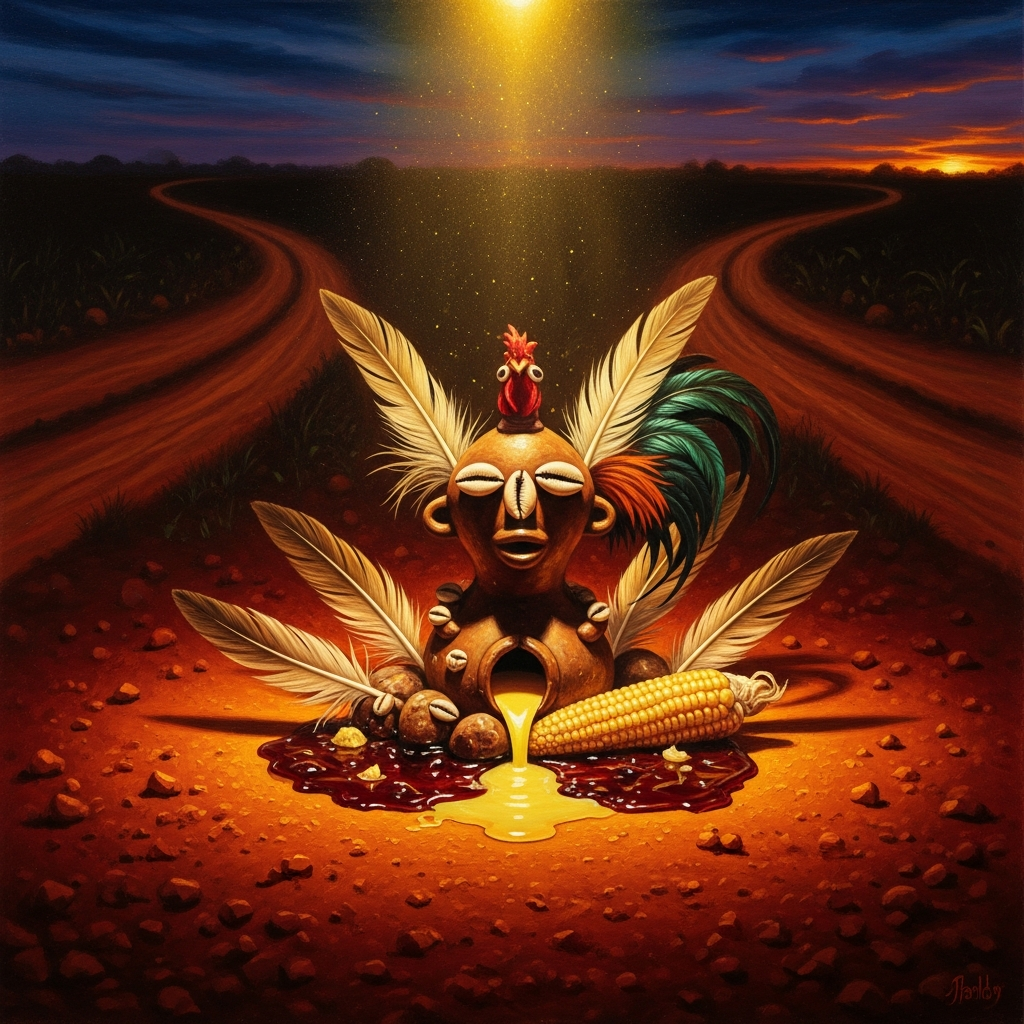 Generating art…
 Echoes Across Traditions
Entities
- Elegba
- Eshu
- Legba
- Orunmila
Sources
- Robert Farris Thompson, *Flash of the Spirit: African and Afro-American Art and Philosophy* (Random House, 1983)
- John Mason, *Orin Orisa: Songs for Selected Heads* (Yoruba Theological Archministry, 1992)
- Henry Louis Gates Jr., *The Signifying Monkey: A Theory of African-American Literary Criticism* (Oxford University Press, 1988)
- Rowland Abiodun, *Yoruba Art and Language: Seeking the African in African Art* (Cambridge University Press, 2014)
- Wande Abimbola, *Ifa: An Exposition of Ifa Literary Corpus* (Oxford University Press, 1976)