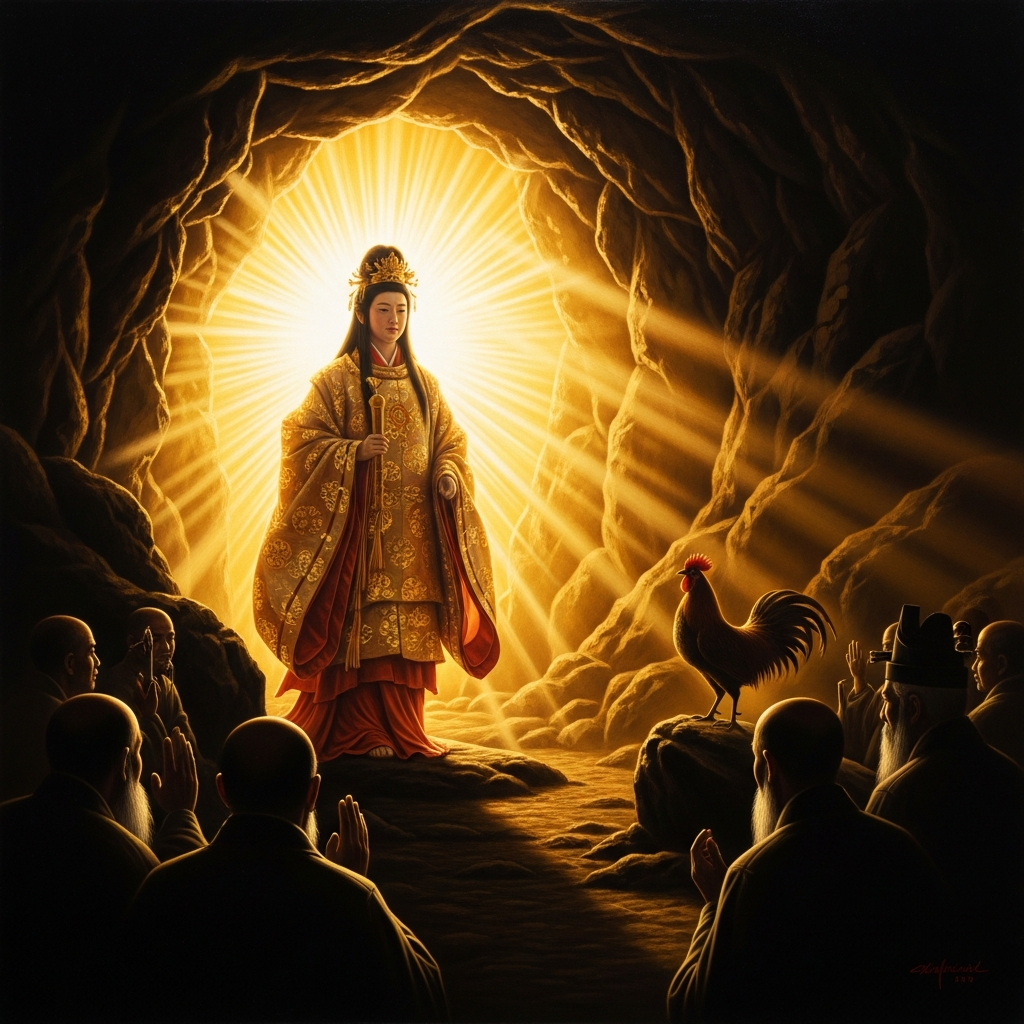
The Weight That Leaves the Body
8th century CE, Nara Period; ritual origin in mythic time, purification prayer codified ~702 CE · Nara, Japan; the Kamo River; the place where river meets sea
Contents
The Great Purification — Oharae — is performed twice a year across Japan: paper dolls absorb ritual pollution, and a river carries them to the sea-swallowing god who dissolves them. A woman in 8th-century Nara carries the contamination of her husband's battlefield death and discovers, in a single ritual act, that pollution is real and its removal is mechanical. It does not require belief. It requires participation.
- When
- 8th century CE, Nara Period; ritual origin in mythic time, purification prayer codified ~702 CE
- Where
- Nara, Japan; the Kamo River; the place where river meets sea
The word for pollution in Shinto is kegare.
It does not translate well. Pollution is too industrial. Impurity implies a moral failing. Sin carries the weight of intention. Kegare is none of these exactly — it is more like a residue, an invisible accumulation, the spiritual equivalent of what accrues on a surface that has been in contact with the edges of life and death. Childbirth creates kegare. Death creates it, and contact with the dead, and contact with the dying. Certain crimes create it. Failure — certain kinds of failure, the kind that breaks what was supposed to be whole — creates it. It is not guilt. Guilt lives in the interior of a person and requires confession and contrition to dissolve. Kegare lives on the surface of a person, the way dust lives on a surface, and it requires exactly what dust requires: removal.
This is the theology that the Oharae ritual enacts. It is performed twice a year — the last day of the sixth month and the last day of the twelfth — by imperial decree, across the entire country. Every priest participates. The Emperor himself participates. And the mechanism is specific: a paper doll, a river, and a deity at the place where the river meets the sea who is very good at dissolving what arrives there.
Her name is Masako. This is a name, not a title — she is not a priestess or a court lady of rank; she is a woman whose husband served in the provincial army and did not come back from the fighting in the north, and the news came in the seventh month, which is the wrong month for this kind of news because the summer Oharae was already past and the winter one is still five months away.
The kegare of death does not wait for the ritual calendar. It arrives with the news, settles immediately, and Masako carries it through the summer and into the autumn the way you carry a weight that you cannot put down because there is nowhere to put it and no one to take it from you. She is not paralyzed by it — she manages the household, feeds the children, maintains the domestic Shinto altar — but there is a quality to the months after the news that she could describe, if pressed, as heaviness. A specific heaviness, different from grief (which is sharp) and different from exhaustion (which is dull). Something deposited on her from outside, something she did not choose and does not deserve and cannot think her way out of.
She arrives at the Oharae at the end of the twelfth month having waited for it the way you wait for medicine.
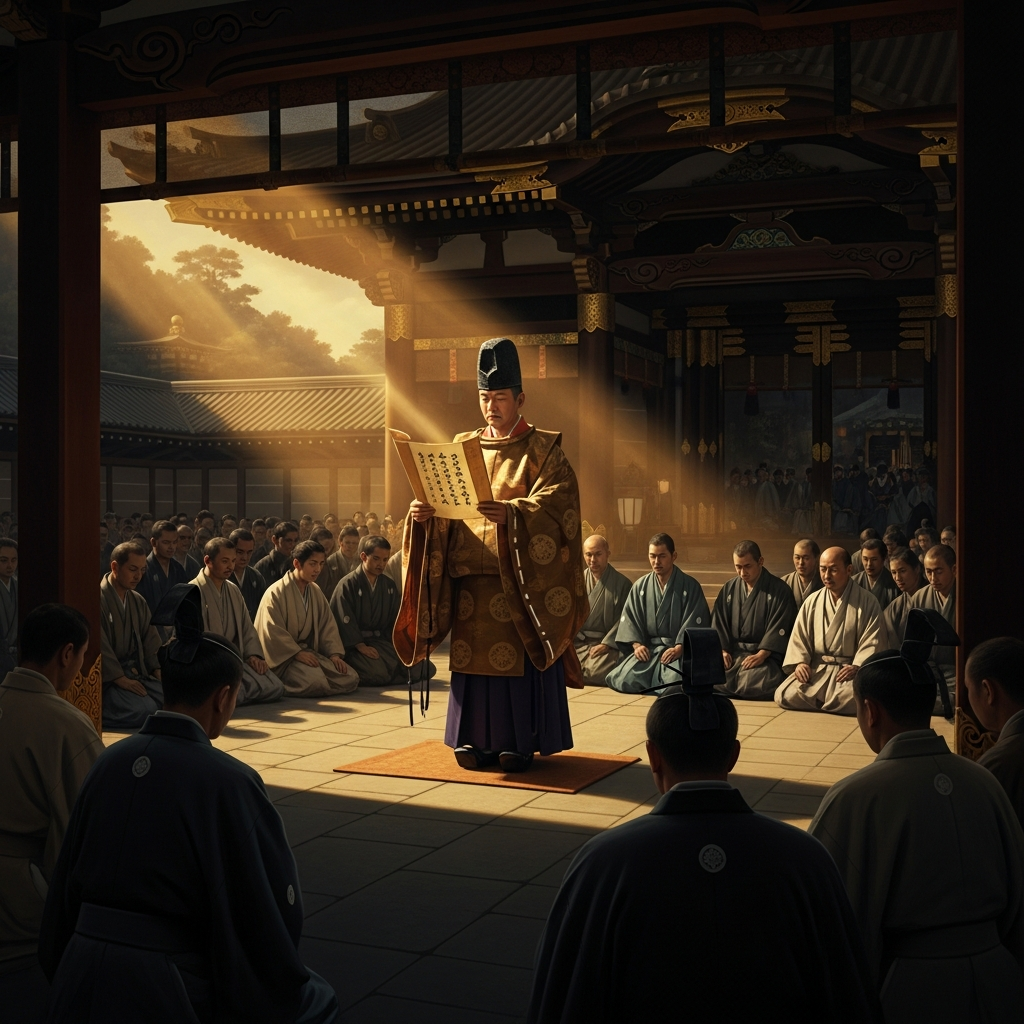
The ceremony is old. The Nakatomi Purification Prayer — the Nakatomi no Harae — is recited by a priest from the Nakatomi clan, the priestly lineage that has maintained this rite since before the text was codified. The prayer is long and formal and dense with archaic language that even educated people of the Nara period cannot fully parse, which is not accidental: the language is not for the congregation to understand. It is for the kami to recognize. The words are the same words that were spoken at the first purification — Izanagi’s purification in the river at Ahaji after he fled Yomi, the bath in which Amaterasu and Tsukuyomi and Susanoo were born from the washing of his face. The prayer recounts that first purification. It invokes Seoritsu-hime, who takes the pollution in the river’s swift upper reaches, and Hayasasura-hime, who takes it where the river meets the sea, and the deity of the sea floor who disperses what Hayasasura-hime brings down. The chain of removal is specified. There is a deity assigned to each stage of the process.
This is what strikes Masako, standing in the crowd in the cold morning: the completeness of the mechanism. Nothing is left to improvisation or to the quality of the supplicant’s feeling. The river will run to the sea whether or not she believes in it.
The hitogata are distributed.
The paper dolls — hito meaning person, kata meaning shape — are cut from white paper into simple human outlines, man-shaped, barely larger than a hand. Each person receives one, or several for a large household. The instruction is to pass the doll over your body, both sides, and to breathe onto it: breathe the kegare into the paper. The breath is important. Breath is the medium of transfer. The Kojiki knows this — Izanagi breathes the deities of breath, and the pollution of Yomi comes off him in the water — and the ritual preserves this understanding in the specific act of breathing onto the doll, which is an act so simple that it is easy to underestimate.
Masako takes her doll. She passes it over her head and her shoulders and her chest and her belly. She turns it and passes it over her back. She breathes onto it, and the breath clouds in the cold air and disperses, and the paper doll is warm from her skin when she finishes.
She feels, in that moment, nothing in particular. This is what the priests would tell her is correct. The ritual is not designed to produce an emotional response. The emotional response is a byproduct, not the mechanism.
The dolls go into the river.
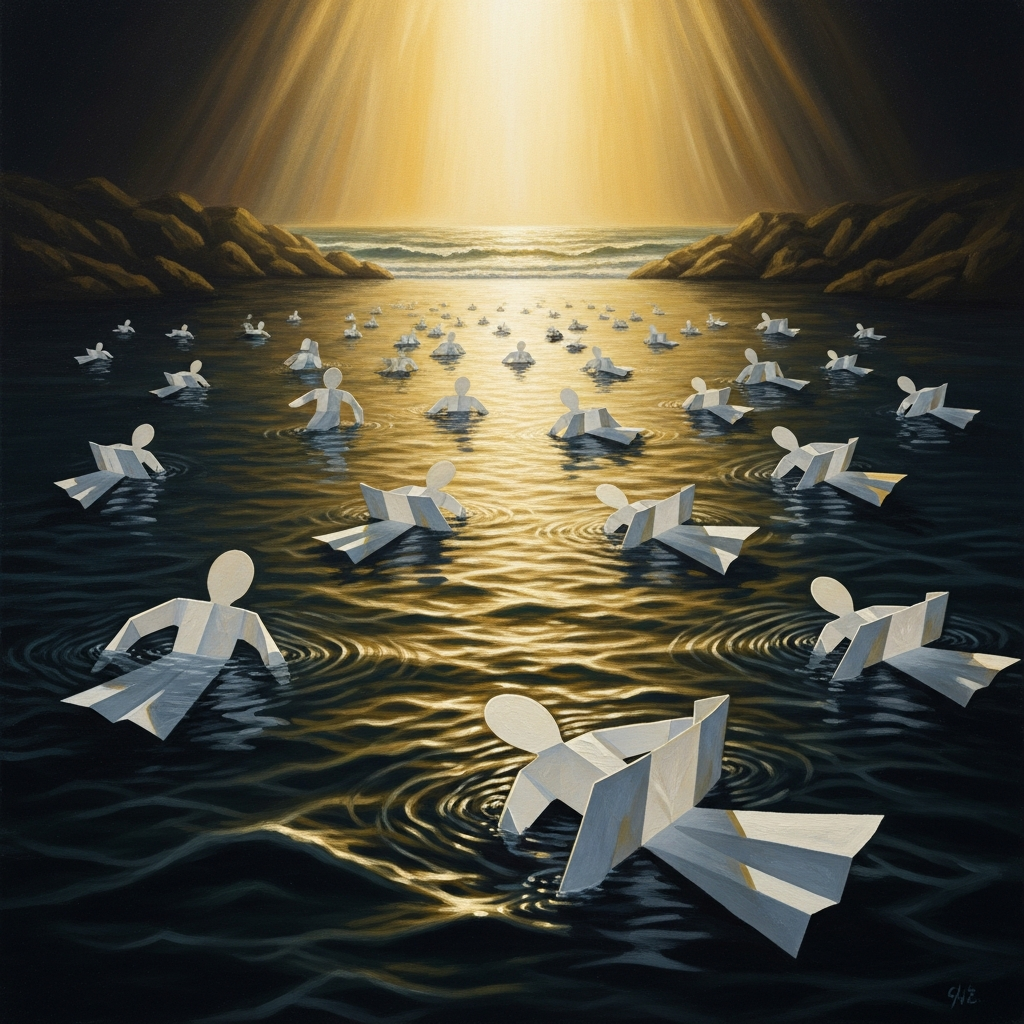
Dozens of them, white paper floating on the dark winter current, the breath-warmth already gone from them in the cold air. They move with the current immediately, purposefully, without resistance — paper does not cling, paper goes where the water sends it, and the water sends them downstream toward Seoritsu-hime in the swift upper reaches, who will pass them to Hayasasura-hime at the river’s meeting with the sea, who will swallow them into the place where what has been breathed into paper dissolves back into nothing.
The priest concludes the prayer. The congregation bows. The ceremony ends with the practical abruptness of something that has accomplished what it set out to do.
It is on the walk home that Masako notices the weight is different.
Not gone — she will grieve her husband for the rest of her life, which is what grief is for. But the kegare, the specific residue of having been in proximity to his death, to the bureaucratic notification of his death, to the months of managing a household that death disrupted — that specific heaviness is different now. Lighter. The way a table feels lighter after you have wiped the dust off it, which it does not feel at all while the dust is accumulating.
She passes a neighborhood Inari shrine on the way home and she stops at it, briefly, not to pray for anything but to note that she is here and the weight is different. This too is a form of Shinto practice — the check-in with the local kami, the acknowledgment of changed circumstance. She bows and moves on.
The theology that Oharae enacts is not a theology of spiritual transformation. It is not asking Masako to become someone different, to resolve her relationship with mortality, to achieve peace or acceptance or forgiveness. It is asking her to pass a paper doll over her body and breathe onto it and put it in the river. The river knows what to do with what it receives. The sea-swallowing deity knows what to do with what the river brings. The mechanism has been running since Izanagi washed the kegare of Yomi off his face in the river at Ahaji and three deities were born from the washing. It will keep running after Masako is gone.
She does not need to believe this in order for it to work. She needs only to participate. The ritual is not a metaphor for purification. It is purification, enacted in the only medium available to beings who carry invisible weight on their bodies: a public ceremony, a piece of paper, a breath, and a river running to the sea.
Kegare does not yield to the interior. You cannot think your way out of it, or pray your way out, or decide you are done carrying it. It is on the surface and it requires a surface mechanism: contact, transfer, release. The genius of Oharae is that it gives the invisible weight somewhere to go — not into nothing, but into a chain of receiving. The river takes it from the paper. The sea-swallowing deity takes it from the river. The ocean floor takes it from the deity. Dissolution happens at every level, presided over at each stage by an entity assigned specifically to that work. The system is complete. You only have to bring what you are carrying and breathe it into the paper, and then trust — which is not the same as believe — that the current will do its part.
Scenes
The white paper dolls float on the surface of the river, dozens of them, each carrying an invisible weight
 Generating art…
 The Nakatomi priest reads the purification prayer aloud in the courtyard of the imperial palace
 Generating art…
 At the place where the river meets the ocean, something vast and unhurried receives what the current delivers
 Generating art…
 Echoes Across Traditions
Entities
- Hayasasura-hime
- Nakatomi clan
- Izanagi
- Seoritsu-hime
Sources
- *Engishiki* — Nakatomi Purification Prayer (Norito), trans. Donald Philippi (1959)
- Stuart Picken, *Essentials of Shinto* (1994)
- Sokyo Ono, *Shinto: The Kami Way* (1962)
- Allan Grapard, 'Institution, Ritual, and Ideology: The Twenty-Two Shrine-Temple Multiplexes of Heian Japan,' *History of Religions* (1988)