Izanami in the Land of the Dead
Mythic Time · Kojiki Book I, ~712 CE · Yomi — the Land of the Dead, the flat dark; the pass of Yomotsu Hirasaka
Contents
Izanami dies giving birth to fire and descends to Yomi, the land of the dead. Izanagi follows her into the darkness to bring her back. He waits in the dark. He breaks his promise. He lights his comb and sees what she has become — and the sight begins the separation of the living from the dead that will never be undone.
- When
- Mythic Time · Kojiki Book I, ~712 CE
- Where
- Yomi — the Land of the Dead, the flat dark; the pass of Yomotsu Hirasaka
She dies in the act of creation.
This is important to the Kojiki: Izanami does not die in battle, does not age, does not wither. She is in the fullness of her generative power — she has already made islands, gods of the sea, gods of wind and mountain and stone — and she dies making fire. Kagutsuchi, the fire god, burns through her on his way into the world, and the burning is not metaphorical. She is scorched from the inside. She lies down and she does not rise again, and the gods of metal and clay and water are born from her dying body in that last exhalation of creation that the body performs even as it goes out.
Izanagi weeps at her head and her feet. He kills the fire god with his blade, cutting Kagutsuchi into eight pieces from which eight more mountain deities immediately emerge, because in this cosmology grief also generates. And then Izanagi makes the decision that will split the world in two.
He follows her down.
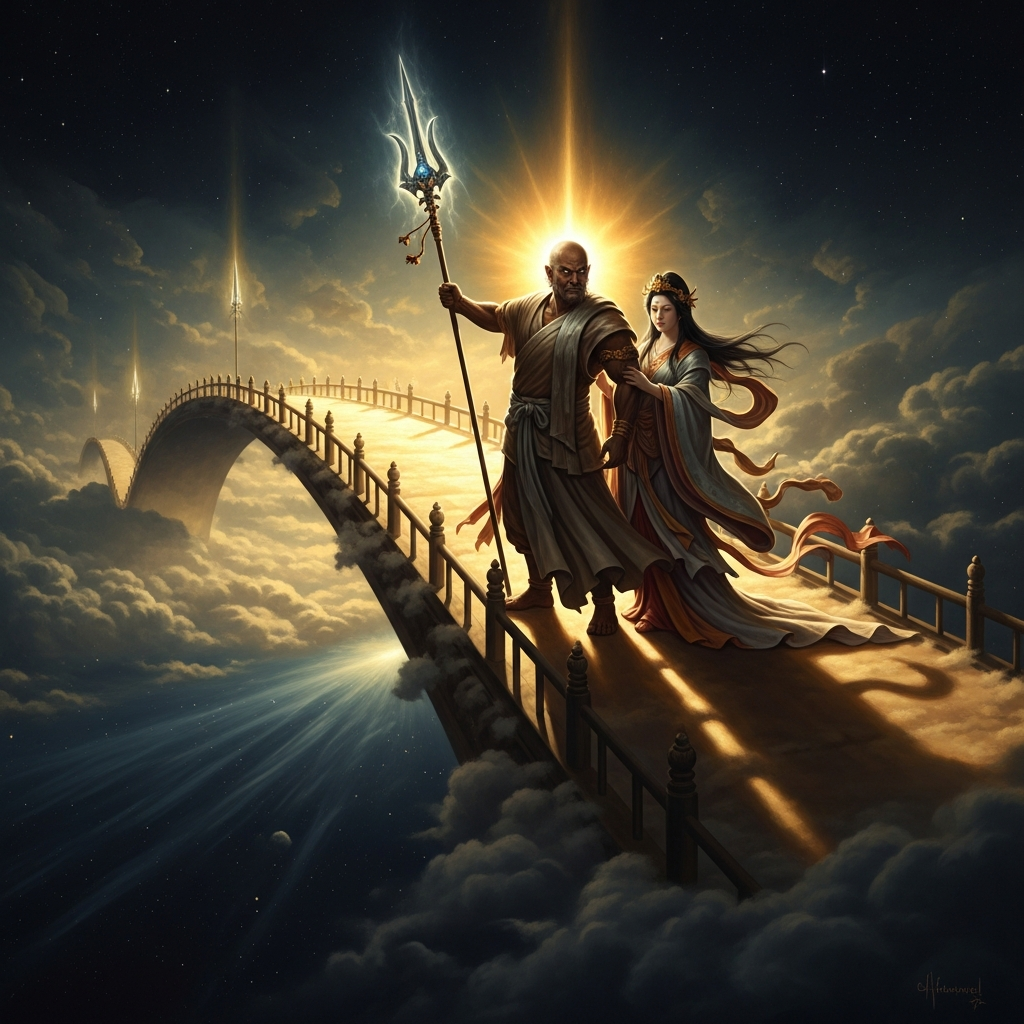
Yomi is described in the Kojiki with a precision that feels like testimony. It is the flat dark beneath the world — not a realm of punishment, not a hell, not an organized afterlife with categories for the virtuous and the wicked. It is simply where the dead go when they go. It is flat because in darkness there is no reason for elevation. It is dark because darkness is what remains when the sun goddess has no authority here. Izanagi descends through passages that the text does not map because the point of the descent is precisely that you cannot map it — you go down and down and the light diminishes and then it is gone, and you call out in the dark and wait for an answer that may or may not come.
Her voice comes.
She says: Wait. I am still in negotiation with the gods of Yomi about returning. I will speak to them. But you must not look at me. Do not come into the hall. Do not light any fire.
He agrees. He waits in the dark at the entrance to the hall of the dead, in the country beneath the world, while his wife negotiates with death on his behalf. He waits and waits. The text does not specify how long. Long enough. Long enough that a man alone in absolute darkness with grief for company reaches the limit of what waiting in the dark without fire can ask of anyone.
He breaks a tooth from his comb.
This is the specific gesture that the Kojiki records — not a torch, not a lamp. He takes a comb from his hair and breaks a tooth from it and lights it. The flame is small. The flame is intimate. It is the smallest possible fire a person can make, which makes what it illuminates worse, not better, because the detail rendered is exact and it cannot be looked away from once seen.
Maggots. In her neck. In her chest. In her belly. The body that made the islands of Japan is rotting, and where it rots it has produced the eight thunder deities — Oichi-kaminari, Kami-kaminari, Kuro-kaminari, Saki-kaminari, Waki-kaminari, Tsuchi-kaminari, Naru-kaminari, Fushi-kaminari — one in each place the decomposition has advanced furthest, so that her body is also an anatomy of the stages of death, each stage presided over by a deity of thunder who was born from it.
The Kojiki does not say Izanagi screams. It says he was afraid.
He runs.
Izanami’s voice comes from behind him — from everywhere in the dark — and what she says is not grief but rage: You have shamed me. She sends the hags of Yomi after him, the shikome, the foul women of the underworld, who pursue him through the darkness at speed. He throws his black hair-vine behind him and it becomes grapes; they stop to eat. He throws his comb-teeth and they become bamboo shoots; they stop to eat again. He buys himself distance in the oldest currency available: food offered to the hungry. The eight thunder deities come next, the ones born from her body, and fifteen hundred warriors of the underworld behind them, and Izanagi is still running, upward through the passages of Yomi, and he reaches a peach tree near the border and throws its fruit behind him and the underworld army recoils — the peach tree’s power over evil spirits is established here, which is why peaches appear at purification rites for centuries afterward.
And then Izanami comes herself.
She comes herself, which is different.
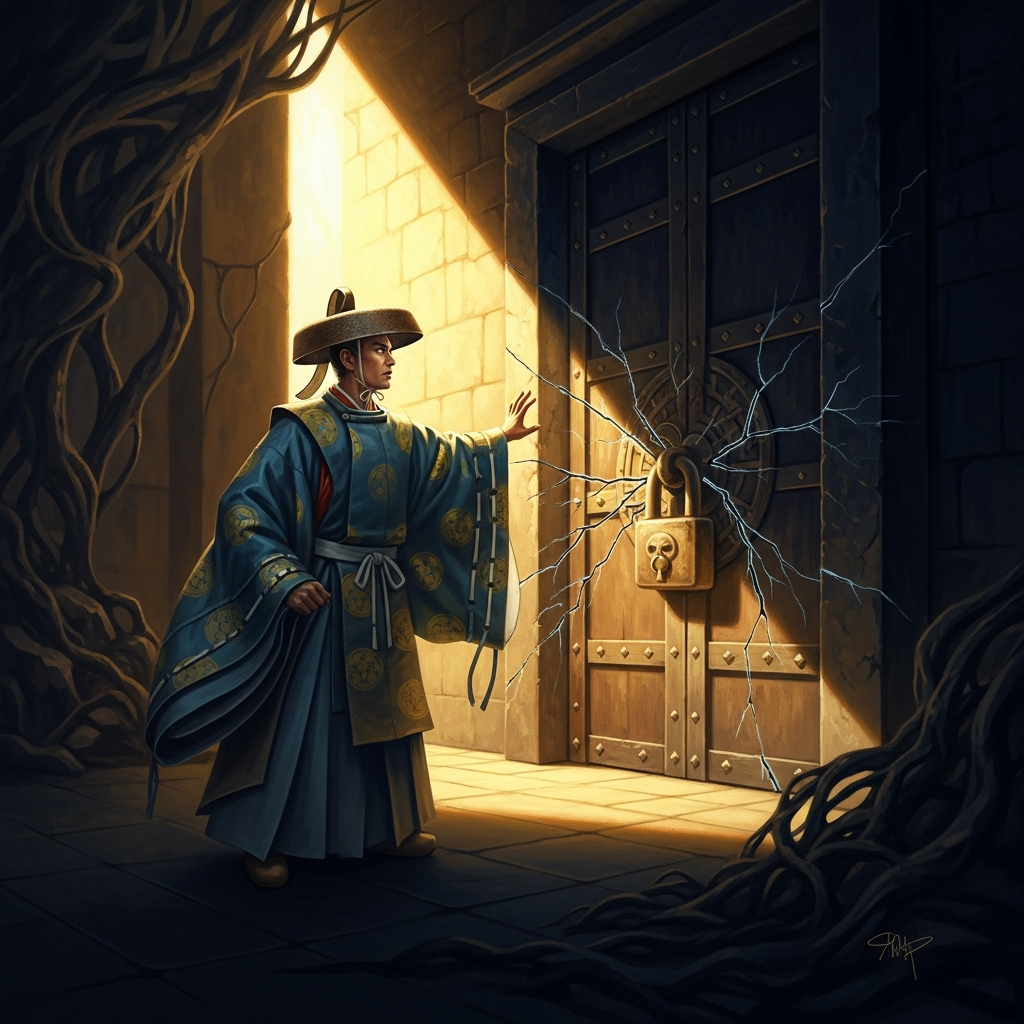
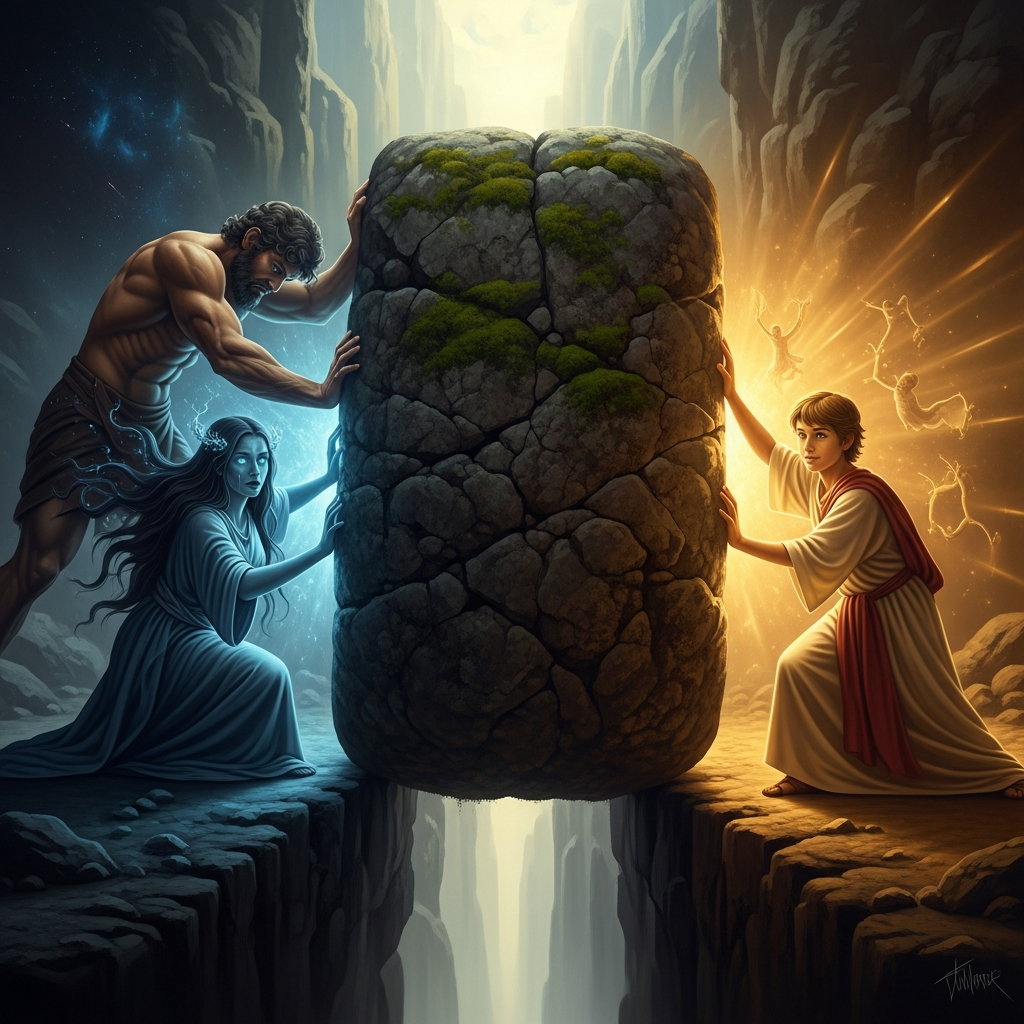
The shikome and the thunder-gods and the armies were extensions of her will. Her coming is her will embodied. She is running through Yomi with the same fury that she birthed the fire god with, the same force that made islands — and it is all directed at Izanagi, at the husband who descended to claim her and then lit a fire and looked at her face and ran in terror from what he saw. He reaches the pass of Yomotsu Hirasaka, the slope at the border between the dead and the living, and he seizes three peaches growing there and hurls them. The army stops. He reaches the great boulder — Chigaeshi-no-Okami, the Great God of the Road-Return — and he rolls it across the mouth of the pass.
She is on the other side of the boulder. He is on the other side of the boulder.
The distance between them is exactly the width of one great stone.
She speaks through the boulder. He speaks through the boulder. This is the negotiation — not Izanami’s negotiation with the gods of Yomi, which she never finished, but this one, at the border, with a stone between the living and the dead. She says: If you do this, I will kill a thousand of your people every day. He answers: If you do that, I will cause fifteen hundred people to be born every day. She promised death; he promised birth. She is the goddess of the completed world; he becomes the goddess of generation and renewal. The margin between them — a thousand killed, fifteen hundred born, five hundred net — is the mechanism of human population, the reason the living outnumber the dead at any given moment, the daily arithmetic of mortality.
Then he names her: Izanami-no-Mikoto, Great Deity of Yomi. She is not lost or diminished in the underworld. She rules it. She has always ruled it. The name he gives her makes it official.
He purifies himself in the river at Ahaji, washing off the contamination of the land of the dead, and from the washing of his left eye Amaterasu is born, and from his right eye Tsukuyomi, and from his nose Susanoo — the three great deities of the upper world, born from the dirt of the underworld rinsed away in a river, which is how it usually goes with creation: the new world is washed from the residue of the old.
The Kojiki understands grief as the most dangerous thing a living person can carry into the dark. Izanagi went into Yomi for love, which is what one does for love, and he waited in the dark for as long as anyone could be expected to wait. He was not wrong to go. He was not wrong to wait. He was wrong only in the moment when the dark became unbearable and he lit the tooth of his comb and held it up, because what love most needs when it has gone into the dark is the willingness to let the dark be dark — to trust the voice that says wait without needing to see the face behind the voice. He could not. None of us could. The boulder at the pass of Yomotsu Hirasaka is there because love looked when it should have trusted, and the dead and the living have been separated by exactly that failure ever since.
Scenes
Izanagi descends into Yomi — the flat dark beneath the world
 Generating art…
 He breaks a tooth from his comb and holds the flame up
 Generating art…
 He seals the pass with the Great Boulder
 Generating art…
 Echoes Across Traditions
Entities
- Izanami
- Izanagi
- Kagutsuchi
- Shikome
- Hayasasura-hime
Sources
- *Kojiki* Book I (trans. Donald L. Philippi, 1968)
- *Nihon Shoki* Book I (trans. W.G. Aston, 1896)
- Yoshida Atsuhiko, *Japanese Mythology* (1996)
- Joseph Campbell, *Oriental Mythology: The Masks of God* (1962)