Tangaroa Breaks His Shell
Before time · Raʻiatea creation tradition, Society Islands; related variants across Polynesia · Te Kore — the void before the world existed, the primordial dark before there was dark
Contents
In the primordial dark, the sea-god Tangaroa cracks his own shell. There is nothing outside him. He breaks pieces off and they become rock and sand. He reaches inside himself and draws out his flesh — which becomes the trees, the living things, the gods who followed.
- When
- Before time · Raʻiatea creation tradition, Society Islands; related variants across Polynesia
- Where
- Te Kore — the void before the world existed, the primordial dark before there was dark
Before the beginning, there is only Tangaroa.
There is no sky and no earth and no sea — there is not even darkness, because darkness requires a space to be dark in, and there is no space. There is nothing, which the Polynesian tradition names with precision: Te Kore, the void; Te Kore-tua-kore, the void beyond the void; Te Kore-i-ai, the void in which there is nothing at all. The Polynesian theologians counted many layers of nothingness, because they understood that nothing is not simple.
In this nothing, there is Tangaroa.
He exists in the form of an egg — a great shell, curved and complete, containing everything he is. He floats in the void the way a sea-bird’s egg floats on calm water, except that there is no water and no calm and no sea. He has been in the shell for a time that cannot be measured because there is nothing yet to measure time against. He is alone in the way that only a god who has not yet created anything can be alone — not lonely, because loneliness requires the memory of company, but absolute.
He turns in his shell. He listens. There is nothing to hear.
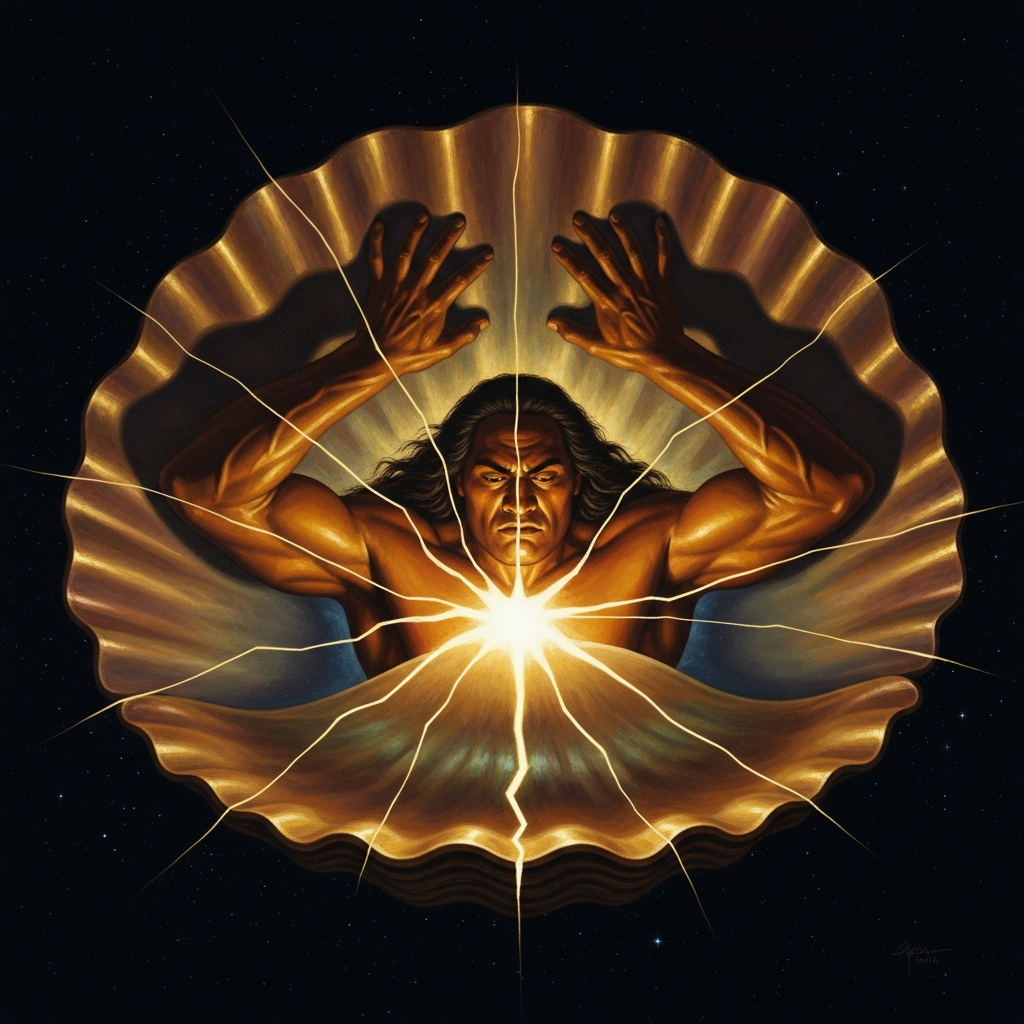
He breaks the shell from the inside.
Not all at once — it is not an explosion. He presses his hands against the inner wall and pushes, and the shell cracks along a single line, and light comes in from nowhere, which means the light comes from him, from his own breaking. The crack widens. He pushes harder. Pieces of shell fall away into the void, and where they fall, they do not disappear.
They land.
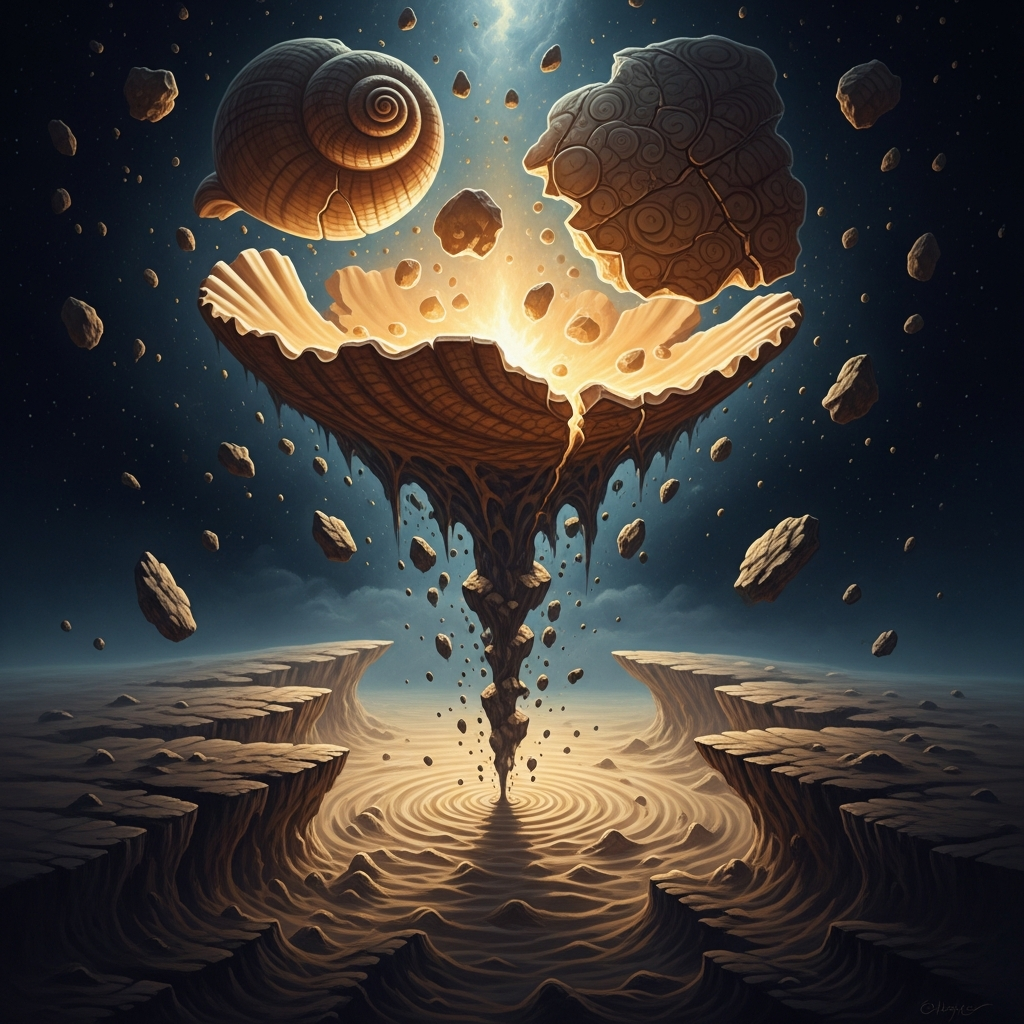
This is the first thing that has ever happened: a piece of something resting on nothing and staying there. The shell-pieces grow denser as they settle, as if the void receives them and solidifies beneath their weight. The largest pieces become rock. The smaller pieces become sand. The edges and splinters become the gravel at the base of cliffs, the rubble at the foot of mountains, the coarse substrate that the sea will one day arrange into beaches.
The void is becoming a floor.
Tangaroa stands on it for the first time — not inside his shell, not floating, but standing on something he made from the only material available to him, which was himself.
He looks out.
There is rock and sand, but there is no water and no living thing and no other being. The floor extends in all directions but there is nothing on it. He has used the shell, and the shell was the exterior of himself — the part that faced the void and held it out. What remains is interior.
He reaches inside himself.
This is described in the Raʻiatea tradition with a kind of clinical precision that is more alarming than any metaphor: Tangaroa reaches into his own body and takes out what he finds there. What he finds is flesh — the stuff of a god’s interior — and he draws it out and holds it in the light that comes from his own breaking, and the flesh does not die.
It grows.
The flesh becomes trees first.
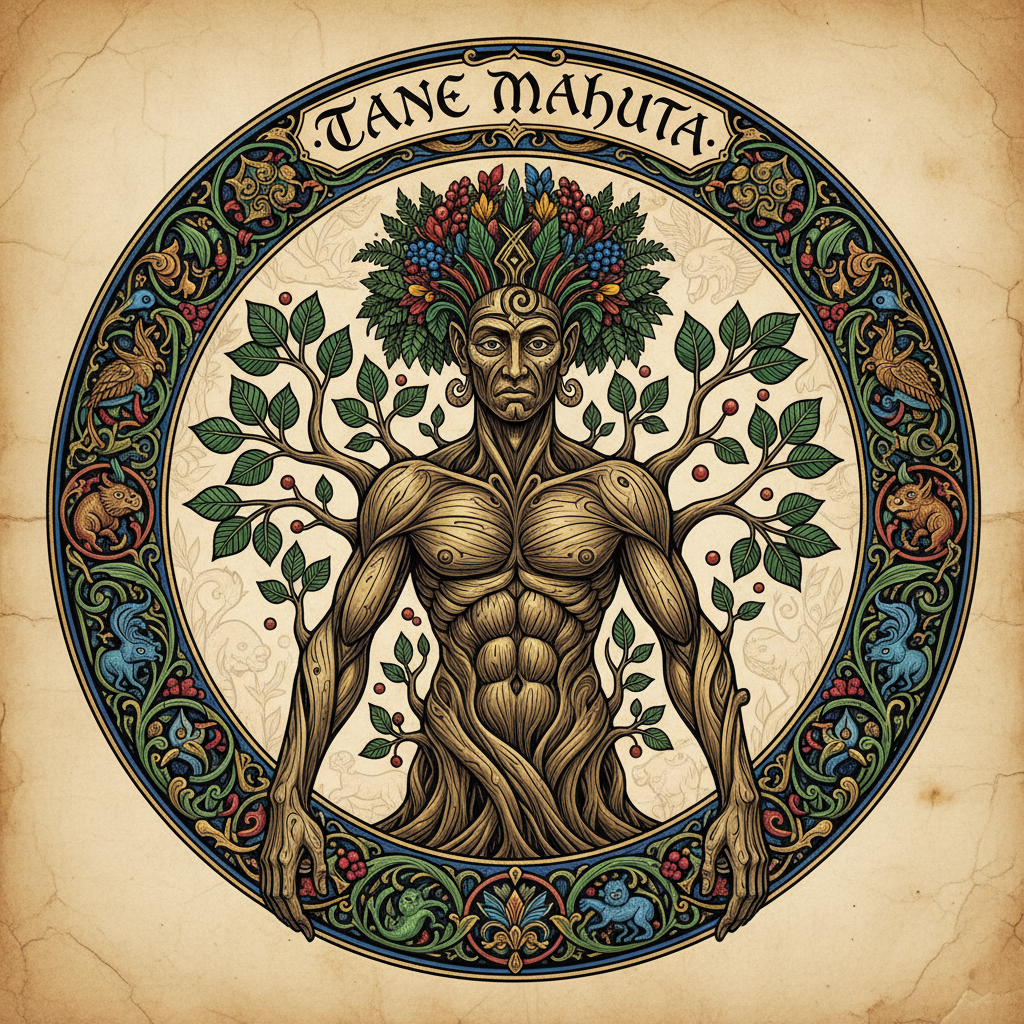
The Raʻiatea account specifies this: the sinew of the god becomes the roots of trees, the muscle becomes the wood, the internal membranes become the leaves. Tāne — who will later be named the god of the forest, but who at this moment is more like the principle of upward growth, the force that makes things reach for light — Tāne is in the flesh, and when the flesh roots in the rock-floor, Tāne begins to differentiate it, to make it specific. This tree is a breadfruit. This one is a coconut. This one is the ʻōhiʻa, which will grow first on new lava and last after everything else.
The trees make shadow. The shadow makes the first distinction between a lit place and a dark place, and that distinction is the first geography.
Other pieces of flesh become birds, drawn upward by the trees. Other pieces move along the ground and become lizards and insects. Other pieces slip into the water that is beginning to collect in the low places of the rock-floor — water condensed from Tangaroa’s breath — and become fish. He is the lord of the sea not because he commands it from outside but because the sea is made of him, because the water in which everything lives is his own exhalation, and the creatures that live in it are pieces of his flesh that learned to swim.
The gods come from what remains.
After the rock and the tree and the bird and the fish, there is still something left — a remainder, a divine surplus — and this remainder has the kind of self-awareness that living things do not yet have. Tāne is already in the forest, shaping trees. Rongo is in the root-vegetables, the taro and the yam, the things that feed people. Tū is in the sinew of warriors, the bone-density that makes a man hard to kill.
They are not separate from Tangaroa. They are his specializations — the parts of himself that, once separated and given to particular aspects of the world, developed their own character, their own preferences, their own names. He did not make them. He became them.
Tangaroa remains as the sea — not as a metaphor for the sea, but as the literal body of the ocean. When the tide comes in, it comes in because Tangaroa is breathing. When a storm raises the sea against a reef, it is Tangaroa deciding something. He is not above the sea, watching it. He is the sea, and the sea is what is left of him after everything else was given away.
He becomes the ancestor of all things that live near water.
The tradition is careful about this. Tangaroa is the ancestor of fish, of sea-creatures, of the reefs and their inhabitants, of the rivers that run to the sea, of the rain that feeds the rivers. He is also the ancestor of the gods who followed — not their creator, exactly, but the being they came from, the original one, the source. When a Polynesian navigator on the open ocean feels the swell pattern shift beneath the hull and knows that land is near, that knowledge moves through the water that is Tangaroa, arrives through the hull that is wood grown in the forest that is Tāne, and reaches the navigator who is flesh that was once the god’s interior.
Everything that exists was, at some point, inside the shell.
Everything that lives is a piece of the god that landed on the floor and stayed there.
The Raʻiatea creation text was one of the most important pieces of Polynesian religious literature recovered in the nineteenth century. Teuira Henry, the granddaughter of a missionary who was also among the first serious scholars of Tahitian tradition, transcribed it from oral sources and published it in 1928 as part of her comprehensive account of Society Islands religion. The creation story it contains is unusual even within Polynesian tradition for its philosophical rigor: it does not describe the world as shaped by a god who preexists it, but as made from a god who empties himself into it.
The theologian might say that Tangaroa undergoes kenosis — the self-emptying that Christian theology attributes to the Incarnation, when the divine empties itself into the finite. The Polynesian version does not require a second act of restoration. The god stays empty. The world stays full.
Fishermen of the Society Islands, before they went to sea, called on Tangaroa not as a patron but as a relative — because they were going into the body of an ancestor, and proper conduct required acknowledgment. You do not go into the body of your ancestor without asking permission first.
Scenes
Tangaroa in the void — the shell cracking from the inside, the first fracture of light in the absolute dark, his own hands pressing against the only wall that exists
Generating art… Pieces of the shell falling away and thickening into rock, into sand — the first geology, the floor of the world made from the god's discarded armor
 Generating art…
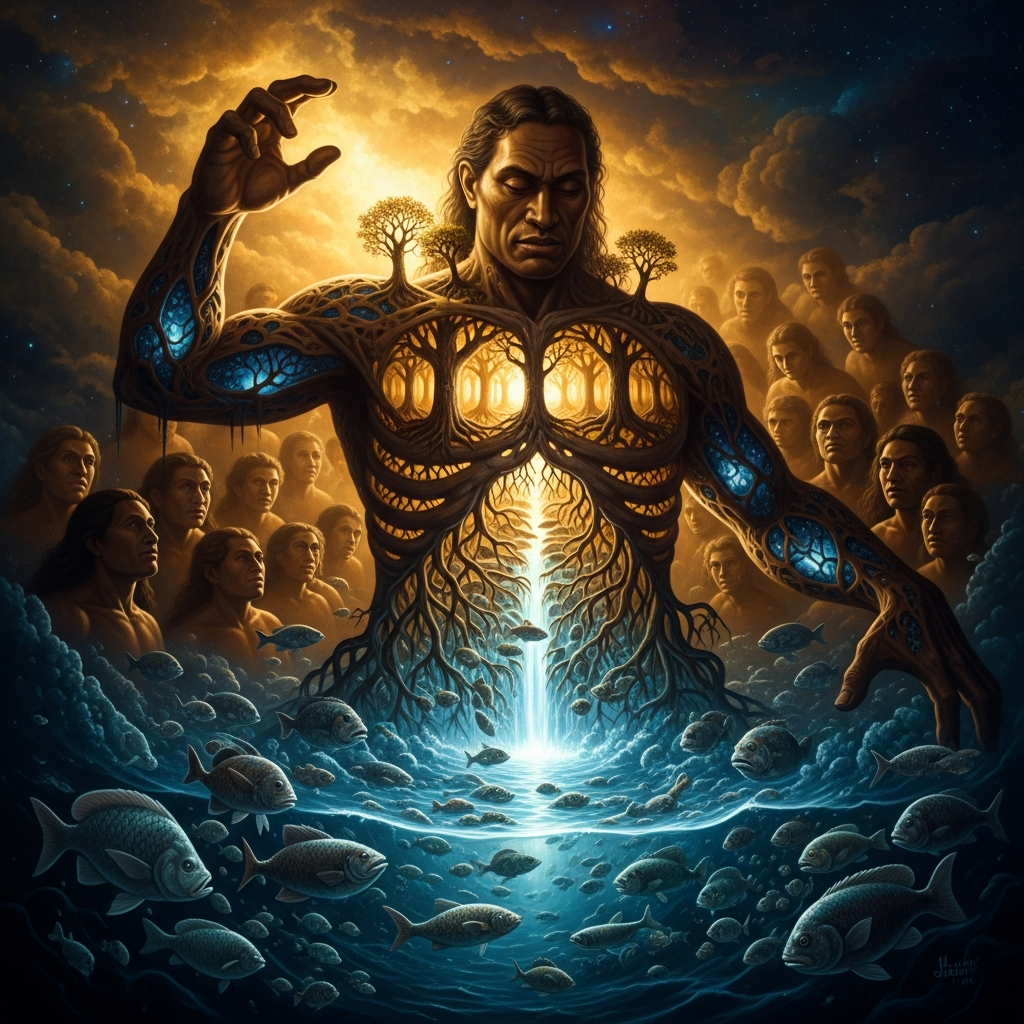
 Tangaroa reaching inside himself — the first trees rooting in his ribs, the first fish moving in the water that was once his blood, the gods who followed born from what remained
 Generating art…
 Echoes Across Traditions
Entities
- Tangaroa
- Te Kore (the void)
- Te Pō (the night)
- Tāne
- Rongo

Sources
- Teuira Henry, *Ancient Tahiti* (1928) — the Raʻiatea creation texts, translated and annotated
- E.S. Craighill Handy, *Polynesian Religion* (1927)
- Martha Beckwith, *Hawaiian Mythology* (1940)
- Te Rangikāheke (mid-19th c. Māori manuscripts)
- Patrick V. Kirch & Roger Green, *Hawaiki, Ancestral Polynesia* (2001)