Hina and the Moon
Mythic time — the age before the voyagers · Earth, then the moon — across Hawaiʻi, Samoa, Tonga, Tahiti, and the Marquesas
Contents
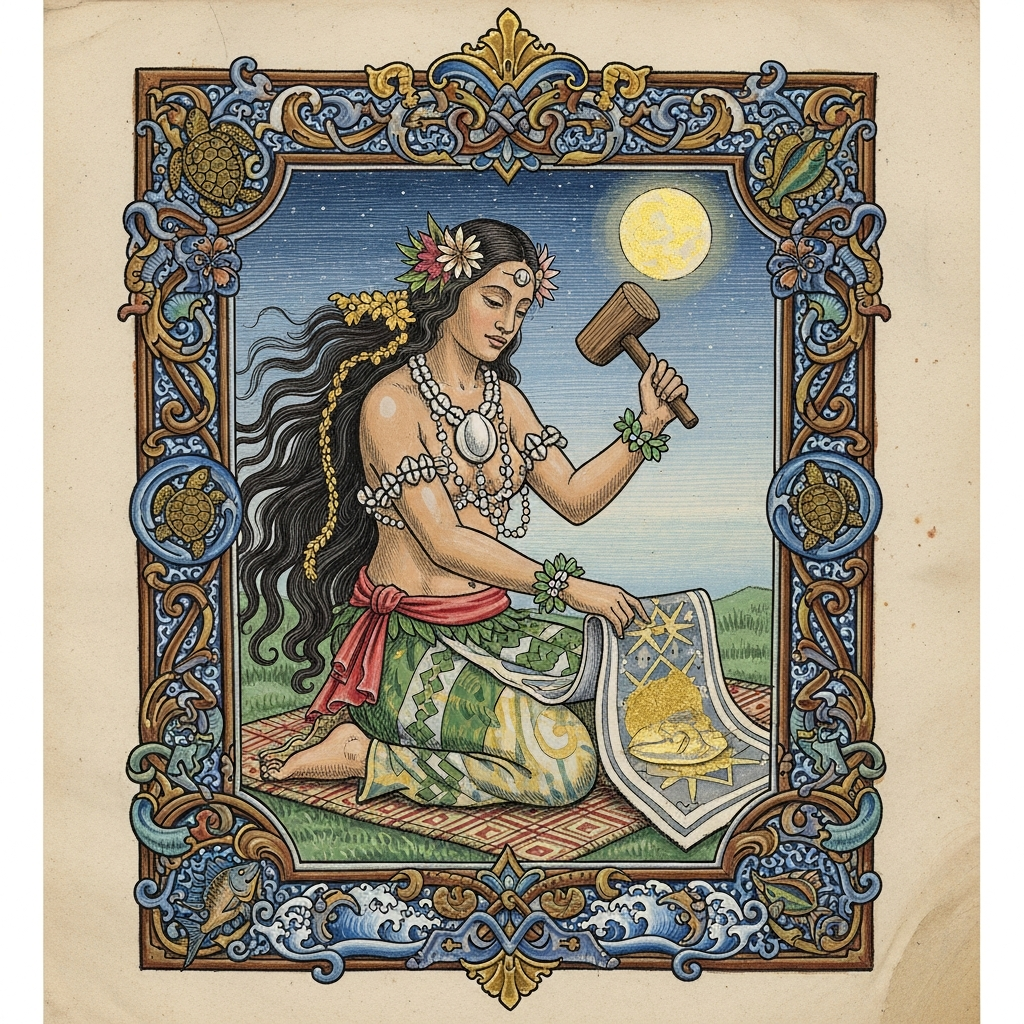
Hina pounds tapa cloth on earth until she can no longer bear it. She climbs the coconut tree toward the moon, slips, climbs again, and reaches the surface. She is taken in. Now she pounds tapa in the moon — and the rhythm of her work is why the moon waxes and wanes. The most widespread woman in all of Pacific mythology chose a harder labor in a better light.
- When
- Mythic time — the age before the voyagers
- Where
- Earth, then the moon — across Hawaiʻi, Samoa, Tonga, Tahiti, and the Marquesas
Before she leaves, she is at her anvil.
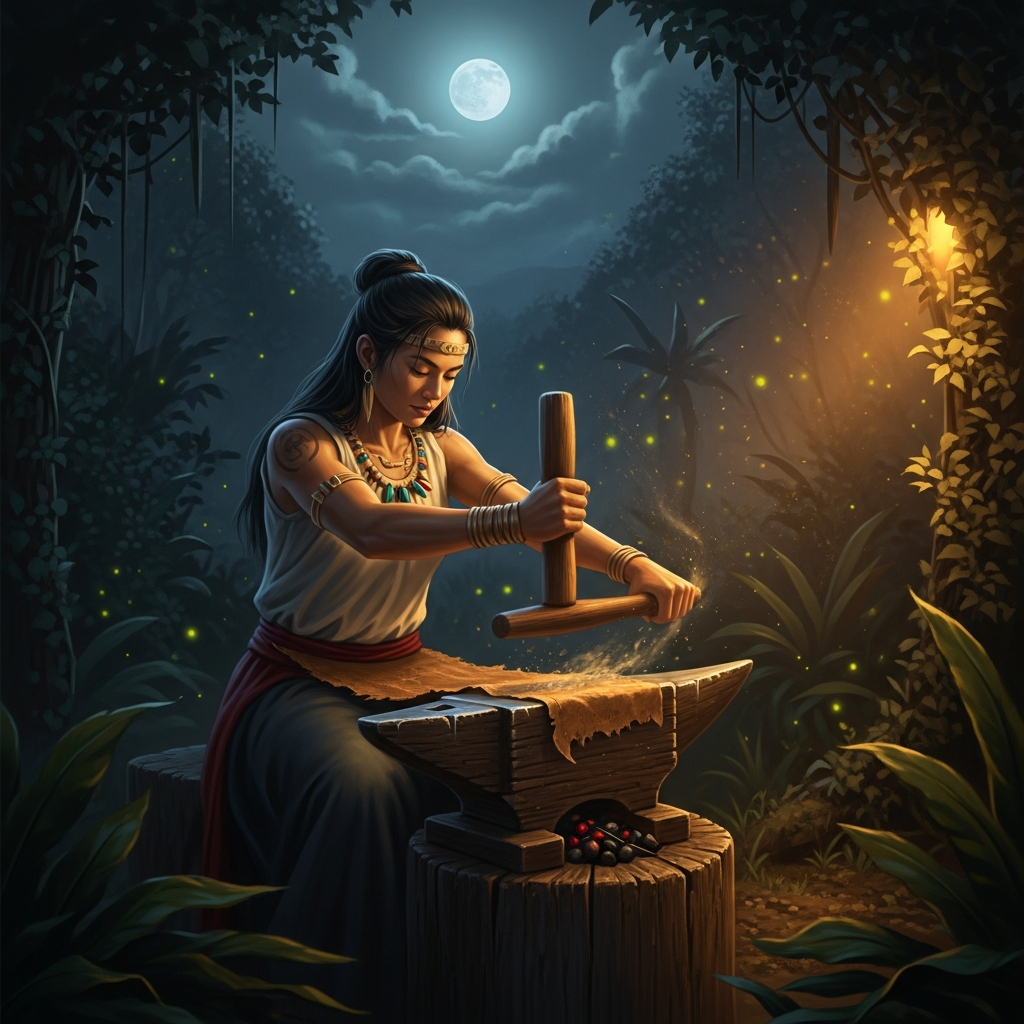
She has always been at her anvil. This is the fact of Hina’s life that the Pacific traditions agree on before they diverge into their variants: the woman beats tapa cloth. She takes the inner bark of the paper mulberry tree, soaks it, and beats it on a wooden log with a grooved mallet, and through the beating it becomes fabric — thin, flexible, usable, the cloth that wraps the living and the dead. She has been doing this since the morning of the world. She will be doing it, the stories tell her, for the rest of her life.
The rest of her earthly life is almost over.
She pounds in the early morning when the light is good. She pounds in the afternoon when the heat makes the bark pliable. She pounds in the evening when the rhythm of it is the only thing that continues to make sense. Her arms know the motion without her mind’s involvement, which is either the sign of mastery or the sign of having done something too many times, and she has stopped being able to tell the difference.
Some versions of her story say she has a husband. He is no help. Some say she has children. They are no help either, in the way that children are often not help. Some say she is alone on the island of her origin — Hawaiʻi, Samoa, Tahiti, Hiva Oa — with nothing but the anvil and the bark and the rhythm and the light that is never quite right.
The light is never quite right.
This is the detail that accumulates, the thing that starts small and grows until it is the whole problem. Earthly light is inconsistent. The sun moves. The shadows shift. In the morning the light falls from one angle; in the afternoon it falls from another; the bark cloth cannot be evaluated the same way twice because the source of the light is always relocating. She wastes material in the bad light. She has to redo work she thought was done. She is exhausted not just from the labor but from the imprecision the labor requires because of the light.
She looks up.
The moon hangs above the coconut grove in a way that suggests it is not, in fact, unreachable.
She looks at it for a while. Then she leans her mallet against the anvil and walks to the coconut tree.
She begins to climb.
The coconut palm is slender and the trunk is ringed and her hands and feet find purchase in the rings as she goes up, higher than she has ever been above the earth, the village receding below her, the sound of the sea growing louder as the altitude changes the acoustic shape of the island. She climbs until the top of the tree sways under her weight and the moon is close — close — almost close enough to touch.
She reaches for it.
She slips.
She falls most of the way back down and hangs there, scraped, breathing hard, looking up at the moon which has not moved.
She climbs again.
She reaches the top a second time. The moon is still there, enormous and pale, the light from it so consistent, so even, so unchanging from moment to moment that she already knows: this is where the work should be done. This is the correct light for tapa-beating. Every shadow the cloth makes under this light is an honest shadow. Nothing shifts. Nothing migrates across the surface of the bark and changes what you thought you saw.
She reaches out.
The moon takes her in.
In some versions this is described as a hand extended from the lunar surface, a pull, an invitation. In some versions the moon simply accepts her the way still water accepts a stone — she arrives and the surface closes around her and she is there, inside the light, on the surface of the moon, and the earth is below her and getting no closer.
She does not go back.
She unpacks her tools on the lunar surface. She spreads her bark. She raises her mallet.
She begins to pound.
The sound of it — if sound travels in that direction, if there is anyone below listening closely enough — is the rhythm that moves the tides, that signals the month’s turning, that marks the count by which the women of the islands track their time and the navigators track their passage. She pounds and the moon waxes: the cloth spreads under the mallet, the tapa grows wider and thinner and the light from the working of it brightens. She rests, at the full, and then the waning begins — the cloth waiting, the work paused, the moon’s face diminishing toward the dark of the new moon where she gathers new bark and begins again.
Her labor is the lunar cycle. The month is her schedule. The full moon is not a triumph or a peak or a mystical maximum: it is the midpoint of the job, the moment when the tapa is at its widest before it is folded and the next sheet begun.
She works in consistent light. She has always wanted consistent light.
In some versions of the story, she was fleeing.
A husband who did not treat her well, who did not see the work, who took what she made and left her the making of it and offered nothing in return. The moon was not a better place — the moon is, objectively, a worse place, colder and more isolated and further from everything a person might want to be near. But it was away. And the light was consistent. And no one followed her there.
In some versions, she fell by accident and the moon received her before she could fall further.
In some versions, she simply decided.
The Pacific does not adjudicate between these versions. All of them are true in the way that different islands are all true despite being made of different rock — they are the same story from different shores, and the shape of the shore determines what the story looks like from where you are standing.
In all the versions, she stays.
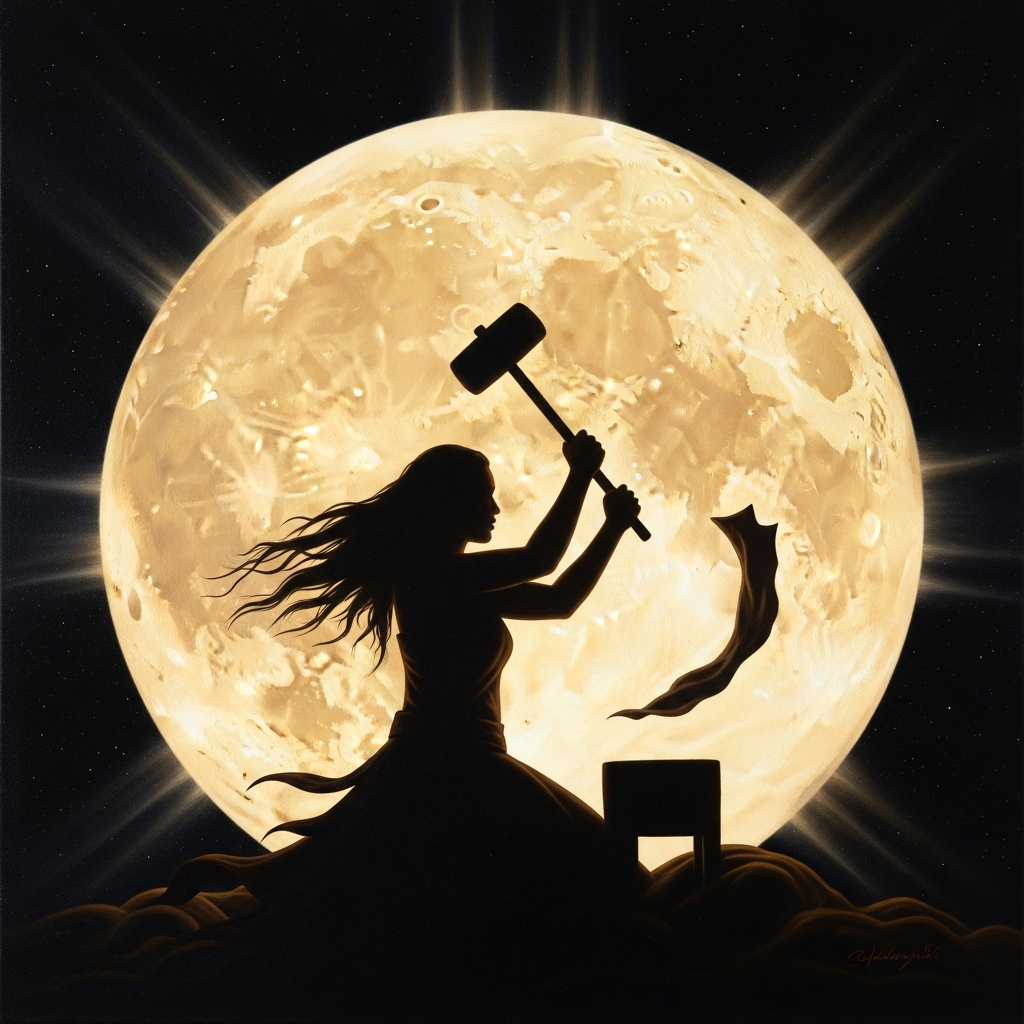
If you look at the full moon and there is a silhouette visible in the pale face — a figure, bent forward, arms raised and lowering in a rhythm — that is Hina at her work. She is not waiting to come back. She found the light she needed and she is using it. Every month the cloth grows and is completed and the next sheet begins. Every month the tides respond to her schedule. Every month the navigators who sail between the islands use her work to count where they are in the month and the year.
The woman who was too tired to stay on earth runs the Pacific’s clock from the moon.
Hina appears in the mythology of every major Polynesian island group, always with the same task and the same destination. She is the most consistent presence in a tradition spread across the largest ocean in the world — more durable than any god, any lineage, any voyaging route. She travels by staying still, in the one place where the light is always right, and the whole ocean navigates by her rhythm.
Scenes
Hina at her wooden anvil in the moonlight, beating bark cloth in a rhythm that has not stopped for a thousand years — yet
 Generating art…
 Hina on the coconut trunk, her hands and feet gripping the pale bark, the moon enormous and close above her, impossibly reachable
 Generating art…
 The silhouette of a woman visible in the moon's face — Hina at her work, her mallet rising and falling, the pale disk of the moon waxing as she beats
 Generating art…
 Echoes Across Traditions
Entities
- Hina
- The Moon (Marama)

Sources
- Martha Beckwith, *Hawaiian Mythology* (1940)
- E.S. Craighill Handy, *Polynesian Religion* (1927)
- Margaret Orbell, *The Illustrated Encyclopedia of Maori Myth and Legend* (1995)
- Te Rangikāheke (mid-19th c. Māori manuscripts)
- Katharine Luomala, *Maui-of-a-Thousand-Tricks* (1949)