Izanagi in the Land of Death
Mythic Time · Kojiki ~712 CE; oral centuries earlier · Yomi-no-kuni — the land of death
Contents
The creator god Izanagi descends to Yomi to reclaim his dead wife Izanami. He lights a torch. He should not have lit a torch. What he sees cannot be unseen, and what he seals behind a great rock on the way out becomes the law that governs every human life that follows.
- When
- Mythic Time · Kojiki ~712 CE; oral centuries earlier
- Where
- Yomi-no-kuni — the land of death
They make the world together.
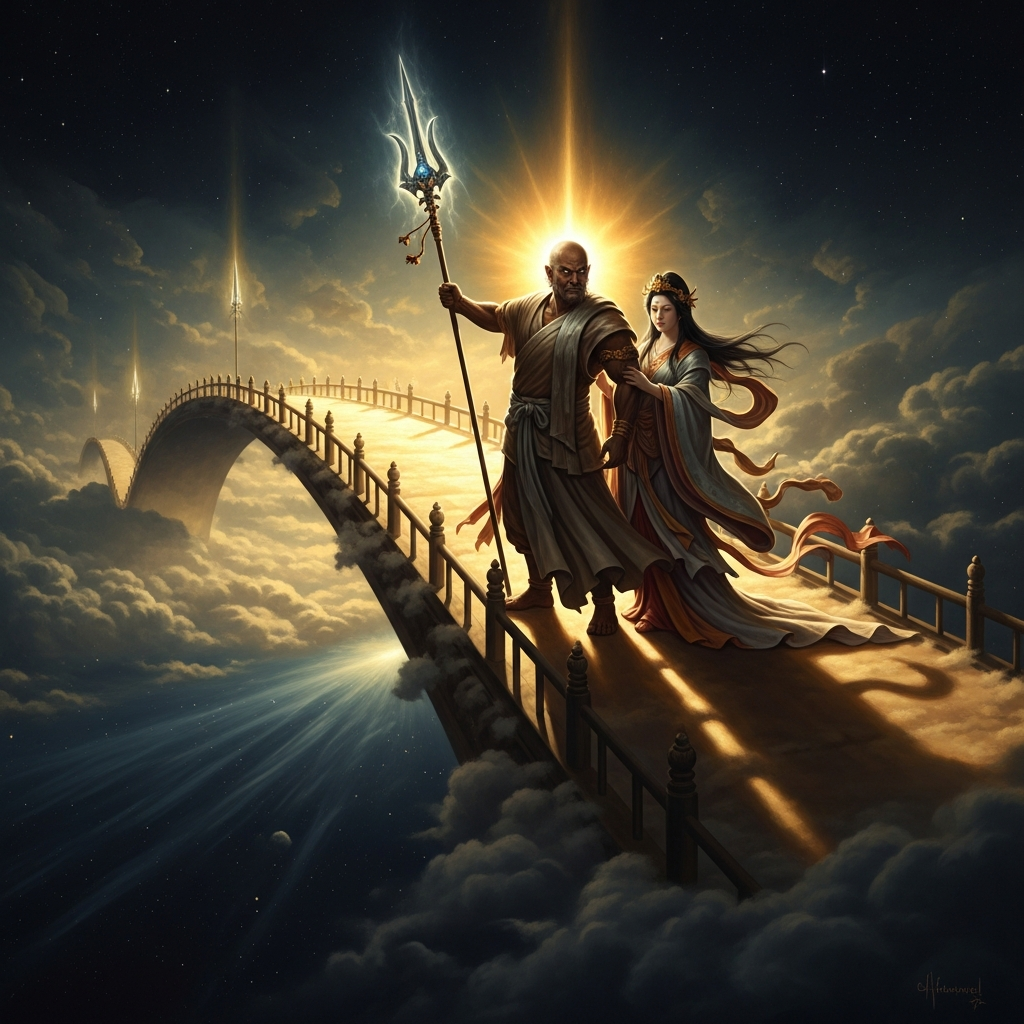
That is the part people forget when they tell this story. Before the descent, before the rock, before the curse — there is a marriage, and the marriage works. Izanagi and Izanami stand on the Floating Bridge of Heaven with the jeweled spear Ame-no-Nuboko and stir the brine of the primordial ocean. The drops that fall from the spear-tip solidify into the island of Onogoro. They descend. They circle the pillar of heaven. They speak the words of union. The islands of Japan rise from the sea one after another: Awaji, Iyo, Oki, Tsukushi, Iki, Tsushima, Sado, Yamato. Eight great islands. A country born from a love that has not yet learned what it costs.
Then Izanami gives birth to Kagutsuchi, the god of fire.
The fire kills her.
Grief in a creator god is not a small thing. Izanagi weeps at the head and feet of his wife’s body until the tears run out. He takes his sword — the ten-span blade at his side, the one he will later use for other purposes — and he kills the fire-child in his rage. From Kagutsuchi’s blood and severed limbs, eight more kami are born. Creation does not stop when it should. It keeps generating out of destruction, out of grief, out of the parts of things that have been cut away.
Then he does what bereaved gods do, which is the same thing bereaved humans do: he goes looking.
The entrance to Yomi is not marked. You find it by following the wrong direction, the one every living thing instinctively avoids. He follows it. He goes down.
The dark of Yomi is not like the dark of a cave or the dark behind closed eyes. It is a dark that has no memory of light. Nothing casts a shadow in Yomi because nothing here has ever been illuminated. The dead move through it the way water moves through water — without friction, without direction, without the sense that movement is happening at all.
He calls her name.
She answers from somewhere deeper in.
Izanami comes to the entrance of the great hall where she now resides. She stands at the threshold — just inside, where he cannot quite see her. Her voice is the same voice. He holds to that. I have come for you, he says. Come back with me. We have not finished making the world.
She is quiet for a time.
Then: I have already eaten the food of this place. The food of Yomi, once eaten, anchors you to it. She knows this. She does not say it lightly. But let me speak with the gods of this realm. Wait for me. And whatever you do — do not look at me.
He waits.
He waits too long.
This is the part of the story that is also the truth of grief: at some point, waiting in the dark becomes unbearable. The mind begins to negotiate with itself. She said not to look, but she has been gone so long. She said not to look, but I can hear something in there that sounds like suffering. She said not to look, but I am the one who made her, and I cannot save what I cannot see.
He breaks a tooth from the comb he wears in his hair. He lights it.
The torch is small. The hall is enormous. In the first instant of light, he sees only the outline of her — the shape of his wife, the woman who stirred the ocean with him, the mother of the islands — and then the light finds the details, and the details are wrong.
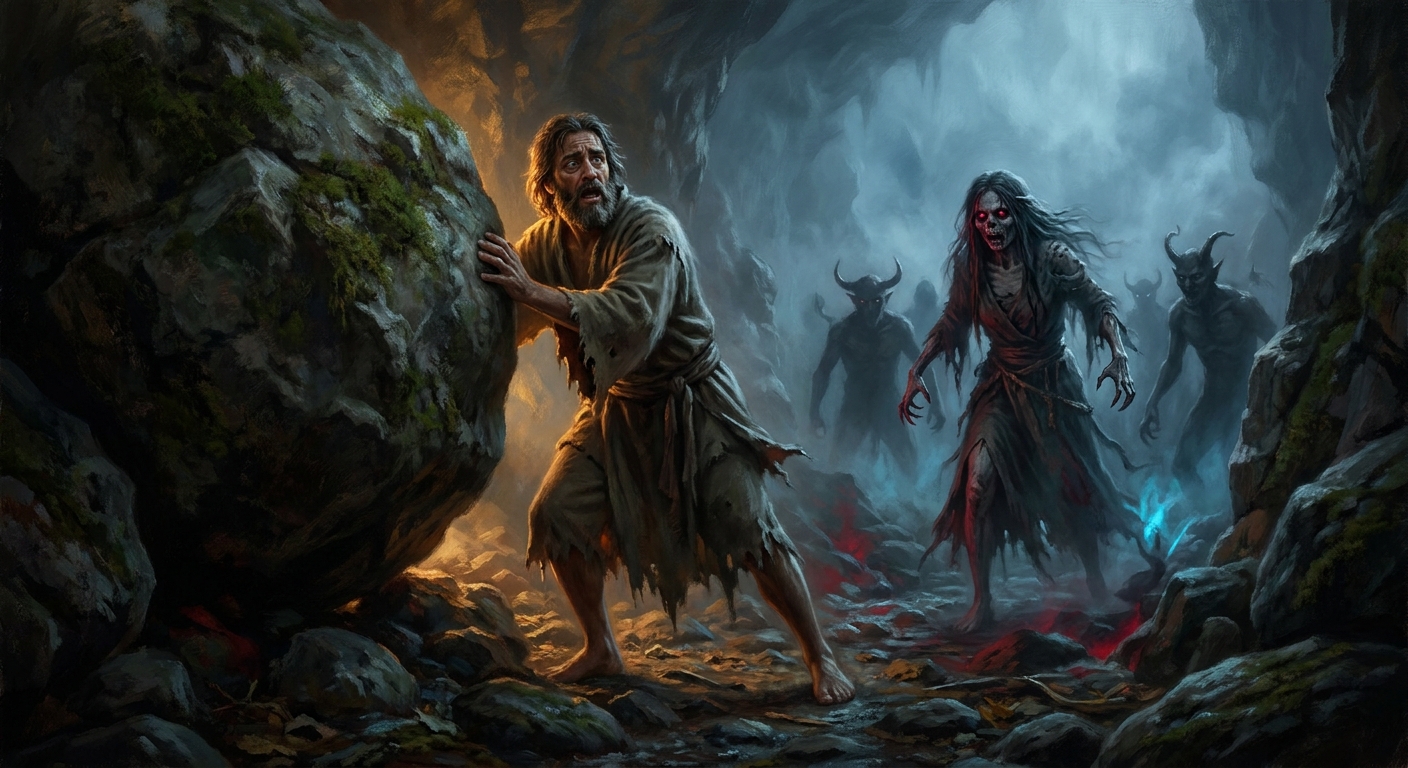
She is not what he left. She is what the food of Yomi has made her. The flesh is gone in places. What remains moves. The eight thunder deities of Yomi have made their homes in her body — Great Thunder in her chest, Fire Thunder at her head, Black Thunder at her belly — and beneath them and between them are the maggots, white and purposeful, going about their work with complete indifference to who she was.
She screams. Not from pain. From shame. From the violation of a prohibition she gave him for his own sake. You have seen me.
He runs.
There is no dignity in it. The god who commanded the ocean to solidify, who named the islands into existence, who killed his own son in grief — he turns and runs from his dead wife in the dark of the underworld, and he runs the way only the truly terrified run, which is without any thought except the location of the exit.
Izanami sends the hags of Yomi after him. The Shikome — the ugly women of the underworld — pour from the hall like water finding a crack, fast and purposeful and utterly without mercy. He runs. He reaches into his hair and throws his black headdress behind him; it becomes a cluster of grapes; the hags stop to eat. He runs further. He throws his comb; it becomes bamboo shoots; the hags stop again.
Then she comes herself, and she brings the eight thunder gods with her.
He reaches the slope that leads back to the living world — Yomotsu Hirasaka, the passage between — and on the slope there are peach trees. He takes three peaches from the branches and throws them back into the dark. The thunder gods retreat. The hags retreat. Even in Yomi, the peach carries the living world’s resistance to corruption. Even the dead do not want to touch it.
He finds the great rock. It is the size of a thing that does not move — the size of a law, the size of a boundary, the size of a decision that cannot be unmade. He puts his shoulder to it and rolls it across the entrance to Yomi.
From the other side, Izanami’s voice comes through.
My lovely elder brother, thine Augustness. The old form of address, the one from the Floating Bridge. If thou do like this, I will in one day strangle to death a thousand of the folk of thy land.
He puts his hand flat on the rock. His wife is on the other side of it. He is never going to move the rock.
If thou do that, he says, I will in one day set up a thousand and five hundred parturition-houses.
She will kill one thousand. He will birth fifteen hundred. Every day, forever. That is the arithmetic of mortality and population, and they are the ones who set it. Death enters the world not as punishment, not as failure, not as the will of some distant judge, but as the outcome of a marriage in which one partner stayed in the dark too long and the other lit a torch when he was told not to.
He walks away from the rock.
He finds a river and washes himself. The purification after contact with death — misogi — is the first ritual act of the living world, and he performs it alone, because there is no one left to perform it with him. When he washes his left eye, a goddess is born: Amaterasu, who will rule the High Plain of Heaven and give the sun to Japan. When he washes his right eye, Tsukuyomi is born, the moon. When he washes his nose, Susanoo is born, the storm.
The three greatest kami in the Shinto cosmos are born from an act of cleaning off the dead.
The story does not resolve. The rock is still there. In Izumo Province, at the Iya Shrine, there is a stone called Chibiki no Iwa — the drag-stone — identified since antiquity as the boulder Izanagi used to seal the passage. Pilgrims visit it.
On one side of the stone: life, light, purity, the world that keeps generating children faster than death can take them.
On the other side: everything that was lost, still waiting, still angry, still making its thousand daily claim.
What the myth understands — what the Kojiki records without flinching — is that the separation was not a victory. It was an agreement. Izanagi and Izanami are still married, still in conversation through the rock, still holding the terms of the only bargain that has ever mattered: we make more than you can take. We make more than you can take. We make more than you can take.
So far, it holds.
Echoes Across Traditions
Entities


Sources
- *Kojiki* book 1 (trans. Donald L. Philippi, 1968)
- *Nihon Shoki* book 1
- Joseph Campbell, *Oriental Mythology: The Masks of God* (1962)
- Joseph Campbell, *The Masks of God: Primitive Mythology* (1959)