Izanagi Washes Himself Clean
Age of the Gods · recorded in the Kojiki, 712 CE · The River at Ahaji, Japan
Contents
After losing Izanami in the underworld and fleeing the Shikome through the dark, Izanagi reaches the river at Ahaji and washes himself. From his left eye comes the sun goddess Amaterasu. From his right eye, the moon god Tsukuyomi. From his nose, Susanoo the storm. The three great kami of Shinto are born from the tears and snot of grief.
- When
- Age of the Gods · recorded in the Kojiki, 712 CE
- Where
- The River at Ahaji, Japan
He runs.
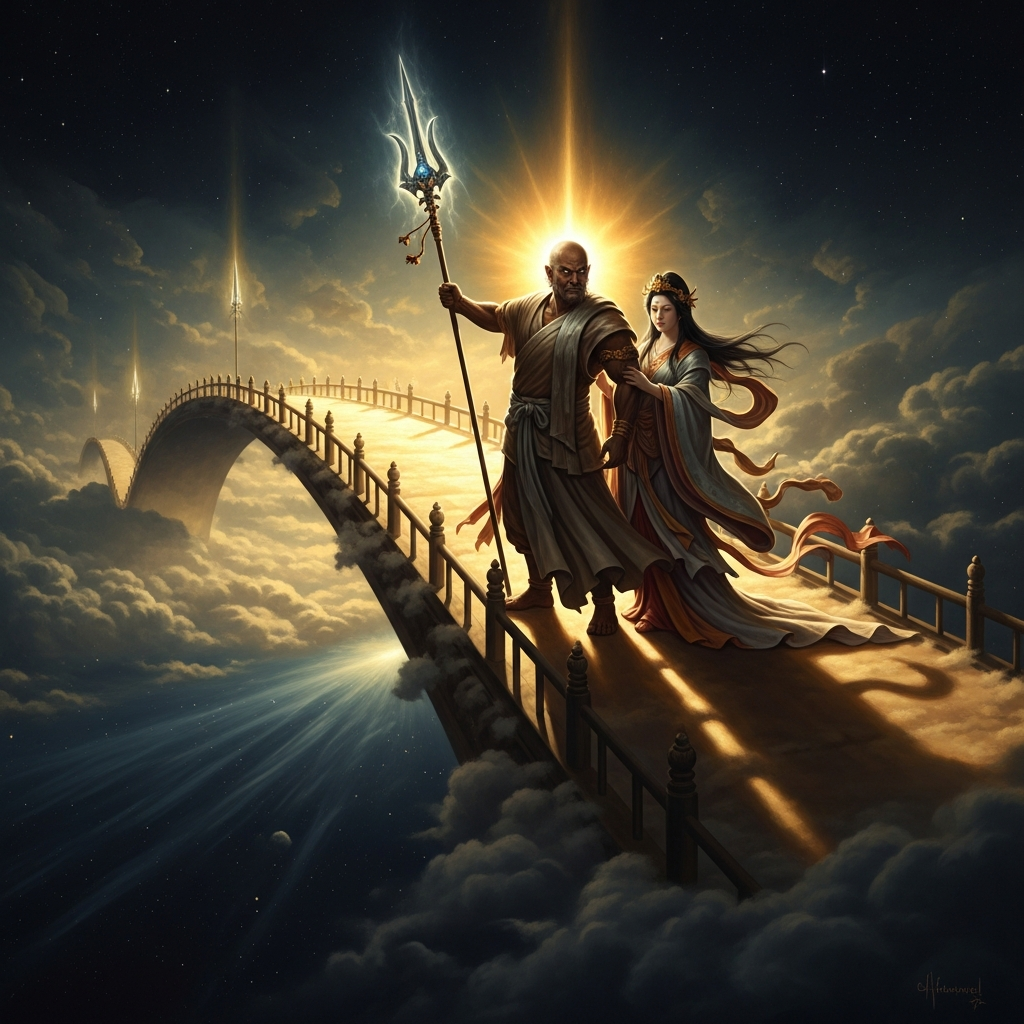
This is the god who made Japan — who stood with Izanami on the Bridge of Heaven and stirred the ocean into islands with a jeweled spear, who brought forth the mountains and the rivers and the trees and the wind — and he is running from his wife’s corpse.
She is not, precisely, a corpse. She is something the Kojiki calls a shikabane, which carries the resonance of both death and defilement, a thing that has crossed into the condition of kegare, ritual impurity, which in the Shinto cosmology is the deepest wrongness the world contains. She died giving birth to the fire god Kagutsuchi, whose heat burned her from within. Izanagi killed Kagutsuchi for it. He killed his own son in grief, and then he went down into Yomi.
Yomi is the land of the dead in the Japanese tradition — Yomi-no-kuni, the Land of Night, a darkness underground where the dead go after they go. It is not hell in the Western sense, not a place of punishment, but a place of wrongness, of things that have become what they should not be. The Kojiki describes it sparsely: a place of rot. A place where the dead are still recognizable but changed.
He went there for Izanami. He loved her. He asked her to come back.
She told him to wait. She would go speak to the gods of Yomi about being released. She told him, specifically, not to look at her. She went into the inner chambers. He waited in the dark.
He waited too long.
He lit his comb on fire to see by — his comb, which is the kind of detail that means the story is old enough to have come from a time when fire was a significant decision, when you burned something to see, and what you burned was what you wore. He held up the light.
He looked.
She was already there. Izanami was lying in the dark, and she was rotting. The fire that had killed her from within had been doing its work. Maggots moved in the Eight Thunder Gods who had taken up residence in her body — the Thunder God of the Head, the Thunder God of the Breast, the Thunder God of the Belly, the Thunder God of the Back, the Thunder God of the Genitals, the Thunder God of the Left Hand, the Thunder God of the Right Hand, the Thunder God of the Left Foot, the Thunder God of the Right Foot. She was not the being he had come for. She was the condition he had been told not to see.
She spoke from the dark. Her voice was the voice he recognized. She told him he had shamed her.
She called the Shikome.
The Shikome — shikome, ugly women, the hags of the underworld — are Yomi’s police force. They are what pursues you when you have seen what you should not see and then fled from it. They do not pursue slowly. They are fast in the way that shame is fast, in the way that the consequences of a terrible decision arrive before you have finished making it.
Izanagi runs. He throws his headdress at them; the headdress becomes grapes; the Shikome stop to eat. He throws his comb; the comb becomes bamboo shoots; they stop again. This is the logic of the flight from the underworld — you carry things to throw behind you, and the things you throw buy moments, and moments are what you are racing against.
Izanami herself joins the pursuit. She sends the Eight Thunder Gods after him. She calls one thousand and five hundred warriors of the dead. He is outrunning a country.
He reaches the slope of the pass between Yomi and the living world — Yomotsu Hirasaka, the Even Slopes of Yomi — and there are three peaches growing there. He throws them at the pursuing armies. Peaches have power against evil in East Asian cosmology, specifically against the unclean force of the dead. The armies rout. The three peaches hold the line.
But Izanami is still coming.
He finds the great rock — the chigaeshi-no-okami, the Great God Who Turns Back — and he rolls it across the mouth of the pass. It takes fifteen hundred men to move this rock, which means it is not a rock that one god should be able to move, and yet here he is, rolling it across the threshold between the worlds, blocking it with his whole body and the whole of his intention.
Izanami reaches the rock. She cannot cross it.
She speaks to him from the other side.
She says: if you do this, I will kill one thousand people from your world every day.
He says: if you do that, I will cause fifteen hundred births every day.
This is the origin of mortality in the Shinto tradition. Not a fall, not a punishment, not an original sin, but a negotiation between estranged spouses across a rock that seals the gap between the living and the dead. She will kill a thousand a day. He will make fifteen hundred. The difference between the dead and the born is the population of the living world.
He calls her: Izanami, my dear elder sister.
The honorific of a husband to a wife, in the archaic phrasing of the Kojiki.
She calls him: Izanagi, my dear younger brother.
The honorific of a wife to a husband.
They have spoken to each other for the last time. He knows this. He turns away from the rock and walks toward the light.
He reaches the sea of Ahaji — not Awaji Island as it is known today, but the sea near it, the water that exists between the living world and the place where the living world begins to know itself. He strips off his clothing. The clothes he wore in Yomi are kegare — contaminated with the death-impurity he has walked through, the sight he has seen, the loss he has suffered. He throws them in the river one by one, and where each piece of clothing falls, a kami is born — the gods of the road, the gods of the crossroads, the gods of the passage between states.
Then he goes into the water himself.
This is the act the tradition calls misogi — ritual purification through water — and this moment in the Kojiki is its origin. He goes into the river to wash off Yomi. He goes in to clean himself of what he has seen and touched and been unable to save. He goes into the water not because he is dirty in any ordinary sense but because he is contaminated in the cosmological sense: he has been where he should not have been, and seen what he should not have seen, and the only remedy is the river.
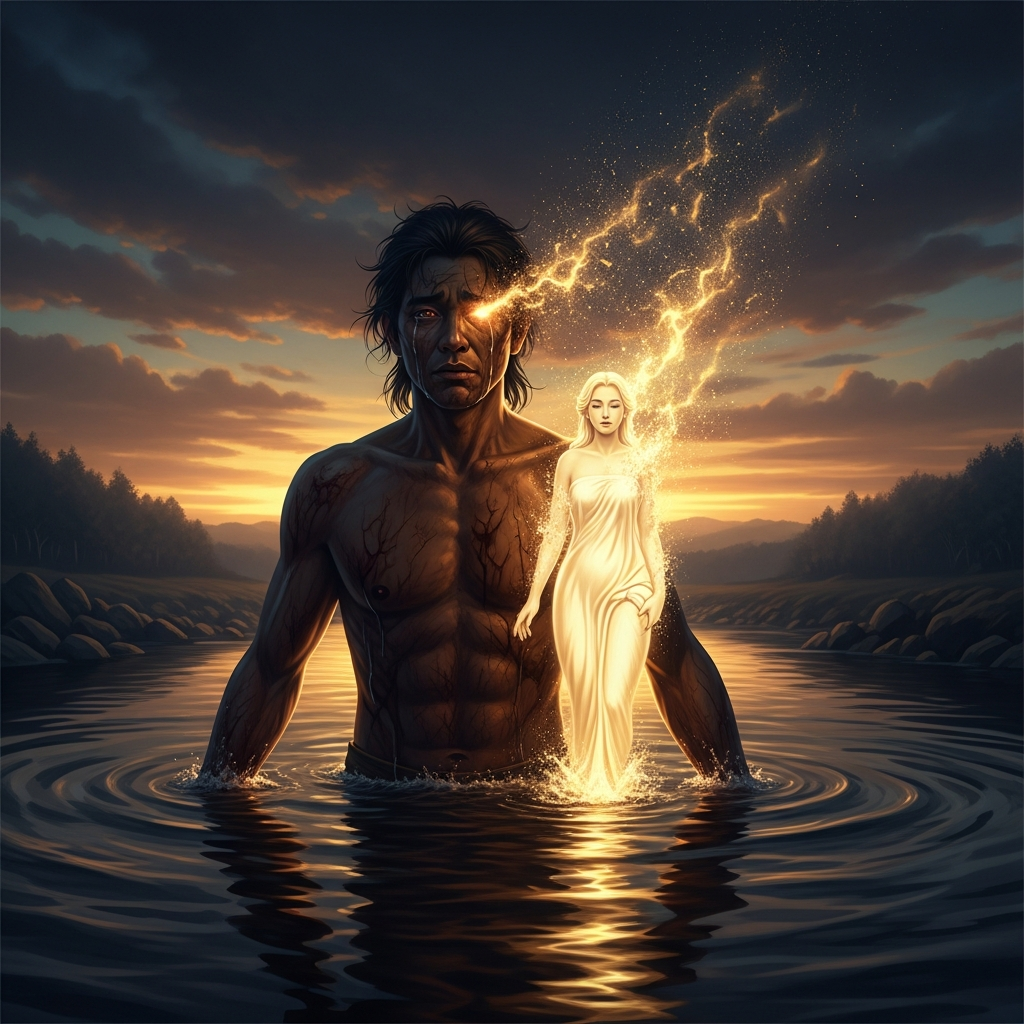
When he dips his left eye, light explodes from the water.
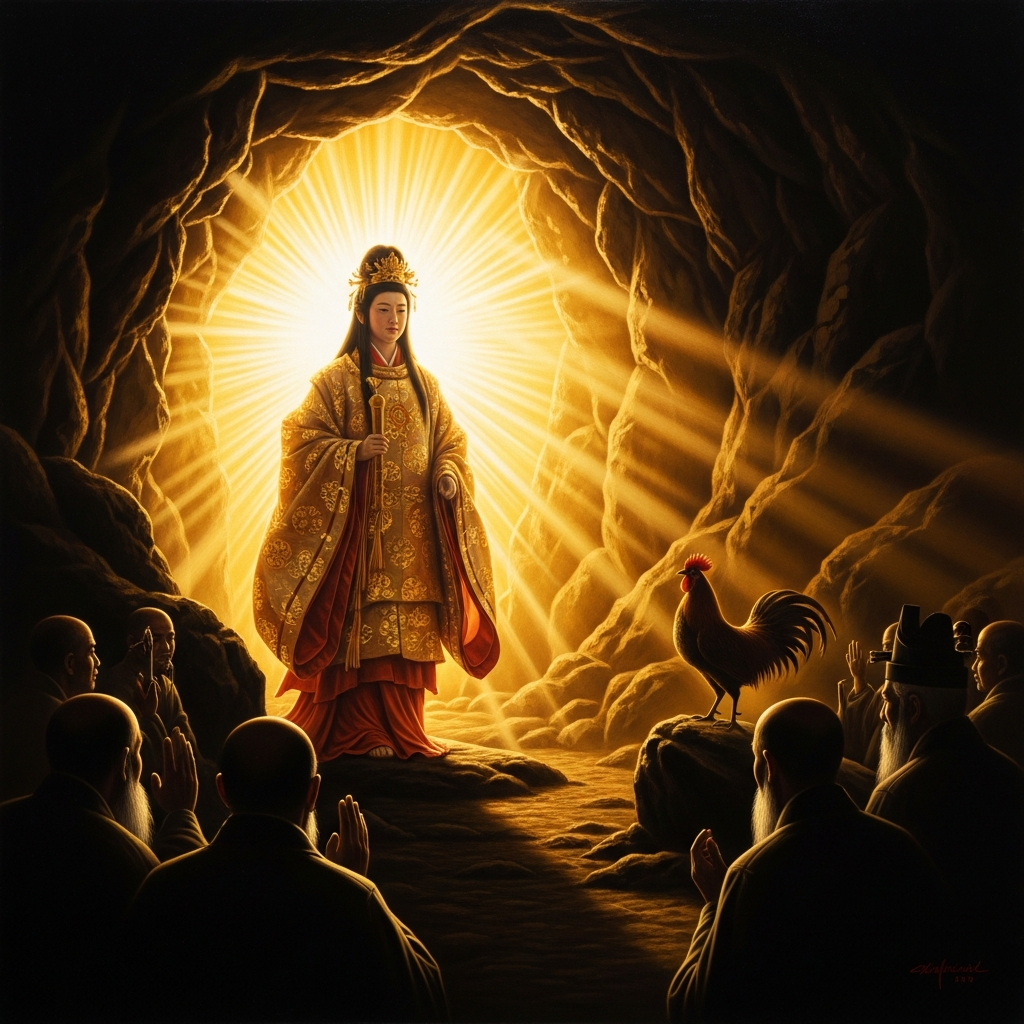
She is born fully formed — Amaterasu-Omikami, the Great Deity Who Illuminates Heaven, the sun goddess who will reign over the Plain of High Heaven, the kami from whom the imperial family will later claim descent, the supreme deity of the Shinto tradition. She emerges from the river and from her father’s eye with the force of the sun at noon, gold and warm and absolute.
She is made of tears. The eye that births her was weeping in Yomi, weeping at the sight of what Izanami had become, weeping through the pursuit and the flight and the long walk back to the living world. She is the sun, and she is grief transformed into light.
When he dips his right eye, silver light follows.
Tsukuyomi-no-mikoto, the moon god, is born from the right eye — quieter than his sister, already somehow separate, already turning his face to a different angle of the sky. The tradition records that he and Amaterasu are separated soon after: Amaterasu sends him to share a meal with the food goddess Ukemochi, and Ukemochi produces the meal from her body, and Tsukuyomi, repulsed by this, kills her. Amaterasu is furious. She declares she will never look at him again. This is why the sun and moon never share the same sky — the separation is an estrangement, the day and the night divided by a quarrel between siblings who were born seconds apart from the same grief.
When Izanagi dips his nose, something wilder erupts.
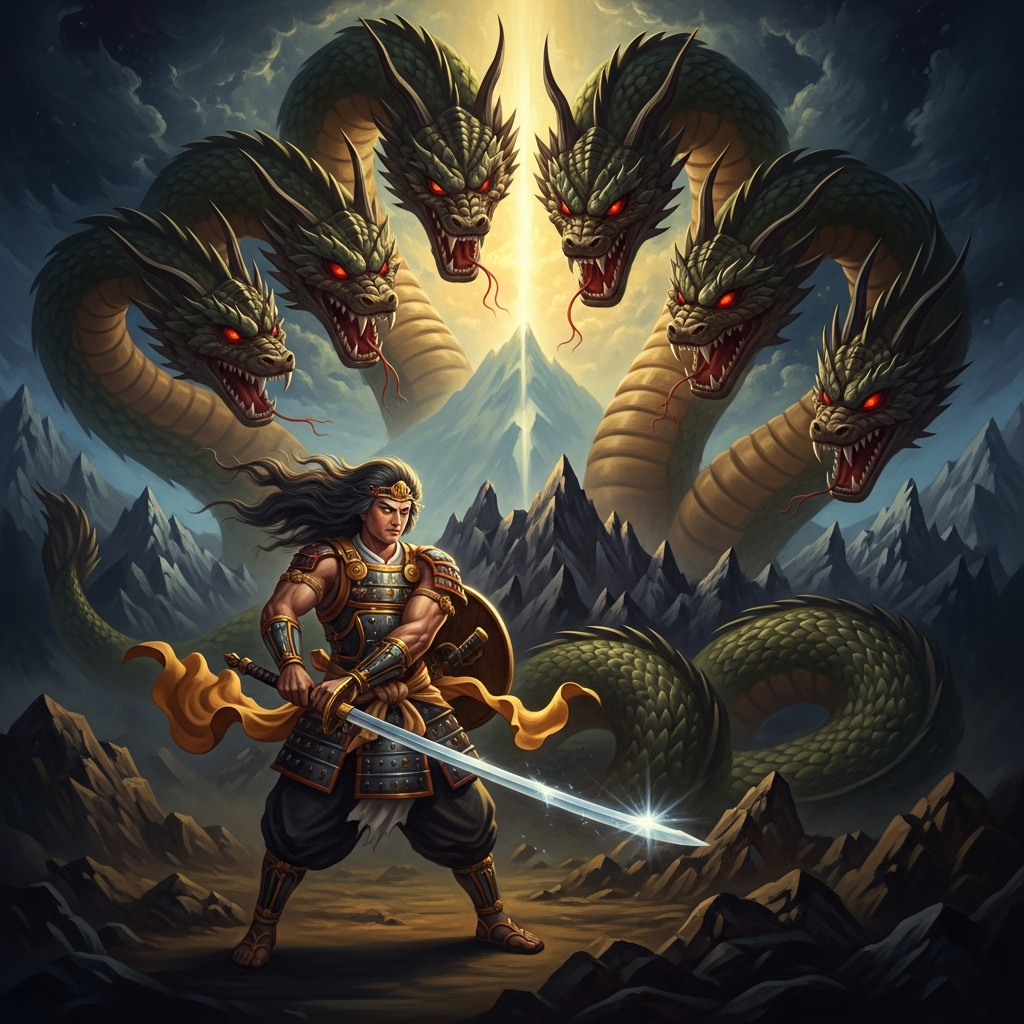
Susanoo-no-mikoto, the storm god — born from his father’s nose, born from snot and tears and the exhaled breath of a god who has been weeping in the underworld, born unruly and loud and already sobbing. He will become the storm god. He will bring rain and grow crops and kill the eight-headed serpent Yamata-no-Orochi and find the sacred sword inside it. He will also be banished from the Plain of High Heaven for weeping too much and bothering his sister and shaking mountains with his grief. He is already, at the moment of his birth from his father’s nose, too much.
The three children stand in the river at Ahaji, born from their father’s face.
Izanagi is overjoyed. The texts are careful about this — the Kojiki does not say he grieved and then recovered; it says he was joyful because he had borne three noble children. The joy is real. It sits alongside the grief without resolving it. He has lost his wife. He has also made Amaterasu.
He assigns them their domains immediately, while standing in the river, his clothing at the bottom of the water, his dead wife on the other side of a great rock behind him. Amaterasu: the Plain of High Heaven. Tsukuyomi: the realm of night. Susanoo: the seas.
He gives Amaterasu his necklace — a strand of five hundred jewels, the Yasakani no Magatama, which will become one of the Three Imperial Treasures of Japan. He gives her his authority. She is the eldest of his divine children, the greatest of his kami, the one whose light will govern the order of the heavens.
She accepts the necklace. She goes up to the Plain of High Heaven. The sun rises.
Misogi is still practiced in Japan. Practitioners enter cold rivers or stand under waterfalls before ceremonies, before important acts, before transitions from one state of being to another. The practice they perform derives, in the tradition’s own telling, from a god who was running from his dead wife’s body when he reached the water.
What the Kojiki preserves is not a mythology of divine perfection. Its gods weep. They burn things to see in the dark. They run. They carry combs and headdresses to throw at things pursuing them in the underworld. They make negotiating faces at estranged spouses through rocks. When they emerge from the experience into the light, they go into the river and wash.
And from the washing, from the tears, from the bodily residue of their grief, the greatest things in the world are born.
The sun rises every morning from a god’s left eye, still carrying the memory of what he saw in the dark. The moon crosses the night sky from a god’s right eye, and it is separated from the sun not by cosmological necessity but by the specific argument that ended their relationship. The storm god was born from weeping and has not stopped.
Izanagi washed himself clean in the river at Ahaji. He was purified. And yet everything that was born from the washing carries the grief inside it — the grief of a god who went looking for what he loved and came back alone.
This is what misogi is for. Not to erase what happened, but to carry it forward into the light.
Scenes
Izanagi wades into the river at Ahaji at dawn, chest-deep in cold water, his face haggard with grief and the horror of what he has seen in Yomi
 Generating art…
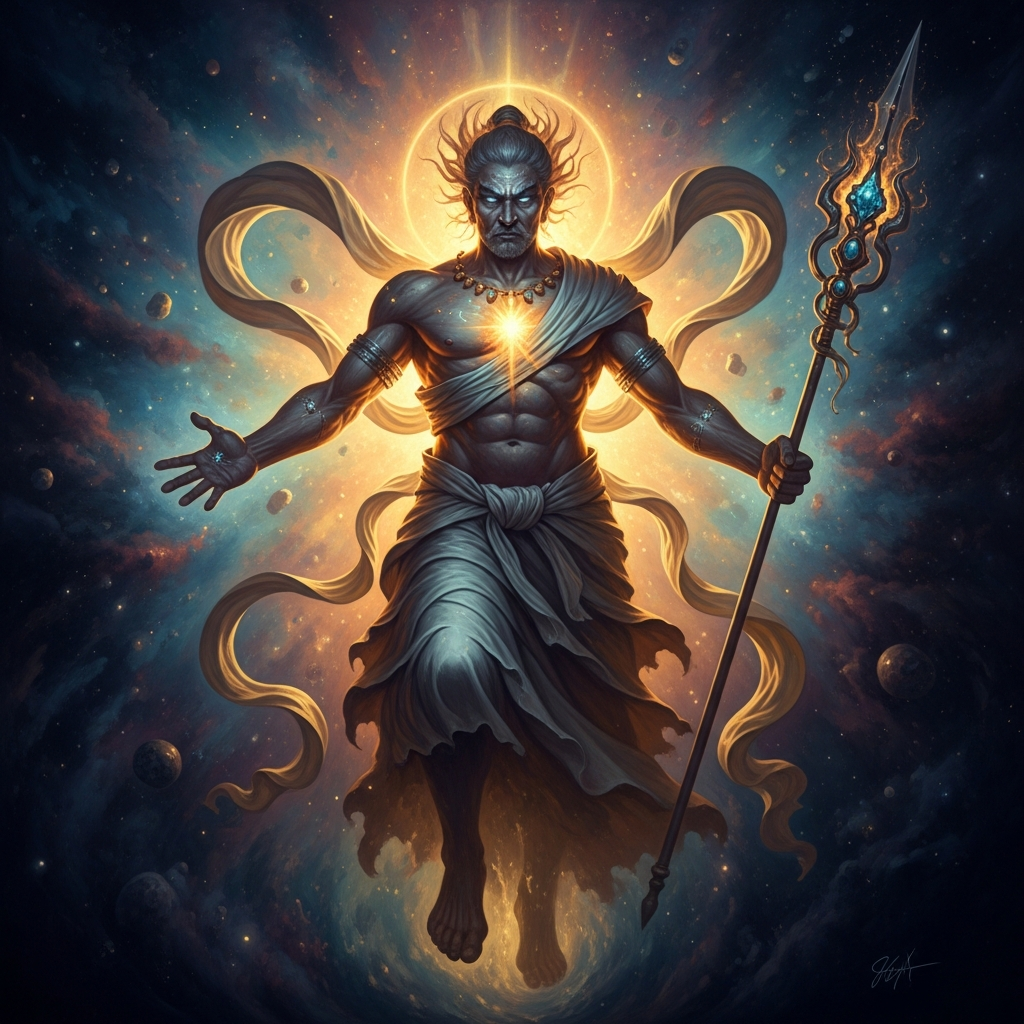
 From Izanagi's right eye, Tsukuyomi is born — a calm, silver light rising from the river's surface as moonrise, the god of the moon standing apart from his sister's golden radiance, already turning his face away, already beginning the separation that will divide day from night forever
 Generating art…
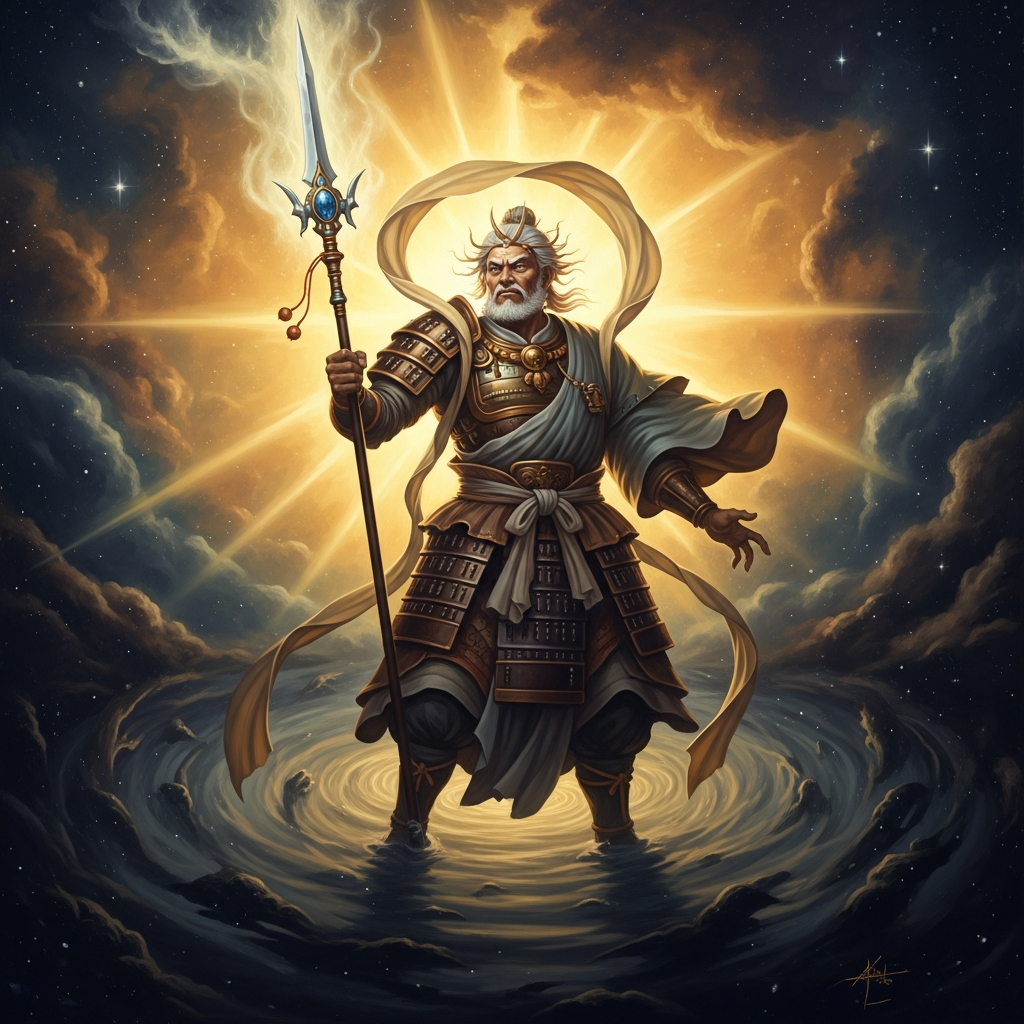
 From Izanagi's nose, Susanoo erupts — not light but storm, a dark figure surrounded by churning wind and rain, born from snot and grief and weeping, already wild, already inconsolable, the god of the storm crying out in the voice of his own nature
 Generating art…
 Echoes Across Traditions
Entities


Sources
- Donald L. Philippi (trans.), *Kojiki* (University of Tokyo Press, 1968)
- W.G. Aston (trans.), *Nihongi: Chronicles of Japan from the Earliest Times* (Kegan Paul, 1896)
- Joseph M. Kitagawa, *On Understanding Japanese Religion* (Princeton University Press, 1987)
- Motoori Norinaga, *Kojikiden* (Commentary on the Kojiki), 1798, excerpts in David Pollack trans.
- Carmen Blacker, *The Catalpa Bow: A Study of Shamanistic Practices in Japan* (Allen and Unwin, 1975)