Okuninushi Surrenders the Visible World
Mythic Time · Kojiki Book I–II, ~712 CE · The Central Land of Reed Plains (Japan); Susanoo's realm in Yomi; the shore at Inasa; Izumo
Contents
Okuninushi-no-Mikoto spends centuries building the land of the living — inventing medicine, surviving the underworld, establishing an abundant country. Then the heavenly gods descend and demand he surrender. He does not fight. He asks only for a palace. The Grand Shrine of Izumo becomes his throne over the invisible world, and the greatest act of statecraft in Japanese mythology is a negotiated abdication.
- When
- Mythic Time · Kojiki Book I–II, ~712 CE
- Where
- The Central Land of Reed Plains (Japan); Susanoo's realm in Yomi; the shore at Inasa; Izumo
Before the heavenly gods claim Japan, a different god is already building it.
Okuninushi-no-Mikoto — Master of the Great Land — is not the first name given to him. He earns it. The Kojiki calls him Onamuji at birth, one of eighty brothers, the youngest and least regarded, sent on errands and mocked and left for dead on multiple occasions by siblings who see in him only an inconvenience. He is a god who begins at the bottom of a divine hierarchy and works his way to the top of a country, and the path between those two points is long enough to fill most of the first two books of the oldest written record in Japan.
His first act of consequence is small and, for that reason, perfectly chosen.
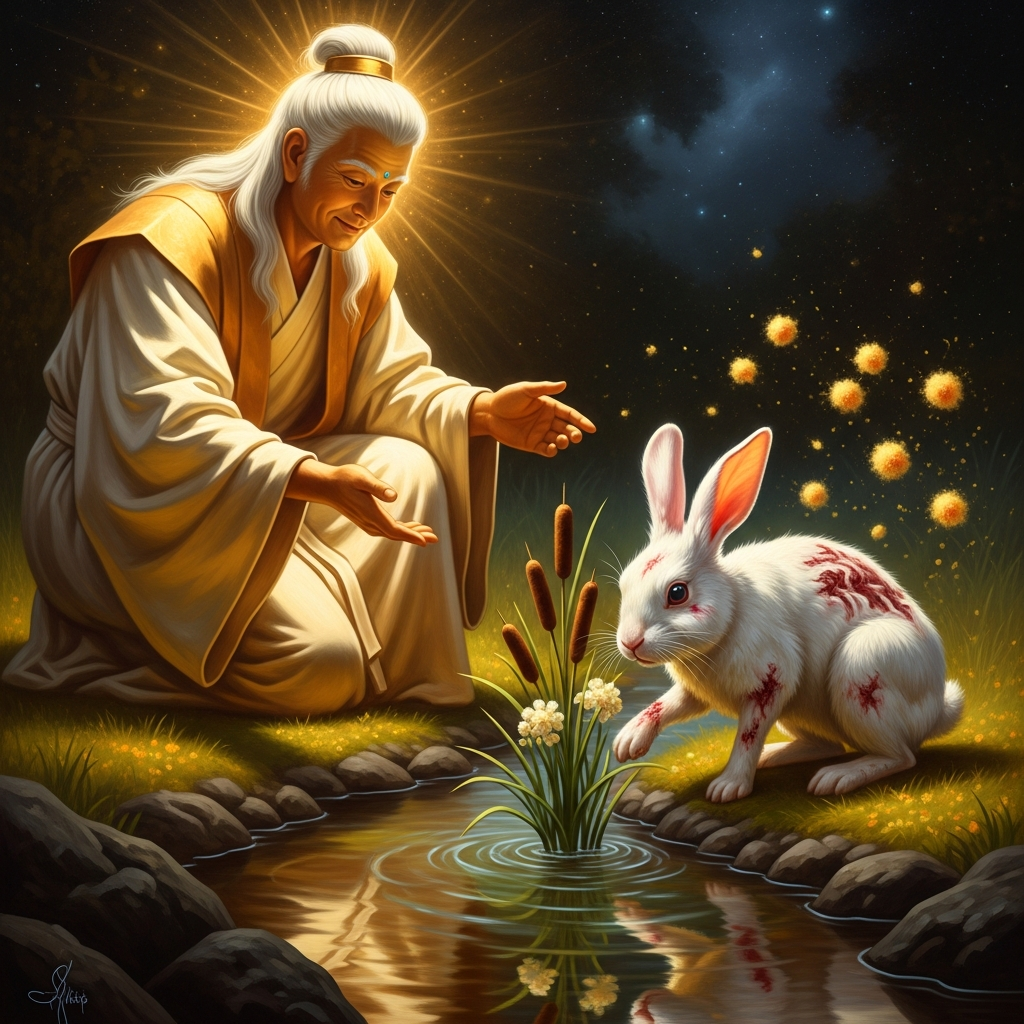
The eighty brothers are traveling to woo a princess in Inaba. Along the shore they find a white rabbit, skinless, weeping on the rocks. The brothers tell the rabbit to bathe in seawater and dry itself in the wind — advice that is not advice but cruelty, since salt on an open wound is torture and they know it. The rabbit follows their instructions and suffers accordingly. Okuninushi comes last, after his brothers have passed, carrying their baggage as is appropriate for the youngest and least. He stops. He asks what happened. The rabbit explains: it was crossing from one island to another by riding the backs of wani — sea creatures, crocodiles or sharks — in a line, counting them as it ran across; but it boasted when it reached the shore and the last wani stripped its skin off for the imposition. Okuninushi listens. He tells the rabbit to wash in fresh water from the river mouth, to roll in the pollen of the cattails blooming at the shore, to lie in the warmth until the fur grows back. He does not explain why he is helping. He simply helps. The rabbit heals, and in its gratitude it prophesies: the princess the eighty brothers are all seeking will marry Okuninushi alone.
This is how the Kojiki establishes its hero. Not through combat or cosmic drama but through the act of stopping when everyone else walked past.
The eighty brothers, predictably, do not respond well to the prophecy. They kill Okuninushi twice. The first time they crush him with a boulder. His mother recovers him and the divine princess of shells and clams heals him with ground shell applied like medicine — the original pharmacopoeia. The second time his brothers lure him into a hollow tree and seal it. He escapes. He flees south to Susanoo’s realm.
Susanoo is in the underworld, which in the Kojiki is also called Ne-no-Kuni — the Root Country, the Land of Roots — a liminal space that is not quite Yomi and not quite the earth. Susanoo is a storm god in retirement, exiled from heaven and settled, and what he sees in the young fugitive who appears at his door is something he recognizes: raw material. He tests it.
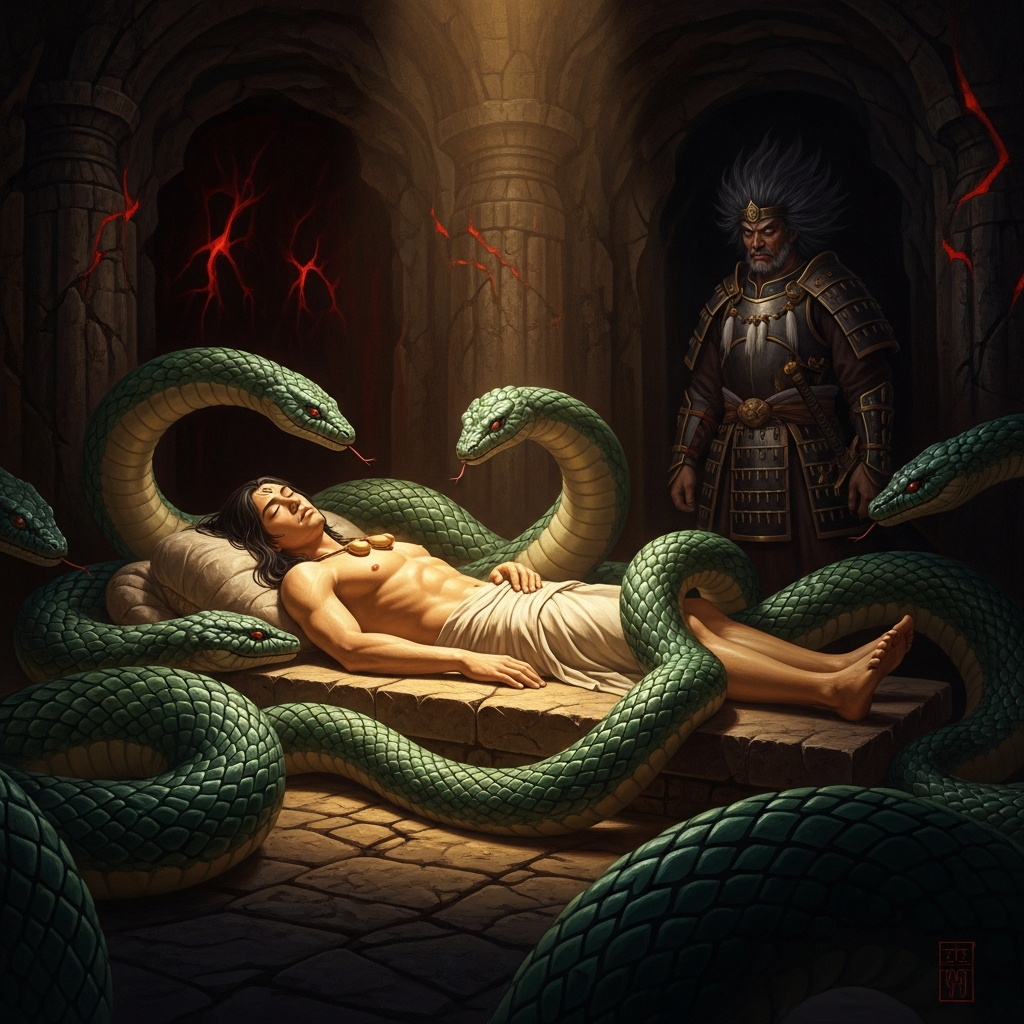
The tests are not metaphors. They are very specific ordeals that require very specific responses. Susanoo puts Okuninushi in a room of snakes. The snake-scarf Susanoo’s daughter Suseri-hime brings him, waved three times, calms them. Susanoo puts him in a room of bees and wasps; the bee-and-wasp-scarf manages that. Susanoo sends a flaming arrow into a field and tells Okuninushi to retrieve it — the field ignites. The mice appear. They come in numbers and they tell him where to stand: the outside looks narrow but the inside is wide, meaning the hole beneath the burning field, and he drops into it and waits while the fire passes over him, and when he comes out the arrow is in his hand. Every test answered. Every night survived.
He escapes Susanoo’s realm with Suseri-hime, taking Susanoo’s sword and his bow and his koto, and as they flee, the koto brushes a tree and the sound wakes the sleeping storm god. Even in that moment, as Susanoo rises to pursue them, he looks at the young god running with his daughter and his weapons and he shouts after him: not a curse but a commission. Use those possessions to push your brothers aside and rule the Central Land of Reed Plains. Call yourself Okuninushi. The man who tested him harshest is also the one who names him.
Okuninushi returns to Japan and builds a country. The Kojiki does not dramatize this in detail — it catalogs it in the way that a nation catalogs its own founding, which is to say as a list of establishments and institutions rather than as a sequence of battles. He builds with a companion: Sukunabikona, a tiny deity who arrives in a boat made from a seed pod and paddles with goose-feather wings, and together they establish the arts of medicine for humans and for animals, the cultivation of grains, and the techniques of ritual that ward off birds and insects and disease. Sukunabikona eventually sails away to the Eternal Land. A different divine spirit enters Okuninushi and completes what the small god began. The land they make is abundant. It works.
Then the messengers come.
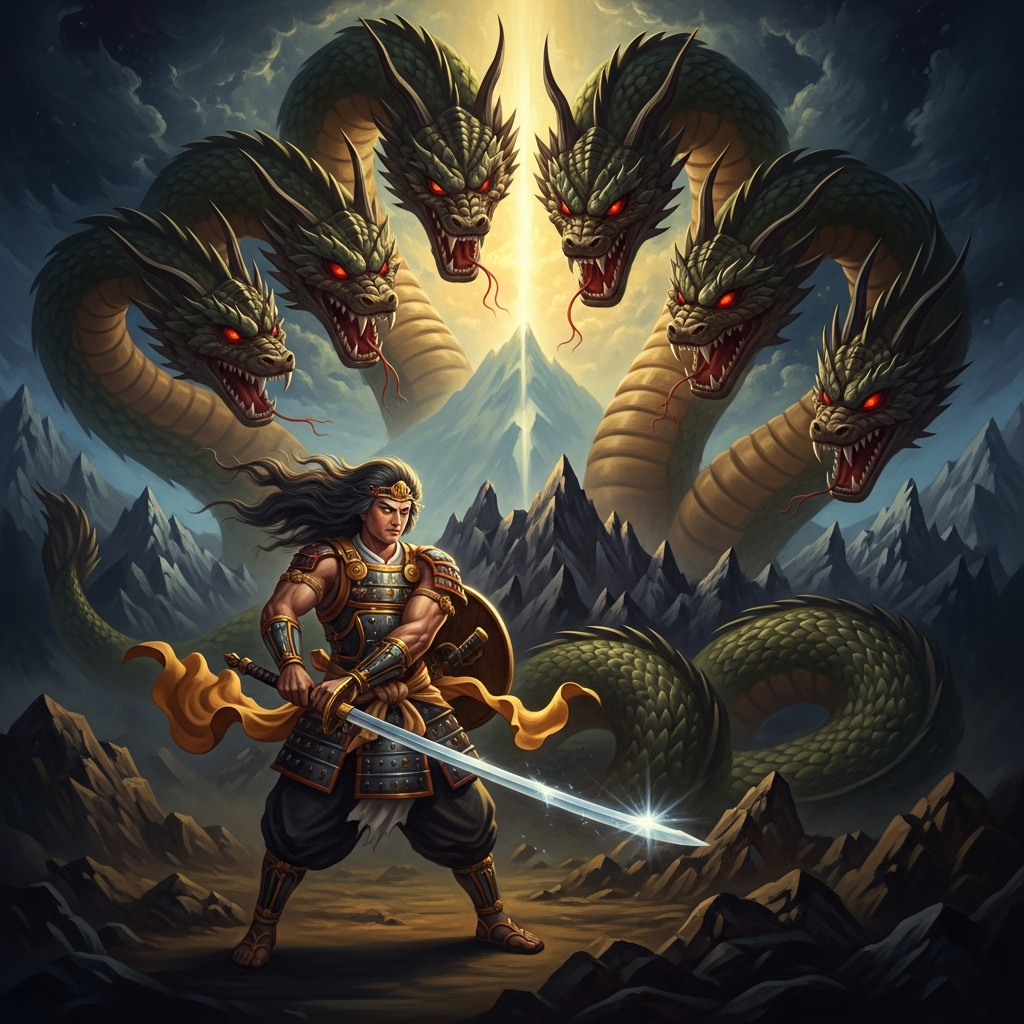
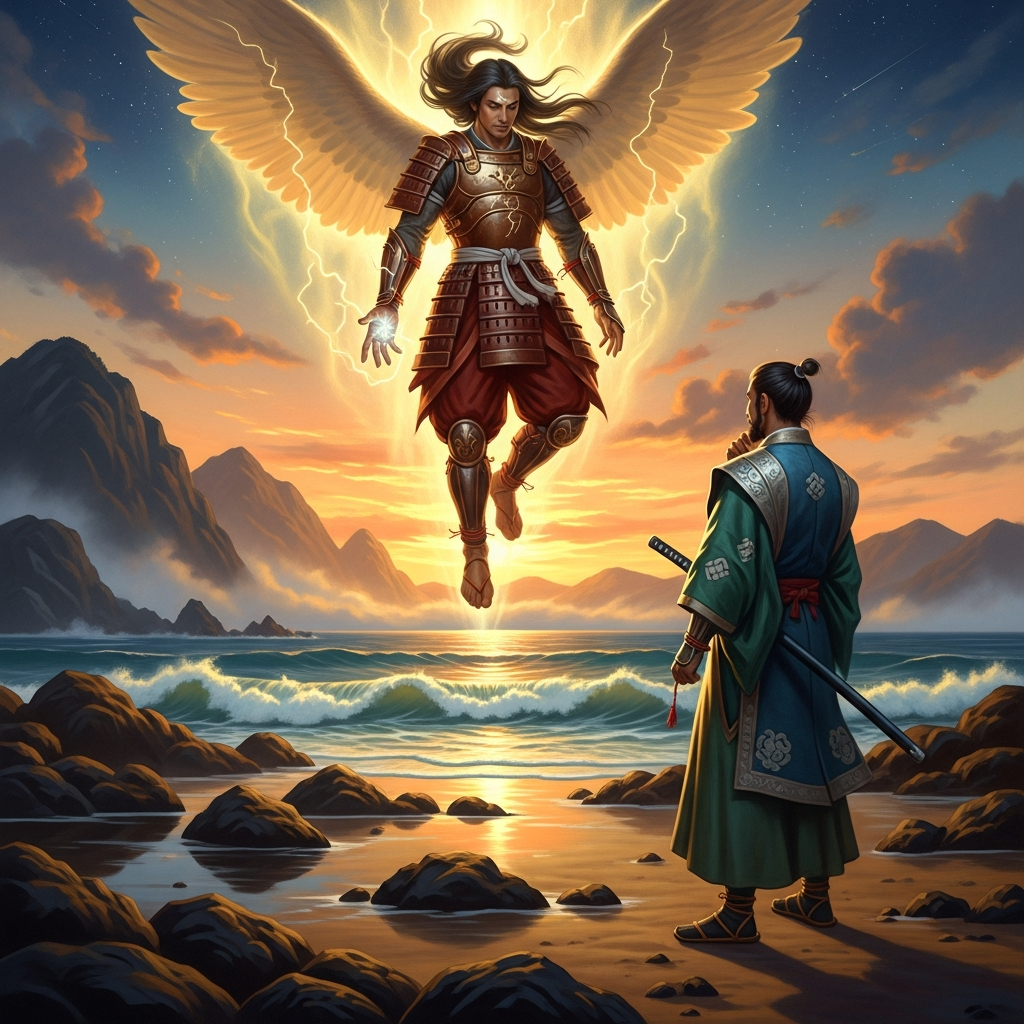
Amaterasu, ruling the High Plain of Heaven, looks down at the Central Land of Reed Plains and determines that it is prosperous enough to claim. The Kojiki is careful about the logic here: the land Okuninushi built is so successful that it attracts the attention of the heavenly gods. His achievement is exactly what makes it irresistible to them. The first messenger sent to negotiate the transfer is Ame-no-Hohi, who descends to the earthly realm and simply never reports back — he likes it there, apparently, and is absorbed into the land he was sent to demand. The second messenger’s son gets killed in the eight years it takes him not to return. The third is Pheasant Woman. The fourth is the war deity Takemikazuchi, the thunder god, who descends to the shore at Inasa with his sword planted point-first in the ocean foam and demands, formally and without ambiguity, that Okuninushi yield.
Okuninushi does not answer immediately. He sends the question to his son Kotoshironushi, who is fishing offshore in the morning mist. Kotoshironushi listens to the demand from his boat. He turns his hand-shielding gesture into a capsizing — the boat flips, he transforms into a bird, he steps under the water — and before he goes he says: I will obey the command of the heavenly gods. This land, I offer it up. Another son, the war deity Takeminakata, tries to fight Takemikazuchi and loses. He is sent to Lake Suwa in Shinano, where he remains.
Okuninushi stands at last at the shore and faces the question directly.
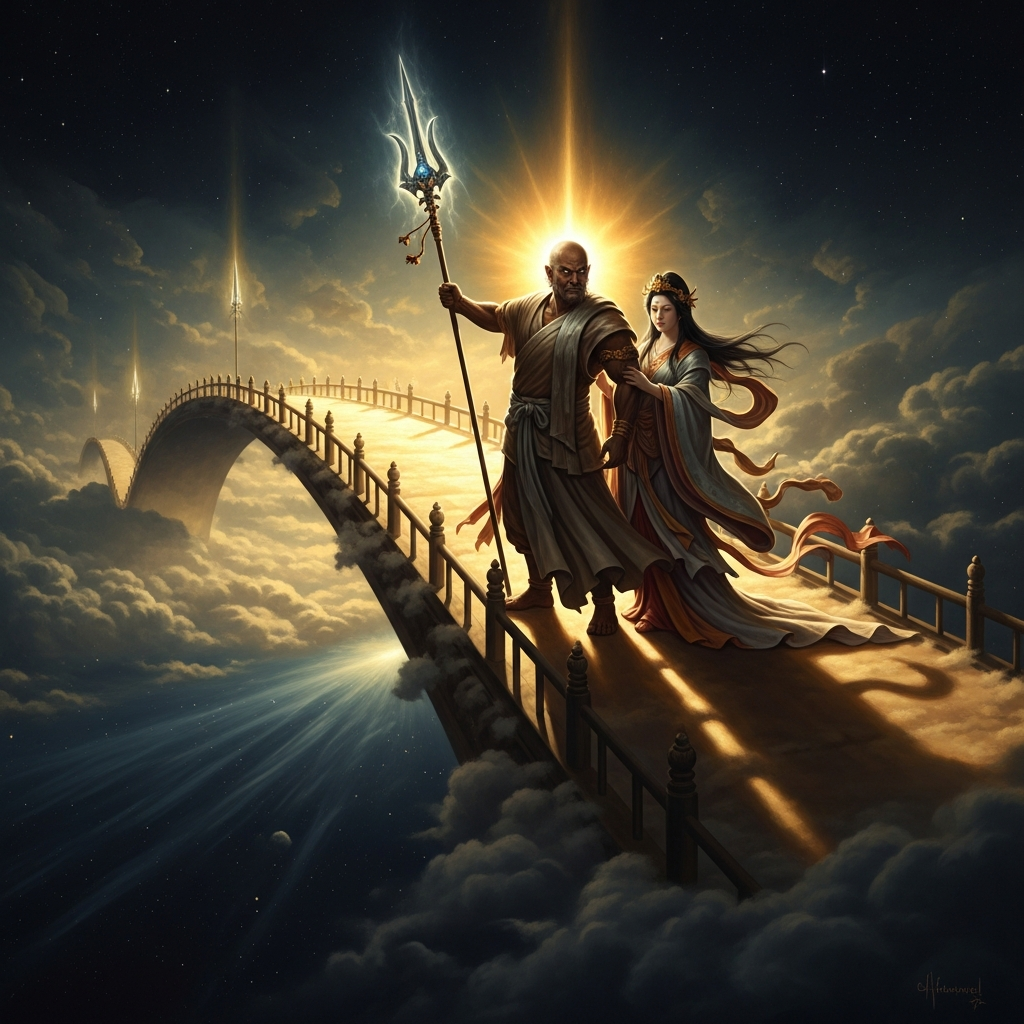
He asks for one thing. He does not ask for the armies to stop coming, or for his title, or for the Central Land. He asks that in exchange for yielding the visible world — the land his hands built, the medicine he invented, the country his centuries of labor established — a great palace be constructed for him. A palace as grand as the one the heavenly gods inhabit. A palace where he can retire and rule what the heavenly gods do not govern.
The negotiation is accepted. The Grand Shrine of Izumo rises at the edge of the sea — the largest wooden structure in Japan, its pillars the tallest in the land. And into it Okuninushi withdraws.
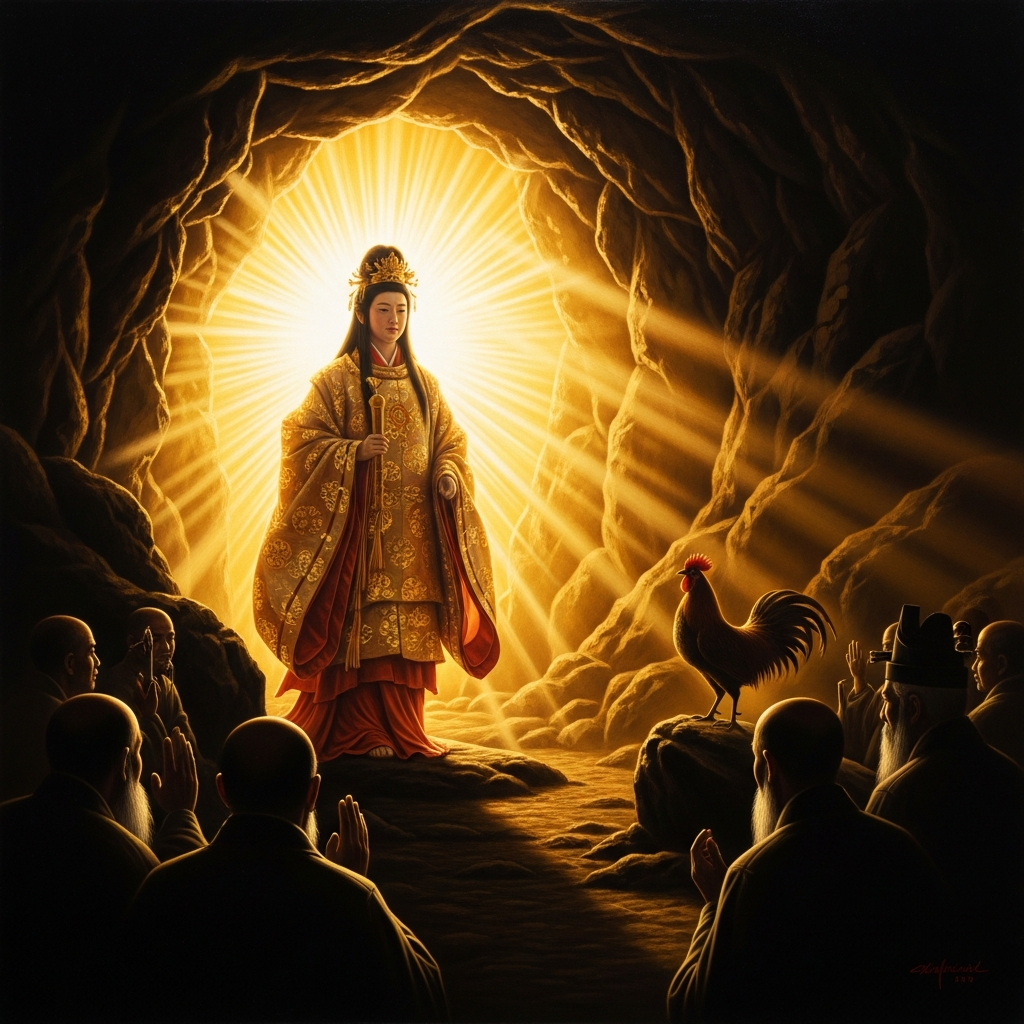
The heavenly gods take the visible world. Okuninushi takes the invisible: the realm of spirits, of the dead, of marriage, of fate, of everything that happens beneath the surface of the world that the sun goddess oversees. He becomes the deity presided over at Izumo, where once a year all the gods of Japan gather in the tenth month — which is why everywhere else in Japan that month is called Kannazuki, the month without gods, and in Izumo alone it is called Kamiari-zuki, the month the gods are present.
What the Kojiki does not frame as loss, we should not frame as loss. Okuninushi spent his centuries building something real — islands of medicine and agriculture, rituals of protection, an abundance the heavenly gods found worth claiming. His surrender is the act of a man who understands the difference between what he built and what he is. He gave the land to those who could hold it in the sun. He took the world beneath the world, the one no sword can reach, the one made entirely of connection and memory and the invisible threads between the living and the dead. The Izumo Shrine stands. The gods still come.
Scenes
Okuninushi finds the white rabbit of Inaba stripped of its fur by the cruel deities
 Generating art…
 In Susanoo's hall in the underworld, Okuninushi sleeps surrounded by serpents
 Generating art…
 The heavenly messenger Takemikazuchi descends to the shore at Inasa
 Generating art…
 Echoes Across Traditions
Entities
- Okuninushi
- Susanoo
- Ame-no-Hohi
- Takemikazuchi
- Kotoshironushi

Sources
- *Kojiki* Books I–II (trans. Donald L. Philippi, 1968)
- *Nihon Shoki* Books I–II (trans. W.G. Aston, 1896)
- Aoki Michiko, *Records of Wind and Earth* (1997)
- Joseph Campbell, *Oriental Mythology: The Masks of God* (1962)