Amaterasu and the Rock Cave of Heaven
Mythic Time · Kojiki Book I, ~712 CE · Ama-no-Iwato — the Rock Cave of Heaven; the High Plain of Heaven
Contents
Susanoo's rampages drive Amaterasu, goddess of the sun, into the Rock Cave of Heaven. The world goes dark. Eight million gods devise a ruse: a lewd dance, uproarious laughter, and a moment of divine curiosity. The strong god seizes the cave door. Light returns.
- When
- Mythic Time · Kojiki Book I, ~712 CE
- Where
- Ama-no-Iwato — the Rock Cave of Heaven; the High Plain of Heaven
The trouble begins with a boundary crossed.
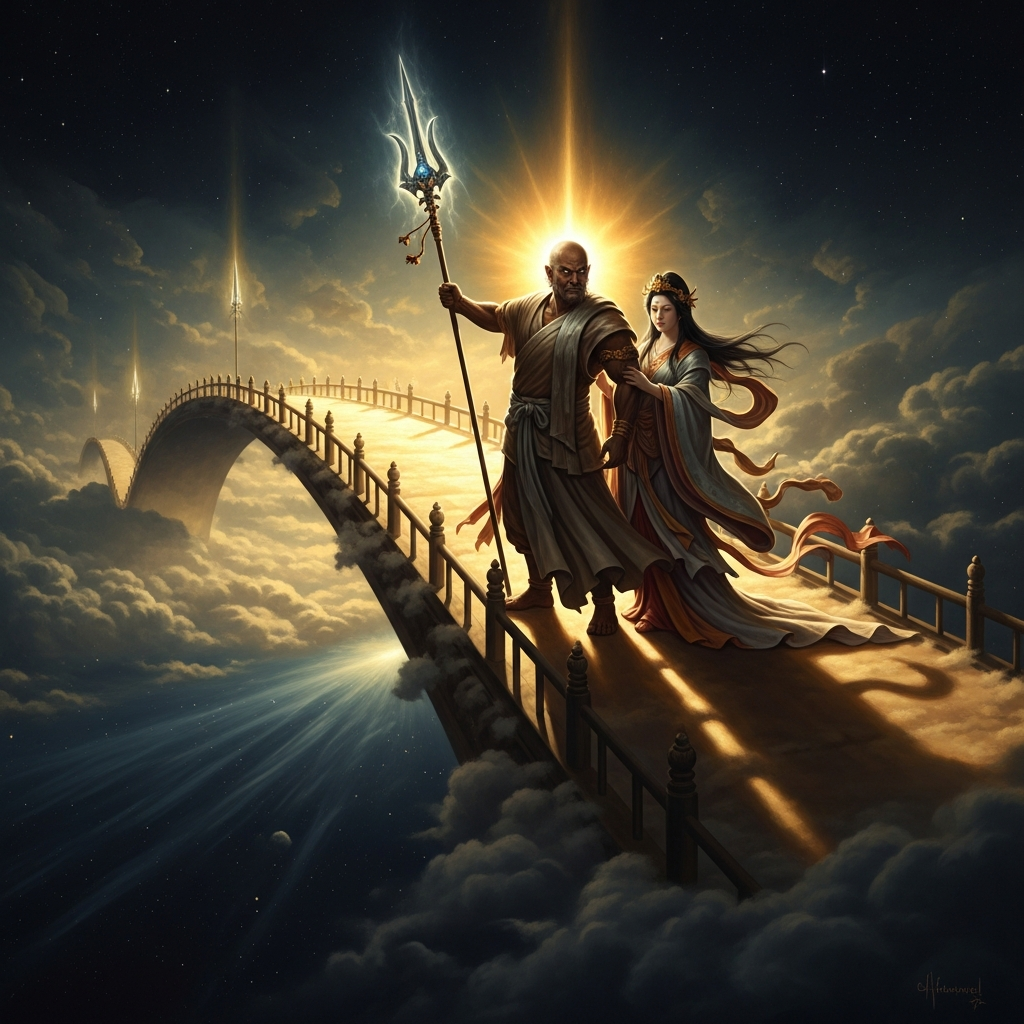
Susanoo is supposed to rule the sea. Instead he weeps — enormous, oceanic grief for his dead mother Izanami — and the weeping shakes the mountains and floods the rivers and the green world goes brown. His sister Amaterasu, who rules the High Plain of Heaven, arms herself before she meets him: she braids her hair up and ties on a quiver and holds her bow at the ready, because she has seen what her brother’s sorrow does to the landscape and she does not trust it. He says he is only grieving. She says she believes him. Then he descends to the earth and his grief becomes something else — he breaks the rice paddy banks, fills in the irrigation ditches, defiles the sacred weaving hall with a dead horse. One of the weaving maidens is startled so badly she strikes herself with the shuttle and dies. And Amaterasu, who has been trying to give her brother every benefit of every doubt, finally retreats.
She goes deep into the mountain.
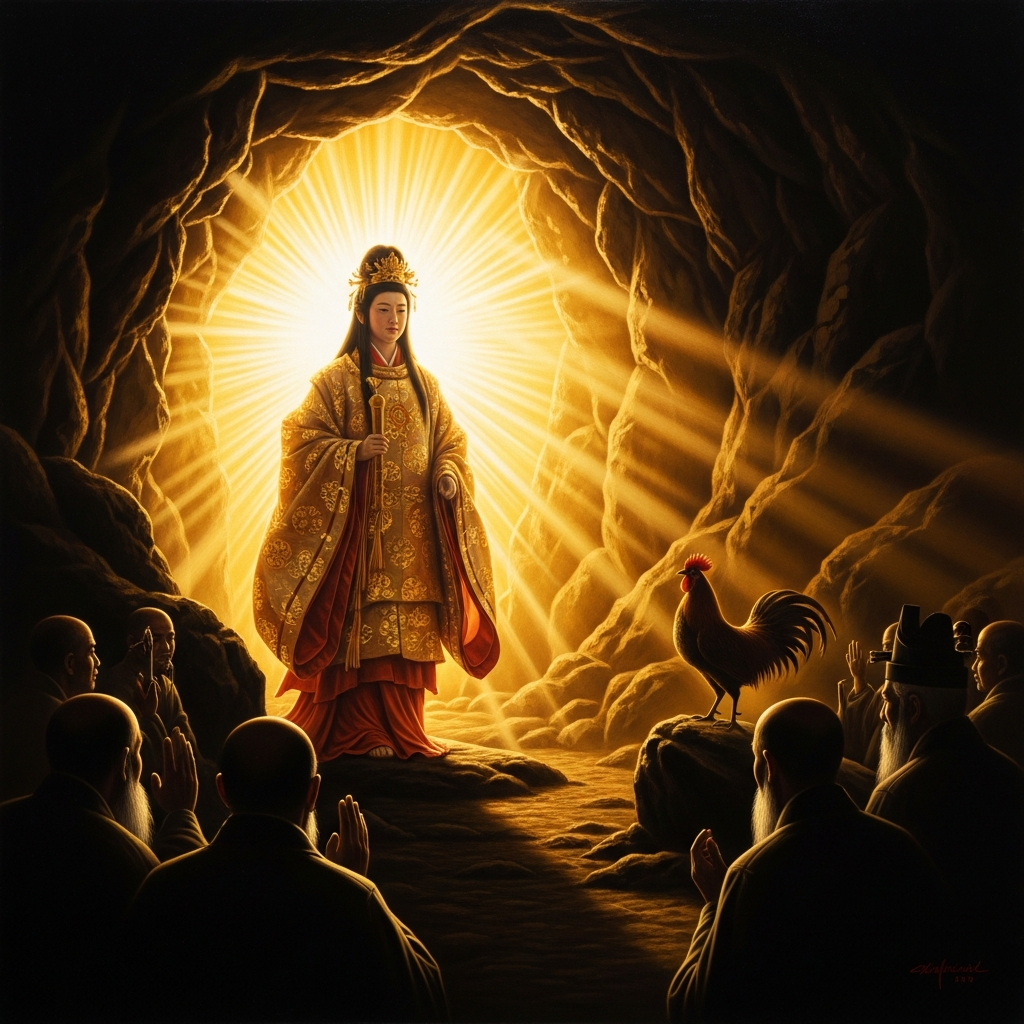
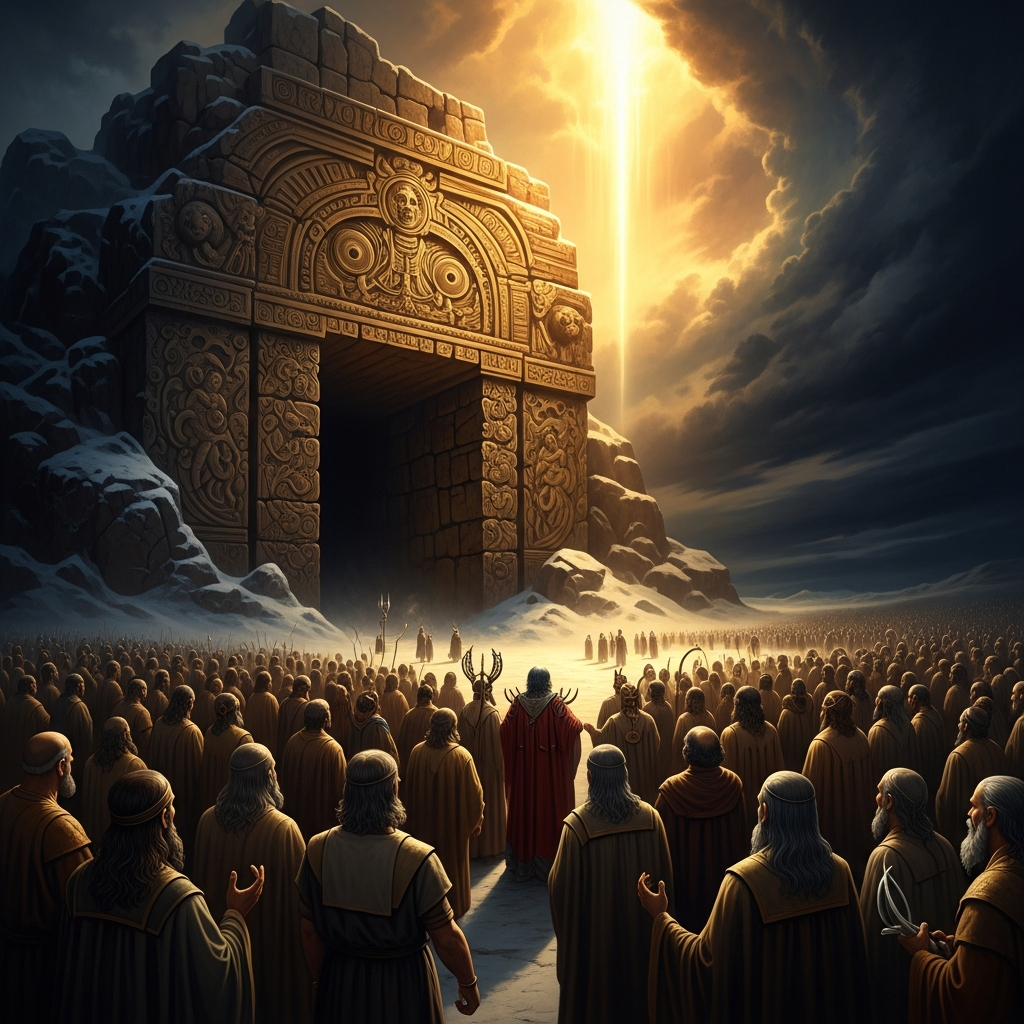
Ama-no-Iwato — the Rock Cave of Heaven — is the place the sun goes when the sun gives up on the world. It is not a cave in any ordinary sense; it is the interior of the cosmos itself, the space behind the light, the room the sun returns to when it decides the world is not worth illuminating. The door is a boulder. She pulls it shut behind her. The sound it makes when it seals is the sound of every dawn that will not come. The High Plain of Heaven goes dark instantly, absolutely. Below on the earth the darkness arrives simultaneously — not night, which has rhythm and the moon and the knowledge that morning follows, but a darkness that feels permanent, that has forgotten it was ever supposed to end. The Kojiki says evil spirits run loose as flies in the fifth month, and ten thousand disasters arise at once.
Eight million gods stand in the dark and think.
They convene on the riverbank before the Rock Cave, eight million of them, and what is striking about the Kojiki’s account is that they do not pray. They do not plead. They do not command. These are gods — they invented prayer, they accept prayers, they know exactly what prayer is for — and they do not use it here, because they understand that Amaterasu is not absent or inattentive. She is hiding on purpose, and she knows they want her back, and if she wanted to come out she would have come out already. So they call a congress. Ame-no-Koyane and Futodama are put in charge. What follows is not supplication. It is a plan.
They hang sacred jewels from a great sakaki tree. They place a mirror in the branches. They dig up a long-crowing bird and set it crying. They perform the divination. And then they call for the dancer.
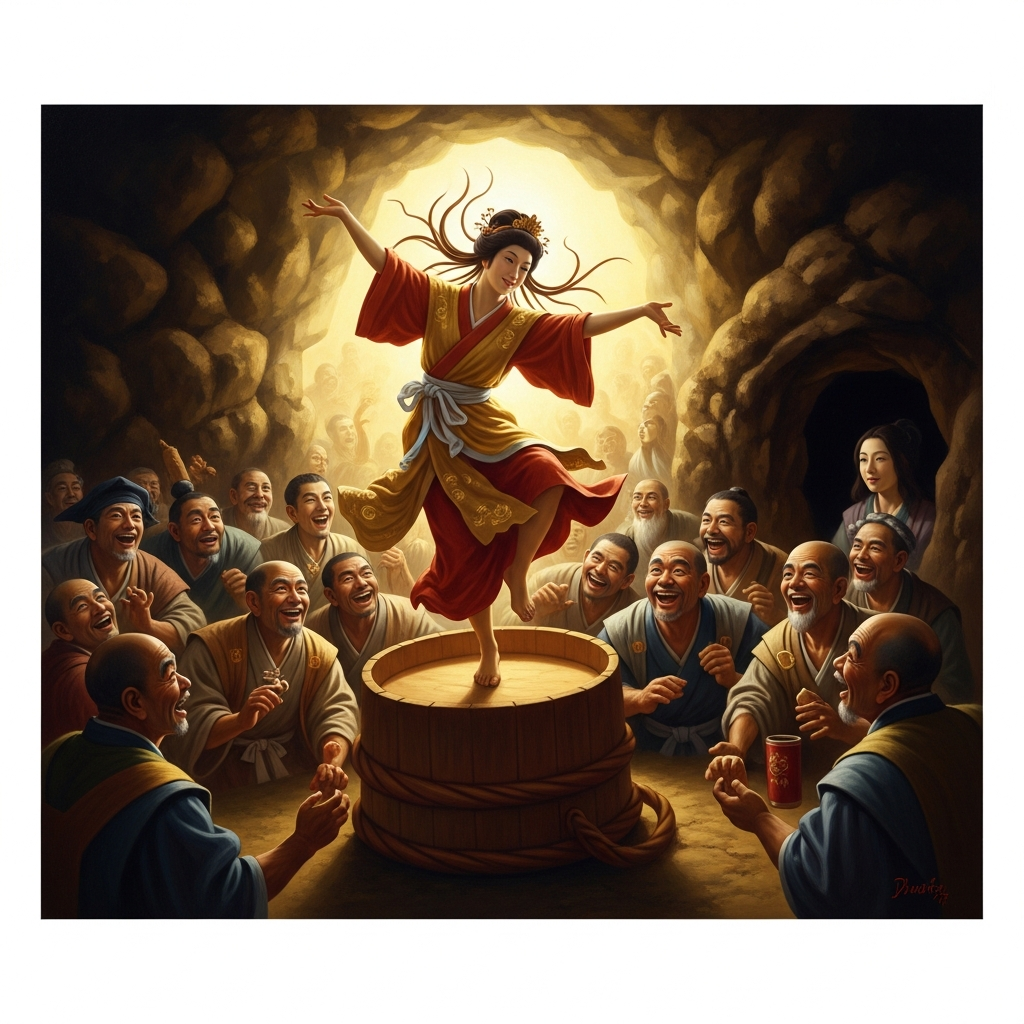
Ame-no-Uzume steps onto an overturned tub.
She is the goddess of dawn, of festivity, of the joy that precedes the light — and what she performs on that upturned tub before the sealed cave is something the Kojiki describes with deliberate frankness. She is possessed. She unties her clothes. She exposes herself. She dances in a way that is not decorative but transgressive, a dance that violates the decorum of heaven with complete, joyous intentionality. And the eight million gods watching erupt. Not in shock — in laughter. Great, helpless, total laughter, the kind that takes the whole body, that makes the eyes water and the knees go wrong. Heaven shakes. The sound of eight million gods laughing at a lewd dance on an overturned tub is, arguably, the loudest thing that has ever happened.
Inside the cave, Amaterasu hears it.
She cannot understand it.
That is the key. She is in the dark. The world is in the dark. There is nothing to laugh at — this she knows, because she went into the cave to escape something that was not funny, and the world without her light is a world of calamity and terror and the loose flies of evil spirits. And yet the gods outside her cave are not praying, not weeping, not demanding. They are laughing. Something is happening out there that she does not know about, and Amaterasu — who is the sun, who illuminates everything, who cannot tolerate the thought that something is happening she cannot see — moves to the boulder. She pushes it open a crack. She peers through.
The world outside floods with the first light it has seen since she entered. A thin shaft, just a crack’s worth, but the plain brightens visibly. And standing just outside the door, perfectly positioned, is a mirror in the sakaki branches, and in the mirror Amaterasu sees a goddess she does not recognize — brilliant, radiant, luminous with power.
She does not recognize herself.
She leans out further.
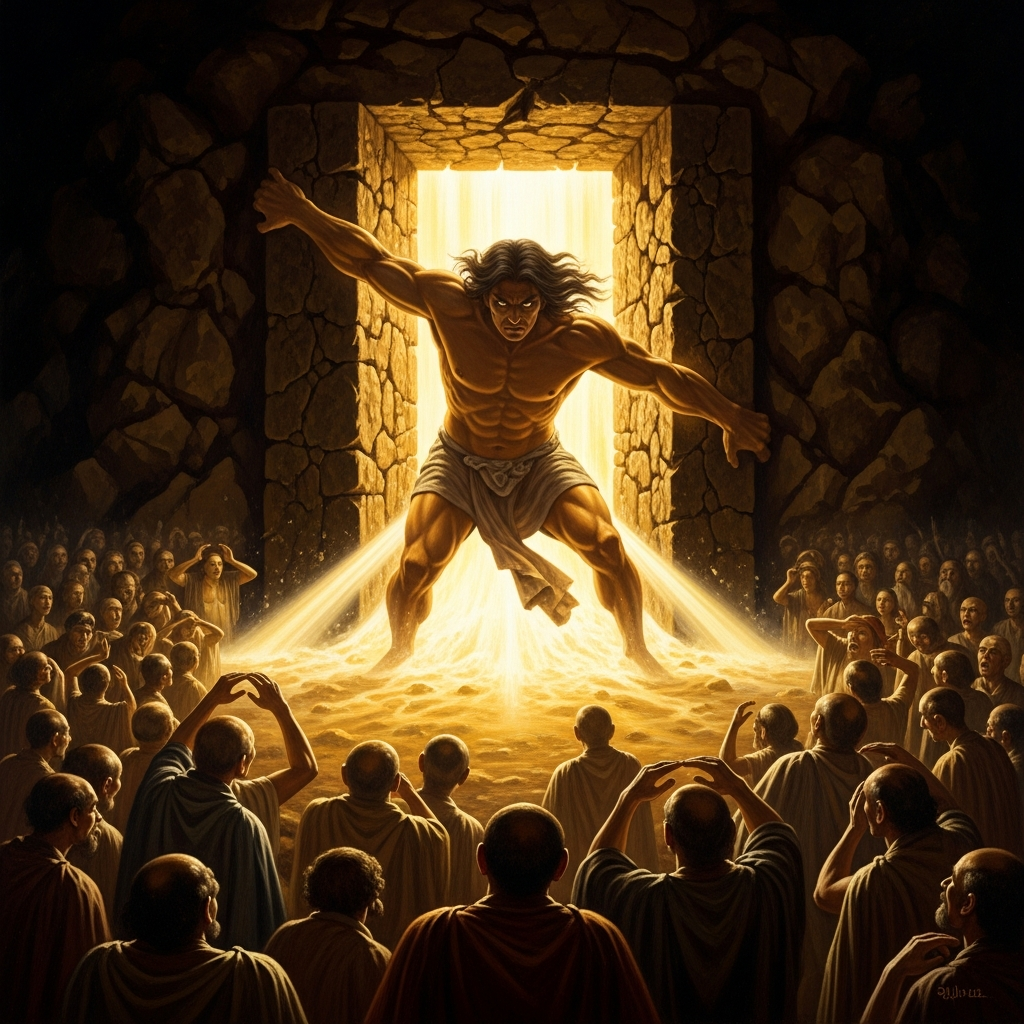
She is looking at her own light reflected back at her and she is pulling toward it, the way light always moves toward light, and in the moment she leans out far enough, the strong god moves. Ame-no-Tajikarao — He-of-Great-Hand-Strength, the deity specifically assembled for this purpose — seizes the edge of the boulder and wrenches it off. It is not subtle. He pulls the door of the Rock Cave of Heaven away from its frame with both hands, and the light that pours out is not a crack anymore. It is the sun. A rope of twisted straw — the first sacred shimenawa — is stretched behind her immediately, across the cave entrance. Two gods hold the cord. Behind her now: the sealed dark. Before her: the eight million gods of heaven, laughing still, holding their jewels and their mirror, the long-crowing bird still calling from somewhere in the cedar branches.
She cannot go back. The rope is there. They have thought of everything.
The lesson that Shinto extracts from this story is not that darkness is defeated by power or by piety. It is defeated by joy. The gods could not drag Amaterasu out, could not compel or bargain or threaten the sun back into the sky. What moved her was curiosity — she heard something she could not explain, saw something she could not identify (herself), and leaned toward it. Every matsuri, every festival drum, every night of communal noise and dancing in front of a shrine repeats this logic: the sacred is not summoned by solemnity alone. Sometimes you put a dancer on an upturned tub and you laugh until the mountain shakes, and you trust that whatever has withdrawn from the world will be unable to resist the sound of a joy it cannot quite place.
Scenes
The Rock Cave sealed
 Generating art…
 Ame-no-Uzume mounts the overturned tub and dances
 Generating art…
 Ame-no-Tajikarao seizes the cave door and wrenches it free
 Generating art…
 Echoes Across Traditions
Entities


Sources
- *Kojiki* Book I (trans. Donald L. Philippi, 1968)
- *Nihon Shoki* Book I (trans. W.G. Aston, 1896)
- Joseph Campbell, *Oriental Mythology: The Masks of God* (1962)
- Motoori Norinaga, *Kojikiden* (1798)