Susanoo and the Eight-Headed Serpent
Mythic Time · Kojiki Book I, ~712 CE · Izumo Province, Japan — the headwaters of the Hi River
Contents
Exiled from heaven, Susanoo descends to Izumo weeping. He finds an old couple with one daughter left — Yamata no Orochi has eaten their other seven daughters and comes again tonight. Susanoo brews eight vats of sake, gets the serpent drunk, and slays it. In its tail he finds the Kusanagi blade.
- When
- Mythic Time · Kojiki Book I, ~712 CE
- Where
- Izumo Province, Japan — the headwaters of the Hi River
He comes down from heaven having lost everything.
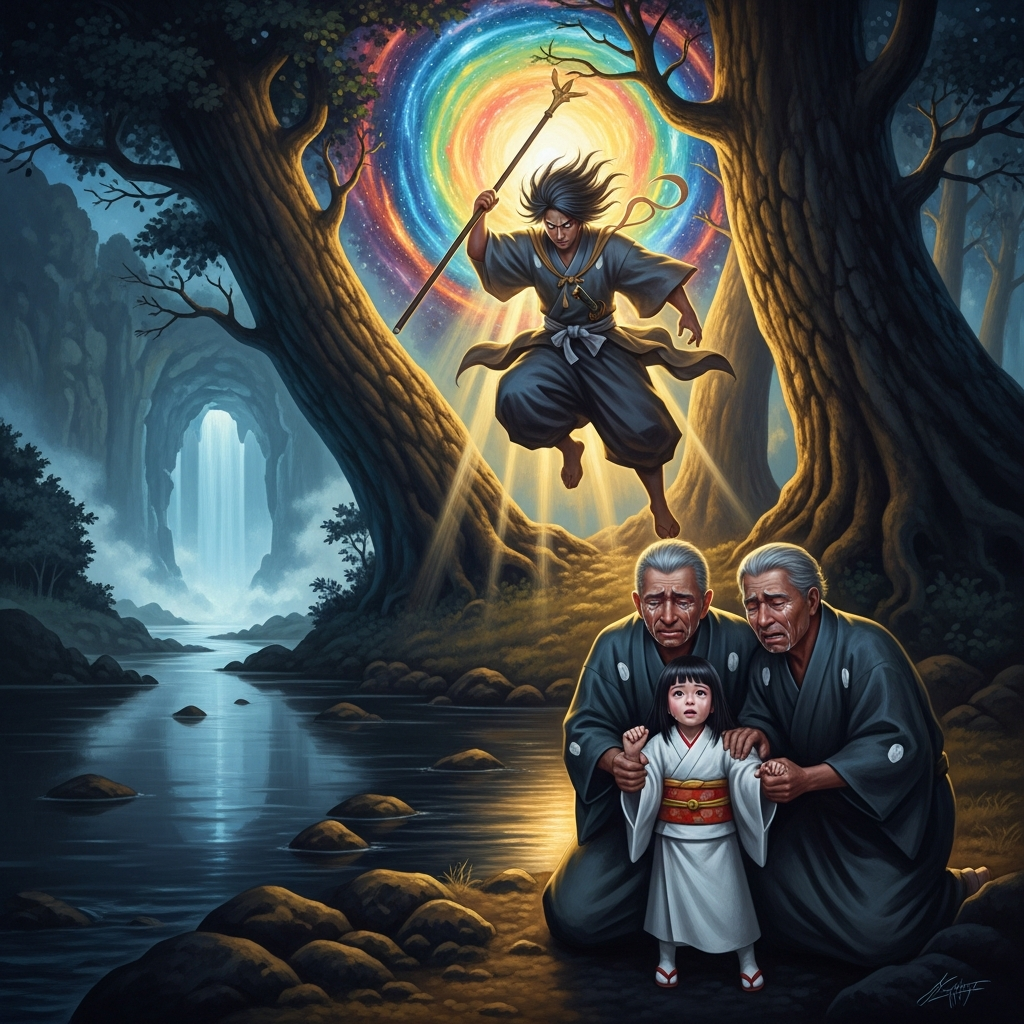
This is not a hero at the beginning of his story. This is a god who wept so much at the border of heaven that the rivers flooded and the mountains shook, and his sister finally said: enough. Susanoo, storm god, born from his father Izanagi’s nose during the first purification of the world — exiled now, sent downward with no commission, no hall, no title beyond the storm already living in his chest. He descends to the province of Izumo, to the upper reaches of the Hi River, and the first thing he notices is the sound of weeping rising from the riverbank. He has been weeping himself for longer than he can remember. He follows it down.
The family at the riverbank is almost done.
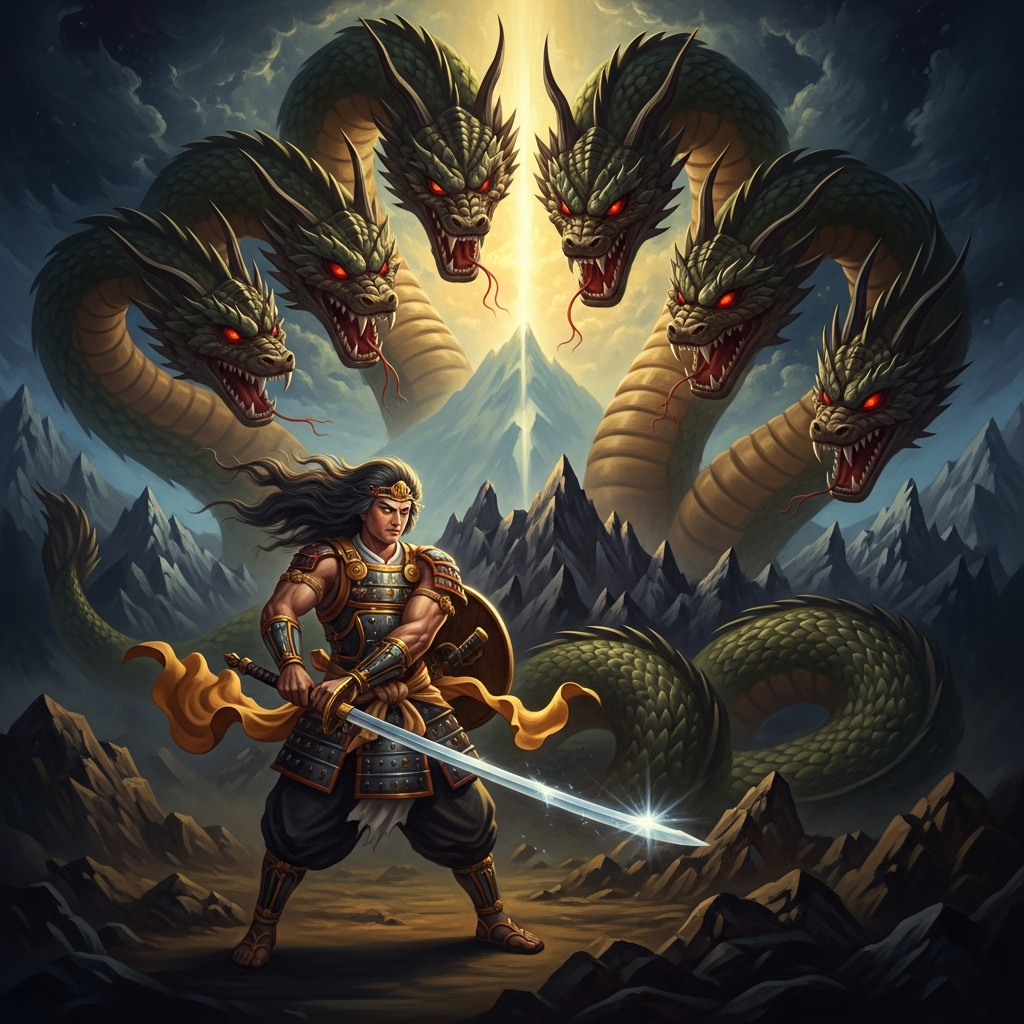
An old man and an old woman kneel in the mud with their youngest daughter between them. The old man is Ashinazuchi — Foot-Stroking Elder. The old woman is Tenazuchi — Hand-Stroking Elder. Their youngest daughter is Kushinada-hime, Wondrous-Inada-Princess, and she is the last. They had eight daughters. Seven are gone. Yamata no Orochi — the Eight-Forked Serpent — took them one by one, one per year, and tonight it comes again. Ashinazuchi raises his head when Susanoo speaks to him, and his voice is the voice of a man past the place where grief can change anything. He describes the serpent precisely: eight heads, eight tails, eyes red as winter cherries, pine trees growing on its back, its body spanning eight valleys and eight hills, venom so strong the grass dies where it passes. He describes it the way a man describes a weather system — not a monster you fight but a fact of nature you endure.
Susanoo looks at Kushinada. She looks back.
“Give her to me as my wife,” he says, “and I will end it.”
He transforms Kushinada into a comb.
This is the part that requires a different understanding of what a storm god does. He does not simply give her a sword, or build her a shelter, or post himself between her and the serpent. He takes a fine-toothed comb of sacred wood, breathes the transformation into it, and tucks her into his hair — safe against his skull, a tooth’s-width from his mind, carried through the whole night in the most intimate proximity a god can offer. Then he turns to the old couple. He tells them what to build: a fence around the estate, eight gates, a platform at each gate, a vat of sake on each platform, eight-times-refined, filled to the brim. Ashinazuchi does not ask questions. He has been stripped of the luxury of skepticism. He builds the fence. He brews the sake. The smell of it rises through the valley all day, sweet and heady, the smell of something extraordinary being prepared.
When the valley goes quiet, the serpent is already coming.
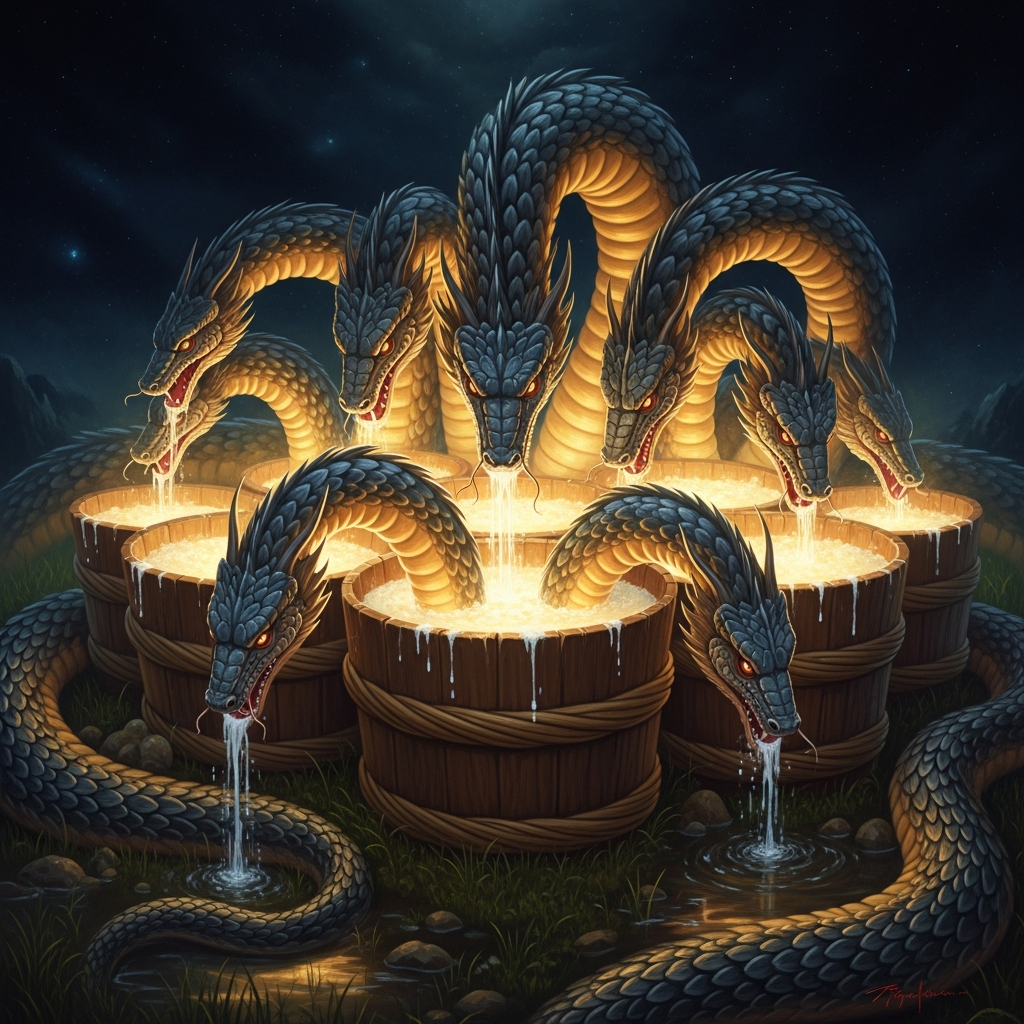
There is a moment before its arrival when every bird stops mid-note and the Hi River seems to hesitate. Then the eight heads push through the eight gates — each head finding its gate as if it has been here before, as if it knows the layout, because in some sense it does: this is its territory, this valley, these people. Each head finds its vat. Each head dips and drinks. Yamata no Orochi, the terror of Izumo, the devourer of seven daughters, drinks the eight-times-refined sake from eight vats with all eight of its appetites operating simultaneously, and the eight heads finish their vats and the eight great necks sway, and one by one, slowly, with the dignity of something that has never once been forced to stop, all eight heads lower to the grass.
Susanoo draws his sword.
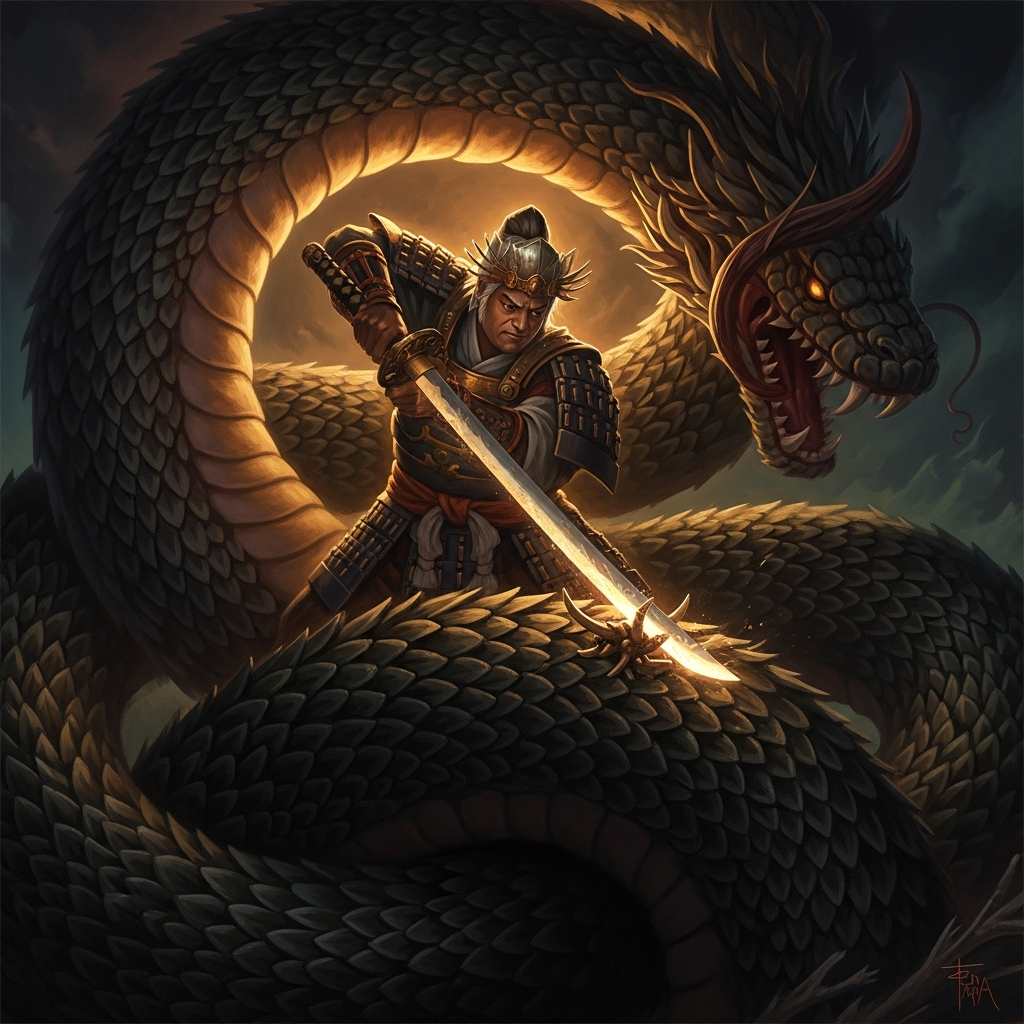
What follows is not a duel. The serpent is drunk and down and Susanoo works through it with the single-minded efficiency of a storm that has somewhere to be. He takes the heads. He takes the tails. He moves through eight necks and eight bodies with his ten-span blade until the Hi River runs red to the sea. The Kojiki does not linger here — it does not need to. The violence is complete and structural and unambiguous. The thing that ate seven daughters is in pieces in the grass and there is nothing left to negotiate with. He works from outside in, and when he reaches the fourth tail — or the eighth, the texts disagree, and the disagreement does not matter — his blade catches. Not on bone. On something harder than bone, something that has been sleeping inside power for longer than the serpent has existed. He cuts more carefully. He draws out a sword.
He holds it up in the red light.
The blade is long and straight and gives off a faint luminosity, the way iron gives off heat hours after the fire is gone — residual, quiet, unmistakable. He does not know its name yet. It will be called Kusanagi-no-Tsurugi, the Grass-Cutting Sword, after the warrior prince Yamato Takeru uses it centuries hence to slash away burning grass during an ambush. But standing now in the ruin of the serpent, in the middle of the valley that had been terrorized for seven years, Susanoo holds a blade that had been embedded in the source of the terror itself — as if the monster’s power was never the monster’s, as if it was just the hiding place for something that belonged to the world.
He sends the sword to Amaterasu. The sister who exiled him. Without a message. Just the sword.
The Kusanagi blade sits today in the innermost sanctuary of the Atsuta Shrine in Nagoya. It has not been displayed publicly in centuries. No one living has seen it. It is one of the three Imperial Regalia — with the mirror and the jewel — and the Imperial enthronement cannot occur without it. Susanoo found it in the body of a drunk dragon in a valley in Izumo and sent it to his sister, and every emperor of Japan since has ruled by its authority. The storm god who could not hold his own grief together long enough to stay in heaven, who wept the rivers into flood and got himself exiled, who came down to earth with nothing — he found the most sacred object in Japan inside the thing that was eating the world, and he gave it away without being asked. That is the whole story, and the sword has been in Nagoya ever since.
Scenes
Susanoo lands at the headwaters of the Hi River
 Generating art…
 Yamata no Orochi lowers all eight heads into the eight vats
 Generating art…
 The sword catches on something harder than bone
 Generating art…
 Echoes Across Traditions
Entities
- Susanoo
- Yamata-no-Orochi
- Kushinada-hime
- Ashinazuchi
- Tenazuchi

Sources
- *Kojiki* Book I (trans. Donald L. Philippi, 1968)
- *Nihon Shoki* Book I (trans. W.G. Aston, 1896)
- Joseph Campbell, *Oriental Mythology: The Masks of God* (1962)