The Ruined God Who Killed the Serpent
Mythic Time · Kojiki Book I, ~712 CE · Izumo Province (present-day Shimane Prefecture); the Hi River; the place where Yamata no Orochi comes to drink
Contents
Susanoo-no-Mikoto, exiled from heaven after his tantrum drove Amaterasu into her cave, descends to Izumo with nothing. He finds an old couple weeping over their last daughter, who is destined to be eaten by the eight-headed serpent Yamata no Orochi. He brews sake in eight vats, waits, and kills the serpent methodically. In its tail he finds a sword. This is not a story about heroism. It is a story about a disgraced god who rebuilds himself through protection rather than conquest.
- When
- Mythic Time · Kojiki Book I, ~712 CE
- Where
- Izumo Province (present-day Shimane Prefecture); the Hi River; the place where Yamata no Orochi comes to drink
He arrives with nothing.
This is the condition the Kojiki establishes before anything else happens in Izumo: Susanoo descends from the High Plain of Heaven stripped of everything the heavenly realm gave him. He has been driven out — not for being evil, the Kojiki is careful about this, but for being catastrophic, for the way his grief for his dead mother Izanami expressed itself as destruction: the rice paddies broken, the irrigation ditches filled, the sacred weaving hall defiled, the death of the maiden startled by the dead horse thrown through the hall’s roof. These are not the acts of a malicious god. They are the acts of a god whose feeling was too large for the vessels available to hold it, and whose environment suffered the overflow. He is not a villain. He is a storm. And the storm has been exiled to the earth, which was not designed to contain it either.
He walks the province of Izumo — the western edge of Japan, where the land faces the Japan Sea with its grey fogs and its heavy winters — and he is, at this point in the narrative, exactly what exile produces: a being of great power without context for that power, stripped of rank and purpose and the divine community he was born into.
He comes to the headwaters of the Hi River and he sees two old people weeping, and between them a young woman, and he stops.
The old man is Ashinazuchi — Foot-Stroking Elder. The old woman is Tenazuchi — Hand-Stroking Elder. The names are tender, the names of people who have spent their life in the small gestures of care. They are weeping in the specific way of people who have already wept too much and the weeping has changed into something quieter and more persistent, a grief that has become the background condition of the household. Susanoo asks what is wrong. He is a god of heaven in exile on earth and he stops to ask what is wrong. This is already, in the context of what he has done, a departure.
The old man explains. They had eight daughters. Every year the eight-headed serpent — Yamata no Orochi — comes down from the mountains and eats one. It has eaten seven. Now only Kushinada-hime remains, and the year is ending, and the serpent will come when it comes.
Susanoo looks at Kushinada-hime.
He says: give her to me as my wife, and I will kill the serpent.
There is no ceremony of agreement. The old parents look at the god standing before them — and even in exile, even stripped of heavenly rank, something about Susanoo reads as what he is, the way a storm reads as a storm even at a distance — and they agree. Susanoo transforms Kushinada-hime into a comb and places her in his hair, which is the act of taking responsibility for something fragile by keeping it closest to the body. She will not watch what is about to happen. She will be held safely in the small architecture of his hair while he does the thing he has agreed to do.
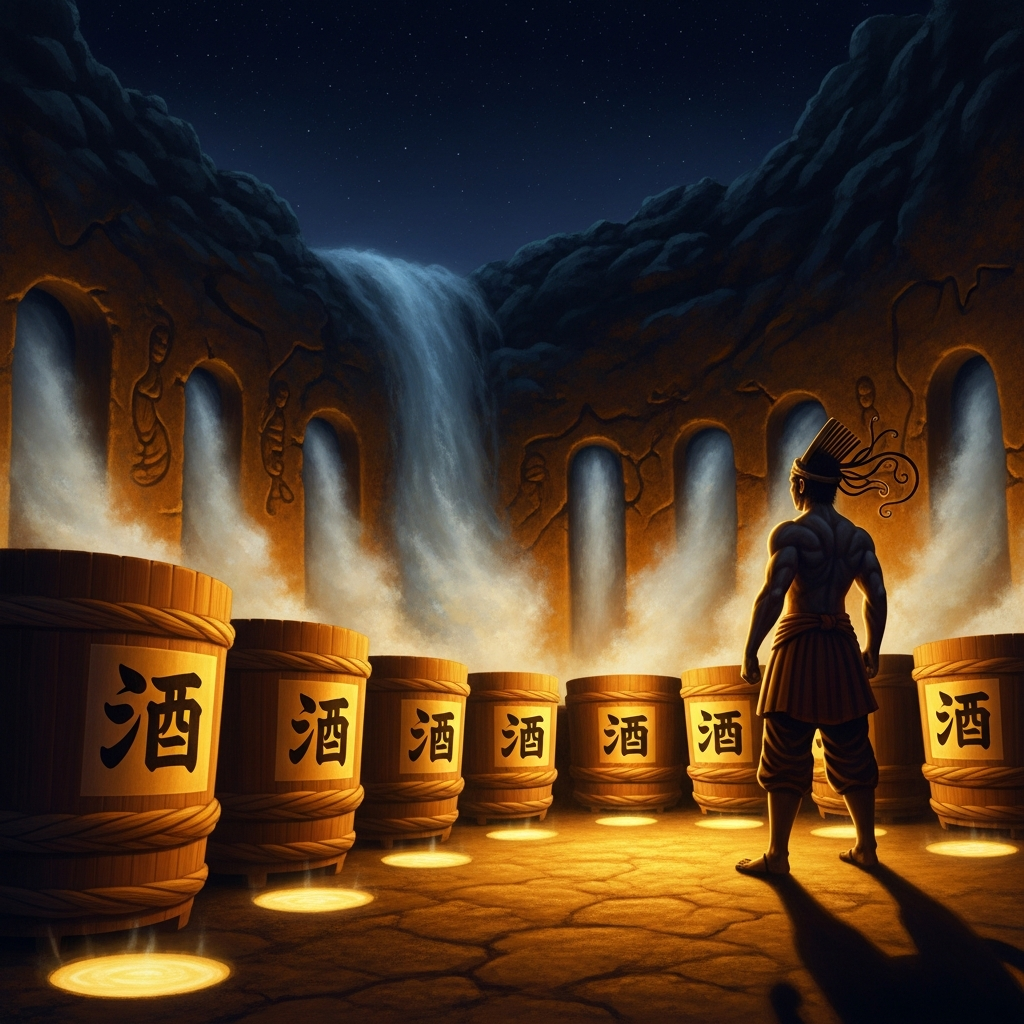
He instructs the old couple: brew sake. Not once — eight times, the strongest possible fermentation, eight rounds of brewing concentrated into eight vats. Build a fence around this place with eight gates. At each gate, place one vat of sake. And then wait.
The preparations take time. The sake takes time. Susanoo waits with a patience that is new to him — the storm that destroyed the rice paddies of heaven is learning to wait beside eight vats in a river valley in Izumo — and the waiting is itself a kind of atonement, a discipline the exiled god has not previously practiced.
The serpent comes at night.
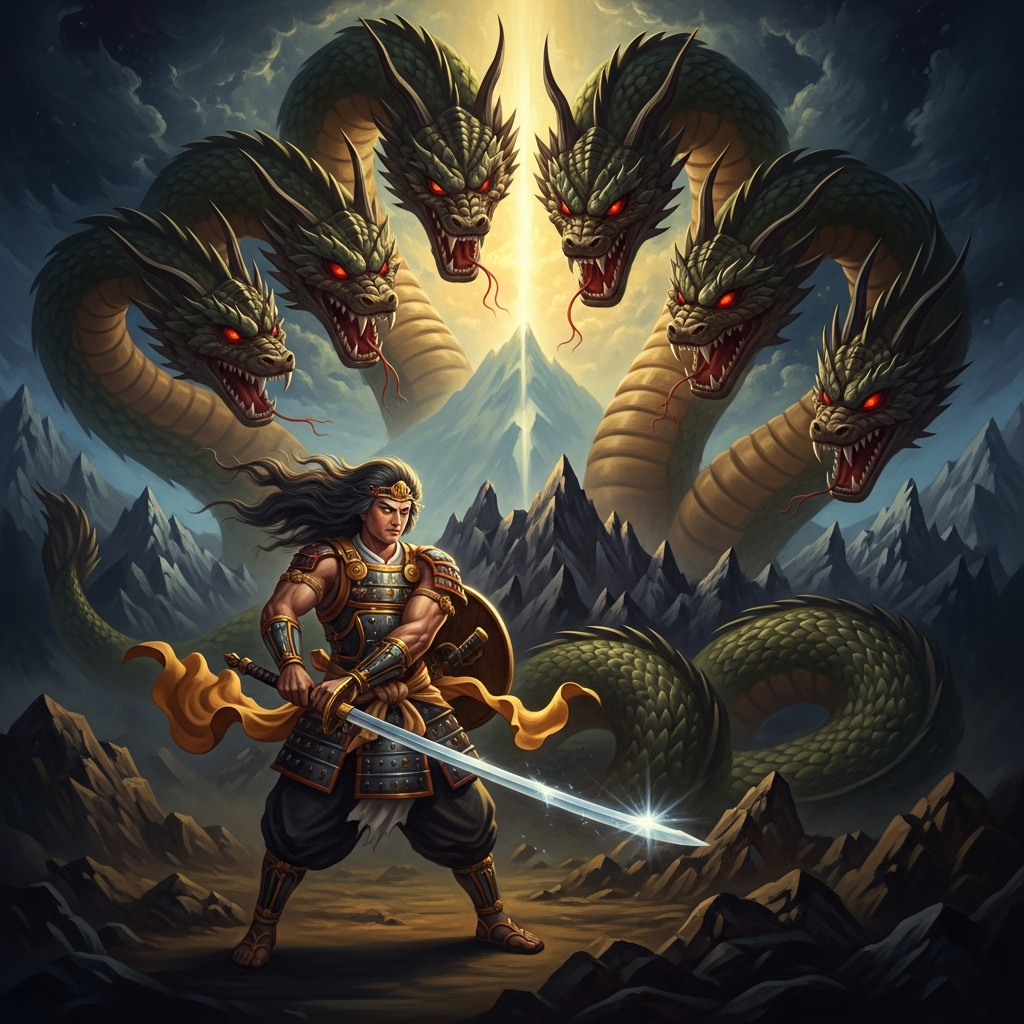
The Kojiki’s description is one of the most concrete pieces of mythological imagery in Japanese literature: eight heads, eight tails, a body that extends across eight valleys and eight mountain peaks, eyes red as the winter cherry. Moss and cypress and cryptomeria grow on its back. The river mist moves with it. It is not described as evil exactly — it is described as enormous, as a thing that fills landscape the way weather fills landscape, that has been part of the geography of Izumo longer than anyone currently living can remember. The old couple does not hate it. They have learned to grieve in advance of it, which is different.
The serpent finds the eight gates and the eight vats of sake. It puts one head into each vat.
Susanoo waits. The serpent drinks. The eight-times-brewed sake is strong enough to cloud the intelligence of eight serpent heads simultaneously, and the Kojiki notes this happening with the same lack of drama it brings to most things: the serpent drank and became drunk. Each head fell into its vat. The vast body settled. The serpent slept.
Susanoo draws his blade and begins.
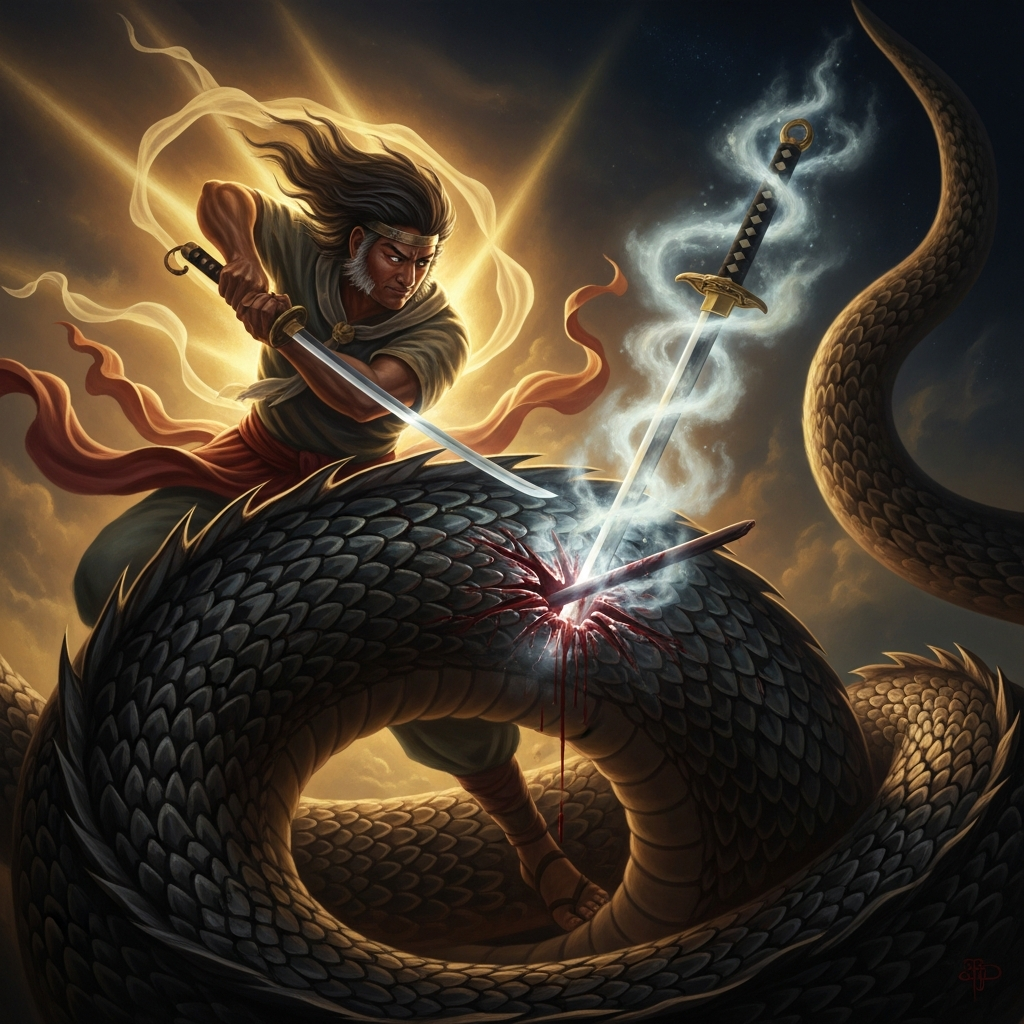
He does not rush. He is methodical. This is the part of the story that the Kojiki passes over quickly — the actual killing — but what the text gives us is structure: he cuts and cuts until the river runs red, which means he is cutting through eight heads and eight tails and the body that connects them, and he does it without theatre, without the boasting that heroes in other traditions perform over defeated monsters. He is a ruined god doing work. When he reaches the eighth tail his blade catches on something inside it, something harder than serpent flesh, and he stops.
He cuts carefully around the obstacle. He withdraws it from the serpent’s tail.
A sword. Wrapped, the Nihon Shoki says, in cloud — Ame-no-Murakumo-no-Tsurugi, Sword of the Gathering Clouds of Heaven. Later renamed Kusanagi-no-Tsurugi: the Grass-Cutting Sword. Susanoo is looking at a sword that was sleeping inside the serpent before anyone alive can remember, a sword that predates the serpent, that was there when the serpent arrived in Izumo and is still sharp after however many centuries the serpent lived. A sword that does not belong to the serpent — the serpent was merely keeping it, the way the earth keeps things it has swallowed.
Susanoo has the wit to understand that this sword is not his.
He sends it to Amaterasu.
This is the most extraordinary gesture in the entire episode. He has killed the monster. He has the legendary weapon. He is a god with nothing who now has something extraordinary and he gives it to the sister who watched him be exiled, who sealed herself into the Rock Cave of Heaven partly because of what his grief did to the world. He sends her the sword. No explanation. No condition. No negotiation.
The sword eventually passes from Amaterasu through the lineage of gods to the first Emperor, becoming one of the three imperial regalia — the Kusanagi, the Yata no Kagami mirror, the Yasakani no Magatama jewel — the physical objects that legitimate imperial rule in Japan to this day. The Emperor holds a sword that Susanoo found in the tail of the serpent he killed on the night after his exile in Izumo, and gave away to the sister he had wronged.
He stays in Izumo. He makes it his province. He writes the first poem recorded in the Kojiki — a love poem for Kushinada-hime, composed when he builds a palace for her in the place where clouds rise eight-fold in the morning — and the poem’s subject is the interlocking of the visible and the sheltering, the cloud that folds around the thing it wants to protect. He is no longer the storm that drowned the rice paddies. He is the weather that the west coast of Japan is made of: heavy, grey, persistent, capable of tenderness.
He is not forgiven exactly. The Kojiki does not operate in the category of forgiveness. What it operates in is continuity: Susanoo is in Izumo, and Izumo is where he belongs, and the things he does there — the serpent killed, the poem made, the sword sent upward to his sister — establish a place for him in the order of the world that his tantrum in heaven could not give him.
He found it by stopping when he saw two people weeping.
The Kojiki knows what exile is for. It is not punishment in the sense of pain inflicted as consequence — it is the mechanism by which a god who does not fit in heaven is relocated to the place where his nature is useful. Susanoo’s storm was wrong for the High Plain of Heaven, where things are arranged and ceremonial and the categories are clear. It was exactly right for Izumo, for the grey-fog coast and the river that runs red with serpent blood and the valley where a couple with nothing left sat and wept and needed something that required force and patience in equal measure. He was not reformed in exile. He was correctly placed. The storm did not change. The landscape finally matched it.
Scenes
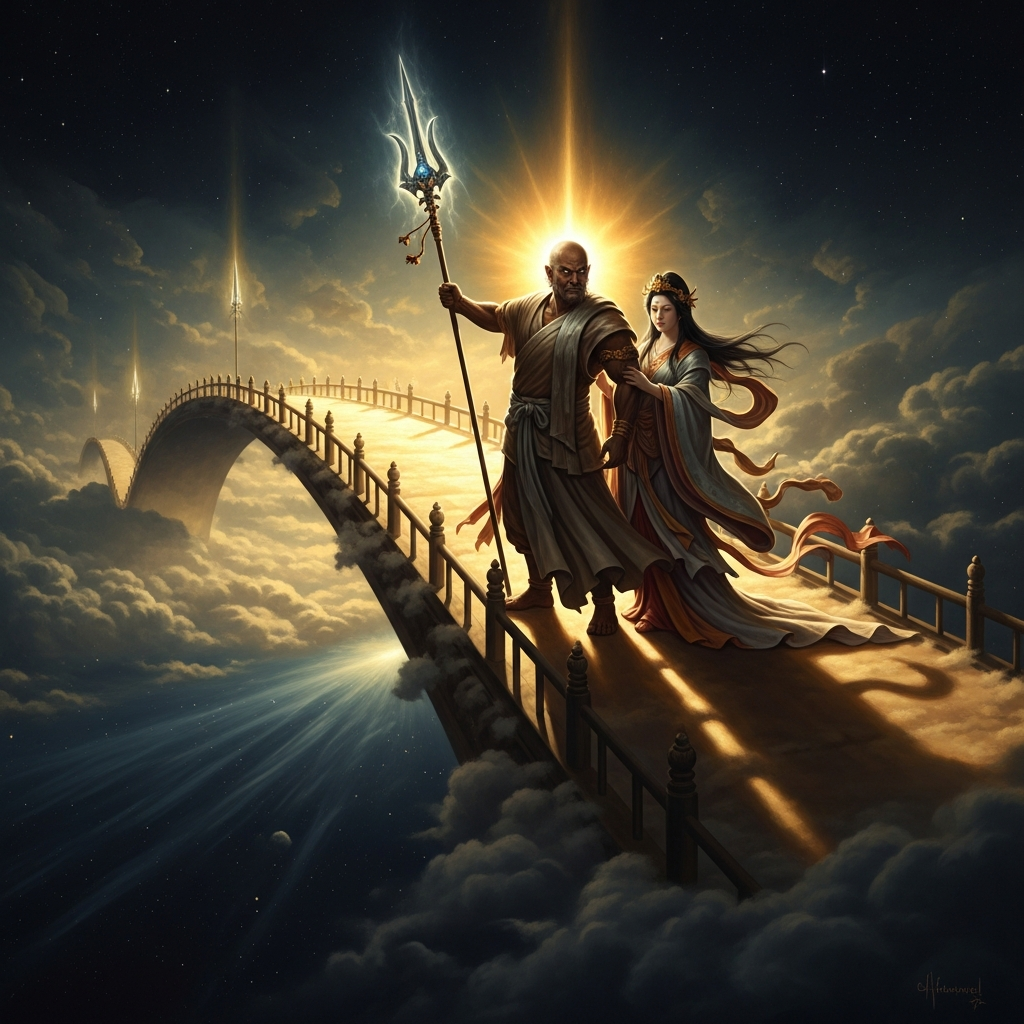
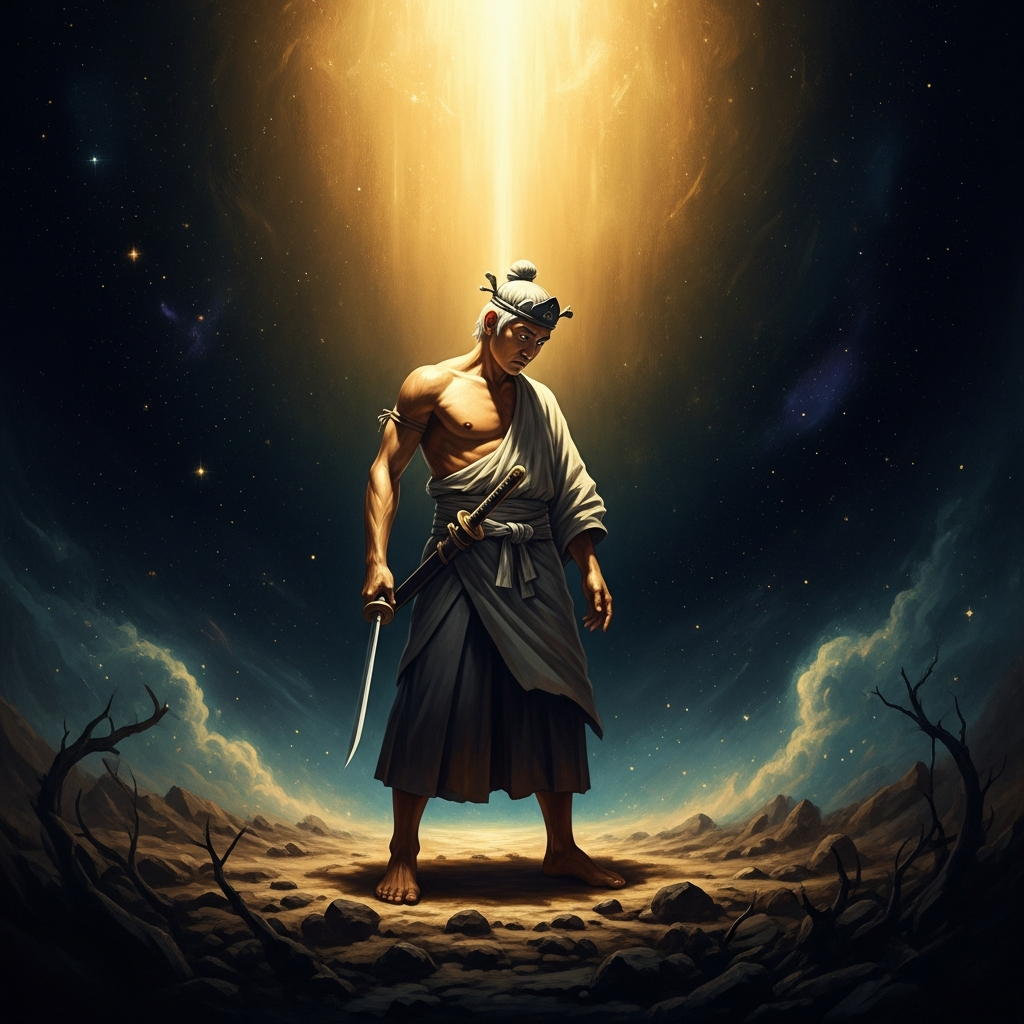
Susanoo descends from the High Plain of Heaven to the province of Izumo, stripped of his divine rank, with nothing but the blade at his belt
 Generating art…
 Eight vats of eight-times-brewed sake, set at the eight openings
 Generating art…
 Susanoo cuts through the eighth tail
 Generating art…
 Echoes Across Traditions
Entities
- Susanoo
- Yamata no Orochi
- Kushinada-hime
- Kusanagi-no-Tsurugi
- Ashinazuchi
- Tenazuchi

Sources
- *Kojiki* Book I (trans. Donald L. Philippi, 1968)
- *Nihon Shoki* Book I (trans. W.G. Aston, 1896)
- Noriko Reider, *Japanese Demon Lore: Oni from Ancient Times to the Present* (2010)
- Michael Como, *Weaving and Binding: Immigrant Gods and Female Immortals in Ancient Japan* (2009)