The Divine Couple Stir the Ocean
Mythic Time · Kojiki Book I, ~712 CE; oral tradition centuries earlier · The Floating Bridge of Heaven; the island of Onogoro; the Pillar of Heaven
Contents
Izanagi and Izanami stand on the Floating Bridge of Heaven with the Jeweled Spear and stir the ocean. The first island rises. They descend, build the Pillar of Heaven, circle it, and speak. Their union seeds the archipelago. Then Izanami births fire — and fire kills her.
- When
- Mythic Time · Kojiki Book I, ~712 CE; oral tradition centuries earlier
- Where
- The Floating Bridge of Heaven; the island of Onogoro; the Pillar of Heaven
They stand on nothing.
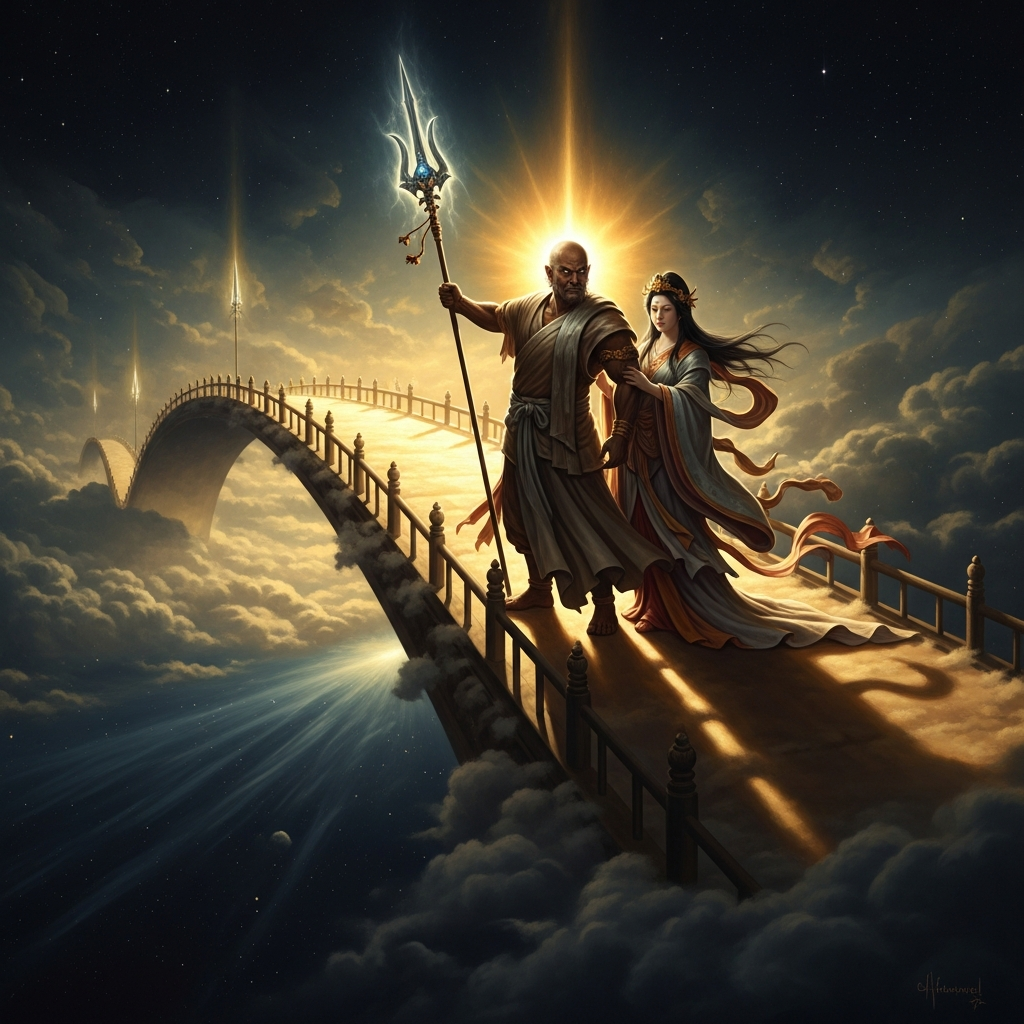
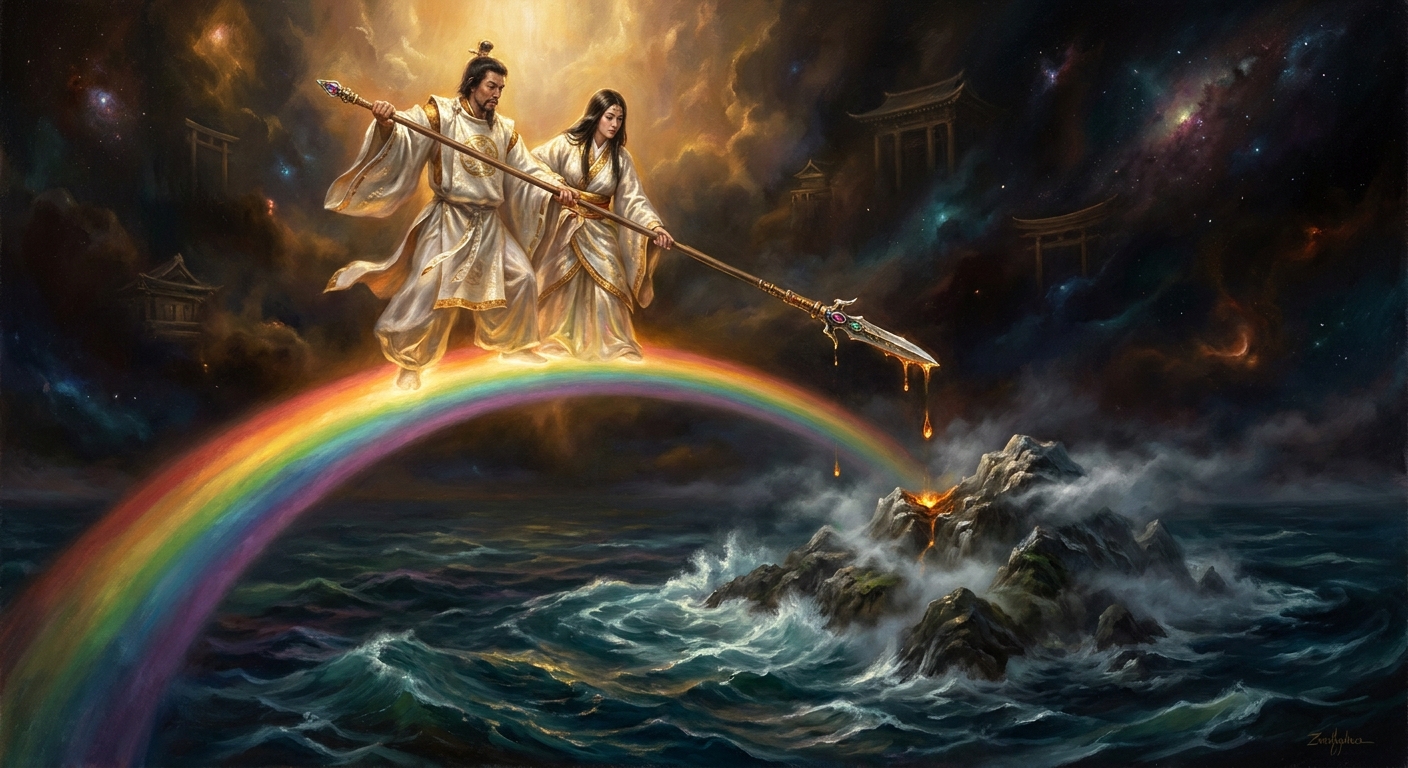
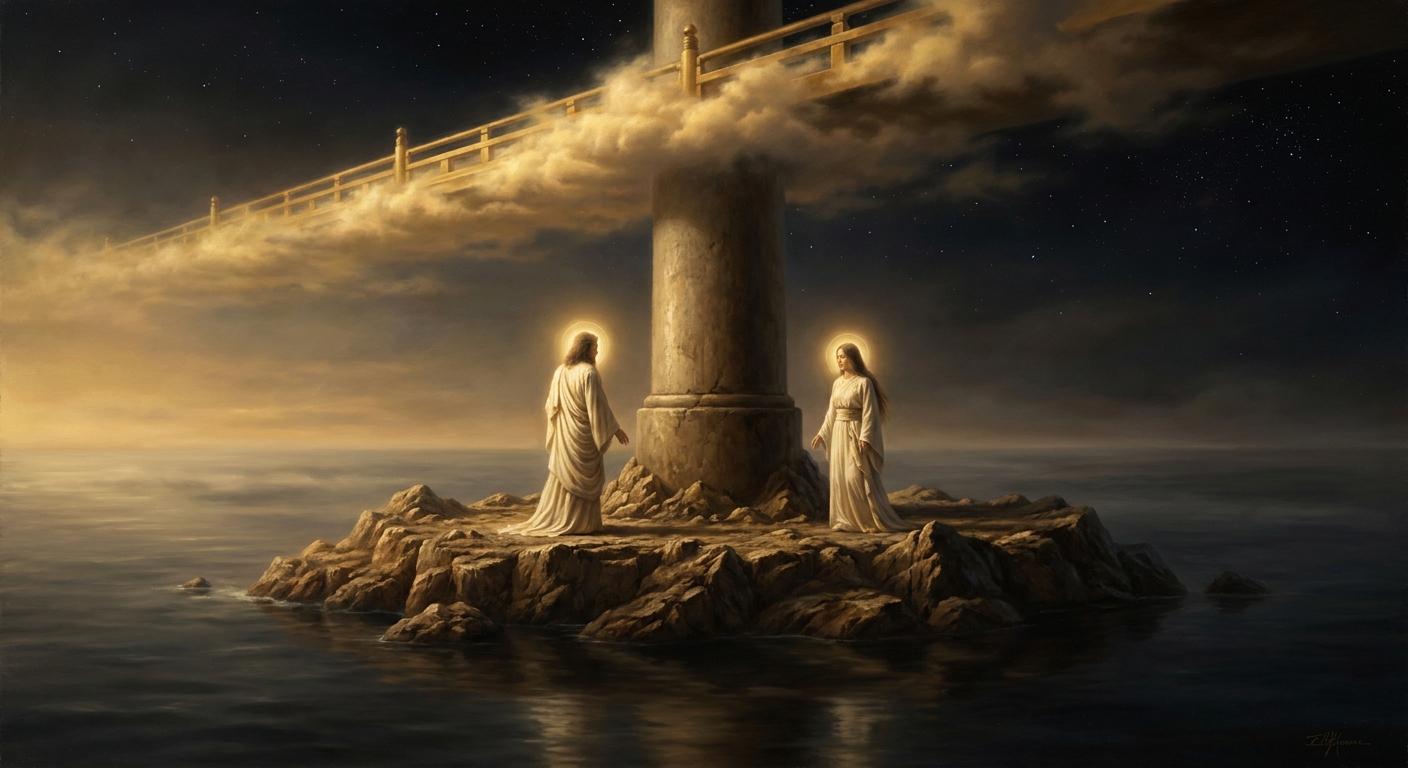
The Floating Bridge of Heaven is not a bridge over something — it floats above the primordial brine, which is not yet an ocean, which has no bottom, no shore, no name. The sky is above them and the not-yet-world is below, and Izanagi and Izanami hold between them the Jeweled Spear of Heaven, Ame-no-Nuboko, its shaft laid across both their hands like a thing too sacred to hold alone. They lean over the edge of heaven and lower the spear-tip into the brine. They stir. The sound it makes is the first sound the world has heard that did not come from chaos — it is churning, it is koworokworo, the old texts preserve the syllables as if the sound itself is the act. When they lift the spear, the brine that drips from its tip does not fall back into the ocean. It hardens. It accumulates. Drop by drop, a landmass forms: the island of Onogoro, Self-Coagulating, the first solid ground in a universe that has known nothing but formlessness.
They descend to Onogoro and raise the Pillar of Heaven.
The pillar is not a monument or a marker — it is the axis of the world, the pin through the center of the turning cosmos, and they erect it themselves from whatever the first solid ground is made of. Then they do the thing that gods have always done when they want to bind themselves to an act: they circle the pillar. This is the marriage ceremony of the creators of Japan. No witnesses. No celestial assembly. Just the two of them walking opposite directions around a pillar in the middle of the first island. They meet on the far side. She speaks first — “What a fine young man!” — and then he speaks, repeating her words back, and their union begins. The first attempt produces children without bones, without form: Hiruko, the leech-child, cast into the sea. The heavenly gods instruct them to try again, this time with the male speaking first. He circles. He speaks. She answers. The children that follow have bones and form and names. The islands of Japan rise.
They do not stop.
Awaji comes first. Then Iyo, then Oki, then Tsukushi, then Iki, Tsushima, Sado, Yamato — eight great islands, and then dozens of smaller ones, each called from the ocean by the speaking of names over the stirred water. And then the other things: the gods of the straits, the gods of the river mouths, the deity of the sea-foam. Creation accelerates. The list in the Kojiki goes on for pages, entity after entity pouring into existence from the union of two gods on an island that did not exist two pages before, and throughout all of it Izanami bears each new deity without complaint, and Izanagi names each one, and the world gets fuller with every breath they take. This is what creation looks like when it is working: not struggle, not drama, but a couple doing something together that they are very good at, that keeps generating abundance beyond what either of them expected.
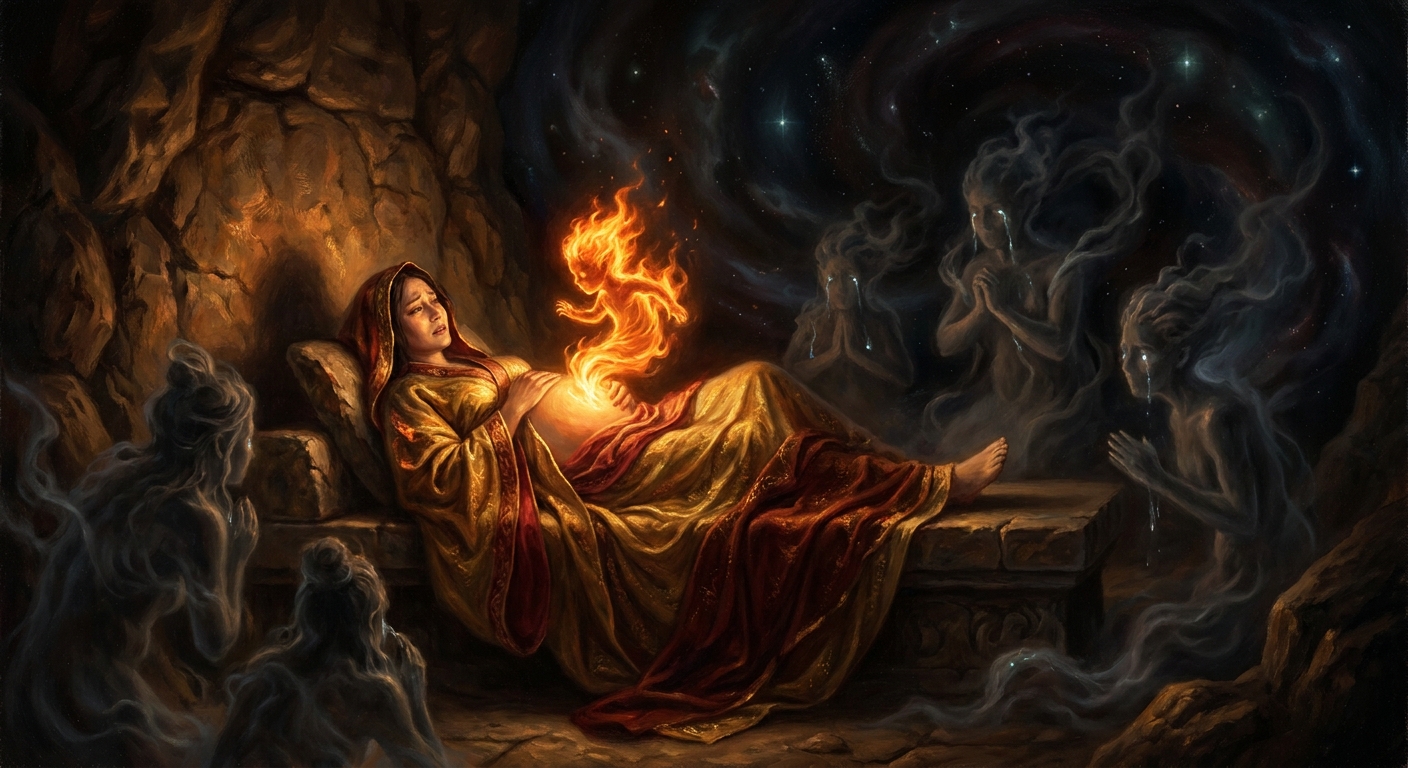
Then Kagutsuchi is born.
The fire god — Hi-no-Kagutsuchi, Burning-Brilliant-Deity — enters the world the same way all the others have, and the same way kills. Izanami is burning from the inside. The fire has no malice; it is simply what fire does; it cannot be told to be less than itself, and what it passes through on the way out, it chars, and what it chars becomes ash, and Izanami, the mother of the islands, is dying in the moment of her greatest act of generation. She does not cry out. The text does not grant her a cry. She simply begins to burn, and then she is on the ground, and the gods of vomit and of feces and of metal are born from the edges of her dying — the last pieces of creation pushed out of her by the body’s refusal to stop even as it ends.
And still she generates.
From her body as she lies dying — from her vomit come two mountain deities; from her feces come clay and soil; from her urine comes the water-goddess Mitsuhanome. This is the moment the Kojiki renders most carefully, the moment when the dying woman becomes a landscape. Her body is not being described metaphorically. She is the source of what will become Japan’s geology — the metal in the ore, the clay in the riverbank, the fertility in the soil. Creation has been, from the beginning, an act of expenditure. The islands were bought with something. The price was the mother who made them.
Izanagi weeps at her head and her feet. The text specifies both: head and feet. He circles her the way he circled the pillar, and the circling that made the world becomes the circling that mourns what the world-making cost.
His grief becomes rage, and rage does not wait.
He draws the ten-span sword — Totsuka-no-Tsurugi, the same blade he will carry into Yomi and later use to purify himself — and he kills Kagutsuchi. The fire god is not given a chance to speak. Izanagi cuts him into eight pieces, and from each piece another deity is born: eight mountain gods, eight fire spirits, the volcano in its violence and its beauty generated from the death of the thing that generated it. Even here, creation will not stop. Even grief produces. Even the sword-strike that ends the fire-child launches a new round of births from the pieces of what has been destroyed. The Kojiki catalogs them all, every entity that springs from the spilled blood and severed limbs, and the catalog goes on and on, because in this cosmology nothing ends cleanly. Everything bleeds more gods.
What the Kojiki understands, and refuses to soften, is that creation and destruction are the same mouth. The Jeweled Spear stirs the ocean and raises the islands; the fire god tears through the mother who made them. Japan is not a paradise placed here by benevolent gods — it is the scar tissue of a cosmogony that worked by burning through its maker, and the gods who populate it are born equally from love and from catastrophe, from the circling of the pillar and from the sword-stroke and from the dying body that would not stop giving even as it went out.
Scenes
The Floating Bridge of Heaven
 Generating art…
 They descend to Onogoro and raise the Pillar of Heaven
 Generating art…
 Kagutsuchi, the fire god, burns his way into the world
 Generating art…
 Echoes Across Traditions
Entities
- Izanagi
- Izanami
- Kagutsuchi
Sources
- *Kojiki* Book I (trans. Donald L. Philippi, 1968)
- *Nihon Shoki* Book I (trans. W.G. Aston, 1896)
- Joseph Campbell, *Oriental Mythology: The Masks of God* (1962)
- Motoori Norinaga, *Kojikiden* (1798)