Kai Kai and Treng Treng — The Serpents' War
Mythic time · Mapuche flood tradition · ngillatun ceremony documented from 16th century through present · Araucania — Mapuche territory, south-central Chile and Argentina
Contents
Two cosmic serpents locked in war: Kai Kai Vilú, the sea serpent, floods the world. Treng Treng Vilú, the land serpent, raises the mountains. Humans climb and climb — those who pray and keep moving reach the summit and become the ancestors of the Mapuche people. The myth is performed in the ngillatun ceremony, which is still held across Mapuche territory. The flood never fully recedes.
- When
- Mythic time · Mapuche flood tradition · ngillatun ceremony documented from 16th century through present
- Where
- Araucania — Mapuche territory, south-central Chile and Argentina
The water rises without warning.
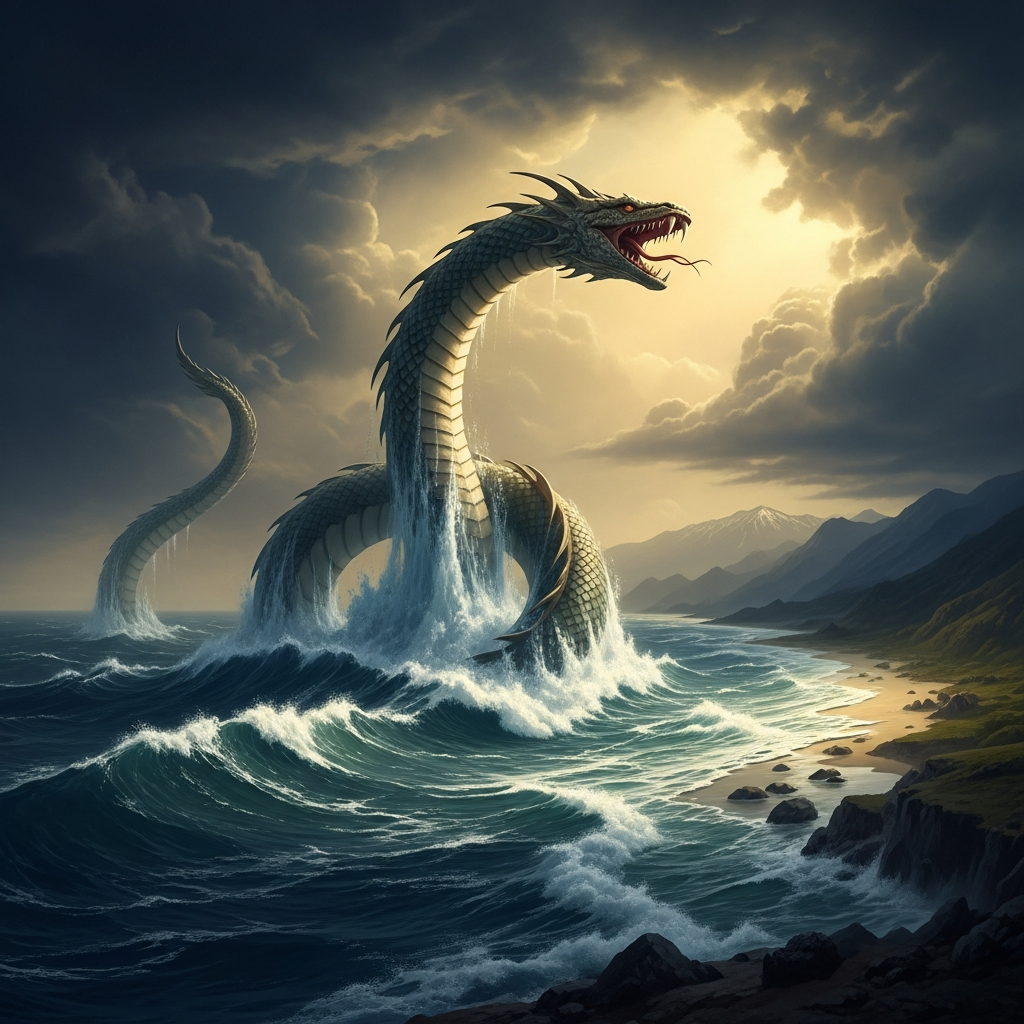
This is the first thing the Mapuche flood myth establishes, and it is the thing that makes it a myth rather than a legend: not a punishment for a specific sin, not a response to accumulated wickedness, but the unilateral movement of a cosmic power that has its own reasons and does not consult humanity before exercising them. Kai Kai Vilú — the sea serpent, the power of the ocean, the force that lives at the bottom of the Pacific where the water is so deep it has no color — wakes and rises, and the ocean rises with it.
Vilú: serpent. The suffix that the Mapuche language applies to the great cosmological beings that are the powers beneath the surface of ordinary reality — not gods exactly, not spirits exactly, but forces so large and so old that they have become geological. Kai Kai Vilú is not just a serpent that lives in the sea. It is the serpent-nature of the sea itself, the willful living quality of the Pacific Ocean, the power that drives the waves and the tides and the tsunamis.
It rises. The ocean follows.
The water moves inland across the coastal range, across the Central Valley of Chile, toward the Andes. Trees go under. Villages go under. The llamas and guanacos that graze the valley floors are gone in the first hour. The water rises faster than anyone can run, which is why the myth is so specific about what determines survival: it is not speed. It is direction.
You have to go up.
Treng Treng Vilú feels the water coming.
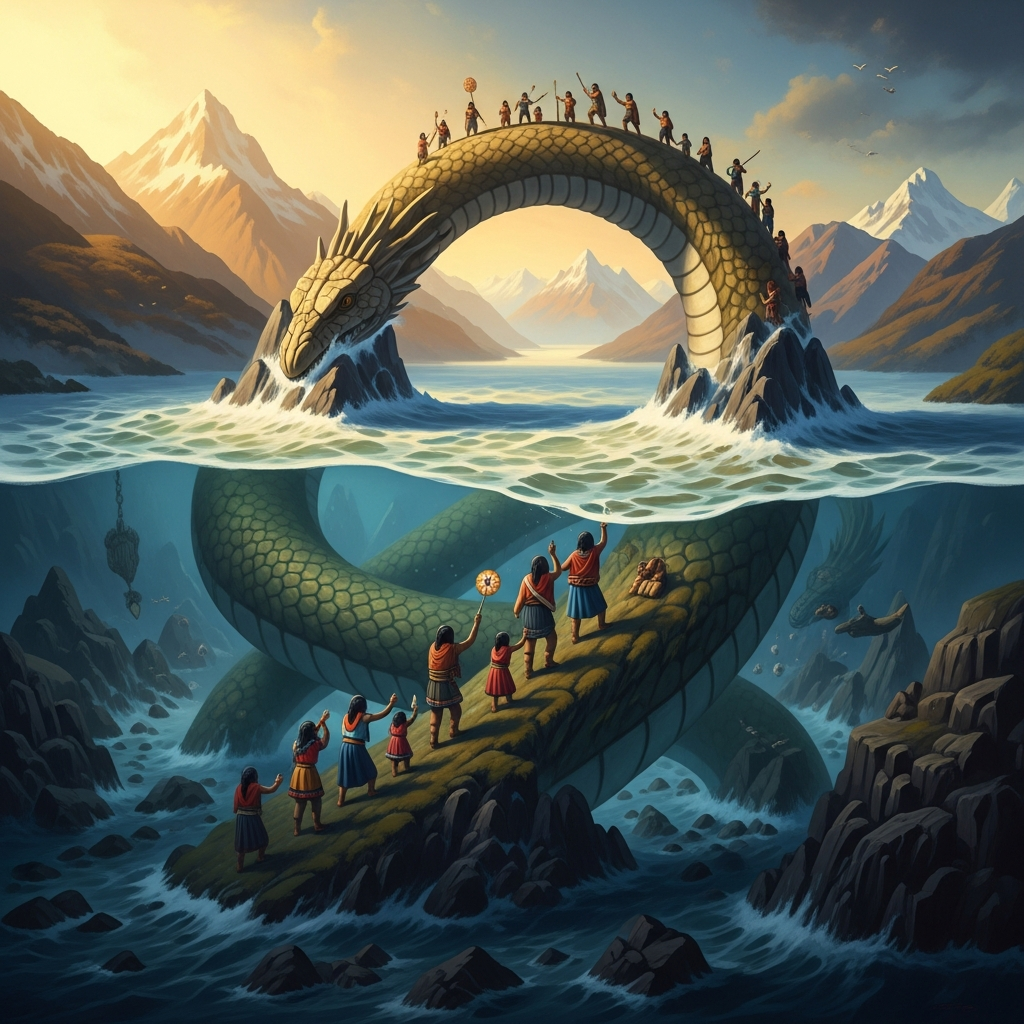
The earth serpent lives beneath the Andes — beneath the long chain of volcanoes and high peaks that form the spine of South America — in the way that any living thing lives in its appropriate medium: not underground as a prisoner or as a hiding thing, but at home, in the body of the earth. When the water rises on the western side of the mountains, Treng Treng Vilú feels it as a living body feels pressure: the water pushes, the earth responds.
Treng Treng Vilú arches.
The mountains rise.
This is not metaphor. The Mapuche who told this story to the first Spanish missionaries and the first anthropologists in the 19th century were also living in the most geologically active mountain range on earth — the Nazca Plate subducting beneath the South American Plate, the volcanoes erupting, the earthquakes regular and catastrophic, the Andes still rising at a measurable rate. The theology of Treng Treng Vilú is not a poetic explanation for geology. It is a living account of geology as experienced by people who have felt the earth move, who have felt the mountains push upward beneath their feet, who have understood this as the earth-serpent responding to pressure.
The mountains rise. The water follows. The mountains rise more. The water follows more.
This is the war: not fire and darkness, not order and chaos in the abstract sense, but two living powers in direct physical contention, and humanity caught between them with no role in the conflict except to survive it.
Those who pray keep climbing.
The myth is specific about the spiritual condition required for survival: ngillatun, prayer, the ceremonial maintenance of the relationship with the divine powers. Those who abandon prayer and try to survive by speed alone turn to stones — the rocks embedded in the high Andean peaks are, in the Mapuche understanding, the calcified remains of the ones who forgot what mattered while the water was rising. Those who climb and pray, who call out to Ngünechen (the governing divine couple, the male and female principle of the universe) while their legs burn and the water laps at their ankles, who maintain the ceremonial relationship even in the extremity of terror — these are the ones who reach the summit.
And the summit is dry.
Treng Treng Vilú has raised the mountains high enough. The water is below. The survivors stand on the peak, exhausted, looking down at an ocean that has swallowed the world they knew, and they are the only people left.
They are the Mapuche — mapu (earth) + che (people), the People of the Earth. The name itself encodes the myth: they are the people who are of the earth, who stayed with the earth when the sea tried to claim them, who trusted the earth-serpent and climbed when it asked them to climb. Their identity is constituted by the act of survival, and the act of survival was constituted by the relationship between prayer and movement.
The water does not fully recede.
This is the element of the myth that most distinguishes it from comparable flood narratives and that most precisely captures the geography of the Mapuche homeland. After the conflict between Kai Kai and Treng Treng ends — the sea serpent pulls back, the waters lower — the world that remains is not the world that existed before. The sea has advanced inland. The Central Valley, which was forest and river before the flood, now has a different relationship to the Pacific. New lakes exist. New bays. New coastlines.
And Kai Kai Vilú is still there. Still at the bottom of the Pacific. Still capable of rising again.
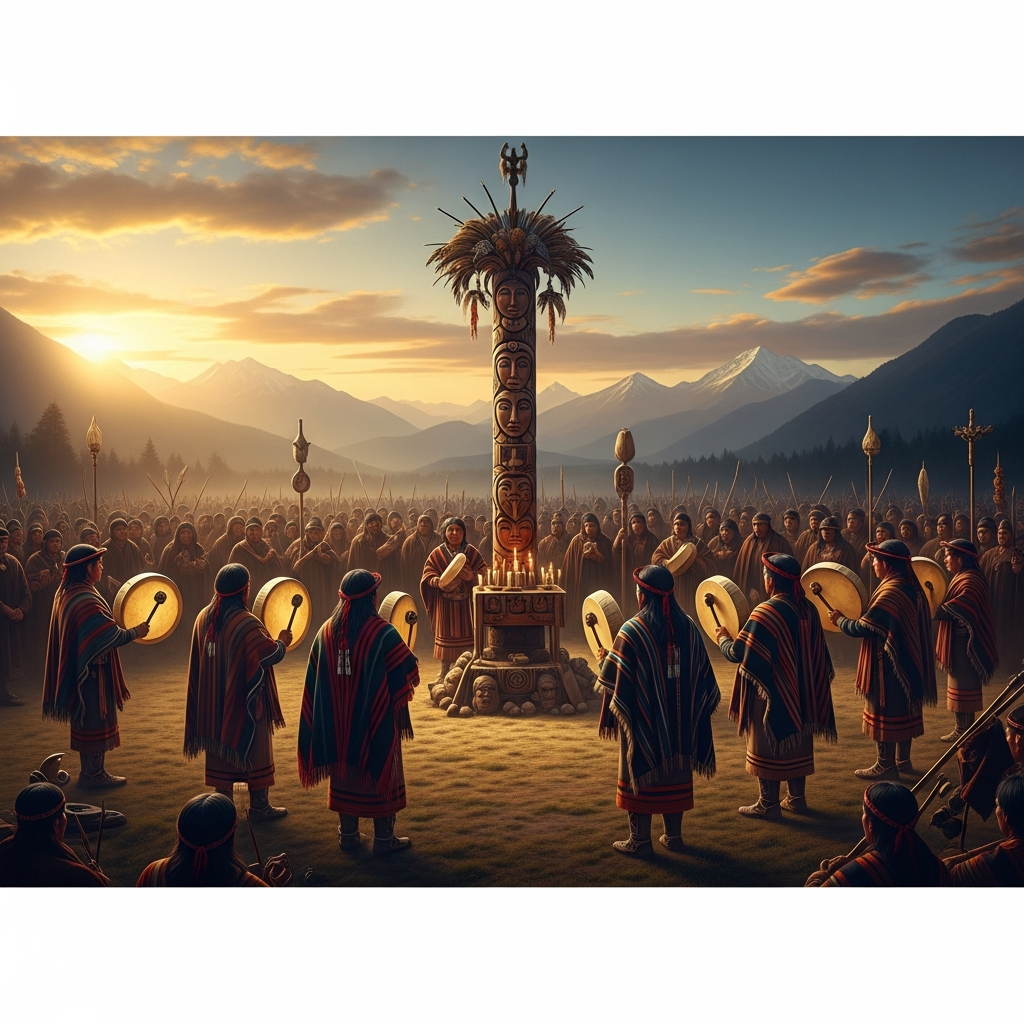
This is why the ngillatun ceremony is not a commemoration. It is not a memorial service for a past event. The ngillatun — the great Mapuche community ceremony of prayer and propitiation — is the ongoing negotiation with the powers that were present at the flood and are still present. The rewe, the carved pole at the ceremony’s center, is the axis connecting the human world to the divine world above and below. The machi — the shaman, usually a woman — chants and drums and enters trance to maintain the lines of communication. The community gathers and participates, performing the ceremony correctly because performing it incorrectly is not merely a ritual error but a practical danger: if the relationship with Ngünechen and with the earth-serpent degrades, the negotiation that is currently keeping Kai Kai Vilú in the depths of the Pacific weakens.
The ngillatun happens several times a year in Mapuche communities across the Araucania region of southern Chile and in the Argentine Neuquén province. Some ceremonies draw hundreds of participants. The Spanish could not suppress it. The Chilean state, which waged military war against the Mapuche from 1861 to 1883 in the Pacificación de la Araucanía — the “pacification” that consisted of military annexation and forced displacement — could not suppress it. It survives because the practical necessity it addresses has not changed: Kai Kai is still at the bottom of the Pacific, and the mountains must be maintained.
The Mapuche have not been pacified.
The Araucanian resistance to first Spanish and then Chilean authority is the longest continuous indigenous resistance to European colonialism in the western hemisphere — 350 years of intermittent warfare from the 1540s to the 1880s, followed by land dispossession and cultural suppression that continues in attenuated form today. The Mapuche of the 21st century are engaged in ongoing legal and sometimes violent conflict with Chilean timber companies, hydroelectric developers, and the state over the ancestral lands that the ngillatun ceremony sanctifies and that the market economy treats as resources.
The Kai Kai / Treng Treng myth is not innocent in these conflicts. It is invoked. The relationship between the earth-serpent and the community — the covenant that the ancestors established when they climbed and prayed and survived — authorizes Mapuche presence on specific land in a way that has no legal equivalent in Chilean property law but that is no less real for that. The land is where Treng Treng raised the mountains for the people. The covenant is with the earth itself.
Ana Mariella Bacigalupo, who spent years with Mapuche machi shamans in the Araucania region, documents how the machi understand their work as continuous with the first survivors of the flood: they are still negotiating, still climbing, still maintaining the prayer relationship that keeps the waters below the summit. The flood is not over. It is managed.
The ngillatun begins before dawn.
The community gathers in the field designated for the ceremony, the rewe pole at the center decorated with fresh maqui branches and canelo leaves. The machi arrives with her kultrun drum — a circular drum painted with the cosmological map of the Mapuche universe, the four directions, the division of the sky. She begins to chant in the low register that indicates communication with powers rather than people.
The sun rises over the Andes to the east, the same Andes that Treng Treng raised in the moment of the flood. The mountains are still high. The prayers, maintained since before anyone now living can remember, have helped keep them that way.
The Mapuche flood myth teaches a theology of continuous vigilance. Other flood myths end: the waters recede, the world is restored, the rainbow covenant is sealed, the disaster becomes history. Kai Kai Vilú is not history. The sea is still there. The serpent is still at the bottom of it. The mountains are still rising, slowly, as the tectonic plates press together in the same movement that has been ongoing since before the first Mapuche looked at the Andes and understood them as the body of Treng Treng. The ngillatun is not a tradition. It is a practice — the ongoing act of maintaining the relationship that keeps the world as it is, the prayer that is the human side of the covenant, the climbing that does not stop because the water has not stopped either.
Scenes
Kai Kai Vilú, the sea serpent, rising from the Pacific in the moment of the flood — an immense serpentine form larger than any mountain, its scales the color of deep ocean, coiling upward and sending walls of seawater across the coastal plains of Chile, the sky dark with storm, the Andes visible in the distance
 Generating art…
 Treng Treng Vilú, the land serpent, arching its back beneath the earth — mountains rising from its coiling body, peaks pushing upward through the flood water, families of Mapuche people clinging to the slopes climbing higher as the water rises below them, the serpent's scales becoming the rock of the Andes
 Generating art…
 A Mapuche ngillatun ceremony in the Araucania region of Chile — the community gathered in an open field at dawn, the rewe altar pole at center carved with faces, machi shamans in traditional dress chanting and shaking their kultrun drums, the Andes visible on the horizon, the ceremony renewing the covenant with Treng Treng
 Generating art…
 Echoes Across Traditions
Entities
- Kai Kai Vilú
- Treng Treng Vilú
- Ngünechen
Sources
- Ramón Lenz, *Estudios Araucanos* (Imprenta Cervantes, Santiago, 1895-1897)
- Ana Mariella Bacigalupo, *Shamans of the Foye Tree: Gender, Power, and Healing among Chilean Mapuche* (University of Texas Press, 2007)
- Tom Dillehay, *Monuments, Empires, and Resistance: The Araucanian Polity and Ritual Narratives* (Cambridge University Press, 2007)
- Rolf Foerster, *Introducción a la Religiosidad Mapuche* (Editorial Universitaria, Santiago, 1993)
- Louis Faron, *Hawks of the Sun: Mapuche Morality and Its Ritual Attributes* (University of Pittsburgh Press, 1964)