Mawu-Lisa and the Weight of the World
Mythic time · Fon oral tradition, present-day Republic of Benin (formerly Dahomey) · The primordial void, and then the earth of Dahomey — present-day Benin, West Africa
Contents
The Fon people of Dahomey know their supreme deity as twins who are one — Mawu the moon-mother and Lisa the sun-father, inseparable, creating the world together with the help of a rainbow serpent who must hold it up forever. Creation is not finished. It is an act of permanent maintenance, one coil from collapse.
- When
- Mythic time · Fon oral tradition, present-day Republic of Benin (formerly Dahomey)
- Where
- The primordial void, and then the earth of Dahomey — present-day Benin, West Africa
Before Mawu-Lisa there is only Nana Buluku.
Nana Buluku is old beyond names — the primordial one, the first, the source that precedes sources. She does not create the world. She creates the creators. From her comes Mawu; from her comes Lisa; from both of them comes everything else. This is the Fon understanding of first things: the ultimate principle is too absolute to act directly on the particular, so the ultimate principle generates twins, and the twins do the work.
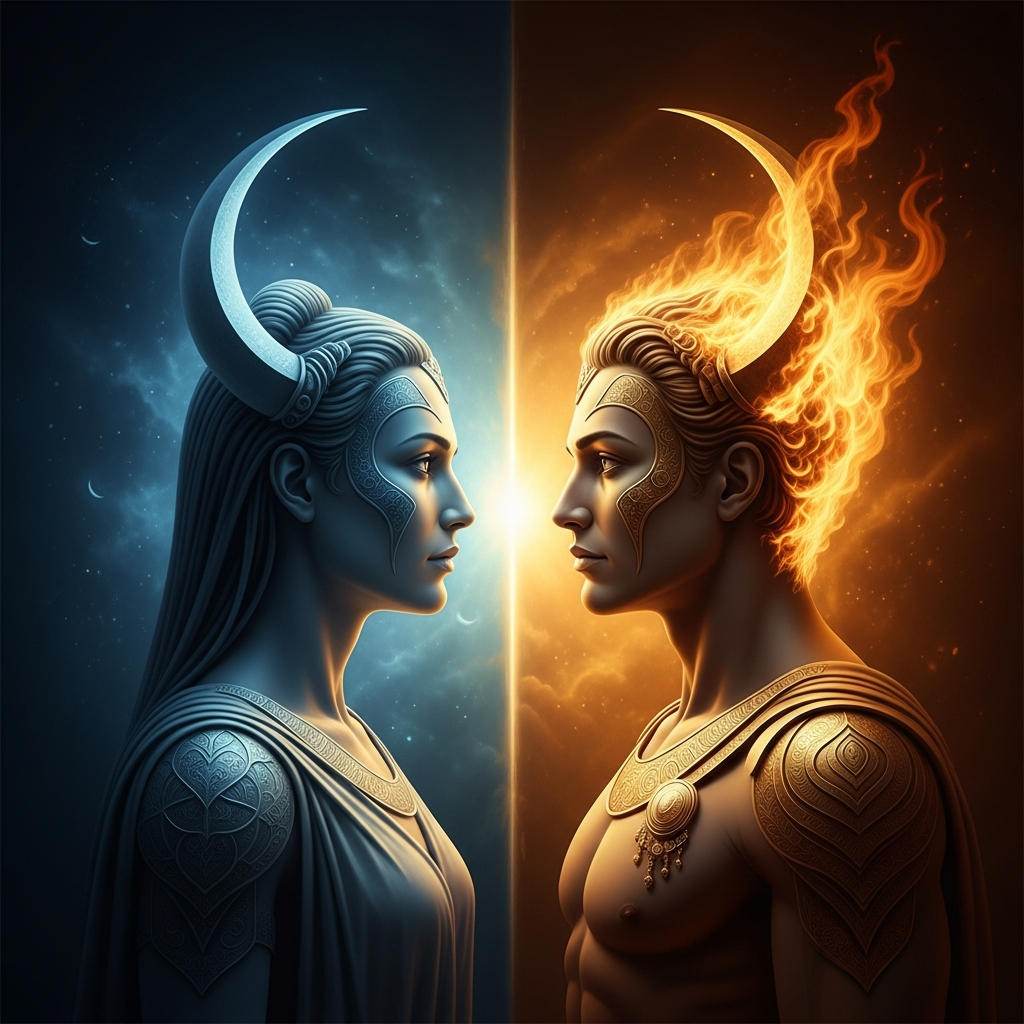
Mawu is female. She is the moon, the west, the night. Her domain is everything that cools and rests and thinks. She governs motherhood and memory; she is the face of compassion, the god who understands what it costs to endure. When the dead arrive at the edge of the other world, it is Mawu’s patience that receives them. Her color is the silver-blue of moonlight on still water. Her time is night: the pause between the days when the world can breathe.
Lisa is male. He is the sun, the east, the day. His domain is everything that forces and builds and does. He governs strength and craft; he is the face of power, the god who makes things happen through sheer applied will. When the living need their arms to work, it is Lisa’s energy moving in the muscles. His color is the gold-white of high noon on dry earth. His time is day: the forward push, the ongoing motion.
They are not two separate gods who happen to be related. They are one god in two bodies, two expressions of a single divine nature that cannot be understood from only one side. Mawu without Lisa is compassion without power — beautiful and unable to act. Lisa without Mawu is power without compassion — efficient and catastrophic. Together they are the whole. The Fon say them together: Mawu-Lisa, a single word for a single being that happens to be twins.
They begin the world in darkness.
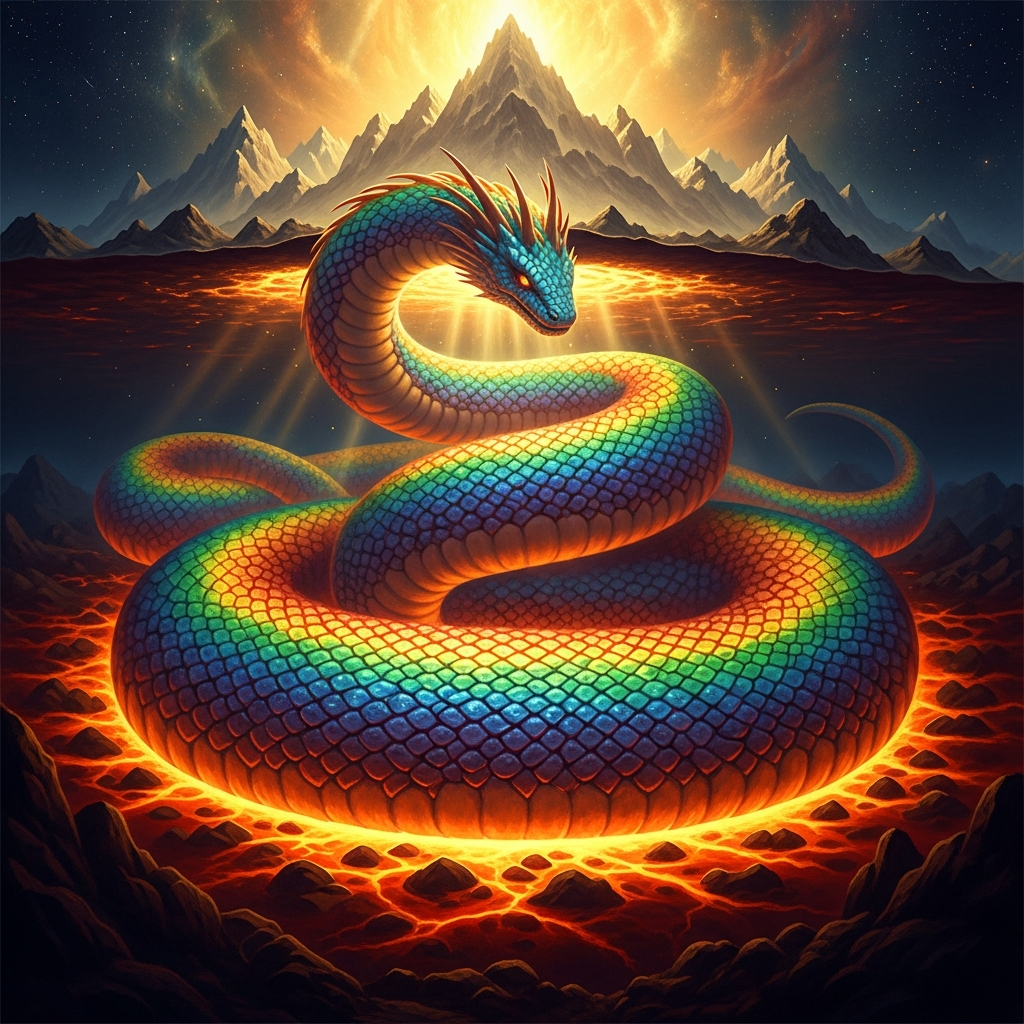
Mawu-Lisa and Aido-Hwedo travel together in the mouth of the rainbow serpent. This is where the theologians pause and ask for clarification, and the Fon tradition is not particularly troubled by the question. Aido-Hwedo is the great rainbow serpent — vast, coiling, iridescent with every color in both the visible and the invisible spectrum. He is also the vehicle of creation. Mawu-Lisa ride in his mouth. As he moves, he makes the world: his body curving through the primal matter lays down the terrain, throws up the mountains at his turning points, carves the rivers where he traveled. The world is not designed from above and implemented below. The world is the record of a serpent’s journey.
Wherever Aido-Hwedo turns, a mountain rises. The Fon point to the folded landscapes of Dahomey and say: there — there he turned. That ridge is where he changed direction. The world’s geography is the serpent’s autobiography.
When the land is made, Mawu-Lisa fills it. They make the living things: the trees, the animals, the first human beings shaped from the substance of the earth and animated with divine breath. They make the sky and the water. They make the patterns of weather and season. They are not building from a blueprint; they are improvising. The world takes shape the way a song takes shape — each part responding to what came before, each moment of creation making the next one possible.
They work with enormous generosity. They give and give. They pour out abundance. They are, as a divine pair, essentially the principle of overflowing — Mawu’s compassion wanting to share everything and Lisa’s energy able to make anything. The world that comes into being under their hands is lavish. It is full. It is, in fact, overfull.
When they are finished, they look at what they have made, and they see the problem.
The world is too heavy.
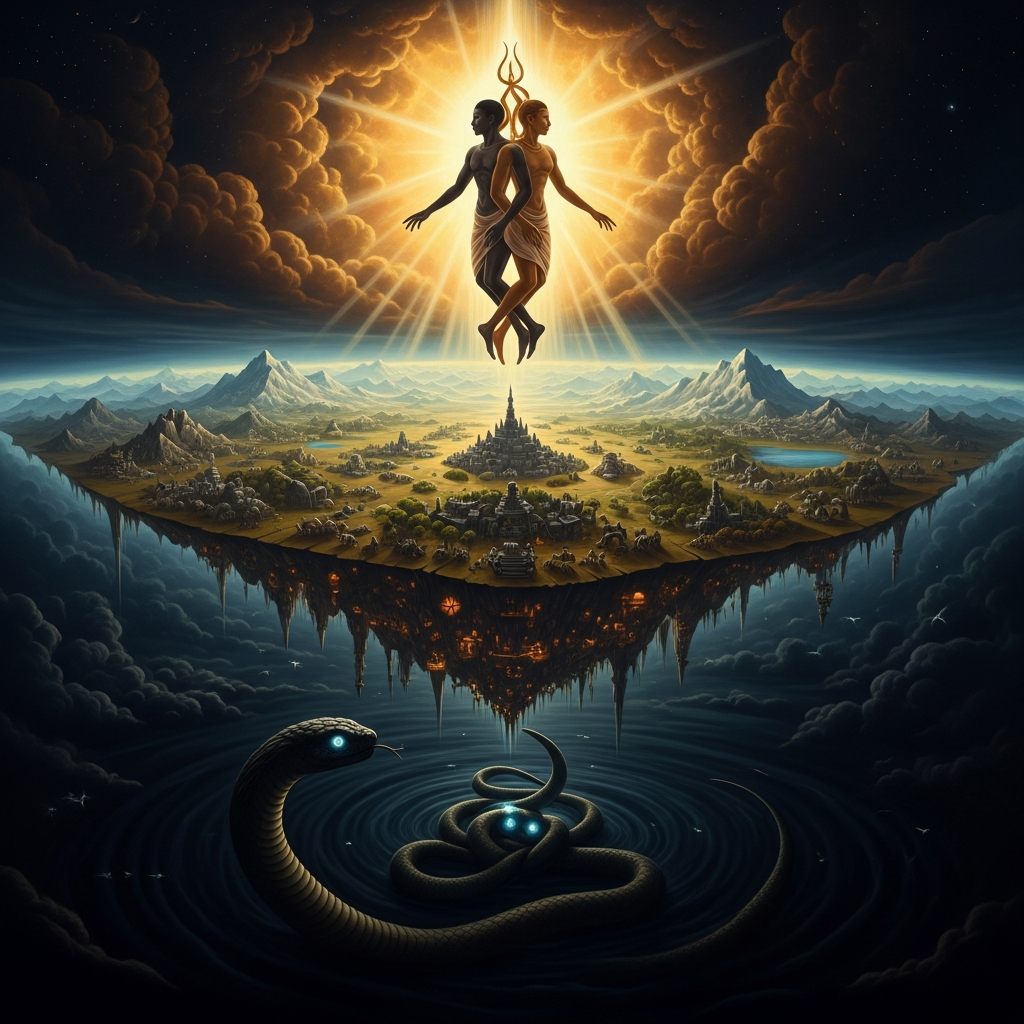
Too many things. Too many mountains, too many trees, too many rivers, too many animals and people and buildings and the things that people make. The earth is not infinite. The earth is a body, and like all bodies it has a limit for how much it can bear. Mawu-Lisa see the world beginning to sag under its own abundance. They see it listing. The divine impulse toward generosity, unchecked, has produced a creation that is on the verge of collapsing under its own weight.
They go to Aido-Hwedo.
The rainbow serpent has completed his journey. The world is made; his job as the vehicle of creation is finished. He is resting in the cosmic sea at the edge of the world, in water that is neither earth nor sky but the medium between them. Mawu calls to him. She says: the world is too heavy. We need you to hold it.
Aido-Hwedo coils beneath the earth.
He coils and coils, his body taking up the space below the ground, his vast rings providing the structure the earth needs to stay aloft. He is the foundation now — not the vehicle of creation but the permanent support of it. The Fon understand this as a literal cosmological fact: the earth floats on the coils of the rainbow serpent in a sea of iron. The sea of iron is dark and cold. Aido-Hwedo lives in it and holds. His food is red iron bars, which the sea provides. He is not uncomfortable, but he is constrained. He is a being who traveled the whole world and now does not move.
Mawu knows this is a cost. She is the face of compassion; she does not miss the cost. She tells Aido-Hwedo what she can: when we made too much, we made a problem that only you can solve, and we are grateful. This is not quite a compensation. But the Fon tradition is not one that pretends large problems have tidy resolutions. The world was made with abundance and the abundance created weight and the weight required a sacrifice, and the sacrifice is ongoing. Every day the rainbow serpent holds the world from below and the world stays up.
There is a condition.
If Aido-Hwedo grows too hot — if the sea of iron warms past the point he can tolerate — he will uncurl. He will writhe in his discomfort, enormous, his body shifting below the earth. The mountains above will shake. The rivers will change course. If the heat becomes unbearable, he will straighten completely, and the world will fall.
This is not a threat. This is a material fact of the construction. The world’s continued existence depends on the temperature of an ocean no one can see, beneath a serpent no one can reach. Mawu-Lisa created the world; they did not create a world that can sustain itself independently. Creation is not an event that happened and finished. Creation is a relationship that requires maintenance — the earth maintained by the serpent, the serpent sustained by the sea, the sea regulated by forces that Mawu-Lisa set in motion and cannot wholly control.
The Fon take this seriously. They do not treat it as a once-upon-a-time story that bears no relationship to the present. The world is still coiling on the serpent. The serpent is still in the sea. If the sea warms — if something shifts in the arrangement — what began as the record of a journey could end as the record of a fall.
This is the Fon contribution to the theology of creation: not the cheerful god who makes a good world and steps back satisfied, but the god who makes an overflowing world and discovers that overflow has consequences, and who responds not with omnipotent correction but with a permanent negotiation involving a very large serpent and a sea of iron. The world is held, not fixed. The world is maintained, not finished.
The rainbow appears in the sky when it rains because Aido-Hwedo lifts his head.
This is the moment when he surfaces briefly — when his colors show through the water-heavy air between clouds and sun. The Fon see this and know he is still there, still coiled, still holding. The rainbow is not a symbol of peace in the Fon cosmology. It is a proof of presence. The serpent lives. The world is still up.
Mawu-Lisa do not govern from a distance. They are present in the alternation of every day — Lisa’s face in the sunrise, Mawu’s face in the moonrise, the twin expressions of the one divine nature turning in the sky above the world their abundance and their serpent hold together. The priests of the Fon know that to pray to Mawu is to pray to the principle that understands the cost of things. To pray to Lisa is to pray to the principle that acts anyway. To pray to Mawu-Lisa together is to acknowledge that wisdom and action are not separate virtues but one virtue that has two faces, and that the world was made by both of them together and can only be held by both of them together.
Aido-Hwedo coils below. He eats his iron bars. He keeps his temperature below the threshold. The mountains do not shake today.
The world was made with too much love — that is the Fon understanding of why it needs holding. Mawu’s compassion poured everything out; Lisa’s strength made everything real; and then the serpent coiled beneath it all because generosity, unrestrained, always produces more weight than the earth was built to bear.
Scenes
Mawu and Lisa face each other across the axis of the world — she is blue-silver, lunar, the calm face of night; he is gold and burning, solar, the force of the day
 Generating art…
 Aido-Hwedo coils beneath the earth in the cosmic sea of iron, rainbow-scaled, vast, the mountains above him the trace of his old turning
 Generating art…
 Mawu-Lisa surveys the finished world from above and sees the problem: too many things, too much weight
 Generating art…
 Echoes Across Traditions
Entities
- Mawu (moon goddess, west, night, compassion)
- Lisa (sun god, east, day, strength)
- Mawu-Lisa (the divine twins as one)
- Aido-Hwedo (the rainbow serpent)
- Nana Buluku (the primordial creator)
Sources
- Melville J. Herskovits and Frances S. Herskovits, *Dahomean Narrative* (1958)
- Melville J. Herskovits, *Dahomey: An Ancient West African Kingdom*, 2 vols. (1938)
- Suzanne Preston Blier, *Vodun: West African Roots of Caribbean Religion* (1995)
- Patrick Bellegarde-Smith and Claudine Michel, eds., *Haitian Vodou: Spirit, Myth, and Reality* (2006)
- Malidoma Patrice Somé, *Of Water and the Spirit* (1994) — for West African cosmological frameworks